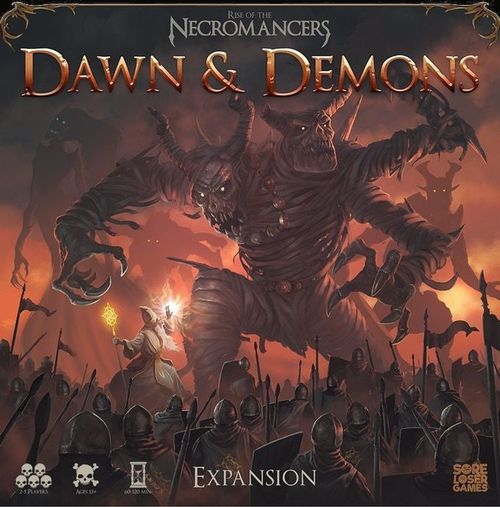
Rise of the Necromancers: Dawn & Demons
Rise of the Necromancers: Dawn & Demons Rulebook
Table of Contents
Table of Contents
Contents of the Game
Miniatures
- 4 Demon miniatures
- 1 Archbishop miniature
Boards and Cards
- 4 Demon boards
- 13 Forces of Light cards
- 13 Lost Arts of Demonology cards
- 12 Cards belonging to the lost Academy of Demonology
- 3 Dungeon cards
- 4 Cards from Rise of the Necromancers that have been revised for co-op mode
Tokens
- 9 Demon/Dawn tokens
- 1 Demon/Archbishop token
- 1 Academy of Demonology token
- 1 Holy Ground token
- 1 Demon Gate token
- 39 Soldiers
- 17 Griffon knights
Note: the printed rulebook lists a Holy Ground token and a Demon Gate token in its components list, but its rules text does not describe how either one is used. They are transcribed here as listed, with no added rules.
Game Mode - Demons (Player Versus Player)
Setting Up the Game
-
Remove the card saying Demon from the Dungeon deck. Shuffle the 13 Lost Arts of Demonology cards into the Library deck, Workshop deck and Dungeon deck in your Rise of the Necromancers game.
Shuffle the 14 new cards into their respective decks:
- 2 Necromancers
- 2 Apprentices
- 3 Items
- 4 Spells
- 3 Dungeon cards
The Academy of Demonology card is kept in the box until it is used.
-
Now do steps 1-9 as explained in the Evil Rulebook for Rise of the Necromancers under the "setting up the game" section.
-
Place the 4 Demon boards next to the Academy cards - one next to each corner of the Game board.
-
Place the Demon miniatures in the corners of the Game board.
Playing and Winning the Game
The game mode Demons is played just like the base game Rise of the Necromancers except now it is also possible to summon Demons. Just like in the base game, the first player to place their 13th Dominion counter on the Game board, Player board or Demon board wins the game.
When you play Demons you should also use the optional rule from Rise of the Necromancers where Necromancers can attack each other – this is simply more evil.
Demonology Cards
When you are on a Library or Workshop space you can choose to pick a Lost Arts of Demonology card from the Library and Workshop deck just like Spells and Items. When you are on a Dungeon space and you flip a Lost Arts of Demonology card from the Dungeon deck, you show it to the other players, take it into hand and flip the next Dungeon card in the deck – this can happen several times and a player can get more than one Lost Arts of Demonology card "for free". When the player flips over a normal Dungeon card, that card is resolved as normal.
During the Play cards step of the turn sequence you may play any number of Lost Arts of Demonology cards and place them face up in front of you. Note that these cards are not actual Items, Spells and Dungeons – they are Lost Arts of Demonology cards.
Flavour: Demonology is the art of summoning, controlling and binding Demons in this world where they do not belong and make them do as we command. Demons are powerful and must be bent to our will as we have done the undead.
How to Summon a Demon and Increase Its Level
You can summon Demons and increase their level by one each turn in the Raise a Minion step of the turn sequence, but this is done instead of raising a Minion.
You can only summon a Demon with the same aspect as your Necromancer (Mist, Blood, Bone or Decay). So if you have not played your Necromancer yet, you cannot summon a Demon.
When you summon a Demon it is level 1. Later in the game you can increase its level to level 2 or even 3. Below you can see how you summon a Demon and raise the Demon level.
Example: The more Dominion counters you have on your Demon board, the stronger your Demon is.
Demon level 1
- You must have at least 1 Lost Arts of Demonology card face up in front of you.
- Pay the cost depicted on the Demon board under Level.
- Sacrifice an active Apprentice by removing it from play.
- Take the Demon board in your Necromancer's aspect (Mist, Blood, Bone or Decay).
- Place the first Dominion counter on the Level track on the Demon board.
- Place the Demon miniature on the Demon board – it is considered to be on the same space as your Necromancer.
If the Demon is already in play, you cannot summon it.
Demon level 2
- You must have at least 2 Lost Arts of Demonology cards face up in front of you.
- Pay the cost depicted on the Demon board under Level.
- Place the second Dominion counter on the Level track on the Demon board.
Demon level 3
- You must have at least 3 Lost Arts of Demonology cards face up in front of you.
- Pay the cost depicted on the Demon board under Level.
- Place the third Dominion counter on the Level track on the Demon board.
The Demon counts as one Minion of its color for the purpose of becoming Academy Headmaster of Blood/Bone/Decay/Mist no matter what level the Demon is. For instance, if you have a level 3 Demon of Decay it counts as one green/Decay Minion.
Demons and Movement
Demons move with their Necromancer
Demons can move around the board with your Necromancer. If a Demon moves around with a Necromancer, the Demon works just like a Minion. That means that the Demon might be the slowest Minion – slowing the Necromancer down – or it might make the Necromancer faster (for more about movement see the section Phase 3 movement in Rise of the Necromancers Evil Rulebook).
When a Demon moves with your Necromancer like a Minion, place it on the Demon board.
Any Minions on the Demon board are considered the Demon's Minions. The Demon can also leave Minions behind to protect Dominion counters just like a Necromancer can.
Demons can move on their own – Unchained Demons
Demons can move around the Game board on their own. If a Demon moves around on its own, it is considered an Unchained Demon and can bring along Minions.
When an Unchained Demon is in the same space as some of its Necromancer's Minions, these Minions can be moved from the Game board or the Player board to the Demon board.
The Unchained Demon and its Minions can move no faster than the slowest of the Demon and any of its Minions.
An Unchained Demon and its Minions can attack and conquer Cities (placing your Dominion counters on the space) or attack opposing Necromancers and Minions. This means that Unchained Demons can move onto any space on the Game board, but they can only make an action if they land on a City or a space with another Necromancer or Minions.
In other words, Demons cannot raise new Minions (except for the Demon of Decay), tax Cities, become Headmaster, look at Spell cards, Item cards or Dungeon cards, or create or use Items or Spells.
Example: A Demon attacking a City while its master studies in a nearby Library.
- In step 3 in the turn sequence, your Unchained Demon moves before your Necromancer.
- In step 4 in the turn sequence, you Unchained Demon acts before your Necromancer.
- A Demon's Minions also count as the Necromancer's Minions regarding Necromancer special rules and the Academy Headmaster position.
- If your Demon ends up on the same space as your Necromancer, immediately move your Demon to the Demon board and its Minions onto your Player board – now the Demon is chained and works just like a Minion again.
Demons and Combat
A Demon participates in combat just like a Minion and you can allocate wounds to the Demon just like a Minion as explained in the combat section in the Evil Rulebook for Rise of the Necromancers. When you allocate wounds to an Unchained Demon and its army, you must allocate wounds to all of the Minions before you allocate wounds to the Demon. Note that Demons have the ability to negate wounds that you allocate to them as explained on the Demon boards, so it is possible for a Demon to survive even if you allocate more wounds to it than it has.
A Demon has as many wounds as its level on the Level track on the Demon board. If a wound is inflicted on the Demon, you must remove a Dominion counter from the Demon board, and the Demon loses a level. If an Unchained Demon is attacked by a Necromancer or another Unchained Demon it cannot flee from combat.
If all Dominion counters are lost from the Demon board, the Demon is lost and the player must return the Demon board and miniature to where they were originally taken. Later, you or another Necromancer can attempt to summon the same Demon again as explained in the section on how to summon a Demon.
Finding the Lost Academy of Demonology
A player can become the Academy Headmaster of Demonology just like they can become Academy Headmaster of one of the other four Academies. To become the Academy Headmaster of Demonology, you need 6 Demonology cards.
This can be Necromancers, Apprentices, Items, Spells and/or the Lost Arts of Demonology cards found in the Item deck, Spell deck and Dungeon deck.
A player who has 6 Demonology cards face up can move onto an unoccupied Dungeon space, take the Academy of Demonology token, place it on the Dungeon space and become Headmaster of Demonology. Now that space is the Academy of Demonology and no longer a Dungeon.
The Headmaster should place two Dominion counters on the Academy. Later other players can try to become Headmaster, but they need more Demonology cards than the current Headmaster.
If there are no unoccupied Dungeons, the Academy of Demonology is lost forever and can never be found.... at least not in this game!
Example: The orange player has six Demonology cards in play: 1 Necromancer, 1 Item, 2 Spells and 2 Lost Arts of Demonology. He moves to the nearby Dungeon and finds the Academy of Demonology.
For more about becoming Academy Headmaster, see the section on Academy spaces in Rise of the Necromancers Evil Rulebook.
Game Mode - Dawn and Demons (Co-operative/Solo Game)
Setting Up the Game
-
Exchange the following cards from Rise of the Necromancers with the corresponding version from Dawn and Demons:
- Bureaucrat (Necromancer)
- Soul Eater (Necromancer)
- Witch Tome (Item)
- Scepter of Domination (Item)
-
Set up the game just as if you want to play Demons as explained on pages 6-7.
-
Put 4 Dawn/Demon tokens and the Archbishop/Demon token Demon-side up in front of the black player. The Archbishop token must be placed to the right of the Dawn/Demon tokens. Place the Archbishop miniature on top of the token.
Example: The Forces of Light deck and tokens next to the Game board.
For an easier game, put down 5 Dawn/Demon tokens instead of 4. For a more challenging game, place 3 Dawn/Demon tokens to the left of the Archbishop token and 1 to the right.
-
Shuffle the Forces of Light deck and put it in front of/near the black player.
Playing and Winning the Game
The game mode Dawn and Demons is played much like the game mode Demons. All the rules of the game mode Demons still apply, except now the Necromancers must work together against the Forces of Light and win or lose the game together.
There are two different ways to win the game:
- Each player places 13 Dominion counters before the Archbishop arrives and before the Archbishop token is removed.
- The Archbishop arrives and one of the players kills him within 5 turns. Note that the players cannot win by placing Dominion counters if the Archbishop arrives.
Dawn/Demon Tokens and the Coming of Dawn
In the black player's first turn of the game (before step 1 in the turn sequence):
- Reveal the top card of the Forces of Light deck. The card takes effect.
In the black player's following turns (before step 1 in the turn sequence):
-
Flip the leftmost token from the Demon side to the Dawn side of the token. If the Bishop token is flipped and is Dawn side up, reveal the top card of the Forces of Light deck. The card takes effect.
Note: the source prints "Bishop token" in this section and the one above; the Archbishop/Demon token is the token meant.
-
If all tokens are Dawn side up, the leftmost token is discarded and the remaining tokens are flipped Demon side up again.
-
If the Archbishop token is discarded, the Archbishop and his clergy call upon the Holy Dawn that banishes all evil, the game ends, and the players have lost.
Whenever any player summons a Demon:
- Place one Demon token to the right of the Archbishop token.
Whenever a Demon is lost:
- Remove one of the Demon tokens to the right of the Archbishop.
Example: Summoning Demons is an evil deed and postpones the coming of dawn! In this example, one Demon has been summoned and therefore there is one Dawn/Demon token to the right of the Archbishop.
Forces of Light Cards
Reinforcements
When a Reinforcement card is revealed, the Soldiers of Light are reinforcing the unoccupied Cities against the undead forces of the Necromancers.
- If it is the first time a Reinforcement card is revealed, roll a die for each City without a Dominion counter: On a roll of 4 or more place a Soldier token on the City.
- If it is the second or third time a Reinforcement card is revealed, simply place a Soldier token on each City without a Dominion counter. This way there can end up being several Soldier tokens on a City.
- If it is the fourth time a Reinforcement card is revealed, the Archbishop arrives! For more on this see below.
Enlightenment
When an Enlightenment card is revealed, the Griffon knights are securing the Workshops and Libraries, barring the Necromancers from the places of knowledge.
When an Enlightenment card is revealed, roll a die for each Workshop and Library space that is not already guarded by a Griffon knight.
- If it is the first time an Enlightenment card is revealed, place a Griffon knight on the space on a roll of 4 or more.
- If it is the second time an Enlightenment card is revealed, place a Griffon knight on the space on a roll of 3 or more.
- If it is the third time an Enlightenment card is revealed, place a Griffon knight on the space on a roll of 2 or more.
See below for the rules on attacking and defeating Griffon knights.
Purge
When a Purge card is revealed, the Knights of Light are defending the Dungeons, denying the Necromancers access to the riches and secrets of the Dungeons.
- If it is the first time a Purge card is revealed, roll a die for each Dungeon: On a roll of 4 or more place a Griffon knight on the Dungeon.
- If it is the second time a Purge card is revealed, roll a die for each Dungeon: On a roll of 3 or more place a Griffon knight on the Dungeon.
- If it is the third time a Purge card is revealed, roll a die for each Dungeon: On a roll of 2 or more place a Griffon knight on the Dungeon.
See below for the rules on attacking and defeating Griffon knights and what happens when Griffon knights land on spaces occupied by Dominion counters, Necromancers and Demons.
Example: Forces of Light cards.
Defeating the Forces of Light
Soldiers
Soldiers come to reinforce the Cities and work just like Minions defending a City.
Soldiers have one wound and one attack with power 2. If you kill a Soldier, you get one Lesser corpse.
Reinforced Cities
To defeat a reinforced City, you must inflict a wound for each tower in the City as well as a wound for each Soldier defending the City. For every wound you inflict on the City, beyond the amount of towers in the City, you remove a Soldier token – if all Soldier tokens are removed, you defeat the City.
Example: The attacking Necromancer needs to inflict three wounds to conquer the City: 2 for the towers and 1 for the Soldier. The Soldier is not removed if only 1 or 2 wounds are inflicted.
Griffon Knights
Griffon knights land on spaces to attack anyone standing there already and to protect the space against the Necromancers and Demons.
Griffon knights have one wound and 2 Ghost strike attacks with power 4. If you kill a Griffon knight you get one Greater corpse.
Ghost Strike
Griffon knights landing on Necromancers, Demons and Dominion counters. If there is a Necromancer, a Demon or Minions on the space where the Griffon knight lands, the Griffon knight will make one round of attacks. If it kills all Minions, Demons and Necromancers, place the Griffon knight on the space. If not, the Griffon knight has been fended off or killed and the token is returned to the box. The defenders do not get to fight back.
If there is one or more Dominion counters on the Dungeon, the Griffon knight will make one round of attacks. For each wound it inflicts, after inflicting wounds to any Minions, Demons and Necromancers on the space, remove one Dominion counter. If the Griffon knight inflicts enough wounds to remove all Dominion counters (usually only 1) place the Griffon knight on the space. If not, the Griffon knight has been fended off and the token is returned to the box.
Defeating Griffon knights. If a Necromancer or an Unchained Demon moves onto a space with a Griffon knight, the Necromancer/Demon must fight the Griffon knight. The Griffon knight must be killed and the Necromancer must survive before you can take the action on the space (Dungeon, Library or Workshop – step 4 in the turn sequence). Note that Unchained Demons cannot collect corpses.
The Archbishop
The Archbishop has 1 feeble power 1 attack – he is an old man after all. He also has the power to banish the undead, see below for details on this.
If the Archbishop arrives (he doesn't always). If he does, the players must kill him within 5 turns or lose the game – no matter how many Dominion counters the players have placed.
When the Archbishop arrives!
- Place the Archbishop miniature, 2 Griffon knights plus 3 Soldiers per player in the Valley of Souls. For instance in a 3-player game: The Archbishop, 2 Griffon knights and 9 Soldiers are placed. Remove any remaining Dawn/Demon tokens.
- Place 4 new Dawn/Demon tokens Dawn side up plus the Archbishop/Demon token with the Archbishop side up.
- If a Necromancer is in the Valley of Souls when the Archbishop arrives, the Necromancer is slain and is out of the game.
After the Archbishop has arrived
- If a Necromancer dies, it is out of the game and can no longer be resurrected in the Valley of Souls.
- Before the black player's turn, discard a Dawn Token (not during the first turn when they have just been placed). After the fifth turn, the Archbishop token is removed and the players lose the game.
- Every turn, the Archbishop banishes the undead sending them back to their graves with his holy rituals. Before black player's turn, each player rolls a die for each of their undead Minions. On a roll of 6 the Minion is destroyed and must be discarded (Demons are not affected by this). This also happens in the first turn, when the Archbishop has just arrived.
Fighting the Archbishop and his Forces of Light in the Valley of Souls
When you move your Necromancer or Unchained Demon onto the Valley of Souls, you fight the Archbishop and his Forces of Light.
This is carried out just like combat in a City, as explained in the Evil Rulebook for Rise of the Necromancers, with the following addition to the combat sequence:
- Step 1 – Determine opponent. The Archbishop banishes the undead in this step: The player fighting the Archbishop must roll a die for each of the undead Minions on their Player board. On a roll of 6 the Minion is destroyed and must be discarded.
- Step 2 – Ghost strike attacks. When you hit with a Ghost strike attack, you remove a Soldier for each hit. If there are no more Soldiers, you remove a Griffon knight, and if there are no more Griffon knights, you remove the Archbishop.
- Step 3 – Remaining attacks. When you hit with your remaining attacks, you remove a Soldier for each hit. If there are no more Soldiers, you remove a Griffon knight, and if there are no more Griffon knights you remove the Archbishop.
- Step 4 – Did I win the combat? If you kill the Archbishop and there is still at least one Necromancer left on the Game board, the game is over, and the players (even slain ones) win. If you did not, the Necromancer/Unchained Demon and the remaining army is moved back from the space it came from before it moved onto the Valley of Souls.
Guidelines for Co-operative Play
Attacking other players
Players can conquer other players' Cities and Dungeons etc. but only if they are not occupied by the Necromancer controlling them. Like in the normal game, players are not allowed to move through other players' Dominion counters, Necromancers or Demons.
Replacing Dominion counters
If a player has placed all his 13 Dominion counters, he can still attack Cities and Dungeons, research Libraries and Workshops etc. to get new Dominion counters. In this case, the player can remove Dominion counters from one or more of his Cities and/or Dungeons and replace them, for instance on a newly conquered City or on his Spell track etc. This allows players to "open" weak Cities or Dungeons to the other Necromancers that haven't yet placed all their Dominion counters. If you remove Dominion counters from a space, you must remove them all.
Example: A Necromancer conquers a City and moves 3 Dominion counters: 2 from Dungeons and one from a City. Now, other Necromancers can conquer the weak City and the Dungeons.
Trading
At the beginning of a player's turn (before step 1), the player is allowed to trade 1 Resource for 1 Resource or 1 Corpse for 1 Corpse with another player who has a Necromancer in an adjacent space.
Talking
Players are allowed to talk about their intentions in the game and plan together, but it is not allowed to talk about which Necromancer a player intends to become/play. Likewise, players are not allowed to reveal or hint to the contents of the top cards in the Library or Workshop decks.
Winning more
The first player who places his 13th Dominion counter or kills the Archbishop obviously wins a little more than everyone else and earns the Necromancers' bragging rights.
Game Mode - Dawn and Demons - No Friends (Player Versus Player)
Playing the Game
Set up the game just like in co-op mode and play with the Dawn/Demon tokens, the Archbishop and the Forces of Light cards, but there is no co-op!
The first player to place their 13th Dominion counter or the player that kills the Archbishop wins the game. All players lose just like in co-op mode: if the Archbishop token is removed or if the Archbishop arrives and isn't killed within five turns.