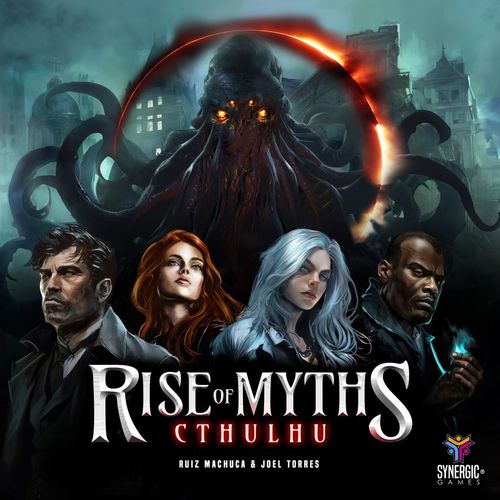
Rise of Myths: Cthulhu
Rise of Myths: Cthulhu Rulebook
Table of Contents
Table of Contents
Components
- 4 Characters, each with 65 cards
- 10 Curse Cards
- 7 Synergy Relic Cards
- 14 Exploration Cards
- 20 Event Cards
- 1 Help Sheet
- 1 Great Old One Board (Cthulhu and Hydra)
- 1 Great Old One Board (The Dunwich Horror and Dagon)
- 1 Shop / Upgrades Card
- 1 Round Effects Card / Round Guide
- 3 Combat Setup Cards
- 2 Modifier Cards for 1/3 Characters
- 3 Health/Sanity Dials
- 1 Round Dial
- 10 Cthulhu Cards
- 17 The Dunwich Horror Cards
- 16 Dagon and Hydra Cards
- 84 Enemy Cards
- Weakness Tokens: 9 of 1/2 and 3 of 3/5
- Prison Tokens: 8 of 1/2 and 3 of 3/5
- Stun Tokens: 8 of 1/2 and 3 of 3/5
- Bleed Tokens: 8 of 1/2 and 3 of 3/5
- Vulnerability Tokens: 8 of 1/2 and 3 of 3/5
- Leader Token
- Coin Tokens: 13 coins of 1, 6 coins of 5, and 4 coins of 10
- Progress Point Tokens: 3 of 1/2 and 3 of 3/5
- Defense Tokens: 17 of 1/2 and 11 of 3/5
Summary
This summary will guide you through game setup and gameplay, ideal for new players or as a reminder.
Game Setup
- Character and Location Selection:
- Decide which Great Old One you will face, which determines the combat location (Cthulhu in Arkham, The Dunwich Horror in Dunwich, and Dagon and Hydra in Innsmouth).
- Select the Characters, with a maximum of three per game.
- Exploration deck Setup:
- Shuffle the 13 initial Exploration Cards, reserving the Great Old One Card.
- Reveal 1 initial card and place the group token on any of its Encounter icons (Combat, Event, or Shop).
- The remaining 12 cards form the Exploration draw deck.
- Enemy and other deck Setup:
- Depending on the chosen Location, create the Enemy supply for each Power level: Common, Minion, Servant, Superior, Elite and Great Old One, the final Enemy of the Location.
- Arrange the Event deck, the Shop Card, the Round Effects Card and the Combat Setup Card. The latter details the Encounter configuration and its rewards based on the number of Characters and completed Encounters.
- Character Setup:
- Each Character organizes their components: 12 Starter rarity Cards (without emblem), 1 Class Relic Card (which indicates the Character's starting Health and Sanity) and tokens.
- Set up the draw deck and discard pile for each Character.
- Place the Health and Sanity dials at the initial value of their Class Relic.
- Apply Upgrades if the Character has accumulated Progress Points from previous games.
How to Play
The game unfolds in two main phases: the Exploration Phase and the Encounter Phase.
1. Exploration Phase
In this phase, Characters move across a dynamic map of Exploration Cards:
- Movement and Card Placement: Characters move freely along paths. When crossing a connection icon on a card's border, a new Exploration Card is revealed and must connect with a symbol of the same color. If a valid connection is not possible, draw cards from the Exploration deck until revealing one that allows a valid connection. Then, each Character loses 1 point of Sanity.
- Encounters: Exploration Cards feature three types of Encounters: Combat, Event, and Shop. When interacting with one, the next numbered Exploration Token (starting from 1) is placed on the icon. Encounters already marked with 1 Exploration Token can be crossed, but this incurs a loss of 1 Sanity Point for all Characters each time.
- Portals: allow Characters to move to other Portals at no cost, or move to previously added Exploration tokens, losing each Character 1 Sanity.
- Exploration Progress:
- Upon accumulating 6 Progress Points through Encounters, each Character gains 5 Recovery points to distribute between Health and/or Sanity.
- Upon reaching 9 Progress Points, the Great Old One Exploration Card is revealed and connected to the map. From this moment, Characters can face it.
- The game ends in Defeat if, after placing Exploration Token number 13, the Old One cannot be interacted with.
2. Encounter Phase (Combat)
Combat Encounters are the heart of the game, where Characters face different types of Enemies.
- Combat Setup:
- The Combat Setup Card shows what Enemies appear depending on the amount of Exploration Tokens on the Exploration Cards, and also the Coins, Progress Points and new card level obtained as rewards.
- Enemies are ordered by Initiative (highest value first, from left to right).
- Health is assigned to them using tokens, indicated in their upper left corner.
- Rounds and Turns: Combat unfolds in rounds, each with the Upkeep phase, the Characters' Turn, and the Enemies' Turn. Use the Round Dial to keep track. During Combat against Great Old Ones, general round effects are ignored.
- Upkeep (Start-of-round):
- Except for the first round, the Leader Character (chosen during the first Upkeep) passes the token to the Character on their left.
- Each Character draws 6 cards (5 during 3 Characters games) from their draw deck (if it runs out, the discard pile is shuffled to refill it).
- Assign each Enemies' target and place the corresponding Character token on their card. Then, "start-of-round" effects and Class card Upkeep effects are applied.
- Characters' Turn:
- The Characters performs actions using cards from their hand or in play.
- Available Actions:
- Gain Energy: discard cards from hand to gain Energy, which is used to play other cards. The amount of Energy is indicated in the upper left, modified if it has the blue flame icon.
- Play Cards: pay the Energy cost indicated in the upper left to play a card. Cards can be Attack, Defense, and Skill. Permanent Skills and cards with Uses remain in play. A card can be played for another Character once per turn, which causes the recipient to lose 1 Sanity point. Cooperative cards do not have these drawbacks.
- Upkeep (Start-of-round):
Introduction
Rise of Myths: Cthulhu is a cooperative deck-building game designed for 1 to 3 players, set in a world inspired by the works of H.P. Lovecraft and his collaborators.
In each game, players progress by exploring until they reach a final confrontation against the Great Old One they have chosen. Even if you cannot achieve your goal at the first attempt, Characters will become stronger for subsequent games, so it is easier to progress further each time. This is called a roguelite system.
Additional content is available for the game, including new Characters, Locations and Enemies. Unless otherwise specified, all Characters may be freely combined in any game of Rise of Myths: Cthulhu.
Game Setup
1. Selecting Characters and Location
At the start of the game, choose the Great Old One you want to face. Each of them has their own particular location. Then, decide which Characters you want to play with. Each game can have up to a maximum of 3.
2. Setting up the Exploration Deck
Set aside the Great Old One Card, then shuffle the 13 remaining Exploration Cards. Randomly reveal one of them and place it into the playing area, then place the Group Token (that represents the Characters) on any Encounter icon on the Card (see Encounters on page 9). Place the remaining 12 Exploration Cards face down to one side of the playing area; this becomes the drawing deck of Exploration Cards.
3. Setting up the Enemy Supply, Event Deck and Other Cards
Create a supply of cards for each Enemy Level related to the chosen location, including the Great Old One, who will be the final Enemy of the location. Place the Event deck, Shop Card, and the Combat Setup Card in the playing area, which indicates the Combat Encounter setup and Rewards depending on the amount of Characters and current Encounter.
4. Character Setup
Each Character sets up their initial components, including their 12 Starter Cards (see Card Rarity on page 21), 1 Class Relic Card and their Character Tokens. Prepare each Character's playing area, including their draw deck, and enough space for their discard pile and Action Cards zone. Also, place the Health/Sanity Dials — setting their values as indicated — based on each Character's Class Relic. Finally, apply any available upgrades for each Character according to the Progress Points they have accrued (see Progress Points and their uses on page 22).
Game Phases
The game is divided into 2 main phases: the Exploration Phase, where Characters investigate the location using Exploration Cards, and the Encounter Phase, which is activated by interacting with Encounters on the Exploration Cards. After obtaining 9 Progress Points by completing Encounters, Characters may reveal the Great Old One position in the current location.
Exploration Phase
Movement
The game begins with the Exploration Phase. Characters can move without restriction along the paths set out by the Exploration Cards as long as they do not cross any Encounter Icons. If the Characters reach a Connection Icon on the edge of a card and decide to use it to continue exploring, a new card is turned over from the Exploration deck and connected via one of its Connection Icons of the same color as where the Group Token is located.
Placing Exploration Cards
Exploration Cards must be placed vertically keeping the Connection Icons alignment and can be connected if:
- The same colored Connection Icons are connected.
- The added card does not overlap a previously placed card.
The cards can be connected without being exactly aligned in height or width. Once a card has been connected, Characters decide whether or not they want to enter the new card.
If a valid connection is not possible when revealing the first card, draw cards from the Exploration deck until a card is found that allows a valid connection; then all Characters lose 1 Sanity Point (see Sanity: Sane and Insane on page 24).
If none of the revealed cards allows a valid connection, and there are no more cards available, each Character loses 1 Sanity Point and the Group will need to find a way through the cards already connected.
There are 2 types of elements that Characters can interact with on Exploration Cards: Encounters and Portals.
Encounters and Portals
Encounters
While moving, if Characters wish to overcome an Encounter icon, they must first interact with it. Encounters can be one of 3 types: Combat, Event, or Shop.
When interacting with an Encounter for the first time, the group must place the next Exploration Token (starting with number 1) on the Encounter icon on the map. Characters can move through Encounters that already have an Exploration Token without repeating the Encounter, but each Character will lose 1 Sanity Point each time they do so (see Sanity: Sane and Insane on page 24).
Portals
Characters can cross Portals freely without adding any Exploration Tokens. When doing so, they can choose to:
- Cross them with no extra effects.
- Move to an Exploration Token anywhere on the map, each losing 1 Sanity Point because they are re-entering it (see Sanity: Sane and Insane on page 24).
- Move to another Portal that has already been revealed at no extra Cost.
If Characters return to an Exploration Token using a portal, they will only lose 1 Sanity point each, even if the route has been through several Exploration Tokens.
Exploration Progress
Upon reaching 6 Progress Points through Encounters (see Coin rewards and Progress Points on page 21), each Character gets 5 Recovery Points that must be used immediately to regain Health and/or Sanity, without exceeding their maximum values (each Recovery Point is equivalent to 1 Health or Sanity Point). Any Recovery Points not used immediately are lost.
Upon reaching 9 Progress Points, turn over the Great Old One Card that was set aside at the start of the game, and connect it to the current Exploration Card. If it is not possible to make this connection, connect it to any other Exploration Card where a connection is possible.
From this moment on, Characters can interact with the central icon on the Great Old One Card as they confront the Great Old One. At the start of the confrontation, remove all Exploration Cards from the game.
Although confronting the Great Old One is not immediately mandatory, once the 13th Exploration Token has been placed, Characters must confront the Great Old One. If Characters cannot interact with it after completing the 13th Encounter, the game ends in Defeat (see Defeat on page 28).
Encounter Phase
Encounters are divided into three types: Combat, Event, and Shop (see Event Encounters and Shop Encounters on page 21-22).
Combat Encounters
During Combat Encounters, Characters confront various Enemies organized by Power levels: Common, Minion, Servant, Superior, Elite and, finally, Great Old One, which represent the greatest challenge and are found at the end of the location.
Combat Setup
The Combat Setup Card shows the Power level and amount of Enemies that have to be added to the Enemy supply for the current Encounter. Shuffle the deck and reveal the Enemies.
If you need to add an Enemy and the supply for that Power level has no more cards, take all discarded cards of that Power level, shuffle them, and create a new Enemy supply.
For example, for the third Combat Encounter in a 2-Character game, the Combat Setup Card indicates that the group will confront 2 Common Enemies and 2 Minion Enemies to be drawn from their corresponding deck. After creating the Enemy supply for the Encounter, reveal and place them from left to right in Initiative order as shown in the top-right corner of the card (see Initiative on page 19). The Enemies with higher Initiative value will be placed on the left side.
If several Enemies have the same Initiative value, keep the original order in which they were revealed. Then, place Health Tokens on each Enemy Card to the Health value indicated in the top-left corner of the card; this will decrease as they take Damage until they are defeated.
Rounds and Turns
Combat Encounters take place over several rounds, each of which consists of Upkeep, the Characters' turn and, finally, the Enemies' turn.
When the Enemies have completed their turn, the round ends and a new round begins.
At the start of each Combat, turn the Round Dial to 1. At the start of each following round, its value goes up by 1.
The Round Effects Card shows extra effects that must be applied at the start of specific rounds. These effects may include:
- Add an Enemy of the indicated Power level at the start of the round.
- Characters lose 1 Sanity Point at the start of the round.
When confronting a Great Old One during a Combat, ignore these extra effects.
Turn: a turn encompasses all actions available to Characters or Enemies.
Round: a round encompasses Upkeep, the Characters' turn and the Enemies' turn.
Characters: protagonists of the story, whose actions are controlled by the players.
Enemies: Great Old Ones and their acolytes, who seek to impede the Characters' progress.
Creature: Characters and Enemies are considered Creatures.
Upkeep
Additional steps for the first round
Each Character prepares their deck by shuffling their Action Cards and creating a single draw deck. Choose which Character starts as the leader for this Combat and give them the Leader Token.
All rounds
At the start of each new round (except the first), the current leader passes the Leader Token to the Character on their left.
Each Character then draws 6 cards from their draw deck. If their draw deck is empty and they still need to draw cards, they reshuffle their discard pile to create a new draw deck, then finish drawing their 6 cards.
Then, assign each Enemies' target(s) using the Character's Tokens and place them on their card. Next, apply any "start-of-round" effects, before each Character performs the Upkeep on any Class Cards that may need it. Some cards with Upkeep may require or enable a Character to spend resources such as Health, Sanity or Energy.
Characters' Turn
Once the Upkeep is over, Characters apply their effects indicated by "start-of-turn". Then, they activate, starting with the Leader. While a Character is active, they can perform actions using their cards.
Characters' Cards
Character Cards, which are divided into Class and Action Cards.
Class Cards show the following:
- Card name.
- Initial and maximum amount of that Character's Health.
- Initial and maximum amount of that Character's Sanity.
- Associated Character.
- The back of each Character Card has a unique illustration depicting its corresponding Character.
- Each Character has a different colored frame on the front of their card.
- Effect.
Class Cards fall into 2 different categories:
- Class Relic: each Character has a Relic that offers special effects, which can only be activated if the corresponding requirements are met. In addition, each Class Relic indicates the Character's initial Health and Sanity values.
- Class Items: these items can be purchased as upgrades during game setup or in the Shop and provide benefits in the game.
The draw deck is from where Characters obtain their cards when they have to add them to their hand. A face up pile of cards that have been played/discarded is known as a discard pile. You may only look at the cards in a draw deck if an effect allows it. You may look at the cards in a discard pile at any time.
Action Cards
This category includes all cards that Characters have available to play from their hand during their turn. They are divided into 3 main types: Attack, Defense and Skill. Action Cards show:
- Card name.
- Identifying color and Energy required to play, or the amount of Energy gained when discarded for Energy.
- Type.
- Rarity.
- Effects.
Attack Cards
Their identifying color is red. The main use of Attack Cards is to perform an Attack, causing Damage to Enemies and reducing their Health until they are defeated.
When an Attack Card is played, unless otherwise stated, it can only be applied to a single Enemy that will be the target. If the Attack reduces the Enemy's Health down to 0, the Enemy is defeated and its card is discarded from play, once any extra effects have been applied. Damage that exceeds the Enemy's Health cannot be used to attack other Enemies.
There are Melee Attack and Weapon Attack Cards:
- Melee Attack Cards have no extra effects.
- Weapon Attack Cards: Some Weapon Attack Cards can only be used a limited number of times or require Ammo to be played.
Defense Cards
Their identifying color is blue. The main use of Defense Cards is to gain Defense to reduce the effect of Enemy Attacks against the Character. When a Defense Card is played, the Character receiving the effect adds the value of Defense Tokens shown on the card to their supply. If a Character suffers an Attack, first reduce the value depending on the Defense the Character has available in their supply. If there is insufficient Defense, they sustain Damage equal to the amount that has not been defended. At the end of the round, any unused Defense is discarded.
Skill Cards
Their identifying color is yellow. The main use of Skill Cards is to provide benefits to Characters and/or cause harm to Enemies. These cards can have varied effects.
- Permanent Skills: When a Permanent Skill Card is played, it remains in play until it must be discarded. Permanent Skills continue to apply their effects for as long as they remain in play.
- Cards with Uses: They can be of any type and are not identified with any specific color. If the card specifies a number of uses, place as many Use Tokens as the card indicates when it is played. Once during the Characters' turn, while the card with Uses is in play, the Character may decide whether to apply its effect. If the Character decides to do so, discard one Use token. Once all Use Tokens have been discarded, discard the Card, as well.
General Rules on Card Effects
- Unless otherwise stated, the effects of Attack Cards apply only to the selected target.
- If the card does not specify a target, the Character chooses against whom to apply each effect.
Example: The Sorcerer plays the Concentrate Pain Card, which allows him to discard Conditions of 1 Enemy, causing 1 Damage for each Condition discarded. There are 3 Enemies in the game, 2 of which have Conditions applied. The Sorcerer uses Concentrate Pain to discard the 2 Conditions of the Bandog. Then, he decides to apply the Damage effect and distribute it freely among the Enemies, causing 1 Damage to the Rabid Beast and another 1 to the Dark Breed. As this is not an Attack Card and has no limitations in its description, the Sorcerer can choose how to distribute Damage among Enemies at his convenience.
Attack/Defense Cards
Their identifying color is purple. Some cards belong to more than one type. If any effect requires the card type to be checked, it is considered to belong to all the types indicated on the card.
Example: The Seer has her Refine Prediction Permanent Skill in play, which allows her — once per turn — to attempt a new Divination after failing the first one. When the requirement is met (failing a Divination), she can use this Skill to apply its effect and try a second Divination. In this case, she must first apply any effects from her first attempt before proceeding with the second Divination.
Performing Available Actions
When activated, Characters can perform actions using the available cards in their hand or those already in play during the current combat.
The active Character can perform actions until they decide to exchange activation with another Character (see Exchange activation on page 18) or until they choose not to perform any more actions in that turn. If a Character has no actions available, they must immediately exchange activation with another Character, who will become the new active Character. This process continues until no Characters can or wish to take any more actions, at which point the Characters' turn ends.
The actions available to a Character during their turn are:
1. Gain Energy
In order to play cards, Characters must first gain the required Energy by discarding cards from their hand. The active Character can discard as many cards as they wish from their hand and accumulate the combined Energy from all of them. After discarding cards to gain Energy, the active Character leaves them face up next to their discard pile, so they can see the Energy gained from them during their turn. At the end of the Characters' turn, cards discarded to gain Energy are added to the discard pile.
As a general rule, the amount of Energy a Character gains by discarding a card from their hand is the same as the value indicated in the top-left corner of the card. Cards with the blue flame icon modify the amount of Energy gained by the value shown alongside it.
Example: The Detective has the Research card in his hand. If he uses it to gain Energy, he will obtain 2 Energy: 1 due to its cost and 1 because of its modifier. He will be able to use this Energy to play other cards this turn. On the other hand, if he plays the card by paying its 1 Energy cost, he will be able to return 1 card from his discard pile to his hand. This does not include cards that he has played or discarded during the current turn. At the end of the turn, whether the card was used to gain Energy or was played, it will be added to the Detective's discard pile.
Cards used to gain Energy are not added to the discard pile until the end of the Characters' turn, but they are deemed to have been discarded for all purposes.
If any other effect grants Energy to a Character, add the required amount of Energy Tokens to the supply. Rules do not allow values below 0, and so it's the minimum amount of Energy that a card may grant (see Golden Rules on page 24).
2. Play Cards
Characters can play cards either for themselves or for another Character, paying their Energy Cost. When a card is played, apply its effects, from top to bottom, one by one. If any effect triggers another effect (like ending an Encounter by defeating the last Enemy), apply it, and then, continue with the effects from the played card, even if the Encounter may have ended.
Play Cards for Yourself
The active Character can play as many cards from their hand as they like, as long as they have sufficient Energy to cover the Cost. With each card played, the amount of Energy available decreases by the same value as the Cost on the card.
Characters can choose the order in which they play cards, but they must apply all the effects of a card before exchanging activation with another Character (see Exchange activation, on page 18) or playing another card.
Play Cards for Another Character
An active Character can play up to 1 card for another Character during their turn. The Energy Cost of the card played must be paid using the active Character's Energy.
When a Character plays a card for another Character, the following changes apply:
- The effect of the card applies fully and strictly to the other Character, even if the effects are negative.
- The Character receiving the effects of the card loses 1 Sanity Point.
Exception: if the card played has the Cooperative effect, the decrease in the Sanity of the Character receiving the effect does not apply. Also, it does not count towards the limit of 1 card played for another Character per turn.
If the Character receiving the effect cannot fulfill any of the requirements on the card — for example, not being able to Discharge Ammo — the card cannot be played in this way.
Example: The Possessed and the Seer are confronting several Enemies and all have the Seer as their priority target (see Targets on page 19). To prevent the Seer from sustaining Damage, the Possessed decides to play the Scare Away Card for the benefit of the Seer, giving her Defense. As a consequence, the Seer loses 1 Sanity. Once the Energy has been paid and the Sanity Points reduced, the Scare Away Card applies its effects on the Seer, who gains Defense and the option to regain Sanity, so potentially ending up with the same amount of Sanity she had before the Possessed played the card.
Selecting Effects
Some cards allow a Character to choose between several available effects. Once the player makes their choice, only the selected effects are applied, while the effects not chosen are ignored.
Timing of Effects
Some effects specify the start-of-turn or end-of-turn requirement. These effects are only applied during the turn of the Creature (Characters or Enemies) that generates the effect and not in each turn. Any effect that does not include "at the start" or "at the end" in its description must be applied during the turn of the active Creature. Start-of-round effects are applied during Upkeep, while end-of-round effects are applied at the end of the Enemies' turn.
When several "start-of-turn/round" or "end-of-round/round" effects coincide at the same moment, follow this order of priority to apply them:
- Effects without a specific indication on the card that are applied during the round, such as the effects of some of the Great Old Ones, like Curses, and the Enemies' protection.
- Start-of-round effects.
- Start-of-turn effects.
- If several effects coincide in any of these 3 steps, players decide the order between themselves.
Example: While using the Astrolabe Class Item, the Seer has interacted with an Event, which has forced her into a Combat Encounter. She is facing a Deep Cryptid. In addition, the Seer only has 2 Health Points and is considered to be Wounded (see Health: Healthy and Wounded on page 25). Also, in a previous turn of this Combat, she played the The Fool Permanent Skill Card. Therefore the start-of-turn/round effects activate in the following order: 1. First, the Deep Cryptid's Protection (see Protection, on page 19) would be applied and it would gain 3 Protection. 2. Second, the Deep Cryptid's special effect. However, as the Seer has no Conditions, she does not lose any Sanity Points. She would also apply now her Class Item. 3. Finally, start-of-turn effect from the The Fool card is activated.
Add, Adds, Remove, and Discard Card Effects
- Gain: the effect applies even if the card did not have it previously. When an effect involves assigning extra Attack or Defense Points, consider these extra points as having been gained.
- Add: the effect only applies if the card already had an effect of the same type previously.
- Remove: the card is no longer available for the rest of the current game.
- Discard: when discarding a card, leave it next to the discard pile, where it will be added at the end of the turn. For the tokens, move them to the supply. Unless otherwise stated, discard card effects should be applied to cards in hand.
If a card allows another card to gain new effects, those effects are applied after resolving all of the receiving card's own effects. If that card already had an effect of the same type, the original effects and the new ones are applied simultaneously. On the other hand, if a card adds effects to another card, those effects are applied simultaneously along with the already modified effects of the receiving card.
Example: The Sorcerer has the Permanent Skill Internalize in play, which allows him to enhance his Sacrifice effect cards. These cards gain Attack 1 and Defense 1. When playing Blood Call, which is a card with Sacrifice effect, Attack 2 and no Defense, it becomes a card with Attack 3, and then, Defense 1. If, on the other hand, Internalize's effect had been that Sacrifice cards add Attack 1 and Defense 1, Blood Call would only have been able to receive the effect to its Attack, becoming a card with Attack 3 but no Defense.
3. Charging/Using Synergy Relics
Each active Character may discard up to 1 card during their turn to gain Energy and accumulate it in their Synergy Relic, if the Character has one available. Energy gained from other sources cannot be accumulated in their Synergy Relic. For each point of Energy add 1 token on it to indicate its Charges. When the Synergy Relic reaches the number of Charges needed according to its requirement, the Character that owns the Synergy Relic may use it during any of their activations to obtain the effect indicated in the card.
Example: The Seer uses the Unaussprechlichen Kulten Synergy Relic effect, which indicates that all cards gain an extra effect. This effect applies to all cards she plays during the turn. If the Seer plays Sense Danger, the Divination (see Divination on page 27) effects of the card are applied first. Once these have been applied, the effects of the Synergy Relic are applied, performing a second Divination.
Example: The Detective plays the card Balanced Stock, which Adds Attack 2 to Weapon Attacks. Then, during the same turn, he plays the Rapid Fire card, which allows him to choose an Attack 5 against a single Enemy or Attack 3 against 2 different Enemies. As Balanced Stock Adds its effect to the ones from Rapid Fire, the Detective can choose between an Attack 7 against a single target or an Attack 5 against 2 different targets.
Relic Use
Each Relic can only be used once per Combat Encounter. Activating it has no extra Cost unless the card states otherwise. Once used, discard all its Charges and turn over the Relic Card to show that it can no longer accumulate or be used again until the next Combat Encounter. Unless otherwise stated, effects only apply to the current round.
Relic Synergy
When a Character uses their Synergy Relic and all other Characters have theirs fully charged (which requires at least 2 Characters in play), a Synergy is activated. In this case, the active Character applies both the upper effect and the lower effect of their Relic.
Example: Having accumulated 9 Charges in his Synergy Relic, the Sorcerer prepares to use it to obtain its effects. Although the Detective is also playing in the current game, he has not yet managed to accumulate enough Charges in his own Relic to have it available, so the Sorcerer will not be able to apply the extra Synergy effect. Seeing this, the Sorcerer prefers to wait until the Detective has accumulated the necessary Charges in his Relic before using his, and thus take advantage of the Synergy Relics.
4. Exchanging Activation
The active Character can exchange their activation with another Character that still has actions available, at any time and at no Cost. This exchange can be done as many times as Characters wish during their turn. When a Character exchanges their activation, all the effects of the cards they have played up to that moment are applied.
Remember: some cards have effects that can be applied to other cards played during the rest of the Characters' turn. Even if a Character has exchanged their activation, cards with ongoing effects or modifiers that affect the entire turn remain active in the game, applying their effects accordingly.
Example: The Sorcerer plays the Benevolence Card, which allows him to ignore the Sacrifice effect for the rest of the turn. He then exchanges his activation with the Seer, who plays a card and returns the activation to the Sorcerer, who plays the Blood Blade Card. As Benevolence is still in play, the Sorcerer ignores the Sacrifice effect of the Blood Blade.
Ending a Turn
The Characters' turn ends when none of them has any available actions remaining, or if they all decide not to perform any more actions. At the end of the turn:
- All their "end-of-turn" effects are activated and applied.
- All Action Cards (played, on the Character's hands or discarded to gain Energy) are placed on the upper part of the discard pile of each Character, except for Permanent Skills in play or cards with remaining Uses on them.
- Discard all Energy except for Charges accumulated on Synergy Relics.
- Apply all Bleed Conditions Characters have and then discard all Characters' Conditions.
If a Character has cards with "during-your-turn" effects, these effects can be applied at any time while the Character is active. However, if a Character has ended their participation in the turn and is no longer able to activate, they cannot apply extra effects until their next turn.
Enemies' Turn
During the Enemies' turn, each one acts in line with the information and sequences specified on its card, including Health, Initiative, Protection, Target, Warnings, and Effects.
Enemies activate in order of Initiative, from highest to lowest, and from left to right. If one of them has specific effects that depend on acting first or last in Initiative, and it shares that position with other Enemies, the effect is applied.
Health: the Token's value that Enemies start with each Combat Encounter. It's reduced when receiving Damage. Once an Enemy loses all its Health, it is discarded from the Combat. Add its card to its corresponding Enemy supply, according to its Power level.
Protection: During Upkeep, the Enemies gain a Defense value equal to their Protection. Each Enemy will be considered to be defending even if it has not a Defense Icon on its sequence.
Each Enemy follows sequences that are divided into columns determining its actions and effects in each round and that must be fulfilled in the given order: column 1 is first, then column 2 and, finally, column 3. Sequences can include actions such as Attacks, Defense and extra effects. Here are the types of actions that an Enemy can perform:
- Attack: the Attack value that the Enemy uses against its target when activated.
- Defense: the Defense value that the Enemy gains at the start of each round. As with Characters, Defense must be reduced to zero before Damage can be inflicted on an Enemy with an Attack. An Enemy is considered to be defending if it starts the round with a positive Defense value, obtained through sequences or other effects such as Protection. At the end of the round, all Defense is discarded. Enemies may sometimes have a Condition icon value instead of a Defense value. In this case, Enemies will inflict that Condition on their target when attacking.
- Extra Effects and Conditions: some Enemies may inflict Conditions with their sequences, other effects during their turn or even during the Character's turn. Except specifically indicated, effects apply only to the Enemy's target when it attacks. Other text effects (included over the sequences), are considered Extra Effects, and will activate according to this:
- If they are Conditions: will apply each time the Enemy attacks.
Repeating Sequences
If an Enemy remains in Combat for more than 3 rounds, it restarts the sequences from the first column. Furthermore, if an Enemy joins the Combat after the first round, it is considered in the current round to have been present from the start.
Example: During Round 4 a new Enemy, the Farmer, is added. Once placed according to its Initiative order, it will perform its sequence as shown in its first column, as if it had been in play from Round 1. Other Enemies will also reset and perform their column 1 sequences.
Targets
Each Enemy chooses a specific Character as a target for its Attack, which updates at the start of each round according to an order of priority shown by the icon on its card. The icons define the following priority criteria:
-
Character with the highest Health.
-
Character with the lowest Health.
-
Character with the highest Sanity.
-
Character with the lowest Sanity.
-
Character who is the Leader in the current round.
-
Character who will be the Leader in the next round.
-
Last Character to have attacked this Enemy in the current round.
-
If it has not been attacked yet, the Leader.
-
If there is a specific requirement: they will activate only if the requirement is achieved.
-
If there is no requirement: they will remain active as long as the Enemy remains in play.
When activated, the Enemy will direct its Attack against the Character that meets its current priority, applying the effects detailed in its sequence.
To keep track of each Enemy's targets more easily, place a Character Token on the corresponding Enemy's Card to indicate the Character it intends to attack when they are revealed.
If there's a tie among several Characters for targeting conditions, the Leader Character will take priority. If none of the tied Characters is the Leader, Players decide the targeted Character.
When an Enemy has an Attack Value in square brackets, it means this Attack affects all Characters in play. These are called Area Attacks. Area Attacks are considered to target all Characters simultaneously.
Remember: final target of an Enemy is determined at the moment it activates. Therefore the target may vary depending on the priority, like current highest/lowest Health or Sanity among Characters, which may end with the Enemy attacking a different target than the one set at the start-of-round.
Example: At the start of the first round, the priority target for all the Enemies is the Character with the highest Health, which at this moment is the Detective. The Keeper acts first and attacks the Detective with 7. The Detective has no Defense accumulated, so his Health is reduced from 10 to 3. After this Attack, a different Character now has the highest Health — the Sorcerer — who has 9 Health. This changes the target of both the Undertaker and the Midwife, who will now attack the Sorcerer instead of the Detective, according to their new priority target.
Ending a Turn and Round
When all Enemies have completed their sequences, any "end-of-turn" effects must be applied. Apply all Enemy Bleed Conditions and then discard all their Conditions. Finally, discard all Defense Tokens from all Creatures and the round ends.
End of Combat Encounters
Failure
If at any time the Health of any Character reaches 0, at the end of a Round the Sanity of any Character is 0, or if Round 6 ends, the game ends in failure. Characters get a Reward limited to the Progress Points accumulated up to the current Combat Encounter, not including it (see Progress Points on page 22).
Success
If the Health of all the Enemies reaches 0, the Combat ends immediately in success. Do not apply any "end-of-turn/round", Conditions or any remaining effects, but do apply those from the card that was played to defeat the last Enemy.
Great Old Ones have their own Failure and Success requirements.
Steps at the End of a Successful Combat
Activating Final Effects
Apply any specific effects to be triggered at the end of the Combat.
Resetting Cards
All Enemy cards from the Encounter are added to the discard pile for each Level. All Character Action cards are placed back in the Character's draw pile.
Rewards
Characters receive rewards based on the Combat Encounter, usually including cards, Coins and Progress Points, as indicated in the Combat Setup Card.
Card Rewards
After the Combat Encounter, each Character may add 1 new card to their deck, based on the rarity level indicated in the Combat Setup Card following the next steps:
- Each Character reveals 3 cards of the corresponding rarity level and chooses 1 to add to their deck.
- If there are duplicate cards, reveal extra cards until 3 unique cards are available.
- Unchosen cards are shuffled back to their deck.
Card Rarity
There are 3 levels of rarity for Character Action Cards, which are shown in the bottom right corner of the cards. From lowest to highest power: Starter (no emblem), Common (bronze emblem) and Uncommon (silver emblem).
Coin Rewards and Progress Points
After the Combat Encounter, the group adds the amount of Coins and Progress Points indicated in the Combat Setup Card.
Example: The time for Rewards comes at the end of a Combat Encounter in a 2-Character game, the card indicates that each Character receives a new card and the group adds Coins and Progress Points to their supply: 1. Each Character receives 1 Uncommon Card for their deck. 2. The group gains 4 Coins and adds them to the general supply. 3. The group receives the amount of Progress Points indicated (add together all the Progress Points at the end of the game as indicated in the Progress Points and their uses section on page 22).
Event Encounters
During Event Encounters, Characters must turn over a card from the Event deck. These Events can be of 2 types: Combat or Other.
Combat Event
Encounter Resolution
A Combat Event is set based on the amount of Exploration tokens already in play, as if it was a regular Combat Encounter. Characters must play the Combat immediately, applying any extra effect included on the card.
Additional Challenges
Some Combat Event Cards feature a specific Challenge. These Challenges have special requirements and offer extra Rewards or Penalties:
- Reward: if the Challenge is completed, Characters receive the positive effect indicated on the card.
- Penalty: if the Challenge is not completed, the negative effect indicated on the card must be applied.
Other Events
For other types of Events, follow the instructions given on the Event Card. They can sometimes offer Progress Points, indicated on the card. Treat these Points as if they were a Reward from a Combat Encounter.
Shop Encounters
During Shop Encounters, Characters have the opportunity to spend Coins from their general supply so they can benefit from different services. Each service must be paid for separately for each Character. The starting available services include:
- Add a Common Card (once per Shop and Character). The Character can pay once to reveal 3 different Common Cards from their deck of Common Cards. The Character chooses 1 of these 3 cards and adds it to their deck. The other 2 cards are returned to the deck, which is shuffled.
- Remove a card (once per Shop and Character). The Character can remove 1 of their Action Cards for the rest of the current game.
- The Character regains 1 Sanity Point (up to 3 times per Shop and Character).
- The Character regains 1 Health Point (up to 3 times per Shop and Character).
Additional Services
Characters will be able to unlock additional services as they obtain upgrades through Progress Points.
Character Progression
Progress Points and Their Uses
Besides being used to unlock Recovery Points and to access the Combat Encounter against Great Old Ones in their locations, Progress Points allow Characters to improve their decks and resources so they can take on new challenges during games. How these points are earned and used is detailed below.
Each Combat Setup Card shows both the number and level of Enemies that will appear in each Encounter, as well as specifying the Reward in Coins and Progress Points that each Character will earn if they are successful in the Combat.
At the end of each game, the total Progress Points accumulated by the group are recorded in each Character's Individual Counter, included on page 36 of this rulebook. This allows accumulated points to be carried over from one game to the next, with a maximum of 25 Progress points per Character. As an example, if the group were to gain 7 Progress Points during the game, each Character would add them to their Counter.
When starting a new game, Characters are able to use the points in their Counter to purchase upgrades for the new game. However, the points in the Counter do not decrease when upgrades are purchased. In subsequent games, Characters will be able to choose other upgrades according to the points accumulated in their Counter.
Each upgrade is only valid for the game in which it is purchased. Each upgrade can only be purchased once per game and is applied only to the Character who has obtained it. The different types of upgrades and their costs are set out in the table below.
Cost in Progress Points to Upgrade for the Game
| Progress Points Cost | Upgrade |
|---|---|
| 1 | Max and Initial Health +1 |
| 4 | Max and Initial Health +2 |
| 1 | Max and Initial Sanity +1 |
| 3 | Max and Initial Sanity +2 |
| 2 | Class Item (random) |
| 4 | Class Item (chosen) |
| 1 | Synergy Relic (random) |
| 3 | Synergy Relic (chosen) |
| 1 | Common card (random) |
| 3 | Common card (among 3) |
| 1 | Remove one Starting card |
| 3 |
Example: The Seer completed her first game earlier, having successfully overcome enough Combat Encounters to have accumulated 7 Progress Points. At the start of the next game, she decides to use the points to purchase several extra upgrades: (1) Max and Starting Health +1. (2) 2 added to her supply. (3) 1 Common Card of choice (1 from 3). (1) Remove 1 Starter Card. If, by the end of her next game, she has accumulated another 8 Progress Points, she will have 15 points available to purchase upgrades in her third game, either by adding upgrades to those she has chosen previously or by selecting brand new ones within her limit of 15 points.
Bazaar
If available as an upgrade, Characters may have access to the Bazaar. Once per game, during the Exploration Phase, Characters may play a Shop Encounter, without having to interact with any Shop, paying only half the price of the first service per Character. This does not add any Exploration Tokens into the game.
Additional upgrades unlocked via Progress Points:
| Progress Points Cost | Upgrade |
|---|---|
| 5 | Unlock Bazaar |
| 2 | 2 Coins |
| 5 | 4 Coins |
Unlock Uncommon cards in Shop is available from the first Uncommon Reward.
Character Counts
Single Character Mode
The following settings apply for games where there is only 1 Character:
1. Special Modifier Card for 1 Character: select either of the 2 sides of the card, depending on which advantages you would prefer for the game.
- Starting Boost side: ideal for games in which the Character does not have many initial upgrades, as it provides immediate bonuses:
- Character gets a Class Item of their choice.
- The Character's initial/maximum Health increases by 2 points.
- The Character replaces 2 Starter cards of their choice for 2 Common cards, following the regular process for adding new cards to their deck.
- Long Game Side: intended for games with several initial upgrades available, as it provides progressive bonuses:
- Character gets a Class Item of their choice.
- Servant-level Enemies grant an Uncommon Card as a Reward, instead of a Common Card.
2. Combat Setup: use the Combat Setup Card for single Character game sessions.
3. Modified Condition Effects: any effect that may inflict the Stun Condition (see Conditions on page 25) will inflict the Vulnerability Condition instead. Any effect that usually applies to Stunned Characters or Enemies will apply to those with the Vulnerability Condition.
3 Characters Mode
The following settings apply for games where there are 3 Characters:
1. Special Modifier Card for 3 Characters: Characters choose one out of the two sides of the card (Leadership or Brotherhood) based on the benefits you prefer for the gaming session.
- Leadership side: at the start of each round, the Leader Character gains 2 Energy.
- Brotherhood side: once per Location, the Characters may draw 1 additional card during the Upkeep phase until the end of the Combat Encounter.
2. Combat Setup: use the Combat Setup Card for three Characters game sessions.
3. Upkeep Phase: each Character draws 5 cards instead of 6.
The Concepts and Additional Rules
Golden Rules
- Priority of Components: if the effect specified for any game component contradicts what is described in this rulebook, the instruction for the component should prevail.
- Tie-breaker: if a tie-breaker is required and no further instructions are available, players decide the result.
- Rounding-off: when effects or values cannot be divided into whole numbers, always round down.
- Limits on Values: no game effect can reduce any value below 0.
Example: The Possessed starts the round with 1 Sanity left, and her Permanent Skill "Rage" in play, that makes her Sanity decrease to 0 at the start of her turn. During her turn, she plays "Sudden Transformation". As she has no Sanity, she can apply the Attack and Bleed effect, but she cannot lose any Sanity, because it is already 0.
Sanity: Sane and Insane
The Characters start the game setting their Sanity Dial with the Sanity value shown on their Class Relic, modified by any applicable upgrades, if any. The Sanity level during that game can never exceed its starting value. If a Character's Sanity is 6 or higher, the Character is Sane, and if it is 5 or below, the Character becomes Insane, and must apply the specific effects detailed below:
Detective: When the Detective is Insane, there is a 50% chance that any Weapon Attack Card he plays will reduce his Attack by 2 points. To determine if this is the case, flip the Coin of Destiny. If it lands on tails, the penalty is applied. If it lands on heads, no extra effect is applied.
Possessed: When the Possessed is Insane, all cards that cause her to lose Sanity add 1 Attack. At the end of her turn, if she is still Insane, the Possessed loses 1 Health Point.
Example: If the Possessed becomes Insane midway through a turn, her next Attacks that cause her to lose Sanity will add 1 Attack and at the end of the turn she will lose 1 Health Point. Remember that end-of-turn effects DO NOT apply if all Enemies have been defeated. Therefore, even if she is Insane, the Possessed will not lose Health at the end of her turn if all Enemies have been defeated during that turn.
Sorcerer: When the Sorcerer is Insane, he adds 1 to the Energy Cost of his first played card with the Sacrifice effect during his turn. This effect only increases the Cost and not the amount of Energy obtained by the card.
Seer: When the Seer is Insane, she must play the Divination effect on all her cards and, each time she fails, she receives 1 Weakness in addition to any other effect.
Defeat by Insanity
If at the end of a round any Character has 0 Sanity and there are still Enemies in play, the game ends in failure. If any Character has Sanity 0 when the last Enemy is defeated, that Character regains 1 Sanity, and the game continues.
Health: Healthy and Wounded
The Characters start the game setting their Health Dial with the Health value shown on their Class Relic, modified by any applicable upgrades, if any. If a Character's Health is 6 or higher, they are considered Healthy, and if it is 5 or below, they are considered Wounded.
If a Character's Health reaches 0, they are defeated and the game ends immediately for all players.
The maximum Health of Enemies is indicated on their cards. Increase or reduce their Health Points in line with Damage sustained or Health regained. Enemies are never considered to be Wounded, regardless of their Health Points.
If an Enemy's Health reaches 0, it is defeated and discarded from the combat.
Conditions
Some effects may inflict Conditions. When a Character or Enemy gets a Condition, add to their card the value of the tokens indicated in the effect. It is not required to deal Damage in order to inflict a Condition.
There is no limit to the number of Conditions for Characters. Unless otherwise stated, Enemies cannot have more than 5 simultaneous Conditions.
The different types of Conditions and their effects are described below:
Vulnerability: If a Creature has Vulnerability Conditions, the next time it suffers an Attack, 1 extra point is added to that Attack for each of them. After applying its effect, all Vulnerability Conditions are discarded.
Weakness: If a Creature has Weakness Conditions, the next time it Attacks, it will reduce the Attack by 1 point for each of them. After applying its effect, all Weakness Conditions are discarded.
Stun: If the affected Creature is a Character, when attacking, each target is selected at random from the available targets, with no target being repeated in the case of attacks against multiple targets. If the Creature is an Enemy, the Players choose the targets, with no target being repeated in the case of attacks against multiple targets. A Character may not attack another Character, nor may an Enemy attack another Enemy, unless otherwise specified. After applying its effect, all Stun Conditions are discarded.
Prison: If a Creature has Prison Conditions, before performing their next Attack, it loses 1 Health Point for each of them. After applying its effect, all Prison Conditions are discarded. If this effect causes the Creature's Health to reach 0, the Character or Enemy is defeated and does not perform its attack.
Bleed: If a Creature has Bleed Conditions, at the end of its turn, it loses 1 Health Point for each of them. After applying its effect, all Bleed Conditions are discarded.
If a Creature has 3 Bleed Conditions (Tokens), it has only one type of Condition, even if it has several of the same type. Similarly, a Creature that has 1 Prison Token and 1 Weakness Token has 2 different Condition types.
Conditions and End of Turn
At the end of their turn, Characters and Enemies must discard all remaining Condition Tokens on their cards, even if they have not applied their effects.
If an Enemy is defeated by the Damage dealt by a Condition (such as Prison or Bleed), it is not considered to have been defeated by a Character, and so extra Effects that may target any Character do not apply.
Occasionally, certain effects depend on a Character having dealt damage on an Enemy. For these effects, a Character is only considered to have dealt Damage if it comes directly from one of their cards. This means that Damage dealt by a Condition does not count as Damage dealt by a Character.
Immunity: when a Creature is immune to a Condition, no effect can inflict it to it. If any immunity is acquired during Combat, the Creature discards all Conditions to which it has gained immunity.
Example: The Sorcerer is confronting the Soul Connector, and during his turn he has inflicted the Bleed Condition 3 times. He also has 2 Energy Points in his supply, with which he prepares to play the Swamp Conversion and Aura of Conditions Cards. If he plays Aura of Conditions first, the card would only have an effect of 1 point, as there is only one type of Condition in play — Bleed. However, if he plays Swamp Conversion first, he can discard the 3 Bleed Conditions from the Soul Connector and inflict up to 5 different Conditions. If he inflicts 1 Condition of each type (Bleed, Stun, Prison, Vulnerability and Weakness) and then plays Aura of Conditions, its effect would be 5 and 5, as there would be 5 different types of Condition in play.
Special Effects
Below are several special effects that can be applied in the game, each with its own characteristics and conditions.
Regain
When a Creature regains Health or Sanity Points, the value of the points increases by the amount indicated by the effect. However, regaining can never take this value above the Creature's current maximum Health or Sanity.
Sacrifice
When a card has the Sacrifice X effect, the Character receiving the effects of this card loses X Health Points after applying extra effects.
Remember: if a card with the Sacrifice effect is discarded to Gain Energy, the Sacrifice effect is not applied. Also, a Sacrifice Card can reduce a Character's Health Points to 0, which can cause the game to end in defeat, so be careful!
Divination
Divination allows Characters to try to "see the future" before an effect is applied. If, after applying any other effect, the Character decides to activate the Divination effect, turn over the next card from their draw deck (or shuffle the discard pile and create a new draw deck if it is empty).
If the type of the revealed card matches the Divination type, it is fulfilled and it applies the upper effect (colored icon). If the type of the revealed card does not match the Divination type, it is failed and it applies the lower effect (uncolored icon).
Once the Divination effect has been applied, the card revealed for the Divination is discarded.
The icons for each type of Divination are Attack, Defense, and Skill.
Example: If the Seer plays the Premeditation Card with an Attack Divination and reveals the Tactical Balance Card, which has both Attack and Defense types and is considered to match, the Divination succeeds, the extra superior effect is applied and the revealed card is discarded.
Only one effect is applied on Divination Cards, because if the revealed card contains the type indicated the Divination is considered to have been successful. As seen in the former example, the revealed Card is both an Attack and Defense Card, and therefore the Divination succeeds and the failure effect is ignored.
Discharge and Reload
The Detective starts each game session with a supply of Ammo indicated on his Class Relic card. Ammo is used to play Weapon Attack cards that include the Discharge (X) effect, reducing the Ammo supply by X. When the Detective has no Ammo left, he cannot play cards with the Discharge effect. In addition, cards with the Discharge effect cannot be played for other Characters.
The Reload effect allows adding Ammo to the Detective's supply. The regain amount cannot exceed the starting maximum amount for the current gaming session. Ignore the Reload effect when playing cards for other Characters.
Coup de Grâce
Coup de Grâce applies an extra effect when an Enemy is defeated by the card that includes it and cannot be played more than once, unless the card indicates it.
Consumable
Cards with the Consumable effect can only be played once during each Combat, and do not get added to the discard pile when played. At the end of the Combat, the card is returned to the Character's deck.
Coin of Destiny
Some Events and effects may require a success or failure test. In such cases, use the Coin of Destiny.
- Heads: Succeed / effect is fulfilled.
- Tails: Failure / effect is not fulfilled.
Difficulty Modifiers
You can adjust the difficulty using the modifiers included in this section. Each one has a corresponding value, depending on its impact on the game, indicated by asterisks. These modifiers are chosen at the start of the game and remain in place until it ends. Progress Points are not awarded in games with modifiers that decrease the difficulty.
Dare to play on the highest difficulty! Beating the challenge at its maximum level not only puts your wit and strategy to the test, but also grants the greatest recognition and satisfaction. Only the bravest players will manage to complete the experience in its ultimate form.
Increase Difficulty
- Partial Enemy immunity to Conditions (*)
- Enemies are immune to the first Condition attempted on them each turn.
- More expensive services (*)
- The first service in each interaction with a Shop or Bazaar costs 1 more Coin.
- Reduced cards for Characters (**)
- Characters draw one fewer card during Upkeep.
- Fewer Upgrade options (**)
- When gaining a new card, only 1 is revealed, instead of 3.
- Complete Enemy immunity to Conditions (***)
- Enemies are immune to Conditions.
Decrease Difficulty
- Character Immunity to Conditions (*)
- Characters are immune to Conditions.
- Cheaper Services (*)
- The first service in each interaction with a Shop or Bazaar costs 1 Coin less.
- Damage Limit per Attack (**)
- Characters cannot receive more than 4 Damage per Attack.
- More Upgrade Options (**)
- When gaining a new card, reveal 5 cards instead of 3.
- Increased Cards for Characters (***)
- Characters draw 1 additional card during Upkeep.
Victory and Defeat
Victory
Characters are deemed to have won the game if they manage to defeat the Great Old One in the final confrontation in the location.
Defeat
The Characters are deemed to have lost the game if:
- At any moment
- If any of the Characters loses all their Health.
- During Combat
- If any of the Characters loses all their Sanity and, by the end of the current round, there are still Enemies in play.
- If by the end of Round 6 there are still Enemies in play.
- Out of Combat
- If after placing the 13th Exploration Token the Characters cannot interact immediately with the Great Old One icon.
- If any Character loses all their Sanity.
Remember: combats against Great Old Ones may have specific victory/defeat requirements.
Great Old Ones
Most Great Old One cards have a single horizontal sequence instead of three vertical sequences, like those of other Enemies. Apply all indicated effects simultaneously during their activation.
Cthulhu (Arkham)
Objective
Survive for 6 Combat rounds and prevent the Threat level from reaching its maximum.
Setup
Place a cube on the Threat counter, starting at 1. Use it to indicate the Threat level during the Combat. Its maximum permitted level depends on the number of Characters.
Prepare the Great Old One and Curse decks next to the Great Old One board.
Each Great Old One card represents a different Enemy, with a maximum of 4 Conditions. If its Health reaches 0, discard it.
Each Curse card applies its effect only during the round in which it is revealed.
Additional Instructions
Upkeep
At the start of rounds 1, 3, and 5, turn over a new Curse Card and apply its effects.
At the start of rounds 2, 4, and 6, all Great Old One Cards in play regain all their Health.
Then, reveal Great Old One cards until each Character has 2 assigned to them. Each of these cards targets its assigned Character.
From round 3, Great Old One cards gain the Enhance effects next to their icon.
Characters' Turn
Characters may attack any Great Old One Card.
Enemies' Turn
Activate the Great Old One cards starting by the ones assigned to the Leader Character, and then, continue clockwise.
At the end of the round, discard any Curse cards in play. Additionally, add to the Threat Counter the Threat value indicated on the Great Old One Cards that remain in play.
Victory and Defeat Conditions
Victory: if all Characters survive until the end of round 6, Cthulhu's summoning is canceled and they succeed.
Defeat: if, at the end of any round, the Threat counter reaches the maximum value according to the number of Characters or if any of them is defeated.
The Dunwich Horror (Dunwich)
Objective
Defeat The Dunwich Horror within 6 rounds, with the help of various Seals that can be activated by discarding the appropriate cards.
Setup
Place cubes on the Health Counter of the Horror of Dunwich, based on the number of Characters.
Prepare the Great Old One and Seal decks next to the Great Old One Board.
The Horror of Dunwich is considered the only Enemy, with a maximum of 4 Conditions. If the Great Old One receives any Condition, their effects are applied in the activation order of its cards whenever possible.
Example: if the Great Old One has Weakness 1, the first activation of one of its cards that attacks that round will have its Attack reduced by 1.
Any Damage sustained (whether by overcoming the Defense of any Great Old One cards, through effects, or through Conditions) is subtracted from the Great Old One's Health, which is tracked on its board's Counter.
Additional Instructions
Upkeep
Once the Characters have drawn their cards, turn over one Great Old One Card and two Seal Cards associated with each Character into play. These cards will target that Character. Each Character must choose one Seal to keep and discard the other.
3 Characters: Turn over 1 Great Old One Card associated to each Character, but only 4 Seal Cards total. Characters must choose 2 and discard the other 2.
Characters' Turn
At the start of their turn, each Character may activate the Seal they have chosen, discarding a card of the type indicated in the Seal Requirement (including Permanent Skills in play). By doing so, that Character gains 1 Use. Alternatively, the Character may discard 2 cards of any other type to activate their Seal. This also grants 1 Use.
When a Seal is activated, its effects are applied. If these refer to a Great Old One Card, apply them to the card associated to the Character who activated the Seal.
For each chosen Seal that is not activated, the Great Old One regains 3 Health points and adds Attack 1 and Defense 1 to its cards. Mark these increments with Use tokens. These effects are resolved before Characters can play cards.
Characters may only attack the Great Old One Card associated with them.
3 Characters: The Characters may activate any Seal, but if its effects refer to a Great Old One Card, apply them to the card associated to the Character who activated the Seal. Apply all the other instructions as usual.
Enemies' Turn
Activate the Great Old One cards starting by the ones targeting the Leader Character, and then, continue clockwise.
Additional Effects, unless stated otherwise, only apply to the card that contains them.
At the end of the turn, discard all Great Old One and Seal Cards in play.
If the Great Old One's Health is lower than half its maximum value, its cards gain the Enhance effects. Remember that Defense is added during the Upkeep Phase, but the Attack is applied during the Enemies' turn. If during the Characters' turn a Great Old One's Health falls below half of its maximum, it will include the Enhance effect as well.
Victory and Defeat Conditions
Victory: the Characters succeed if they all survive and also reduce The Dunwich Horror's Health to 0 before the end of round 6. The Great Old One is confined and returned to its plane of existence, with the Characters victorious in the Combat.
Defeat: otherwise, they are defeated.
Dagon and Hydra (Innsmouth)
In their lair in Innsmouth, the Leaders of the Deep Ones lie in wait for the Characters. Will they be strong enough to survive the confrontation and prove their worth?
Objective
Defeat Dagon and Hydra (hereafter referred to as Companions) by reducing their Health to 0 before the end of round 6.
Setup
Place Cubes on the Health Counter of Dagon and Hydra according to the number of Characters in play.
Prepare the Vanguard and Rearguard decks next to the Great Old One Boards.
Each Companion counts as an independent Enemy, with a maximum of 4 Conditions. If a Companion's Health reaches 0, it is defeated, and removed.
Any Damage sustained (whether by overcoming the Defense of any Great Old One cards, through effects, or through Conditions) is subtracted from the Great Old One's Health, which is tracked on its board's Counter.
Additional Instructions
Upkeep
Assign 1 Vanguard and 1 Rearguard, facedown, to each Companion. Reveal only the one corresponding to their current position. The starting position of each Companion depends on the number of Characters:
- 1 Character: randomly choose which Companion will start in the Vanguard, the other one will start in the Rearguard.
- 2 or 3 Characters: both Companions start in the Vanguard.
Characters' Turn
Whenever a Companion sustains Damage from a Character while in the Vanguard, it immediately moves to the Rearguard and:
- It reveals its Rearguard card. The Companion will gain the Defense indicated in the Rearguard card.
- Its Vanguard card is turned face down.
If a Companion sustains Damage while in the Rearguard, it remains in that position.
Extra Effects
Whenever Dagon deals Damage, its target loses 1 Sanity.
Whenever Hydra deals Damage, it regains 1 Health.
Damaged Companion
If a Companion's Health value is lower than half of its maximum, its cards gain the Enhance effects. Remember that Defense is added during the Upkeep Phase, but the Attack is applied during the Enemies' turn. If during the Characters' turn a Companion's Health falls below half of its maximum, it will include the Enhance effect as well.
3 Characters: at the start of the first round, reveal 1 random Elite Enemy card and add it to the current Combat.
Enemies' Turn
Enemies' activation depends on the amount of Characters:
1 Character
Activate the Companion in Vanguard, if present. Also activate any Companion that was attacked (even if it did not sustain any Damage). If both Companions activate, Dagon always activates first. If neither Companion was attacked this round, only the one in the Vanguard will activate.
2 or 3 Characters
Both Companions activate in their current positions, each targeting the last Character that attacked them, or the Leader if they have not received any attack this round. Dagon always activates before Hydra. If the Elite Power Level Enemy is in play, it activates after the Companions.
End of Turn
At the end of the Enemies' turn, discard the Vanguard and Rearguard cards in play, regardless of the number of Characters.
Victory and Defeat Conditions
Victory: if all Characters survive and both Companions' Health is reduced to 0 before the end of round 6, the Companions will withdraw from the Combat, acknowledging the Characters' power.
Defeat: otherwise, they are defeated.
Glossary
Action Cards: cards that apply their effects when played, either by Characters or Great Old Ones. Character Action Cards are divided into Attack, Defense, and Skill types.
Additional Services: upgrades obtained through Progress Points that expand the services available in Shops and Bazaars.
Ammo: exclusive resource from the Detective used to play Weapon Attack cards with the Discharge (X) effect.
Attack Cards: allow Characters to deal Damage on Enemies. They can be Melee or Weapon-based, with or without a limit on their uses.
Bazaar: upgrade available through Progress Points giving access to discounts on Shop services once during the game.
Bleed: a Condition that causes the affected creature to lose Health at the end of their turn.
Character: an investigator, a group member with specific skills and characteristics that are available for players to use during the game. Each has their own deck of cards that define their playstyle.
Charge Synergy: a process in which Characters accumulate Energy in their Synergy Relics. Once the necessary charges have been reached, the Synergy Relic can be activated to unleash powerful effects.
Coin of Destiny: a component that allows you to resolve situations that require a random effect.
Combat Encounters: effects triggered when interacting with the Combat Icon or occasionally through Event Encounters on Exploration Cards, where Characters must confront Enemies and receive Rewards upon completion.
Common Cards: cards with a bronze emblem, slightly more powerful than the Starter Cards.
Conditions: effects that can be applied to both Characters and Enemies, altering their behaviour or abilities.
Consumable: a card effect that can only be played once during a Combat. After the Combat ends, it returns to the Character's deck.
Cooperative: effect of some cards that allows Characters to ignore penalties when played for another Character.
Coup de Grâce: a special effect activated when defeating an Enemy using a card on which it features.
Creatures: this category includes Characters and Enemies.
Damage: reduction of Health caused by Enemy Attacks, effects from cards, or Conditions. If a Creature loses all its Health, it is defeated.
Defeat: condition that occurs when Characters lose all their Health or Sanity at the end of a turn, or fail to defeat the Great Old One within the time limit. The game ends unsuccessfully.
Defense Cards: allow Characters to accumulate Defense to protect themselves from Enemies.
Discard Pile: where cards that have been played or discarded are placed. When the draw deck has no more cards, discarded cards are shuffled to form a new draw deck.
Discharge: reduction of the Detective's Ammo after applying the effect of one of his cards.
Divination: an effect that allows a Character to apply additional effects if revealing a card from the draw deck meets specific conditions.
Draw Deck: where cards await to be drawn. New cards are drawn from here during Upkeep.
Encounter Phase: activated when an Encounter begins, its effects depend on the type of Encounter (Combat/Event/Shop).
Enemies: creatures that confront the Characters during the game. They're divided into Power levels, being the Great Old Ones the most powerful ones.
Energy: an essential resource needed to play cards, obtained by performing the "Gain Energy" action. Each card has an Energy Cost that must be paid by the Character before it can be used.
Event Encounters: effects triggered when interacting with the Event Icon on Exploration Cards. There are two types: Combat or Other.
Exchange Activation: a free action that allows a Character to activate and play cards, changing the current active Character.
Exploration Phase: the stage of the game where Characters investigate the map using Exploration Cards. This is the first phase of each game.
Gain Energy: an action in which Characters discard cards from their hand to accumulate Energy in order to be able to play cards.
Great Old Ones: final Enemies in each location. They are extremely powerful entities, such as Cthulhu, Dagon and Hydra. Defeating them is the main objective of the game.
Health: an attribute indicating the Character's physical condition. If it falls to 5 or below, the Character is considered Wounded. If it reaches 0, the Character is defeated.
Healthy: Character is considered Healthy if their Health is 6 or higher. This may affect certain cards.
Initiative: a value that determines the order in which Enemies are activated in Combat. Enemies with higher Initiative act first.
Nightmare Effect: Great Old Ones cards may include this extra effect that must be applied when instructed by the Encounter setup.
Insane: when a Character's Sanity is 5 or below, they become Insane, which triggers various effects depending on the Character.
Order of Priority: rules determining how to apply effects that occur simultaneously.
Portal: interacting with a Portal allows the group to move to another Portal at no Sanity cost, or to any Exploration token, in which case each character loses 1 Sanity. Portals can be crossed or used without placing an Exploration token on them.
Prison: a condition that reduces the Health of a Creature by 1 Point per Prison Token before its next Attack. If its Health is reduced to 0, the Creature is defeated, and the Attack is not carried out. After applying the effect, all Prison Tokens are discarded.
Progress Points: a resource accumulated during games by successfully completing Combat Encounters and Events, allowing Characters to obtain upgrades for future games. They symbolize Character progression and experience, even if a game ends in defeat.
Protection: extra Defense that Enemies gain during the Upkeep phase of each round.
Rarity: a classification of power. The levels of rarity include Starter, Common, and Uncommon.
Regain: an action that restores lost Health or Sanity through card effects or skills.
Relic Synergy: an extra effect triggered when activating a Synergy Relic while all other Characters also have their Relics fully charged as well.
Reload: Detective's action to replenish Ammo, allowing the use of cards that require the Discharge effect.
Rewards: Characters receive Rewards for completing a Combat; they usually include new cards, Coins and Progress Points.
Round: a complete sequence including Upkeep, Character turns, and Enemy turns. At the end of the round, all Defense Tokens from all Creatures are discarded.
Sacrifice: an effect requiring the loss of Health to play certain cards.
Sane: when a Character's Sanity is 6 or higher, they are considered Sane.
Sanity: represents a Character's mental stability. If it falls to 5 or below, the Character becomes Insane. If it reaches 0, it may result in defeat.
Sequences: columns on Enemy Cards that dictate their actions during each round. Sequences may include Attacks, Defense, or extra effects.
Shop Encounters: effects triggered when interacting with the Shop Icon or, occasionally, with Event Encounters on Exploration Cards allowing Characters to obtain services in exchange for Coins from their general supply.
Skill Cards: allow Characters to apply multiple beneficial effects to themselves or harmful effects on Enemies. Permanent Skill Cards remain in play for multiple rounds.
Starter Cards: the basic set of 12 cards each Character starts with. They have no Rarity symbol.
Stun: a Condition that modifies the target.
Synergy Relic: a special artifact upgrade that Characters can charge by accumulating Energy. Once charged, it triggers powerful effects that can be further enhanced if all other Characters also have their Relics fully charged.
Target: one Creature chosen by another Creature to suffer its Attacks and/or effects. Selecting an Enemy Target is based on priority criteria, such as Health or Sanity levels.
Turn: the period in which a Character or Enemy performs actions. During Characters' turns, each Character can play cards, gain Energy, or exchange their activation with another Character.
Uncommon Cards: cards with a silver emblem, slightly more powerful than Common cards.
Upkeep: the first step of each Combat round. Characters reorganize their cards and apply start-of-round effects, among others.
Uses: number of times a played card can be used, up to once per round. The card remains in play until the end of combat, and after applying its effect, one use token is removed. When there are no tokens left, the card is discarded.
Victory: condition in which the Characters successfully defeat the Great Old One of a location.
Vulnerability: a Condition that increases the Attack sustained by a Creature from others.
Weakness: a Condition that reduces a Creature's next Attack by 1 point per Weakness Token. After the effect has been applied, all Weakness Tokens are discarded.
Wounded: a Character is considered Wounded if their Health is 5 or below. This may affect certain cards.