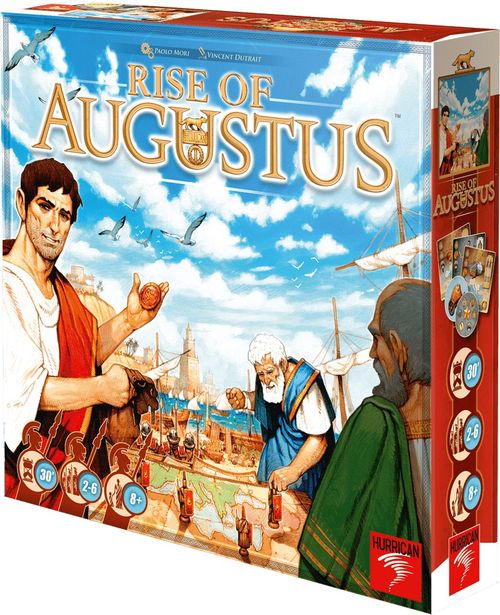
Rise of Augustus
Rise of Augustus Rulebook
Table of Contents
Table of Contents
Contents
- 88 objectives
- 48 legions
- 23 mobilisation tokens
- 12 rewards
- 1 cloth bag
- 1 scorepad
The rules booklet opens with an example of the game set-up for four players. Points 1 to 6 provide an overview of the principles of the game, the components and the set-up. Read them, then move on to the rules. The last page of the booklet is useful as a player aid.
Overview of the Game
2. The Objectives
You start the game with three objectives to conquer and seven legions.
There are two types of objective: provinces and senators.
On each objective, you find different information:
- I Objective number (1 to 88).
- II Name of the Senator / Name and colour of the province.
- III Situation and resources produced. Only wheat and gold resources are useful in the game. The others are just for illustration ...
- IV Victory points.
- V Type and number of legions to mobilise.
- VI Power provided by the objective.
3. The Mobilisation Tokens
A town crier draws one of the 23 mobilisation tokens from the bag. He states what it is aloud and puts it on the table.
- Each token can mobilise one of the six categories of legion.
- A "joker" token allows you to mobilise the legion of your choice.
| Token | Double Sword | Shield | Chariot | Catapult | Standard | Dagger | Joker |
|---|---|---|---|---|---|---|---|
| Quantity | 6x | 5x | 4x | 3x | 2x | 1x | 2x |
4. Your Aim
Depending on the tokens drawn, you can mobilise or move your legions to complete your objectives.
Your aim: Get as many points as quickly as possible because the game ends when, at the end of a turn, a player has seven controlled objectives.
5. AVE CESAR
When an objective is completed, you proclaim aloud AVE CESAR.
If several players complete an objective in the same round, each player concerned indicates their objective's number; the lowest goes first. You take back your legions, carry out any powers granted by the objective, and place it slightly to one side in the controlled objectives area, and depending on the course of the game, claim rewards.
You then choose a new objective from among the five face up in the centre of the table and put it in front of you. Then you take the first objective from the deck to bring the available objectives back up to five.
6. Continuing the Game
If other players have announced AVE CESAR, they perform the same steps, otherwise the town crier draws a new mobilisation token. And so on, until one of you has seven controlled objectives at the end of a round.
You then add up the points. The player with the most points wins the game and can claim the title of Consul.
Set Up
(see illustration on the previous page of the booklet)
The set-up illustration labels the following areas of the table: the Objectives deck and the Available objectives next to it, the Discarded objectives, the Bag containing 23 mobilisation tokens, the Scorepad, the Stock of legions, the Five rewards for number of objectives, the Five rewards for colour objectives and the Two rewards — Resources: gold and wheat. In front of each player are his Seven legions and objectives being conquered, and behind them the Areas reserved for the objectives under control.
Player aid
The player aid at the back of these rules should be readily accessible by the players.
Rewards
They are set out in a row in the centre of the table. There are five rewards for number of objectives, five rewards for colour objectives, and two rewards for resources: gold and wheat.
Legions
Each player receives seven. The remainder are put to one side.
Mobilisation Tokens
The 23 tokens are mixed up in the bag.
Objectives
Five objectives are placed in the centre of the table.
Each player receives six chosen at random. He selects three of them and puts them in front of him, and discards the other three.
A deck is formed from the rest of the objectives, face down.
For a first game, each player receives three random objectives and puts them in front of him.
The Conquest of an Objective
The oldest player begins as town crier. He takes the bag, draws a token, states aloud what it is and puts it face up on the table.
All the players, including the town crier, can place a legion on one of their objectives, on a space of the same category as the drawn mobilisation token:
- either by taking a legion from their stock,
- or by moving a legion already posed. It does not matter if it was placed on another category space and / or another objective. This movement can be very useful to complete an objective.
You can only place or move a single legion for each token drawn from the bag.
Example
- The Town Crier announces Shield!
- The player may:
- Place one of the two legions still in his stock onto the shield space of objectives 19 or 20.
- Move any one legion from objectives 19, 20 or 21 to a shield space on objectives 19 or 20.
- Do nothing at all. Placing or moving a legion is never mandatory.
Joker Token
- It replaces any category of legion.
- After having drawn the Joker, all the mobilisation tokens are put back into the bag and the player to the left of the Town Crier becomes the new Town Crier.
To Complete an Objective
An objective is completed as soon as all its spaces are occupied by a legion. The player then announces aloud AVE CESAR.
Then he proceeds as follows:
- He removes all the legions from the objective and puts them back into his stock.
- He carries out the possible power provided by the objective.
- He moves the objective into his area showing the objectives under control.
- If possible, and if he wants to, he claims a reward. (See § rewards) In this example he takes the wheat reward and places it in front of him.
- He chooses a new objective from the five available and places it in front of him. He adds the first objective from the deck to bring the number available back up to five.
When Several Players Announce AVE CESAR at the Same Time
All the players concerned declare the number of their completed objective. Whoever has the lowest number begins. Then each player in turn, in increasing order of objective number, performs all of steps 1 to 5 above.
IMPORTANT: Completed objectives awaiting resolution are «neutralised», ie they cannot be the target of negative effects of enemy red objectives.
If, through the power of his objective, a player has the ability to complete others, this is done immediately before moving on to the next player and without taking into account the other players' numbers.
Claim a Reward
There are three types of rewards:
- A. Colour of objectives.
- B. Number of objectives.
- C. Control of gold and wheat resources.
A. Colour Objectives
These rewards are granted automatically when a player is the first to control:
- three objectives of the same colour
- an objective of each colour (green - pink - orange - senator)
It is possible to have several rewards of this type.
B. Number of Objectives
This reward may be claimed by any player at the moment he controls the exact number of corresponding objectives (two to six) and if the reward in question is still available in the centre of the table.
But note: A player can only have a single reward of this type. The reward can only be claimed when the player controls EXACTLY the number of objectives indicated. (A reward that is not claimed immediately is a lost reward for that particular player.)
It is not possible to exchange a reward for another of higher value.
It is thus necessary to choose:
- take a reward when that is possible, at the risk of not being able to claim a reward of greater value later,
- wait until you control more objectives, at the risk that the desired reward is grabbed by another player in the meantime.
Note: It is impossible to lose a colour or number of objectives reward. Even if a player later loses one of the objectives that enabled him to obtain a reward, he still keeps it.
Number of Objectives — Example
1. Dimitri starts because his objective has the lowest number of the three (70). He removes all the legions from the objective and puts them back into his stock. The power of the objective allows him to immediately mobilise two legions. He takes advantage of this to place them on his objective (1) which he therefore immediately completes. Both objectives are moved to the controlled area.
He is the first to control three green provinces and takes the corresponding reward.
Moreover, as he has four controlled objectives, two possibilities are now available:
- either decide to immediately take the corresponding reward. In this case, even if he later controls a fifth or sixth objective before the other players, he will not be eligible for the corresponding rewards
- or he can decide to renounce collecting the reward for controlling four objectives in the hope of getting a fifth, or even a sixth, objective before the other players and thus obtain more points. Obviously, it is riskier, because if the other players control a fifth or sixth objective before he does, and they claim the corresponding reward, he will have nothing at all…
Finally, he chooses two of the five objectives from the ones available and then adds the first two objectives from the deck so that there are five objectives available again.
2. It is now Romain's turn (76). He removes all the legions from the objective and puts them back into his stock. The effect of his objective is devastating: all the other players MUST remove all the legions from an objective that is being conquered. Marilyn does not remove any legions because only objective (80) has any but it is neutralised (see objective status). Dimitri meanwhile is forced to remove the sole legion on objective (4). He puts it back into his stock.
Romain moves his objective into his controlled area. He chooses an objective from the five available, then adds the first objective from the deck so that there are five objectives available again.
3. Finally it is Marilyn's turn (80). She removes all the legions from the objective and puts them back into her stock. This objective has no particular power but it does score a lot of points. She moves it to her controlled area. She chooses an objective from the five available, then adds the first objective from the deck so that there are five objectives available again.
C. Control of Gold and Wheat Resources
The first player to control an objective producing gold and / or wheat will automatically get the corresponding reward.
He keeps it as long as he controls more objectives producing such resources than any other player(s).
But, if a player matches him by controlling the same number of resources, he must give him the resource.
Control of Gold and Wheat Resources — Example
Marilyne controls a first gold-producing objective. She takes the gold reward and puts it in front of her.
Then she controls a second gold-producing objective. She retains the reward.
Romain control his first gold-producing objective. Marilyne retains the reward.
Later in the game, Romain controls a second gold-producing objective. He therefore takes the gold reward.
If Marilyne wants to get this award back, she must control a third gold-producing objective.
Consequences of Losing an Objective
- Dimitri completes objective (81). All the other players MUST remove one of their controlled objectives.
- Adrien chooses to remove objective (6). Nevertheless, he still retains the legion obtained.
- Marilyne, who has the wheat reward, chooses to remove objective (40). She loses a wheat resource. They then check to see who has the most wheat.
- If it is still her (even if tied), she retains the reward.
- Otherwise, she gives it to the player with the majority. In the case of a tie, she chooses which of the tied players to give it to.
- If no player has wheat, the reward is returned to the centre of the table.
End of the Game
The game ends if a player has seven controlled objectives at the end of the round.
If several players complete an objective in the same round, they carry out the five steps as normal.
Then, each player adds up his points using the scorepad as follows:
- Total the points from rewards.
- Total the points shown on controlled objectives.
- Total the points from powers.
- Add it all together.
- The player with the most points wins the game and can claim the title of Consul.
- In the case of a tie, the one who controls the most senators wins.
Example of Final Scoring
Paolo's scorepad, line by line:
- Rewards: 15 points.
- Points shown on the controlled objectives: 31 points.
- Points from powers: 8 points, then 10 points.
- TOTAL: 64 points.
- One point per shield appearing on the controlled objectives: there are ten shields, but the maximum value allowed by this objective is eight points.
- Two points per green province controlled.
Various Stages of the Evolution of an Objective
- Objective being conquered. As soon as it comes into play and so long as all necessary legions have not been mobilised an objective is considered to be in the process of being conquered.
- Objective completed. When the last legion needed has been mobilised, the objective is complete. The player announces AVE CESAR.
- Objective neutralised. Before coming under control, the legions must be withdrawn and any indicated powers must be carried out. During this time, it is regarded as neutralised.
- Objective under control. Then it is moved to the controlled objectives area (the areas reserved for the objectives under control). It can again be the target of adverse effects.
Play Aid
The powers have three types of effects: IMMEDIATE EFFECT, PERMANENT EFFECT, AT THE END OF THE GAME.
Immediate Effect
Immediately mobilise two legions on the corresponding spaces of your objectives — shown for each category in turn: double sword, standard, shield, dagger, chariot and catapult.
Mobilise the number of legions indicated on the spaces of your choice (joker spaces).
Immediately complete one of your objectives.
Take two objectives instead of one to replace the one you have just controlled.
Rearrange all your legions on your objectives as you see fit.
You receive one or two additional legions.
Red objectives — EACH opponent must immediately:
- … remove a legion
- … remove two legions
- … remove all the legions from an objective
- … remove a controlled objective
Permanent Effect
The equivalences shown on the objectives are:
- Double Sword = Shield
- Shield = Chariot
- Chariot = Catapult
- Standard = Dagger
- Catapult = Standard
When a mobilisation token is drawn, you can choose on which type of space you want to place or move a legion. Either on the drawn token's space, or on the related category's space. Note: You cannot «chain» multiple powers like this: Example: Dimitri has shield = chariot and chariot = catapult. If a shield token is drawn, it can be placed on a shield or chariot legion, but not catapult.
At the End of the Game
Each space with this category on your controlled objectives earns the number of points indicated:
| Category | Points per space | Maximum |
|---|---|---|
| Double Sword | 1 | 6 MAX |
| Shield | 1 | 8 MAX |
| Chariot | 2 | 10 MAX |
| Standard | 3 | 15 MAX |
| Catapult | 3 | 12 MAX |
| Dagger | 4 | 20 MAX |
Each controlled objective of the same colour earns the number of points indicated:
| Colour | Points |
|---|---|
| Senator | 2 |
| Green province | 2 |
| Pink province | 4 |
| Orange province | 6 |
Each red controlled objective earns five points.