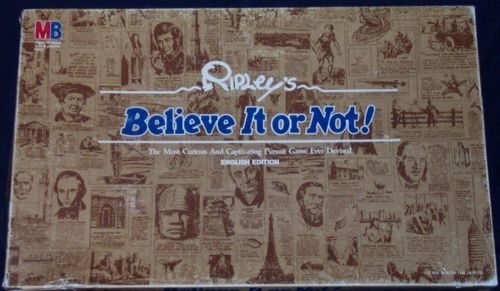
Ripley's Believe It or Not!
Ripley's Believe It or Not! Rulebook
Table of Contents
Table of Contents
Object
Be the first player to reach the "You Have Won The Game" space.
Contents
- 1 gameboard
- 6 plastic pawns
- 4 decks of 60 cards each
- 1 cardboard tern token
- 1 instruction book
How To Set Up The Game
Open the gameboard and place it on a flat surface within easy reach of all players.
Each player chooses a pawn and places it on the space marked START.
Punch out the "tern" token that pictures an arctic tern from the box platform. Believe it or not, this token is used to keep track of whose turn it is during the game.
Take one deck of cards and shuffle it. The other three decks are supplemental decks to be used when you have become familiar with the questions and answers in the first deck. Do not mix up the cards from one deck to another! Notice that the card backs are different colors to distinguish one deck from another. Deal five cards face-down to each player then place the remainder of the deck facedown on one of the two gold-bordered card spaces on the gameboard to form a draw pile. Use the card space on the opposite side of the board for the discard pile.
Basic Game Play Summary
This is a different type of game because you do not spin a spinner or roll a die to move your pawn on the gamepath. Instead, you play cards that contain either movement directions, multiple choice questions, true statements, or bluff statements which prompts the movement of your pawn or an opponent's pawn. On your turn, choose a card from your hand and ask an opponent either to answer a question or to declare a statement as true or false. If your opponent selects the incorrect answer or incorrectly declares a statement true or false, then you move your pawn ahead the number of spaces as directed by the card. If your opponent's response is correct, then your opponent's pawn moves ahead. There are also spaces on the board that can direct your pawn's movement such as slide, shortcut, trade places and speed up spaces. When two pawns land on the same space, a challenge occurs. In a challenge, a card is drawn from the draw pile and played as such a card on a normal turn is played!
How To Play The Game
Who Plays First?
Believe it or not, the shortest player plays first. Play then proceeds to the left. The first player takes the tern token to show it is his or her turn.
What To Do On Your Turn
Basically, choose one card from your hand to play. Ask the question on the card or give a statement aloud to the selected opponent. The player who asks the question is called the "asking" player; the player who answers the question is called the "answering" player. Two major things can happen: if your opponent gives an incorrect response, you move your pawn ahead the number of spaces stated on the card; if your opponent gives the correct response, then your opponent moves his or her pawn ahead the number of spaces stated on the card. At the end of your turn discard the card and pass the tern token to the player on your left to keep track of who plays next.
The Cards
There are four types of cards used in the game: Multiple Choice cards; Statement cards; Bluff cards; and Movement cards. A description of each card and how to play it follows.
Multiple Choice Cards
Example card as printed: type of card "Multiple Choice"; "Ask Left 3" (what player to ask, and the number of spaces a pawn advances). Questions on the example card:
- Believe it or not, in 1963, the United States government considered using pennies made of: A. tin; B. aluminum; C. plastic; D. paper.
- Believe it or not, an auctioneer received $7,000 for a stuffed: A. cabbage; B. white shark; C. moose; D. auk.
- Believe it or not, ground-up mummy fragments were used in Europe as: A. medicine; B. wall decorations; C. spices; D. jewelry.
(In the printed example, the correct answer is shown in italics.)
Two to four questions appear on each card and each question has four possible answers. A Multiple Choice card always tells you which player must answer the question. Look at the above example. "Ask Left" means ask one of the questions on the card to the player on your immediate left (if the card had said "Ask Right," you would ask one of the questions to the player on your immediate right; if the card had said "Ask Anyone," you could pick any player to answer the question).
A Multiple Choice card also always tells you how many spaces on the gamepath a pawn can advance on the question. In the above example, the numeral "3" indicates that three spaces can be advanced. Other Multiple Choice cards say advance 1, 2, 4 or 5 spaces.
How To Play A Multiple Choice Card
On your turn, ask one of the questions on the card to the indicated player. When you ask the question, give the four possible answer choices, listed as A, B, C or D. Note: the correct answer is always in italics! The "answering" player then picks one of the four choices as an answer. You, the "asking" player, announce whether it was correct or incorrect.
- if incorrect, give the correct answer and move your pawn ahead the number of spaces indicated on the card.
- if correct, the "answering" player moves his or her pawn ahead the number of spaces indicated on the card.
Discard the Multiple Choice card facedown on the discard pile and your turn is then over. Pass the tern token to the player on your left who then must play a card.
Statement Cards
Example card as printed: type of card "Statement"; "Ask Anyone 1" (what player to ask, and the number of spaces a pawn advances). Statements on the example card:
- The Canadian National Railroad is three miles longer in summer than in winter, believe it or not.
- Leon Yonders, playing billiards with the cue behind his back, sank 180 balls in succession, believe it or not.
- Tabular icebergs turn blue with age and sometimes are 100 miles long, believe it or not.
- Natives on the island of Yap use money made of 12 foot stones, believe it or not.
- Eleven percent of the average grocery bill pays for packaging, believe it or not.
Four to six statements appear on every card. Each statement on the card is true and ends with the phrase "believe it or not." Just like the Multiple Choice card, the player that must be asked the statement and the number of spaces a pawn advances are all on top of the card. In the above example, the "asking" player can ask any player and the number of spaces a pawn can advance is 1.
How To Play A Statement Card
On your turn, choose one of the statements to read to the indicated player. The "answering" player must declare whether the statement is true or false by saying either "I believe it" or "I don't believe it."
- if the "answering" player does not believe the statement, move your pawn ahead the number of spaces indicated on the card.
- if the "answering" player does believe the statement, the "answering" player moves his or her pawn ahead the number of spaces indicated on the card.
Discard the Statement card facedown on the discard pile and your turn is then over. Pass the tern token to the player on your left who then plays a card.
Bluff Cards
Example card as printed: type of card "Bluff"; "Ask Right 2" (what player to ask, and the number of spaces a pawn advances). Hints on the example card:
- HINT #1: Dr. Denbar Michaels, after living 10 years in ______, invented the ______, believe it or not.
- HINT #2: Tchaikowsky / Overture of 1812 / 1809
Bluff cards have no questions or statements on them. Bluff cards ask you to make up your own false statement and ask an opponent to decide whether the statement is true or false. Bluff cards carry two different types of hints on them: HINT #1 gives you an incomplete statement that allows you to fill in the blanks with false facts. Using Hint #1 from the example above, you could bluff with the following statement..."Dr. Denbar Michaels, after living 10 years in a tropical rain forest invented the umbrella, believe it or not." Or you could try to bluff with HINT #2 which presents you with three key words to help you make up a false statement. Using Hint #2 from the above example, you could bluff with the following statement..."Tchaikowsky wrote the famous 1812 Overture to commemorate an event that actually took place in 1809, believe it or not." You may also choose to ignore the hints given on the card and make up your own outrageous and false statement--just keep a straight face when tale-telling, so your opponent will believe you!
Bluff cards, just like Multiple Choice cards and Statement cards, tell you right on top of the card which player to direct the bluff to and how many spaces a pawn advances. In the example on page 10, the "asking" player tries to bluff the player on his or her right and the number of spaces a pawn advances is 2.
How To Play A Bluff Card
On your turn, make up a false statement by either using Hint #1 or Hint #2 on the card or using your own imagination to make up the bluff. Direct the bluff to the player indicated on the card. Be sure to have the false statement clearly in your mind before you start speaking, try not to hesitate in your delivery, and always end your statement with the phrase "believe it or not." The "answering" player must declare whether the statement is true or false by saying either "I believe it" or "I don't believe it."
- if the "answering" player does believe the statement, move your pawn ahead the number of spaces indicated on the card.
- if the "answering" player does not believe the statement, the "answering" player moves his or her pawn ahead the number of spaces indicated on the card.
Discard the Bluff card facedown on the discard pile and your turn is then over. Pass the tern token to the player on your left who then plays a card.
Statement and Bluff Cards--Their Special Relationship
Have you noticed that a Statement and a Bluff are structured exactly the same--an outrageous fact followed by the phrase "believe it or not." There is one distinct difference, though. All Statements are true and all Bluffs are false. When you play a Statement card, your goal is to convince the "answering" player that the statement is false and that you are actually playing a Bluff card; when you play a Bluff card, your goal is to convince the "answering" player that the statement is true and that you are actually playing a Statement card. To do this, you must be a good actor or actress--your delivery is everything. When saying a Statement, try to make it sound like you are not reading it right off the card. When bluffing, try not to hesitate--say the bluff confidently--and if asked to repeat the bluff, make sure you can!
Movement Cards
Example card as printed: type of card "Movement Card"; "Move 4 Back" (the number of spaces a pawn moves, and the direction of movement).
Movement cards have no questions, statements or hints on them. They are cards that direct a pawn to move either forward or backward along the path a certain number of spaces. On the top of the card appears the direction the pawn must move and the number of spaces it must move. In the above example, the pawn must move back along the path four spaces.
How To Play A Movement Card
Movement cards are special cards that allow you to either tell the truth about what they say or not to tell the truth about what they say.
To play a Movement card, place it facedown in front of you. Now you have a choice between telling the truth or not telling the truth about how many spaces the card is worth and the movement direction. You may want to move your pawn ahead when the card states move back or vice versa, or you may want to move your pawn more spaces or less spaces than the card allows. Of course, you may want to move your pawn exactly as stated on the card. Your decision to tell the truth or not to tell the truth about what the card states depends on what is best for you and where you want to move. For example, if the card says MOVE 2 AHEAD and you want to do it, you would say, "Believe it or not, this card allows me to move my pawn 2 spaces ahead." If the card says MOVE 3 BACK and you do not want to do it, you could say the card says something else and hope you don't get caught. For example, instead of saying MOVE 3 BACK, you could say, "Believe it or not, this card allows me to move my pawn 1 space ahead." Any opponent can dispute what you stated by saying "I do not believe it." If more than one player challenges you, the first player that says "I do not believe it" is considered the player that disputed you. If no opponent disputes what you stated, place the card facedown on the discard pile and move your pawn along the path exactly what you stated. No one will know whether you were telling the truth or not. If an opponent disputes what you stated, turn the card faceup to show it to your opponents. If you told the truth, move your pawn along the path exactly what the card states. Then, as a bonus, you can either move your pawn forward the number of spaces stated on the card or move your opponent's pawn who disputed you, backward that number of spaces. If you did not tell the truth, you must move your pawn along the path exactly what the card states. Then, the opponent who disputed, as a bonus, can either move his or her pawn forward the number of spaces stated on the card or move your pawn backward that number of spaces. After a Movement card is played, place it facedown on the discard pile and your turn is over. Pass the tern token to the player on your left who then must play a card.
Rules Of Pawn Movement
Pawns move along the path from the START space towards the YOU HAVE WON THE GAME space unless directed to move backward by a Movement card or a special space. See "The Special Spaces," on page 18, for details. See Figure 1, below, for a look at how to enter the gamepath from START.
Two pawns can occupy the same space which always results in a challenge. See "The Challenge," on the next page, for details.
Figure 1: Shows a section of the gamepath with the START space and a space marked "MOVE AHEAD 3 SPACES," with an arrow indicating the direction pawns enter the gamepath from START. Caption: All pawns enter the gamepath in the direction of the arrow.
The Challenge
When A Challenge Occurs
If your pawn lands on a space occupied by an opponent's pawn by exact count, a challenge immediately takes place. It does not matter whether you moved there on your turn or during another player's turn. A challenge is not counted as a player's regular turn. It is considered an extra turn that temporarily interrupts the regular order of play.
Who Challenges Whom?
The player who lands on the space challenges the player already on the space. These are the only two players in the challenge. The player who lands on the occupied space is called the CHALLENGER; the player already on the space is called the CHALLENGED PLAYER.
How A Challenge Is Played And Won
The CHALLENGER places his or her cards facedown on the table (they are not used in the challenge). The CHALLENGER then draws the top card from the draw pile--this is the card used in the challenge. The CHALLENGER then plays this card exactly as he or she would play such a card on a normal turn except the card is always directed at the CHALLENGED PLAYER. After the card is played and the challenge is won, discard the card facedown on the discard pile. Now resume the regular order of play. The player holding the tern token should take his or her turn and play next.
When A Challenge Leads To Another Challenge
If the winner of a challenge moves his or her pawn and lands on another space occupied by an opponent's pawn, another challenge immediately takes place.
Replenishing Your Hand
At the start of the game, you were dealt five cards. After you play all five of these cards, take five more from the draw pile.
The Special Spaces
Move Spaces
These spaces direct you to move your pawn a certain number of spaces ahead or back. If you land on such a space by exact count, immediately move as directed. If the move lands your pawn on an occupied space, then you challenge the other player on the space.
The Shortcut
There are two "Shortcut" spaces on the board. Refer to Figure 2, below, to see what a shortcut space looks like. If there are two or more pawns ahead of your pawn on the path, you can use a shortcut. Exact count is not needed. Just count the arrowed space marked SHORTCUT as any other space on the board and move through the shortcut. You could also land directly on a shortcut space. Please Note: a challenge can only occur on a shortcut space if another pawn occupies the shortcut space and not the two adjacent spaces next to it.
Figure 2: Shows a shortcut space marked SHORTCUT, the spaces marked MOVE AHEAD 3 SPACES, MOVE BACK 3 SPACES, SPEED UP and TRADE PLACES WITH NEAREST PLAYER, and the two adjacent spaces next to the shortcut. Caption: In Figure 2, a challenge would not occur if a pawn occupied the shortcut space and another pawn occupied either of the adjacent spaces.
Trade Places Space
These spaces direct you to exchange places with another player on the path. If you land on such a space by exact count, you must move your pawn to a space occupied by an opponent's pawn and move your opponent's pawn to the space you vacated as directed by the space. Please Note: if you land on an occupied "Trade Places" space, then a challenge occurs and you do not trade places with anyone. Also, if there is no player in position to change places with, then ignore the directions on the space.
Speed Up Spaces
There are two "Speed Up" spaces on the board. If you land on such a space by exact count, immediately move your pawn ahead two spaces and every pawn on the path behind you simultaneously moves ahead two spaces.
The Slide
There are three "Slides" marked by large arrows on the path. The purpose of the slides is to increase the chances of two players landing on the same space thus resulting in a challenge. If your pawn moves ahead and lands on a space that is part of a slide, then immediately slide your pawn to the space at the end of the slide. If there is another pawn at the end of the slide, a challenge immediately takes place.
Moving Back Onto A Slide
There is a possibility that your pawn will be forced to move back onto a space in a slide. If this happens, move back and remain there (do not slide back down to the end of the slide). If any other pawn uses that slide, it does not affect your position.
How To Win The Game
Be the first player to reach the "You Have Won The Game" space, and you'll do just that...win the game! You can land on it on your turn or on an opponent's turn and exact count is not needed.
Strategy Hints
- Plan your moves to enable you to land on advantageous board spaces.
- Try to land on a space occupied by another player so that you can possibly advance even further on a challenge.
- When you play a card that says "Ask Anyone," try to ask the player who has the least to gain by getting the card correct and moving forward. Generally you direct your cards to those players who are falling behind; in case you're unable to move, it allows them to go forward rather than a lead player moving forward.
- Don't waste a high movement card right before a slide, since landing on any space along the slide will move you forward.
- Plan your moves carefully as you approach the shortcut spaces so you can use them. (Remember, you cannot use a shortcut if you are in first or second place.)