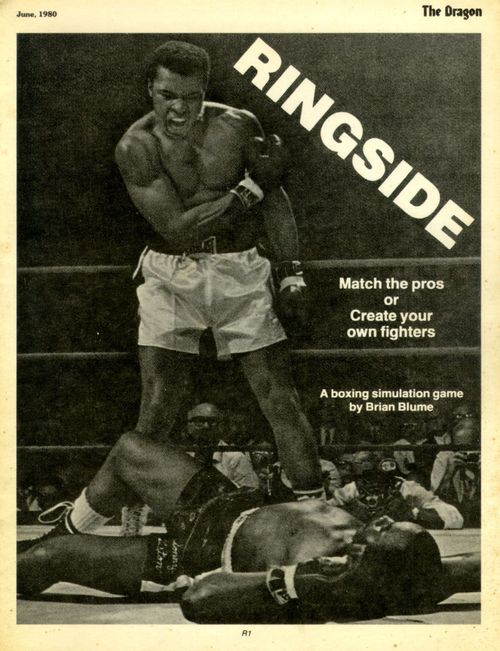
Ringside
Ringside Rulebook
Table of Contents
Table of Contents
Introduction
RINGSIDE is a game which recreates the action of a boxing match, simulating every major aspect of combat between two antagonists in a ring. Players assume the roles of the fighters themselves, either on a one-to-one basis, or with each player ("manager") having more than one fighter in his stable.
On a match-by-match basis, players strive to become the best fighter by taking and holding the championship. In the Campaign Game, which must be moderated by a non-playing referee, players seek to gain success in the ring and to translate that into as much in money winnings as possible, so as to also be acclaimed the best (richest) manager of fighters.
Fighters and Their Abilities
Each player may have one or more fighters, the number for each player to be agreed upon among all players. Once a fighter's abilities have been determined, he must have a minimum number of fights (see Experience) before retiring, unless historically accurate fighters are used, and players may wish to retire a fighter prematurely to maintain the historical reality.
Fighters' abilities are determined as follows:
- AGILITY: A number from 41-60, generated by rolling d20 and adding 40.
- PUNCHES: The six punches are uppercut, right jab, right hook, combination, left jab and left hook. Each punch has a rating of 1-4. To find it, roll d4 and use that number, unless a 4 is rolled, in which case the result of a second roll is used. Thus, the only way to obtain a "4" rating for any punch is to roll 4 twice in a row.
- ENDURANCE: A fighter's base endurance is from 1-20, according to the roll of a die. To that number is added, before a fight, seven points for each scheduled round of that fight.
- COUNTERPUNCH: A number from 11-30, generated by rolling d20 and adding 10.
Beginning the Fight
At the start of a fight, or any round within a fight, players will position counters representing their fighters on diagonally adjacent squares in the center of the ring (2 counters within the 4-square area). Each player rolls a number from 1-100, and the player with the higher number becomes the attacker to begin the round.
During the round, if an attacker attempts to strike and misses he becomes the defender. The previous defender becomes the new attacker and is eligible to strike the next blow. If an attacker attempts to strike and succeeds, he remains the attacker and may attempt to strike again. (Exception: see Step IV, Counterpunching.)
Game Procedure
Step I: Determination of Hits
To determine whether the attacker (A) strikes the defender (D), A rolls a number from 1-100. If it is higher than D's Agility rating, the punch has struck home. If the punch misses, proceed to Step V, Movement. If the punch hits, proceed to Step II below.
Step II: Effect of Hits
If A hits D, A secretly selects one of the six punches as the type he has thrown for that blow. D secretly chooses the punch he wishes to anticipate. The two choices are revealed and cross-indexed on the Punching Chart (printed beside boxing ring). The resulting number, plus A's listed ability for the punch he has thrown, represents the amount of damage the punch caused. This number is subtracted from D's Endurance total. Proceed to Step III below.
Punching Chart (rows: punch thrown by A; columns: punch anticipated by D)
| Punch thrown \ Anticipated | Uppercut | Right Jab | Right Hook | Combination | Left Jab | Left Hook |
|---|---|---|---|---|---|---|
| Uppercut | -1 | 2 | 2 | 4 | 2 | 2 |
| Right Jab | 2 | -1 | 2 | 2 | 1 | 4 |
| Right Hook | 3 | 1 | -1 | 2 | 3 | 3 |
| Combination | 4 | 2 |
Step III: Knockdowns
If any particular punch causes 4 or more points of damage to D, there is a chance for D to be knocked down. A rolls a number from 1-100, and if that number is less than or equal to the points of damage caused, D is knocked down.
If D's endurance has been reduced to zero or less, 10 is added to the number of damage points caused by the punch, but only for purposes of determining a knockdown, not for actual damage. This reflects the higher chance of knocking down a fighter who is nearly out on his feet, and gives punches that yield 3, 2, 1, or even zero points of damage a chance of causing a knockdown when D is in a weakened condition.
After a knockdown that does not lead to a knockout (see How to Win), both fighters resume the bout as if they were beginning a new round, as in Step I, except that the fighter who was knocked down remains the defender.
If D is hit but not knocked down, proceed to Step IV below.
Step IV: Counterpunching
D can attempt to counterpunch after being hit by rolling a number from 1-100. If it is less than or equal to D's Counterpunch rating, D can attempt a counterpunch by following the procedure under Step I. If the counterpunch attempt misses, A and D retain their previous roles, and play proceeds to Step V below. If D fails to roll a number less than or equal to his Counterpunch rating, play proceeds to Step V.
If D's counterpunch hits his opponent, D becomes the attacker and proceeds with Step II.
Step V: Movement
If A misses D in Step I, D must move one square sideways (at a 90-degree angle) or backwards (in the general opposite direction) away from A. If A hits D and Steps II, III and IV have been played, D must move one space straight backwards (no 90-degree move permitted).
If D is against the perimeter of the ring (on the ropes) and is hit, he may move diagonally backward if that is his only possible move. If D is on the ropes and cannot move at all, after he is hit, D's Agility rating is reduced by 10 for as long as he remains on the ropes.
After D has moved, A must move to a space adjacent to the defender, unless D's move did not separate the fighters, in which case A does not have to move but may still do so.
Play then resumes with Step I, with A and D roles remaining the same if A has just hit D, or switching between the fighters if A has just missed.
The Round
Each round lasts 18 turns of roughly 10 seconds each. Each turn represents the time elapsed during which punches are actually thrown, in addition to other, ineffectual actions (feints, a foot shuffle, etc.).
A new turn is begun every time players return to Step I in the Game Procedure, except when the procedure in Step I is played in the form of a successful Counterpunch attempt. An extra turn is marked off each time a fighter is knocked down and the resulting roll is "a count" of 4 or more.
At the end of each round, each fighter regains 10 points of Endurance as a result of resting between rounds. However, a fighter's Endurance may never exceed the number of points with which he started the fight.
How to Win
A boxing match can be decided by Knockout (KO), Technical Knockout (TKO), or by decision.
A KO can occur after any knockdown. After D has been knocked down, A rolls a number from 1-10, adding 4 to that number if D has a current Endurance rating of zero or less. If the resulting number is 10 or more, A wins the fight by KO.
A TKO is automatically declared at any time when a fighter's Endurance rating falls to a total of minus 25 or less. He is deemed unable to continue the fight, and his opponent is awarded a victory by TKO.
If no KO or TKO occurs, the winner by decision is the fighter who won the greater number of rounds. The winner of each round is that fighter who caused the greater amount of damage to his opponent in that round. Note: Punches which result in knockdowns count double, for purposes of this calculation only. If the fighters caused equal amounts of damage, the round is declared even. If each fighter wins an equal number of rounds (possibly including some even-score rounds), the fight is declared a draw.
The Cover-Up
The cover-up is an optional defensive tactic which may be employed by the defender at the beginning of Step I, before A rolls to see if his punch has hit. D can choose to cover up, protecting himself more completely by using his arms to shield his body and face. Covering up adds 10 to D's Agility rating, but also adds 20 to A's Agility rating. The Agility adjustments last until the next time the same fighter is D in Step I, or until D manages a successful counterpunch, whichever occurs first. A cover-up can be extended from turn to turn by simply re-establishing that tactic at the beginning of each Step I.
Punching Fatigue
A fighter who throws many punches will tire more quickly than one who throws fewer. Thus, if a fighter hits his opponent more than five times during a round, the first fighter loses one Endurance point for each additional time the opponent is hit, beginning with the sixth hit.
Advanced Rules
If both players agree before a fight, the advanced rules may be used. The rules for Backpedaling, Clinching and Rushing must all be used if any of them are to be used.
Backpedaling
At the start of Step I (before A rolls for a possible hit), D may choose to Backpedal. This tactic adds 25 to D's Agility rating, but enables A to remain the attacker for another Step I procedure, even if his first punch misses. Exception: Play proceeds as normal if D makes a successful counterpunch, with D becoming A for the start of the next Step I. This tactic is generally only useful if D is far ahead in rounds or in points within the current round, or if D has had his Endurance drastically reduced. Backpedaling may not be combined with Covering Up or Clinching, and may not be employed when D is on the ropes.
Clinching
At the start of Step I (before A rolls for a possible hit), D may choose to Clinch. This tactic, when used by D while he is on the ropes, negates the normal 10-point loss in Agility incurred in that situation. During a Clinch, no hooks may be thrown by either player.
A Clinch continues until one of the players misses a punch (not a counterpunch). Neither player may Clinch on two successive opportunities (at the start of Step I), since this is interpreted as an attempt to stall, and the "referee" will immediately separate the fighters to prevent the second Clinch. Clinching may not be combined with Backpedaling or Covering Up, and A is not allowed to Rush a Clinch.
Rushing
At the start of Step I (before A rolls for a possible hit), A may choose to adopt the Rushing tactic, after D has chosen a special tactic (if any) and so long as D's tactic does not prevent the use of Rushing.
Rushing lowers both fighters' Agility ratings by 10 and also raises D's Counterpunch rating by 15 for the duration of the Rush. The effects of a Rush continue until the same fighter attacks again in Step I, or until the original D hits his opponent by counterpunching. An attacker may not Rush if D has chosen to Clinch, or if D is on the ropes.
Optional Scoring System
If players desire, they may use a "10-point must" system or a "5-point must" system to score each round. At the end of each round, consult the chart below. According to the difference in damage caused by the more successful fighter vs. the less successful, the fighter who loses the round can earn from 6-10 points (or 1-5 points) while the fighter who wins the round always earns 10 (or 5) points. If the fight does not end in a KO or TKO, the winner of the bout is the fighter with the greater number of total points.
| Damage Difference | Points to Winning Fighter | Points to Losing Fighter |
|---|---|---|
| 0 or 1 | 10 or 5 | 10 or 5 |
| 2 to 20 | 10 or 5 | 9 or 4 |
| 21 to 40 | 10 or 5 | 8 or 3 |
| 41 to 60 | 10 or 5 | 7 or 2 |
| 61 or more | 10 or 5 | 6 or 1 |
Campaign Rules
The Campaign Rules contain provisions for each player fighting and managing a number of different fighters over an extended period of game time. Guidelines are given to calculate a fighter's change in status over the course of his career. Players can act as managers, trying to better their lots in life by taking a cut of a fighter's winnings, and/or by betting on the outcome of particular bouts.
Experience
Every time a fighter wins two fights in a row, he gains a small amount of "experience" which translates into the improvement of one of his basic ratings. The player rolls a number from 1-10 and applies the result as follows:
- Roll of 1, 2, 3, 4, or 5: +1 to Endurance rating
- Roll of 6, 7, or 8: +1 to Agility rating
- Roll of 9 or 10: +1 to Counterpunch rating
Experience is gained for each fight won in succession after the second victory, i.e. for each of the third, fourth, fifth, sixth (or more) consecutive victories. If a fighter loses a fight after winning two or more in succession, he must again win two fights in a row to gain Experience. Note: No fighter may ever gain more than five points in Agility or Counterpunch ratings, or 10 points to his Endurance rating as the result of earned Experience.
Popularity
Each fighter has a number of Popularity Points (POP), representing his standing with the fans and reflecting, to a degree, his ranking among other fighters of his class.
After each fight, POP's are awarded as follows:
- 2 POP's for winning by KO
- 1½ POP's for winning by TKO
- 1 POP for winning by decision
- ½ POP for each knockdown punch for each fighter, not including a KO punch
- Minus ½ POP for losing a fight by decision
- Minus 1 POP for losing a fight by TKO
- Minus 1½ POP for losing a fight by KO
A fighter may also gain a POP bonus for his ranking within his class. The current champion automatically receives 10 POP. Challengers receive POP in accordance with their current ranking, figured according to the following formula: Contender's rank (#1 contender on down) is subtracted from 51 and divided by 10, with fractions rounded up or down to the nearest ½ POP. Example: The #1-ranked contender receives 5 POP; 51 minus 1 is 50, divided by 10 equals 5. The #4-ranked contender receives 4½ POP; 51 minus 4 is 47, divided by 10 equals 4.7, rounded to 4½.
The Arenas
There are five different arenas where fighters may be scheduled. Each arena will schedule one "card" of fights per week of game time. The arenas and the requirements and benefits which apply to each one are as follows:
The Best. Fights for the championship may only be conducted here. It is also the place for bouts where the fighters have a combined POP of 35 or more, or where one fighter has a POP of at least 20 and his opponent has a POP of 10 or more. Championship fights are 10-15 rounds in length, as agreed upon by the players or dictated by the campaign referee. Other fights are 8-12 rounds in length. The purse in a championship fight awards a base of $35,000 to the winner and $15,000 to the loser, with each total modified upward by $1,000 per POP of the respective fighters. In a non-championship fight, the winner receives $7,000 and the loser $3,000, with each total increased by $100 times the combined POP of the fighters.
High Class. Bouts conducted here must involve fighters with a combined POP of 25, or two fighters with a high POP of at least 16 and a low POP of no less than 6. All fights are 6-12 rounds in length. Winnings are $2,000 for the winner and $1,000 for the loser, plus $50 times the combined POP added to each fighter's purse.
Middle Class. Bouts conducted here must involve fighters with a combined POP of at least 18, or two fighters with a high POP of at least 12 and a low POP of no less than 3. Fights are 6-10 rounds in length. Winnings are $700 for the winner and $300 for the loser, each total increased by $20 times the combined POP.
Low Class. Bouts conducted here must involve fighters with a combined POP of at least 10, or at least one fighter with a POP of at least 8. Fights are 5-8 rounds in length. Winnings are $300 for the winner and $100 for the loser, plus $10 times the combined POP added for each fighter.
The Pits. Any bout may be conducted here, regardless of how low the fighters' POP. Fights are 3-7 rounds in length. Winnings are $70 for the winner and $30 for the loser, plus $10 times the combined POP added for each fighter.
Note: The chart above is structured for heavyweight fighting. If players are handling fighters in lower weight classes, the length of the fight is reduced by two rounds (to a minimum of 3 rounds), and all winnings are halved.
Fighters may not compete more than once per month without incurring a penalty. If a fighter returns to the ring in less than one month, any damage (loss of Endurance) that was sustained by that fighter in his previous fight is carried forward to the second fight.
Retirement
A fighter may be retired at any time after he has fought 10 times, or if he loses three fights in a row. At this time, the player may roll to determine the new ability ratings for another fighter to replace him.
The Cut
The player, in his capacity as the manager of his fighter or fighters, receives a percentage of the winnings amassed by that fighter, which is known as the manager's "Cut."
The Cut is initially determined by generating a number from 11-30 (d20 + 10). This is the percentage of the fighter's winnings which the manager will receive. The initial Cut percentage remains in effect for 10 fights. If a fighter is not retired at this time, a new Cut is determined.
The new Cut is determined by generating a new number from 11-30, using the same procedure described above. That base number is increased by 1 for each loss the fighter has suffered so far, and decreased by 1 for each win the fighter has scored.
Other new Cuts may be calculated at the end of every 10-fight sequence for a given fighter, if that fighter remains active, by using the same procedure as for the first new Cut. Note: The Cut can never be lower than 10% or greater than 30%, regardless of modifiers which would otherwise raise or lower it beyond those bounds.
Campaign Notes
All fights should be scheduled in advance through the Campaign Referee. Alternatively, the referee can schedule bouts and notify players as to the date of the fight, its location, and the purse.
The referee is responsible for maintaining rankings, awarding the proper POP to each fighter accordingly, and for keeping players informed of changes in a fighter's ranking. The referee will post a list of cumulative winnings for each fighter, and the managers' cuts.
It is suggested that players be provided with a certain sum of money (probably no more than $10,000 apiece) with which to purchase fighters (fighters may be sold or traded), make side bets on bouts, or pay to reserve space in an arena (if such payment is required by the referee).
30 Super Sluggers to Start With
Want to recreate the "Thrilla in Manila?" How about giving Tunney another chance at Dempsey? Would Ali still be "Number One" after a bout with Joe Louis?
Those matches and many, many more can be played with the RINGSIDE rules and the following game statistics for 30 of history's most famous heavyweights.
The ratings were devised (and recently revised) by RINGSIDE designer/author Brian Blume. He originally used these fighters and dozens of other heavyweights and light heavyweights as part of the playtesting of the game.
The figures for each fighter represent general evaluations of his ability or strength over the course of his career. To be even more true to life, many fighters could have different statistics in the different time periods of their careers. Other alterations and/or adaptations of the statistics are possible, depending on the preference of the players.
Many of the abilities for these fighters are higher than those attainable through the game procedure for rolling up fighters. Many of the heavyweights have Agility of more than 60, Counterpunch ability in excess of 30, and/or a base Endurance of more than 20, and a few have one or more punches rated at "5". These "inflated" ratings are designed to reflect the talent and power of the legendary fighters they describe, and not to encourage players to "boost" the abilities of their "imaginary" fighters in the same way.
Because this list of fighters was compiled several years ago, many newly prominent heavyweights are not included. Players are invited to use these ratings as a standard for comparison if they wish to generate other real-life fighters from the present or the past.
| Fighter | Agility | UC | RJ | RH | Co | LJ | LH | Counterpunch | Endurance |
|---|---|---|---|---|---|---|---|---|---|
| Muhammad Ali | 68 | 4 | 3 | 4 | 3 | 5 | 4 | 34 | 23 |
| Duane Bobick | 46 | 2 | 2 | 3 | 3 | 3 | 3 | 20 | 8 |
| Oscar Bonavena |
Column key: UC = uppercut, RJ = right jab, RH = right hook, Co = combination, LJ = left jab, LH = left hook.