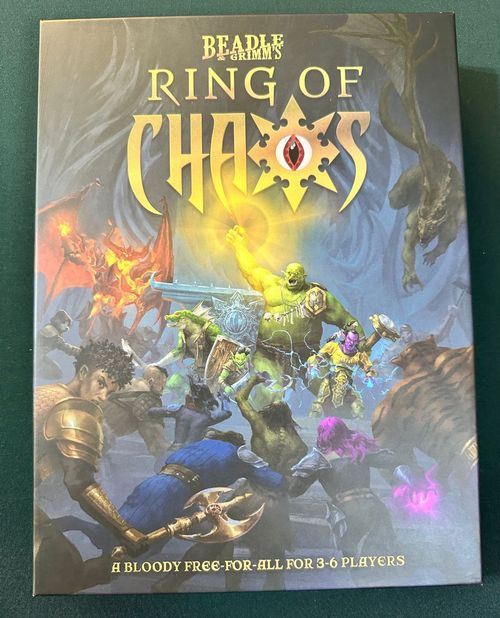
Ring of Chaos
Ring of Chaos Rulebook
Table of Contents
Table of Contents
- Object of the Game
- Glossary of Important Terms
- Contents
- Class and Counter Cards
- Setup
- Playing the Game
- Turns
- Movement, Movement Cards and Player Positions
- Attack Actions
- Taking Damage
- Wearing the Ring of Chaos
- Discarding Excess Cards
- Party Elimination
- Temple Guardian Cards
- Claiming Victory
- Action Deck Cards
- Adventuring Parties
- Frequently Asked Questions (and Important Reminders)
Object of the Game
Each player commands a group of four Heroes in a quest to claim the all-powerful Ring of Chaos and hold it long enough to summon the chaos gods to their service.
You can claim victory in one of two ways:
- Amass 11 Summoning Points, or
- Be the last Adventuring Party with at least one living Hero.
Glossary of Important Terms
Adventuring Party: A group of four Heroes, one of each Class, controlled by a single player.
Hero: One individual Party member, represented by a single card. Every Hero must be assigned one Class, represented by where they are placed on your player mat. Every Hero will have one of three status options that will change over the course of the game:
- Full Strength: the Hero's card is face-up and can use all Class cards associated with it (see below).
- Wounded: the Hero's card is face-down (showing the "Cannot Defend" text). Wounded Heroes can continue to use Class cards, but they cannot defend themselves from attacks.
- Dead: the Hero is removed from the player mat. You cannot play Class cards for this Class (unless your Adventuring Party's special power allows you to do so).
Example: Robb's Fighter and Cleric are at Full Strength. His Wizard is Wounded and therefore cannot defend herself. His Rogue is Dead, so Robb cannot currently play any Rogue Class cards.
Contents
- 6 player mats
- 1 double-sided battle map, with two versions of the Chaos temple
- 8 pairs of Adventuring Party standees (1 pair for each party)
- 8 Adventuring Party cards
- 6 pairs of standee stands (1 pair for each player)
- Deck of 94 Action cards, including 8 Temple Guardian cards
- 1 Ring of Chaos
- Deck of 32 Hero cards
Class and Counter Cards
For purposes of winning the game, both "Full Strength" and "Wounded" Heroes are considered "Alive." A player is removed from the game only if all four of their Heroes are "Dead."
Class: There are four Classes: Cleric, Fighter, Rogue, and Wizard. Each Class has special cards associated with them in the Action deck. These cards are color-coded with a bar across the top. For example, the Pickpocket card is a Rogue Class card, and it has a red bar on top that matches the red Rogue bar on your playmat.
Counter Cards: Counter cards are Action cards that prevent the effect of a card another player has just played. They can be played when it is not your turn (also known as a "Counter Action").
Setup
Quick Setup
- Distribute player mats
- Choose a battle map
- Choose Adventuring Parties and catch-phrases
- Assign your Heroes on the player mat
- Place one standee on a starting space and the other on the Summoning Ladder
- Place the Ring of Chaos on the Chaos Altar
- Deal four cards to each player, discarding and replacing any Temple Guardians
Detailed Setup
Each player takes one player mat and places it in front of them.
Choose one of the two battle maps. They have different layouts presenting different challenges, but are equal in complexity. Place the selected battle map in the center of the table where everyone can reach it.
Pick a starting player at random and deal two Adventuring Party cards to that player. The player chooses one to be their Adventuring Party. The next clockwise player receives the rejected Adventuring Party card and a new Adventuring Party card, and chooses between the two. This continues around the table so that every player is choosing one of two possible Adventuring Party cards.
Once everyone has selected an Adventuring Party, each player:
- Reads aloud their Adventuring Party's name and special power, and
- Announces what their Party's catchphrase will be. This can be anything you want; it is simply the phrase that you will repeat every round to signify the end of your turn.
Example: Char, playing the Hell Raisers, announces that her catchphrase will be, "I'll see you in Hell." Going forward, she will repeat it at the end of every turn to signify that she has completed all her Actions and the next player may draw.
- Next, each player takes the four Hero cards that make up their Adventuring Party (they have the same party name at the bottom of their cards) and arranges them on the four Class slots on their player mat (Cleric, Fighter, Rogue, and Wizard). There is no gameplay impact for which Hero is which Class, but they must remain in the same Class for the entire game.
Place all cards face-up (without the "Cannot Defend" text) and covering the tombstones. This indicates that they are all at Full Health.
Each player takes the pair of matching Party standees that match their Adventuring Party card. One goes on their player mat's Summoning Ladder; everyone starts at "0." The other standee goes on the battle map at the starting space closest to the player (the edge spaces at the bases of the stairways).
Place the Ring of Chaos on the Chaos Altar.
Shuffle the eight Temple Guardian cards in with the Action cards and deal four cards face down to every player. If a player receives a Temple Guardian card in their initial hand, put that card in the discard pile and take another card. Do this as many times as necessary so that everyone starts with four cards.
Place the deck face-down on the table as the draw pile.
Playing the Game
The player to the left of the player who selected the first Adventuring Party goes first. Turns then continue in clockwise order.
Turns
Every player's turn is made up of three phases:
- Draw three cards, one at a time. If a Temple Guardian card is drawn (see "Temple Guardian Cards"), resolve it immediately.
- Take up to three Actions. You can only take one Action of each type, but they can be in any order.
- Take up to one Move Action:
- Play a Move Action card, or
- Move up to two spaces on the battle map.
- Take up to one Attack Action:
- Play an Attack Action card, or
- Draw one additional Action card for your hand.
- Take up to one Bonus Action:
- Play a Bonus Action card, or
- Pick up the Ring of Chaos (if it is in your space), or
- Steal the Ring from an Adjacent Adventuring Party (if available).
- Take up to one Move Action:
- Discard any excess cards. You cannot end your turn with more than five cards in your hand.
Movement, Movement Cards and Player Positions
The battle map shows where each Adventuring Party stands in relation to each other in the Temple of Chaos. If there is a line connecting one space to another, those spaces are considered "Adjacent" for both combat and movement purposes.
On their turn, a player can choose to use their Move Action to move their Party up to two Adjacent spaces on the battle map. If the space you want to end your move on is occupied by another Adventuring Party, you can push that Party to another empty, Adjacent space of your choice (including the one you are vacating) and take the space for yourself. If you are moving two spaces and you pass through an occupied space, the other Party does not move.
Diagram caption: Adventuring Party A is Adjacent to Party B because their spaces are connected. Adventuring Party C is not Adjacent to either Party A or Party B because their spaces are not connected.
Additionally, there are several Move Action cards that allow players to change Party positions on the battle map.
Attack Actions
There are two basic types of Attack cards: "Melee Attacks" which can only affect a Party Adjacent to yours on the battle map, and "Ranged Attacks" which can only affect a Party that is not Adjacent to yours.
- A card designated as "Attack Action – Any" like Imprison can be used as either melee or ranged.
- "Attack Action – All" cards like Pit Trap impact every Adventuring Party except the one who played it.
Attacks are always directed at a specific Hero/Class (e.g., the Fighter). The player who plays the Attack card chooses which of the other player's Heroes they want to attack.
The exceptions are:
- "Attack Action – All" attacks that affect more than one Party, such as Pit Trap, or
- Attacks from Temple Guardians.
In these cases, the defending player chooses which Hero is attacked.
Most Attack cards have other cards that can prevent their effects, known as Counter cards. When an Attack card is played against one of your Heroes, you can play any appropriate Counter card from your hand as an immediate Counter Action.
Taking Damage
Every Hero starts the game at "Full Strength." When an attack against them is successful, they are reduced to "Wounded." Flip over their card so the "Cannot Defend" text is displayed.
A Wounded Hero cannot use any Counter cards to defend itself against further attacks.
If a Wounded Hero has another successful attack against it, that Hero is reduced to Dead. Remove the card from your mat.
- When a Hero is Dead, you can no longer use cards that are exclusive to that Hero's Class. For example, if your Fighter is currently Dead, you cannot play the Savage Attack card.
- If all your Heroes are reduced to Dead, you are immediately out of the game (see "Party Elimination").
Heroes generally only move one status level up or down at a time, as defined by the card played. A Full Strength Hero can be reduced to Wounded, or a Dead Hero can be raised to Wounded.
Wearing the Ring of Chaos
On their turn, a player may get an opportunity to take and wear the Ring of Chaos. This can only happen under three conditions:
- If the Ring is unclaimed and in their space on the map, they can pick it up as a Bonus Action, or
- If the Ring is being worn by an Adventuring Party that is Adjacent on the map, they can use their Bonus Action to steal it, or
- They can play a card that allows them to take the Ring from another Party (such as Dominance).
The player takes the Ring and places it under their standee on the board, to alert everyone at the table that their party possesses the Ring.
An Adventuring Party that acquires the Ring (by any method) automatically gains one Summoning Point. A Party that is wearing the Ring when their turn begins gains three Summoning Points.
Discarding Excess Cards
At the end of your turn, you can only hold up to five cards in your hand. This is the only time when there is a limit to the number of cards you can hold.
Party Elimination
When all Heroes in a player's Adventuring Party are Dead, that player is permanently eliminated. Discard all remaining cards and remove the player's Party standee from the battle map.
The player who dealt the final blow to another Party receives all the eliminated player's Summoning Points—although, as described in "Claiming Victory" below, you cannot go past 10 Summoning Points via this reward.
If no player is responsible for the final blow (for example, as a result of a Temple Guardian card) no one receives a reward.
If the eliminated Party was wearing the Ring, it is dropped in the Party's vacated space on the battle map.
Temple Guardian Cards
Temple Guardian cards (marked as "Threat" cards with a black bar across the top) do not go in a player's hand when drawn. They are played immediately and affect every player at the table.
When a Temple Guardian card is drawn, every Party is subjected to an attack. The player can pick which of their Heroes receives the attack. It can be countered with any playable Attack Action card or any playable Counter Action card.
This includes special cards such as Pit Trap or Hasty Retreat. If the card you play has additional effects, those effects take place. For example, if you play Hasty Retreat to counter a Temple Guardian attack, you move 1-3 spaces on the board as well. However, since the Temple Guardian has no location on the battle map, a card like Fireball will not hurt other Parties.
After the Temple Guardian attack has been resolved, the drawing player selects another card for their hand (so no matter how many Temple Guardians a player draws, they always receive three new cards for their hand at the start of their turn).
Note: Temple Guardians take effect even in non-typical draw situations. For example, if you draw a card as your Attack Action and get a Temple Guardian, it goes into play immediately just as it would on a normal draw.
Claiming Victory
There are two ways to win Ring of Chaos.
Summoning Point Victory
You can win the game by accumulating 11 Summoning Points. Use the standee on the Summoning Ladder on your player mat to keep track. You cannot have Summoning Points of less than zero.
There are four ways to get Summoning Points:
- When taking the Ring (either when unclaimed, from an Adjacent Adventuring Party, or by using a card power) you receive 1 Summoning Point.
- If you are wearing the Ring when your turn begins, you receive 3 Summoning Points.
- Some cards allow you to steal Summoning Points from other players, as defined by the card.
- Finally, if you eliminate another Party from play, you receive all of their Summoning Points.
You cannot acquire the 11th Summoning Point by taking it from other players (options 3 and 4)—the 11th Point can only be acquired by taking or wearing the Ring (options 1 and 2). Therefore, the only way to win the game by Summoning Point Victory is to either acquire the Ring as part of your turn, or hold it when your turn begins.
Elimination Victory
If only one Adventuring Party remains with at least one Alive Hero, that player claims victory regardless of Summoning Points.
Action Deck Cards
Move Action Cards
Move Action cards allow the player to move Parties on the battle map.
- Dominance: Switch places on the battle map with the Party that's wearing the Ring and take the Ring for yourself.
- Leadership: Move all Adventuring Parties, other than yourself, to any location on the battle map.
- Sneak: Swap places on the battle map with another Adventuring Party. The Party that possesses the Ring cannot be moved by this card.
- Teleport: Move to any open space on the battle map, except the Chaos Altar.
Other cards that can be played during the Move Action:
- Bully (Fighter only): Move to any open space on the map that is Adjacent to another Party (other than the Chaos Altar) and make an immediate melee attack against that Party. The attack requires no additional Attack card to use but can be parried as if it were a Sword card.
- Earthquake (Wizard only): Every Party, including the caster, reduces one Hero by one level. This card cannot be countered.
- Pickpocket (Rogue only): Take one random card from the hand of a player whose Party is Adjacent to yours on the battle map.
- Scavenge: Draw any one card from the discard pile and add it to your hand.
Note: You can choose to draw a Temple Guardian, which then immediately goes into play! (But since you're not drawing it, you don't get to pick another card after the Temple Guardian attack is resolved.)
- Tithe (Cleric only): All other players drop one card of their choosing, face-up. The player who played Tithe selects one of those dropped cards to add to their hand, then discards the rest.
Attack Action Cards
Melee Attack cards:
Attack one Hero in an Adjacent Party. Countered by Parry. If successful, the attack lowers the chosen Hero by one level.
- Dagger (Rogue only)
- Mace (Cleric only)
- Staff (Wizard only)
- Sword (Fighter only)
There are also two special Melee Attack cards that cannot be Parried:
- Dagger of Biting (Rogue only)
- Sword of Slaying (Fighter only)
Ranged Attack cards:
Attack a Hero in any Non-adjacent Party. Countered by Dodge. If successful, the attack lowers the chosen Hero by one level.
- Bow (Rogue only)
- Holy Strike (Cleric only)
- Lightning Bolt (Wizard only)
- Throwing Axe (Fighter only)
There are also two special Ranged Attack cards that cannot be dodged:
- Lightning Storm (Wizard only)
- Holy Vengeance (Cleric only)
Other Attack Action cards:
- Fireball (Wizard only): Make one ranged attack, then make additional ranged attacks against any other Parties Adjacent to the original target (even if those additional targets are also Adjacent to you). Countered by Dodge.
Example: Adventuring Party A casts a Fireball against Party B. She makes a ranged attack against a Hero from Party B, then also makes a ranged attack against a Hero from Party C because they are Adjacent to the original target (Party B). It does not matter that this additional target is Adjacent to the casting Party.
- Imprison (Cleric only): Cause any player to lose all action phases on their next turn. They still draw and discard cards and acquire Summoning Points, if appropriate. Place this card in front of the targeted player until their next turn, then discard when their turn is over. This card cannot be countered.
- Pit Trap (Rogue only): All other Adventuring Parties lower one Hero one level. There is no Counter card for this action – if a Party's Rogue is currently Alive (either Full Strength or Wounded), the attack fails. If Dead, the attack succeeds.
- Savage Attack (Fighter only): Melee attack. You may also play any (or all) other Melee Attack cards in your hand as part of the same single Attack Action. These additional attacks can be on the same player or on other Adjacent players. Countered by Parry (each Parry card counters one attack).
Bonus Action Cards
- Chaos Magic: Force any player to give you one of their Summoning Points. Countered by Chaos Magic.
- Healing Potion: Raise one Hero from Wounded to Full Strength.
- Mind Control (Wizard only): Cause the Party holding the Ring to give it to you.
- Necromancy: You and every Adjacent Adventuring Party raises one Hero from Dead to Wounded.
- Poison (Rogue only): Force any one player to discard a card of their choice from their hand.
- Resurrection (Cleric only): Raise one Hero from Dead to Wounded.
Counter Action Cards
These cards can be played immediately to counter cards played against you.
- Chaos Magic: This card can be used to stop someone else from playing Chaos Magic. Unlike other Counter cards, it can be played by any player, not just the target. This card can also be used as a Bonus Action card (see above).
- Dodge: Counters one ranged attack.
- Hasty Retreat: Avoid any attack and move one to three spaces on the battle map in any direction. (You must move at least one space.)
- Heroic Sacrifice (Fighter only): Prevent a Party from taking the Ring from any other Party. Reduce one of your Heroes one level.
- Parry: Counters one melee attack.
Adventuring Parties
- Brute Squad: Your successful melee attacks count as two hits against a single Hero (i.e. the Hero drops from Full Strength to Dead).
- Death from Above: You can play any Attack card as if it were a standard ranged attack from any Class (Bow, Throwing Axe, Holy Strike, or Lightning Bolt).
- Defenders of the Faith: As a Bonus Action, you can discard any two cards to raise one Hero by one level. (If used to raise a Dead Hero, this power is vulnerable to the Hell Raisers special power as if it were a Resurrection or Necromancy card.)
- Den of Thieves: If you draw a card as your Attack Action, you can choose to take a random card from any other player's hand instead of drawing from the deck.
- Dread Legion: You can continue to use Class cards for any Hero that is Dead. You can never use Resurrection cards.
- Giant Slayers: Each time you are hit with a successful attack, you draw a card. The new card is added to your hand after the attack is resolved, so it cannot be used to counter the attack.
- Hell Raisers: You can play a random card as a Counter Action to negate another player's Resurrection card or Necromancy card. The card is selected at random from your hand by the victim, and then discarded.
Frequently Asked Questions (and Important Reminders)
- It is essential to game play that cards are drawn one at a time. Temple Guardian cards are resolved immediately, so the drawing player should not have the benefit of cards drawn after the Guardian appears!
- If there is a question about card interpretation (either Action cards or Party cards) always defer to the more complete explanations in this rule book.
- You can take your Actions in any order, but you cannot split them up (e.g., you cannot move one space as a Move Action, take an Attack Action, then move a second space to finish your Move Action).
- Any time a rule refers to a Party's proximity to another Party (e.g., "Adjacent"), it refers to their relationship on the battle map, not the actual players at the table. The only exception is turn order, which always moves clockwise around the table.
- When you use a card to defend against a Temple Guardian, any additional effects from the card take place as well. For example, using a Pit Trap to defend against a Temple Guardian will impact all the other Parties as well! However, remember that since the Temple Guardian has no location on the battle map, a card like Fireball will not hurt other Parties.
- When defending against Temple Guardians, remember that you can only use cards that your Party can currently play—for example, you cannot use a Savage Attack card to defend yourself if your Fighter is already Dead (unless you're playing the Dread Legion Party).
- When a player draws and resolves a Temple Guardian card, they then get to draw a replacement card. The only exception is when a player intentionally draws a Temple Guardian card while using Scavenge.
- You MUST be holding the Ring at the start of your turn, or obtain the Ring as part of your turn, to win a Summoning Point victory—you cannot acquire the 11th point by stealing a Summoning Point or by eliminating another player's Party.