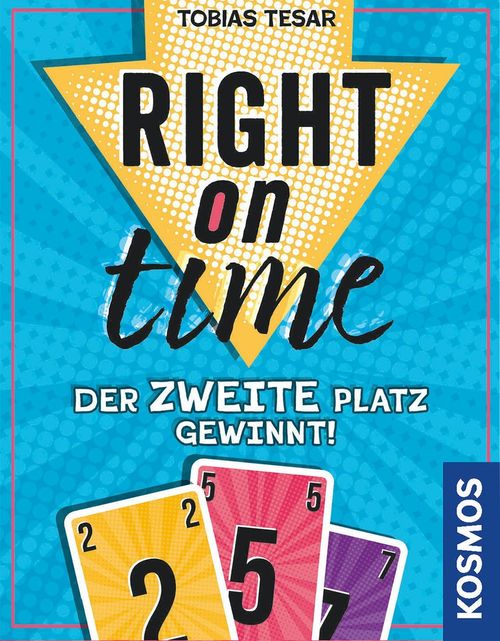
Right on Time
Right on Time Rulebook
Table of Contents
Table of Contents
Game Overview
In Right on Time, you try to get rid of your hand cards as quickly as possible, but not quite! Here the winner is not the first person to lay down all their cards, but the second. Make another person lay down their last card in front of you and you win the round. The first person to win 3 rounds wins the game.
Contents
- Normal number cards ("1" 4x, all other numbers 5x each)
- Special number cards (4x each): Joker, Du bist! ("You are!"), Ziehen! ("Draw!"), Zurück auf Null ("Back to Zero")
- 9 victory points
Course of Play
Right on Time is played over several rounds. In each round, you take turns clockwise and always lay down 1 or 2 hand cards. If you manage to lay down your last card as the second person, you win the round and receive one victory point. If you have won 3 victory points (3 rounds), you win the game.
Setup of a Round
- Shuffle all cards face down.
- Deal 7 cards to each person. Take these cards into your hand and keep them secret from the other players.
- Place the remaining cards as a draw pile where everyone can reach it.
- Keep the victory points ready.
The oldest person starts the round (in the first round only) and makes the first move by placing 1 card of their choice from their hand face up in the middle of the table. Then the turn is over. This card forms the discard pile, onto which you now all take turns placing further cards clockwise.
On your turn, you must lay down either 1 or 2 cards. You have the following options:
- Lay down 1 card that has a higher value than the top card of the discard pile.
- Lay down 2 cards whose values are each lower than or equal to the value of the top card of the discard pile.
- Lay down 1 Zurück auf Null ("Back to Zero") card. This card can be placed on any card.
If you cannot lay down any card(s), you must draw a card (see the section "Unable to lay down cards").
The person who lays down their last hand card as the second person wins the round and receives one victory point. If nobody has 3 victory points yet, you begin a new round.
All further rounds are always opened by the person who won the previous round.
Laying Down Cards
Laying down 1 card
You may lay down 1 card if it shows a higher number than the top card of the discard pile.
Example: pictorial example on the rulebook page (not reproduced).
Laying down 2 cards
You may lay down 2 number cards. Both must each show a number that is lower than or equal to the top card of the discard pile. You may choose the order of the two cards laid down. So you decide which card lies on top of the discard pile at the end of your turn.
Special Cards
Zurück auf Null ("Back to Zero")
The Zurück auf Null card is a special number card. You may lay it on any card, but you always lay it down alone. If it is the top card of the discard pile, it has the value 0. This means that all other cards are higher than the Zurück auf Null card, and only a single card can be laid on it.
Joker
The Joker is a card that can count as any number from 1 to 7. When you lay down a Joker, you say clearly and loudly which number it should count as from now on. Observe the laying-down rules as for all other cards. So you can lay the Joker alone if you play it as a higher number, or together with another card if you play it as a lower or equal number. A Joker can never be laid down alone on a card with value 7, because it cannot be higher than 7.
Du bist! ("You are!") and Ziehen! ("Draw!") cards
Du bist! and Ziehen! cards always have a number value. You lay them down as usual under the laying-down rules for number cards, either alone or together with another card. In addition, they have the following special effects:
Du bist! When you lay down a Du bist! card, you choose a person who must make the next turn, and play continues clockwise from that person. You may not choose yourself. It is allowed to choose the person who would be next to play anyway.
Ziehen! When you lay down a Ziehen! card, you choose a person who must draw a card from the draw pile. You may also choose yourself. Drawing a card does not change the turn order. If you lay down such a card as your last hand card and choose yourself, you are still in the game. However, you may not choose another person who has already laid down all their hand cards.
If you lay down 2 cards and one of them has a special effect (Du bist! or Ziehen!), you carry it out, regardless of the order in which you place the 2 cards on the discard pile.
If you lay down 2 cards with a special effect, you may carry out only one of them. You decide which one.
Unable to Lay Down Cards
If you have only 1 card left in your hand, it may be that you cannot lay it down according to the rules (for example, because it shows a lower number than the top card of the discard pile). In that case you must show the card to the other players. You keep the card, draw another card from the draw pile, and end your turn. So you do not lay down any card(s), even if the drawn card would allow it.
Sometimes you can use this rule tactically. If you are in danger of having to lay down your last card as the first person, a single low number card can "save" you. A Joker can only not be laid down if a card with value 7 is on the discard pile.
End of a Round
A round ends as soon as the second person has no cards left in their hand. This person receives one victory point.
If nobody has 3 victory points yet, you play another round (see "Setup of a Round").
Bonus card for the first person
If you, as the first person, have laid down all your cards, you receive no victory point but a consolation prize: you draw the top card of the draw pile and place it face down in front of you on the table. You may look at this card at any time. In the next round, you may take this card into your hand at any time and, in exchange, place another of your hand cards face down under the draw pile. The bonus card stays in front of you until you decide to take it into your hand. You may also have several bonus cards in front of you.
End of the Game
If at the end of a round a person has 3 victory points, that person wins the game.
Variant: Less Influence of the First Person
In certain game situations (especially in larger groups), the person who lays down their cards first can influence who wins the current round (keyword: "kingmaker effect"). This can be an advantage for making it harder for the player in the lead to win the overall game. If your group does not want this, you can reduce the effect with all or some of these additional rules: If, in your last turn, you play ...
- a Du bist! card, you always choose the person to your left.
- a Joker, it always counts as a 7.
- two number cards, you must place the higher one on top.
Variant: 2-Player Game
You can also play Right on Time with two people using these changes:
- Deal 8 hand cards to each person instead of 7.
- Winning condition: As soon as one person lays down their last card first, the other person has exactly 1 turn left to get rid of all their hand cards too. If they cannot get rid of all their cards in this turn, the first person wins the point. If they manage to get rid of all their cards in this turn as the second person, they win the point. The first person to have 3 victory points wins the game.
- No bonus card: The first person does not receive a bonus card.
- Ziehen! card: Unlike the base game, you may have the other person draw a card even after they have already laid down their last card. They are then back in the game. The next person who lays down their last card then becomes the first person again, and the other person again has exactly 1 turn to lay down all cards.
- Du bist! card: Unlike the base game, you may choose yourself with the Du bist! card and thus be directly up again. This counts as one turn: if you lay down all your cards as the second person in this way, you have won.
All other rules are as in the base game.
Notes on the Translation
- The source is the German Kosmos rulebook. Card names are given in German with an English gloss where the German term is kept in the text (Zurück auf Null, Du bist!, Ziehen!). Joker is the same word in both languages.
- The pictorial examples printed in the German rulebook (the 1-card and 2-card laying-down examples) are images with no text and are not reproduced.