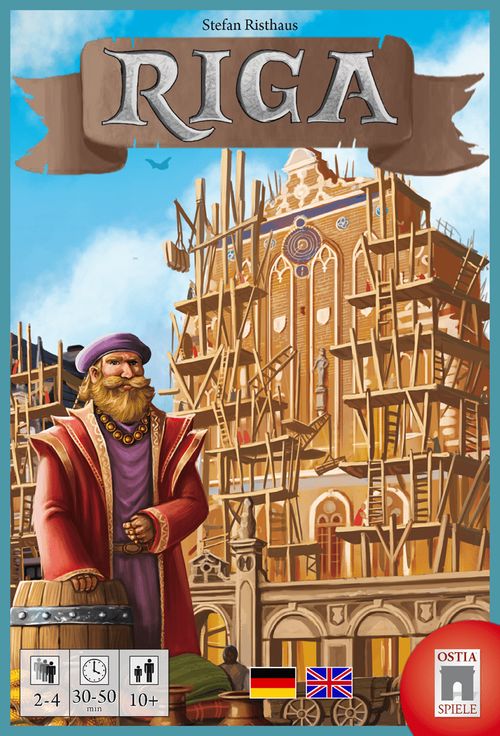
Riga
Riga Rulebook
Table of Contents
Table of Contents
Material
110 cards, consisting of:
- 44 commodity cards (8× Cloths, 10× Glass, 12× Wine, 14× Grain)
- 48 buildings (12 different per city in Visby - Red, Tallinn - Yellow, Stockholm - Blue, Danzig - Green)
- 16 Riga buildings (Brown), 4 different per player
- 1 Starting player card with short rules
- 1 separation card with an arrow
Game Setup
Note: In the first game, remove the Riga buildings from the game. When you use the Riga buildings later, each player takes a set of Kloster, Schule, Speicher, and Wechselstube to their display face-down. Riga buildings are not considered hand cards.
- Separate commodity cards and building cards, shuffle them and create a draw pile for both card types. Leave some space for a discard pile next to each draw pile.
- Determine a preliminary starting player who gets the starting player card. The starting player reveals one commodity card and repeats to add one commodity card until the total value is 6 or more. The other players do the same. The player with the lowest total value decides who will be the definite starting player getting the starting player card. In case of a tie, the preliminary starting player or the next player in clockwise order may decide. Take the revealed commodity cards in front of you to your hand.
- Each player draws 2 building cards. Take one of them to your hand and discard the other one face-down forming a common discard pile.
- Place the separating card near the building draw pile above it.
Gameplay
Riga is played in several rounds called a "year". In a 2- or 4-players game, there are 8 years. When playing with 3 players, the duration is 9 years.
Every year has the following phases (seasons):
- Spring: Supply
- Summer: Conduct one turn each in clockwise order
- Autumn: Conduct one turn each in counter-clockwise order
- Winter: Check hand limit; new starting player
Note: We propose that you separate the top 8 building cards (9 in a 3-players game) from the pile. Each year, draw the first building from the separated pile, and all further ones from the regular draw pile.
In case that you do not have to draw a building, take the top card from the separated pile and place it on top of the regular draw pile. If the separated draw pile is empty, the final round begins.
Spring: Supply
Reveal multiple separate sets of commodity cards on the table by drawing separate commodity cards and laying them out in rows until the overall commodity value of a set is 9 or more Ducats. This finishes a set. Now begin the next set.
Repeat this until you have 2 more sets than the number of players partaking in the game. In a 3-players game, create 5 sets.
If the draw pile is empty, shuffle the discard pile to create a new draw pile and continue drawing. If all sets from the last year remained untouched, the display simply stays unchanged.
If you play with the Riga cards, some sets from the previous year may have a total value lower than 9. Add single cards to those sets to increase their value to 9 or more again.
Now remove A all buildings below the separation card and put them face-down to the discard pile.
Move B the separation card above the remaining buildings and move the complete row of cards downwards (not necessary in the first year).
Reveal C new buildings from the draw pile and place these above the separation card until there are two more buildings than the number of players partaking (player count plus 2).
If the draw pile is empty, shuffle the discard pile to create a new draw pile. In case that the discard pile is empty too, no more buildings will be added to the row (very rare!).
Summer: Turns in clockwise direction
The starting player is the first to take a turn, the other players follow in clockwise order.
Each turn consists of two phases: first A take cards from the supply, then B erect buildings.
In addition, you may use the features of the buildings in your display. For details of the functions of the buildings see below (see Building Features).
A Take cards from the supply
In your turn, you choose to either take one building or a complete set of commodities from the supply to your hand.
Important: You must not pass, you have to take a building or a set of commodities to your hand. You may have any number of cards on your hand now, there is no hand limit at this time.
B Erect building(s)
In the second phase of your turn you may erect up to 3 buildings from your hand. You may also decide to erect no building.
To erect a building, you have to pay the costs depicted in the upper left corner of the building card.
There is no cash in the game. You pay the costs by discarding commodity cards and use benefits from features of the buildings in your display (see Building Features).
The value of commodities vary depending from the city (color of the name scroll). The exact value valid for erecting the building for each of the commodities is printed on the building card itself.
Note that there's always one commodity that cannot be used (marked "–") and another commodity that has a value higher than the regular value printed on the commodity card (highlighted red).
Place the building card in your display and discard the commodity cards used for payment. If the commodity cards have a higher total value than necessary, the rest is forfeited (no change).
Example: If you want to erect the "Markthalle" in Danzig, the costs are 8 Ducats. If you discard 2 cloths cards worth a total of 10 Ducats, the surplus 2 Ducats are lost.
Usually you erect buildings one by one separately. You cannot save Ducats paid but not needed for one building for payment of another building.
Only if you erect buildings of the same city at the same time, you may total the costs of these buildings and discard commodities to pay the total sum. This way you can avoid wasting money.
Example: You want to erect the "Archiv" and the "Schatzkammer" in Visby (a total of 16 Ducats). You pay the exact total with 2 Wine (5 Ducats each in Visby), 1 Grain (2 Ducats), and 1 Glass (4 Ducats).
When playing with the Riga buildings, you can erect those buildings the same way by paying the costs with commodities. Flip the Riga building to the face-up side. Note that you may only erect 3 buildings in total (including Riga and other buildings) per turn.
Autumn: Turns in counter-clockwise direction
Starting with the player to the right of the starting player, conduct a second turn in counter-clockwise order. The turns are conducted the same way as described in Summer.
As a result, the player to the right of the starting player has two turns in a row.
Winter: Check hand limit; new starting player
If you have more than 6 cards in your hand at this time (commodities plus buildings), discard cards of your choice until you have at most 6 cards left. Only cards in your hand count. Do not consider erected buildings in the display nor unerected Riga buildings.
Move the starting player card to the player left to the current starting player, making them the new starting player. If the game end is not yet triggered, the next year is started with the Spring phase.
End of Game
The game ends after 8 years (with 3 players after 9 years).
Total the victory points of the buildings you have erected (depicted in the seal) and subtract 2 points for each building in your hand (that you have not built).
Subtract 2 points for each Riga building you did not erect during the game.
The player with the most victory points wins. In case of a tie the player with most money wins. Money is the total amount of the regular value of your hand commodities and the unused benefits of the buildings in your display. In case of another tie, there are multiple winners.
Building Features
You may not use the functions and benefits of a building in the same turn you erected the building (this also applies to Merchants and Knights). Therefore, the player to the right of the starting player must separate his two subsequent turns carefully. Functions and benefits may be used at any time during your turn.
You may combine the effects of several of your buildings. For example, you may reduce the costs to erect a building to the half using the Kran (Crane) and pay the costs with money from the Wirtshaus (Tavern).
Some buildings have features that may only be used once. If you use this feature, cover the left half of this building with another building to show that this feature is no longer available. If you do not have another building erected yet to cover the exhausted feature, take a building from the draw pile and place it facedown on your building. As soon as you erect another building use this new building for covering the exhausted function of your first building and remove the facedown building back to the buildings draw pile.
Details about the buildings (each is available once per city):
- Archiv (Archives): During final scoring, you gain 2 victory points per set of one Merchant and one Knight to the maximum of three sets (6 points). If you have 5 Knights and 2 Merchants, each of your Archiv buildings brings 4 points.
- Bank (Bank): You have 2 Ducats per Merchant in your display for building. Keep the Merchants.
- Bauhof (Building Yard): Draw 5 building cards from the pile. You may choose to take one of these buildings to your hand. Put the other buildings facedown to the discard pile. If the pile consists of less than 5 cards, draw all cards.
- Festung (Fortress): You have 2 Knights.
- Gildenhaus (Guild Hall): You have 2 Merchants.
- Kontor (Branch Office): You have 4 Ducats for building. You have 1 Merchant.
- Kran (Crane): Halve the costs for any one building. For each single building, you may only use one Kran. If you erect more than one building at a time, you may use one Kran each for any one of these buildings.
- Loge (Secret Society): Gain victory points at final scoring depending on the number of Loge buildings you have erected. For example, you gain 19 points for 3 Loge buildings in total (not 3× 19 points!).
- Manufactur (Manufactory): For each discarded commodity card of the depicted type you get 1 Ducat more than the value printed on the building card. However, you still cannot use this commodity in cities where this type is not wanted (marked "–"). You have 1 Knight.
- Markthalle (Market Hall): You may use the specific type of commodity to pay the costs, although the value of this commodity is marked "–" on the building card. Together with a corresponding Manufactur, you can even sell for a higher price. You have 1 Merchant.
- Schatzkammer (Treasury): Draw 3 commodity cards from the pile and choose one of these to your hand. Discard the other 2 cards. You have 1 Knight.
- Wirtshaus (Tavern): You have 2 Ducats per Knight in your display for building. Keep the Knights.
The Riga buildings
- Kloster (Monastery): exchange two commodity cards from sets in the common supply before taking one of these sets to your hand in the first phase of your turn.
- Schule (School): Choose how to rotate the Schule when erecting it. You must not rotate the card later in the game. You now have either 1 Merchant or 1 Knight. Cover the left side.
- Speicher (Storehouse): You may keep 8 cards in Winter instead of 6.
- Wechselstube (Exchange Office): Lay out the building with the 0 to the right and cover the left half of the building. At the end of a turn, you may discard commodities with a regular value of 6 or more to turn the Wechselstube by 180 degrees to show 8 Ducats on the right. During a later turn, you can rotate the building back to 0 to have 8 Ducats for building. You may turn the card to 8 Ducats again in that same turn by discarding commodities with a value of 6 or more.
Also Available
›Blind Hen‹
Each player tries to collect chicken cards with the most points. As if it were not difficult enough to collect the bustling chickens, Blind Hens are sneaking among them causing trouble. But even a Blind Hen "sometimes finds a grain of corn" (German saying).
Imprint
Author: Stefan Risthaus Rulebook Layout: Stefan Malz Graphics: Fiore GmbH Art. No.: OST-RI-01
Author and publisher want to thank all playtesters and rule readers, especially Heike Risthaus, Volker Wichert, Sonja & Christian Heider, Thorsten Walter, Wilfried & Malte Meinecke, Heike & Andrea, Stefan Malz, Uwe Hilgert, and the Salzgitter gaming group.
Copyright © 2017 OSTIA-Spiele GbR Heike Risthaus and Malte Meinecke Hauptstraße 29, 38268 Lengede www.ostia-spiele.de