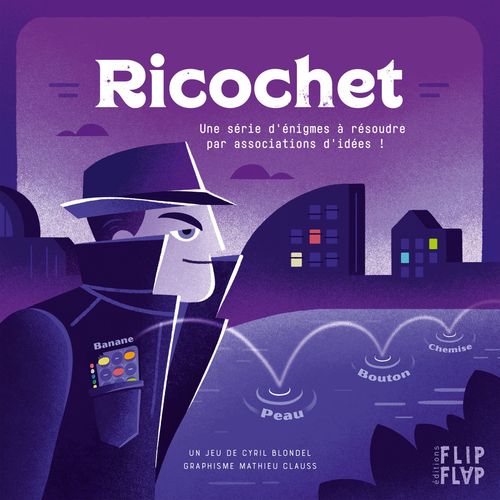
Ricochet: À la poursuite du Comte courant
Ricochet: À la poursuite du Comte courant Rulebook
Table of Contents
Table of Contents
Overview
A game by Cyril Blondel.
1 player and up. Ages 14 and up.
Ricochet is a solo or cooperative game of deduction and word association. 30 riddles to solve will plunge you into the zany story of a team of secret agents.
Components
- 15 boards (each face presents one riddle)
- 20 numbered pebbles
- 2 white pebbles
How to Start
Take riddle #1 out of the box, and follow the procedure of the demonstration grid presented below (different from the one you have in hand):
- Read the instructions first, specific to the riddle.
- Then read the hint, if there is one.
- Read the dialogue. The last sentence of it has disappeared! Your mission: find the last sentence of the dialogue!
- Prepare your pebbles to play them in the order indicated. Sometimes, certain pebbles are not played. When that is the case, the instructions say so.
To find the last sentence of the dialogue, look carefully at the clues given to you to get started:
- You are looking here for a rebus made of 3 words! Some riddles offer rebuses of 4 or 5 words. (Example: Rebus of 3 words.)
- Two starting words are given to start your ricochets! Sometimes a riddle offers a different starting point (a single word, a question, etc.). (Example: Start: Job - Paris)
With all this information, then look at the 25 words offered. To find the final rebus, you must cover 22 words using your pebbles. That will leave 3 words visible. Reading these words OUT LOUD, IN THE RIGHT ORDER, creates an AUDITORY rebus that gives you the last sentence of the dialogue!
How to Ricochet
To cover the words, you must make ricochets, that is, go from one word to another by association of ideas!
How do you ricochet?
Each of the starting words must make you think of a word in the grid. In the example below, "Job" must make you think of one word, and "Paris" of another word. The links between the words are strong and obvious: synonym, opposite, compound word, category, component, common or literary expression, title of a work (book, song, film...), etc. (Conjugation and plurals can also help you from time to time.)
The only rule to respect to validate the choice of your ricochets: the two words considered MUST BE ALIGNED (same row or same column)!
When you think you have found them, place the two pebbles above each word:
Example: "Job" makes you think of "Cook." "Paris" makes you think of "France." The hypothesis is possible because both words are in the same column.
Next, each word #1 must make you think of another word. The two new words #2 must also be aligned.
Example: "Cook" makes you think of "Restaurant." "France" makes you think of "Europe."
Once you have placed pebbles #2, you can then move pebbles #1 down to cover the words.
Then, the two words #2 must make you think of two new aligned words, which you mark with your pebbles #3, and so on until the white pebbles!
The White Pebbles
The last pebbles of the path, the word (or sometimes just one) gives you a CLUE (context, rebus, comment...) to solve the final auditory rebus.
If you are unsure about a word, use the pebble's face with a question mark to flag a hypothesis.
Completing the Grid
Once you have filled the whole grid with pebbles, some words remain uncovered.
Worked example: The two white pebbles point to the words "Before - Play." That is the clue for solving the final rebus. The three remaining words are "Eagle - Bacon - Read." Read out loud in the right order: "Read Bacon Eagle" = "Read the rule[book]!" (a spoken pun: in French, Lire Lard Aigle sounds like Lire la règle, "read the rulebook").
End of a Riddle
If the rebus gives a sentence that, in connection with the clue, makes sense with the dialogue, then congratulations, you have solved the riddle! You can then move on to the next one (on the back, then on the next board) and continue the story.
Conversely, if you cannot find a sentence that makes sense, you will need to go back (to your question-mark pebbles) or start again from the beginning.
Finally, if your patience is being sorely tested, if you are on the edge of a nervous breakdown, if the game is about to go flying out the window... you can consult the solutions.
The Solutions
We decided to trust you to solve the riddles yourselves. The solutions are therefore not found in this box, but only on the website: www.flipflapeditions.fr
By going to the Ricochet game page and the adventure in question, you will find the answers for each riddle, pebble by pebble. By clicking on the number of the riddle you want, the answers appear in two columns.
Once you have found your mistake, you can finish the riddle yourself.
In all cases, the final rebus is never given in the answers, so that you get the pleasure of solving it using the clues. If you still cannot find it, you have one option left: phone a friend! To do this, send a message (indicating the name of the adventure and the number of the riddle) to: [email protected]
Tips
- Check all the words in the grid carefully before making your choices, in order to weigh up all the possible hypotheses.
- There are no puns or rebuses along the way, only for the white pebbles and the final rebus.
- Read the ending rebuses and the clues out loud carefully.
- The difficulty of the grids increases with the use of symbolic links, cultural references, tricks, etc... but the links between words are always strong and obvious.
- Do not hesitate to use a search engine, typing in the two words you are puzzling over, to see if a connection reveals itself (the site www.cnrtl.fr can also be useful to you).
- You can time yourselves and note the time spent on each solve. When you redo the riddles in a few months, you will be able to compare!
For our French-speaking friends (Benelux, Quebec...): in the answers, words drawn from very (too) French references or expressions are marked with an asterisk ().*
Thanks
Thanks to Amandine Sauzedde, Claude Clément, and Camille Blondel for all the testing; to Max Valentin for the deep inspiration; to Alexandre Astier for the love of dialogue.