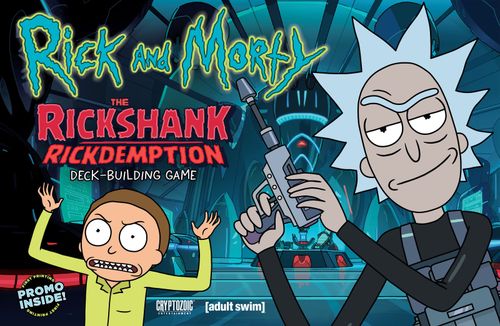
Rick and Morty: The Rickshank Rickdemption Deck-Building Game
Rick and Morty: The Rickshank Rickdemption Deck-Building Game Rulebook
Table of Contents
Table of Contents
Overview
While you begin with only your Genius Waves, as the game progresses, you will add new, more powerful cards to your deck, with the goal of defeating as many Nemesis cards as you can. In the end, the player who has accumulated the most Victory Points from the cards in their deck wins the game.
Contents
- 192 Game Cards
- 35 Genius Waves Starter Cards
- 15 Worthless Starter Cards (Jerry, Beth, and Summer)
- 84 Main Deck Cards
- 16 Portal Gun Cards
- 7 Nemesis Cards
- 20 Morty Waves Cards
- 15 Location Cards
- 9 Access Tokens
- 1 Location Deck Token
- 6 Oversized Characters (plus one updated Crazy Rick from the original game)
Types of Cards
The different card types that you can play are Starter, Rick, Morty, Special, Gromflamite, Council, Location, and Equipment. Morty Waves have no card type.
Setup for Your First Game
1. Oversized Characters and Starting Decks
Each player is dealt a random oversized Character card. Alternately, each player may choose one or deal two to each player and they choose one of those two.
Each player begins with a starting deck of seven Genius Waves cards, one Jerry, one Beth, and one Summer. You will use your Genius Waves cards to buy more powerful cards to add to your deck, improving it as the game goes on. The other three members of the Smith Family that you start with don't do anything for you when played. However, there are some cards and Locations that will reward you handsomely for playing a card as terrible as Jerry. If you don't have any of these cards or Locations, then Jerry, Beth, and Summer cards are good ones to destroy. More on how to do that later.
2. The Main Deck
Most of the cards that you will add to your deck as the game progresses come from the main deck. Shuffle the main deck and place it in the middle of the table. The main deck is made up of Rick, Morty, Special, Gromflamite, Council, and Equipment cards (84 cards total).
3. Mixing with Close Rick-Counters of the Rick Kind
Shuffle both main decks together to make one giant deck!
Shuffle all of the Locations together to make one large stack. Use the whole stack for both games. Also, use the Access Token pool for all mixed games.
4. The Nemesis Stack
There are seven different cards that go into the Nemesis stack each game. All seven will be used each game. Cornvelious Daniel will always be the top card of the stack, while Galactic Federation President (with the blue back) will always be the last card of the stack.
Set Cornvelious Daniel and Galactic Federation President aside and shuffle the five Seal Team Ricks Nemesis cards face down. Place Galactic Federation President face down to start the stack. Place the now-shuffled five Nemesis cards face down on top of him. Finally, place Cornvelious Daniel face up on top of the stack.
Note: All cards in this stack are considered "Council of Ricks" for the purposes of cards that reference the stack.
(When mixing with Close Rick-Counters of the Rick Kind: grab both final Nemeses, secretly choose one of them at random, and place it face down. Grab both starting Nemeses, choose one of them at random, and place it face up off to the side for a moment. Shuffle the remaining 10 Nemeses/Council of Ricks, randomly choose five of them, and place them face down on top of the last Nemesis card. Lastly, place the chosen starting card on top of the stack. The stack should have a total of seven cards in it. Place the unused Nemeses back in the box without looking at them.)
5. The Location Deck
Shuffle the Location deck and place the Location deck Token on top of it. This will prevent players from mistaking it for the main deck or their own deck. The face-up Location discard pile sits next to the Location stack.
6. Access Tokens Pool
Grab the nine Access Tokens and place them in a pool near the stacks or the Line-Up. Make only one pool, so everyone can easily see how many are in the pool. In the episode, Level 9 Access is what Rick needs to change the Galactic currency from being worth 1 of itself to 0 of itself. In this game, you can buy and gain Access Tokens for fun and profit. They have a cost of 2, and you may not buy more than one per turn. More on these later.
7. The Line-Up
After shuffling the main deck, place the top five cards from the main deck into the Line-Up. There is no board necessary to play this game; just reserve space for each card.
Next, place the Portal Gun, Nemesis, and Morty Waves stacks at the end of the Line-Up. Place the shuffled Location deck (with token on it) on one end of the stacks. Portal Guns and Nemesis cards are always available to be bought or defeated during your turn (while cards remain in their stacks). Morty Waves are never bought; they are gained only through unfriendly card effects. The main deck and the four stacks of cards on the end are not part of the Line-Up.
Once you have arranged the main deck, the Line-Up, and the other stacks, your opening five cards in the Line-Up will vary.
Gameplay
Randomly determine a player to go first. Each player begins by shuffling their deck and drawing five cards. Players take turns in clockwise order. You take your turn by playing cards from your hand face up for all players to see. This generates Power (the "currency" of the game) and other effects.
Each turn, you may buy cards from the Line-Up, from the Portal Gun stack, and/or buy the top card of the Nemesis stack to improve your deck. Cards you buy or gain are always immediately placed into your discard pile unless you are instructed otherwise. Discard piles are always face up. Soon they'll be shuffled into your deck, and then you'll be drawing these newer, more powerful cards into your hand so you can play them. Buying powerful cards builds up the effectiveness of your deck. That's why it's called a "deck-building game"!
You can buy any number of available cards with combined cost less than or equal to the amount of Power you have for the turn. For example, your Genius Waves each give you +1 Power. If you draw four of them and no other cards with any Power bonuses, your total Power for the turn is 4. You can buy a single card with cost 2, 3, or 4, or even two cards each with cost 2, assuming these options are available. Portal Gun cards are (usually) available if the cards in the Line-Up are too expensive, and you may buy more than one during your turn if you wish. You may simply end your turn if you cannot buy or do not wish to buy any cards.
Jerry, Beth, Summer, and Morty Waves provide no Power. Since they weaken your draws and deck, you may want to try to destroy them as soon as possible. You may play them if you wish, but they have no effect when played. They are not discarded until the end of your turn when you discard all cards you have played and any cards that you have kept in your hand. However, there are cards you can buy that will make playing them worthwhile.
Order of Playing Your Cards
On your turn, you get to play the cards in your hand in the order of your choice. When you play a card, its game text resolves immediately. When you have played all the cards you wish to play at that time, total up the Power you have accumulated and buy what you wish to buy from the Line-Up or the face-up stacks. You do not have to play all of the cards in your hand before you start making purchases if you don't wish to. You may play additional cards even after making purchases.
Turn Sequence
- Play cards from your hand.
- Total up your Power and purchase cards with combined cost less than or equal to that total. You may play additional cards even after making purchases.
- As soon as you buy or gain a card, place it into your discard pile, unless instructed otherwise.
Access Tokens in the pool have cost 2, and you may only buy one per turn.
Ending Your Turn
- Announce that you are ending your turn. Your turn is now over.
- Place any cards remaining in your hand into your discard pile.
- Resolve any "at the end of your turn" effects.
- Place all the cards you played into your discard pile. Any unspent Power is lost.
- Draw five cards from your deck.
- Fill each empty slot in the Line-Up with a card from the top of the main deck.
- If the top card of the Nemesis stack is face down, flip it face up and read aloud the next Group Attack.
- The next player starts their turn.
Do not shuffle your discard pile and make it your new deck just because you have no cards in your deck. Wait until you must draw, discard, or reveal a card from your deck. Then shuffle your discard pile, and it becomes your new deck.
Sample Turn Sequence
After shuffling up your starting cards, you draw a hand of four Genius Waves and one Jerry for your first turn. You may play the four Genius Waves for a total of 4 Power, which is enough to buy Daddy's Little Girl from the Line-Up. After buying it, you put it into your discard pile. Jerry provides you with NOTHING, per usual.
End of Game
The game ends immediately when either of the following two conditions is met:
- Galactic Federation President is defeated.
- You are unable to refill all five slots of the Line-Up.
Return all Ongoing cards you have in play, all cards in your hand, and all cards in your discard pile to your deck. Then, players total up the Victory Points cards in their deck. Morty Waves that are not paired up with Genius Waves will reduce your total score.
The player with the highest Victory Point (VP) total is crowned the winner! In case of a tie, the tied player with more Nemesis cards wins. If there is still a tie, the tied player with the greater number of cards in their deck wins.
Additional Rules
Oversized Characters
Your Character gives you an ability that you may choose to use during your turn. If a Character has two abilities on their card, both of them may trigger on the same turn. An oversized Rick is not a "Rick card" and an oversized Morty is not a "Morty card," so if you play a card that counts card types or even the number of Ricks you have played, your oversized Rick does not contribute to that in any way.
Attacks and Defenses
Some cards allow you to make an Attack against the other players in the game. When you play a card with an Attack ability, each affected player has an opportunity to avoid the Attack with a card that has a Defense ability. A player using a Defense card's ability negates the Attack only for that defending player. A player may only utilize one Defense card per Attack. If a player doesn't avoid the Attack, they are immediately affected by the Attack card's ability. However, if the Attack requires interaction among the players (like passing cards), the Attack won't resolve against any players until each player has had a chance to avoid it. Avoiding an Attack does not negate any other abilities (like +2 Power) of a card, unless an ability specifically counts the number of players successfully hit by the Attack.
The Nemesis Stack
On each Seal Team Ricks Nemesis card, you will find a Group Attack. When revealed on the Nemesis stack, the Group Attack resolves immediately against each player in the game. Each player with a Defense card may defend against the Attack. The Attack will resolve against any players who do not defend themselves. These Attacks do not happen during any player's turn.
When you have accumulated enough Power in a turn, you can choose to defeat a card in this stack. If you defeat (buy) a card on this stack, take the topmost face-up card from the stack and place it into your discard pile, unless instructed otherwise. The next card in the stack remains face down until your turn is over, so a player may defeat only one of these cards per turn. Nemesis cards range in cost from 8 to 14, and the middle five cards of the stack are randomized at the start of each game, so check the stack for the current Nemesis card's cost.
Nemesis Cards in Your Deck
Like any other card you acquire, a Nemesis card will aid you in your future turns. When you play a Nemesis card from your hand, the text at the top of the text box is the relevant text. The Group Attack is no longer applicable, as the card already made that Attack when it was first revealed on the stack.
Nemesis is not a card type. It's a sub-type that the "bosses" have. They have a card type such as Gromflamite or Rick, just like any other card. For example, if you play Cornvelious Daniel, you are playing a single card type: Gromflamite.
Morty Waves
Some cards force players to gain a Morty Waves. If this happens, the card is typically placed in that player's discard pile, effectively adding it to their deck. Morty Waves have no ability when drawn or played during the game and can be played or kept in your hand and discarded at the end of your turn.
At the end of the game, each Morty Waves in your deck subtracts 1 Victory Point from your VP total, so you'll need a plan for destroying them at some point! However, you can pair up a Morty Waves with a Genius Waves (if you still have any) to negate the -1 VP. Each of your Morty Waves needs to pair up with a separate Genius Waves to achieve this benefit. Each Morty Waves that has no partner Genius Waves will still reduce your score by 1 VP.
If the Morty Waves deck runs out, effects that would cause a player to gain a Morty Waves card do not do so, but any other effects those cards have still resolve as usual. A player may still play a Defense to avoid an Attack, even when there are no Morty Waves available to be gained.
Shuffling Your Deck
You don't shuffle your discard pile and make it your deck as soon as you run out of cards. However, at any point during the game if there are no cards in your deck and you need to draw, discard, or reveal a card from your deck, immediately shuffle your discard pile, and it becomes your new deck.
Discarding Cards
When a card tells you to "discard" a card, it means from your hand as the default. However, a card may tell you to discard a card from another place, such as the top of your deck or from in play. Cards discarded in this way count as being "discarded."
Ongoing
When you buy or gain a card with Ongoing, it goes to your discard pile just like any other card. However, when you later draw and play an Ongoing card, it will remain in play in front of you for the rest of the game, or until a card effect causes you to lose it from in play.
An Ongoing card in front of you (that you control) counts as "in play," just like any card you played during your turn. It counts as "played" only on the turn in which it entered play. Cards in the Line-Up or that a foe controls are never "in play" for you to take advantage of, though some cards will allow you to affect foes' cards in play. Ongoing cards give you special abilities turn after turn while they remain in play.
Stack Ongoing
This ability is found only on Galactic Federation President. While he is the top card of the Nemesis stack, this ability is active. It remains active until he is defeated (bought) by a player to end the game.
The Location Deck
This randomized deck features Locations that were featured in "The Rickshank Rickdemption." The easiest way to access the Location deck is to buy a Portal Gun. Each time you play a Portal Gun, you may discard a card of your choosing from your hand. If you do, flip the top card of the Location deck face up and place it in front of you. You get to take advantage of the card text on that Location this turn. You may even choose to buy the card at any point during your turn before or after using it. If you buy the card, it immediately goes to your discard pile like any other card you would buy. If you do not wish to buy it or can't afford it, it still remains in play until the end of your turn.
At end of turn, discard all Locations that were played via Portal Gun or other temporary means to the Location discard pile next to the Location stack. If you buy a Location played via Portal Gun, it goes to your discard pile as usual. If the deck runs out, shuffle the discard pile to create a new Location deck. If all Locations have been purchased, an effect that plays any cards from the Location deck will fail to play a Location.
Destroying Cards
Some cards have abilities that allows you to destroy a card from your hand, your deck, or even the Line-Up. When you destroy a card, place it into a face-up pile of destroyed cards anywhere away from the play area, removing it from your deck and the game. You often get to choose which of your cards to destroy. If Morty Waves and Portal Guns are destroyed, they do not go back to their respective stacks.
Gaining Cards
When a card tells a player to gain a particular card or a card of their choice, that card is taken and immediately placed in that player's discard pile at no additional cost, unless otherwise directed by the card. If a card tells to you gain a card with a specific name, card type, or cost and there are none available, you simply don't gain the card.
Resolving Card Abilities
If a card's ability affects multiple players, and the order matters (for example, an Attack that has all three opponents gain a Morty Waves, with only two Morty Waves remaining in the stacks), resolve that ability for each affected player in clockwise order, starting from the player who played the ability.
When you play a card that triggers another effect, like on your oversized Character or a Location you control, fully resolve the card you are playing before resolving any secondary effects triggered by your card play.
Own vs. Control
You control cards that you have played and are in play or that are in front of you on an Ongoing basis. You do not control cards in your hand, deck, or discard pile.
You own cards that come from your deck, whether they are in play, being played, or in your hand, deck, or discard pile. You may both own and control the same card at the same time.
Card Types
There are eight different playable card types in the game: Rick, Morty, Equipment, Gromflamite, Council, Special, Starter, and Location. Morty Waves have no card type. A "Morty" card is a brownish card with the card type Morty on its "card type bar" in the middle of the card, just under the art.
Zones
Zones are areas in the game: in play, a player's deck, a player's hand, a player's discard pile, the main deck, the Location deck, the destroyed pile, and the Line-Up.
Access Tokens
Access Tokens are a finite resource that you can acquire in a few ways. The easiest is to buy one during your turn. They each cost 2. You may only buy one per turn, but you can gain any number of them through various card effects. If all nine are owned by players, you cannot buy or gain any. Access Tokens do nothing on their own, but lots of cards reference them.
Some cards give you tasty bonuses just for having Access Tokens. Don't get too attached to your Access Tokens, however. You will lose/spend them on a variety of things. Some cards give you the option to discard an Access Token you own for an extra benefit. That means putting it back into the pool from your personal supply. If a card utilizes Access Tokens, it will say so on the card. Some Attacks might make you discard an Access Token. But Voting on Council cards is where you will probably spend most of your Access Tokens.
Council Cards
When you play a Council card, read the Bid/Referendum/Sanction (hereafter referred to as a Vote) text out loud, as it affects all players. Each player has one inherent Vote, just for being a player in the game. Each player will need to secretly decide if they want (potentially) to spend some of their Access Tokens to add to their Vote count. Each Access Token you choose to Vote with counts as 1 Vote. Each time a Vote takes place, each player must Vote.
After Access Token Votes have been added to your inherent Vote, you may reveal any number of Council cards from your hand. Each Council card revealed from your hand counts as 1 Vote. There is an image on Council cards to remind you of this ability. Note that the Council card the active player is resolving is not in their hand, so it does not grant them an extra Vote.
If you are on the winning side of a Vote, discard all Access Tokens you used to Vote and Council cards you revealed from your hand. If you are on the losing side, you retain your Access Tokens and any Council cards you revealed are returned to your hand.
There are three different types of Votes. Be sure all players understand the differences prior to Voting.
Bid: You are Voting on a bonus for yourself. Each player holds 0-9 of their Access Tokens in their hand. When everyone is ready, all players reveal any Access Tokens in their Voting hand simultaneously. Players may now add Council cards to their Vote count. The player with the most Votes gains the reward.
Referendum: You are Voting on whether or not to do the listed effect (affects all players). Each player holds 0-9 of their Access Tokens in one hand. On a count of "1-2-3!" each player uses that hand to Vote. Thumbs up for "Yea" and thumbs down for "Nay." Reveal any Access Tokens in your Voting hand, and then you may add Council cards to your Vote count. If the Yeas have more Votes, perform the action. If the Nays have more Votes, nothing happens.
Sanction: You are Voting on who gets punished. Each player holds 0-9 of their Access Tokens in one hand. On a count of "1-2-3!" each player uses that hand to point at a player. You may even point at yourself. Reveal any Access Tokens in your Voting hand, and then you may add Council cards to your Vote count. The player with the most Votes pointing at them performs the listed action.
Rules on Voting
- Each player, no matter what Character they are playing, has 1 inherent Vote.
- If a Vote would result in no action, you may skip that Vote. For example, if there are no 0 cost cards in the destroyed pile, you should not resolve the Recycle Sanction.
- Players must divulge the number of Access Tokens they own upon request (and can't lie).
- Players who own Access Tokens need not spend them on a Vote.
- When you Vote, you do not have to spend all of your Access Tokens.
- Place the Access Tokens you don't wish to use on your lap or in your non-Voting hand to conceal the fact that you didn't put them into your Voting hand.
- You cannot add additional Access Tokens to your Vote after they have been revealed.
- Players may reveal any number of Council cards as Votes at any time during a Vote resolution. You may continue to reveal cards if your Vote count is overcome.
- If there is a tie, the person who played the Council card being resolved breaks the tie.
Voting Example
Kristin plays a Rezone Council card. Its Referendum text will force each player to discard an Ongoing card if it passes. Each player grabs the Access Tokens they wish to Vote with (and hides the rest), then makes a count of "1-2-3!" Mike and Andrea Vote thumbs down. Kristin Votes thumbs up. Each reveals their hand with Access Tokens. The Vote is currently 2-2, as Kristin Voted with 1 Access Token (1 inherent Vote plus 1 Access Token equals 2 Votes), while Mike and Andrea Voted with no Access Tokens. However, each of their inherent Votes were still added together for the "Nay" option.
Andrea reveals a Council card, making the Vote 3-2 in favor of "Nay." Kristin reveals a Council card of her own. Mike and Andrea both decide against revealing more Council cards, so the Vote stands at 3-3, but since Kristin played the Rezone card, she breaks the tie in her favor. Kristin discards the Council card she revealed and discards the Access Token she bid with. Andrea's revealed Council card returns to her hand. Each player will now have to discard an Ongoing card they own in play.
Specific Card Clarifications
Security Specialist Rick, The Dinner Table: This card must be in play for the Defense to work. You cannot use it from your hand. You may only discard this card when defending against an Attack.
Aqua Morty, Aqua Rick: Holding this in your hand to discard it at end of turn won't work, as it is no longer your turn at that point. Discarding one of these to a Group Attack also doesn't trigger the ability, as those don't happen during a player's turn.
Space Prison: This card stalls the acquisition of new Ricks bought by foes for a little while. If players are having trouble remembering who owns a Rick, try putting him under this card so that the card is oriented towards the owner. If this card leaves play, the owner of the currently imprisoned Rick gains their card.
Big-Head Morty, Communications Gromflamite: You may discard only one Access Token each time you play this card.
Bugged-Out Morty: If you avoid a Group Attack, you don't give a card to anyone.
Szechuan Sauce: Get it before it's ... wait, already too late. When this hits the Line-Up, if you don't buy or gain it, it will destroy itself at the end of that very turn. Act fast!
Cornrow Rick, Rick D-99: If you have an Access Token or a Gromflamite/Rick, you lose one of them. If you have neither, you are unaffected.
Eye-Poppin' Morty: The first line of text is mandatory if you play it. After destroying a card in your hand (this card is no longer in your hand when played), you must decide whether or not to destroy this card. This card allows itself to be destroyed as a cost when played, so you do not need an outside effect to destroy this card.
Fake Gun: Note the negative VP value. When you buy this, you immediately get rid of it. The person you give it to is not considered to be "gaining" the card. When the new owner plays it, they choose a foe and Attack so they can try to get rid of it.
Future Rick: If you use a Location you played via Portal Gun, then buy it, and put it back into play with Future Rick, you may use it again.
The Brainalyzer 9000: If you play an Ongoing card this way, you get to keep it and will score it at the end of the game. If it leaves play due to a card effect, return it to the top of the former owner's deck.
Galactic Federation President (GFP): The top line of his text box is used only if Evil Morty from the original game is mixed in with this game. If you wish to try to defeat him, you must discard an Access Token at the start of your turn. You can't use any Ongoing or Character abilities before deciding.
The Drive-Thru: If you play this card via a Portal Gun or similar effect, you won't be able to use it. You must have it in play at the start of your turn to be able to use it. It's the best way to get your hands on some of that Sauce!
Greedy Gromflamite: The discard effect may be used multiple times during your turn, and not just at the moment you play him.
Moron Morty: If you buy or gain a Morty with cost 3 or less, you may immediately put it on top of your deck when you resolve this ability. A "Morty" is a brown card, not a card with Morty in its name.
Rick D-99: Remember that members of Seal Team Ricks are Rick cards.