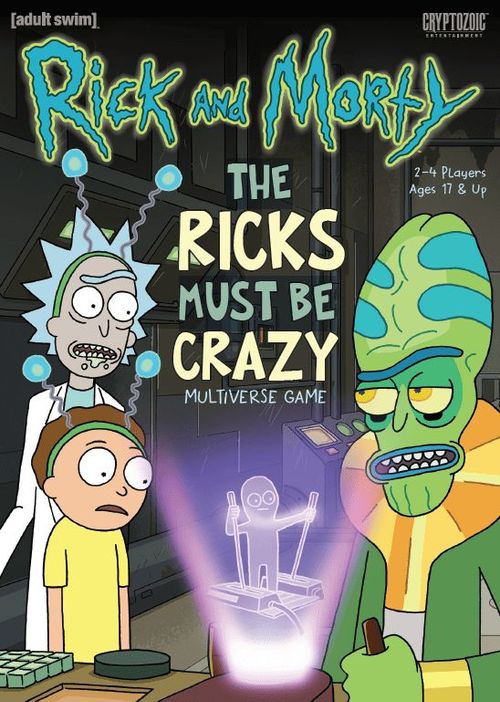
Rick and Morty: The Ricks Must Be Crazy Multiverse Game
Rick and Morty: The Ricks Must Be Crazy Multiverse Game Rulebook
Table of Contents
Table of Contents
Game Components
- 60 game cards
- 4 large universe cards
- 4 large character cards
- 4 character tokens (with stands)
- 1 first player token
- 1 energy and VP (victory point) tracker
- 5 action tokens
- 32 implementation/control tokens (8 per player)
- 4 VP tokens
- 1 energy token
Object of the Game
Score the most victory points (VP) by producing (or stealing!) energy and activating your inventions. The number of VP needed to end the game depends on the number of players:
| Players | 2 | 3 | 4 |
|---|---|---|---|
| VP | 50 | 40 | 30 |
Setup
First choose a character, take its card, its token with stand, and implementation/control tokens. Put all of this in front of you.
Easier play: to make the game easier, flip the character cards to the side without the ability and play as if that ability did not and never did exist.
If you play with character abilities, read your ability aloud: all players must know whom they are playing against.
Then put all VP tokens on the tracker with the character side up, and the energy token with the side without "+30" up, on the space marked 0 of the energy and VP tracker.
Then place the large universe cards in the centre of the table in the following order from top to bottom: "Rickiverse" (Rick-universe) - "Microverse" - "Mini-verse" - "Tiny-verse" (Crohoverse). Leave about 10 cm of free space between them so that cards can be played there. Read aloud the properties of the universe cards and refer to the clarifications on p. 17 if anything is unclear.
After that each player puts his character token on the "Tiny-verse" card: the game begins in this universe.
Shuffle the game cards, form a deck and put it face down on the table. Then deal 5 cards to each player's hand.
During the game you may have more cards in hand. There is no hand limit, so you may hold an unlimited number of cards.
The player with the lowest mobile phone battery charge takes the first player token and 5 action tokens. Why exactly 5? Because you all start your journey in the Tiny-verse, and its card shows a gear with "+5".
Symbols
Action symbol - a gear. A number without "+" inside the action symbol on a card means that implementing this card takes that many actions. For example, implementing a card with a symbol showing 3 takes 3 actions.
On universe cards the number in the action symbol has a "+": this means that at the start of your turn you receive as many action tokens as is indicated in the action symbol on that card. They are needed to mark how many actions you receive and spend during your turn.
Important: you can increase the number of actions available to you (see p. 17). That is, the tokens you receive do not necessarily limit your available actions.
Energy symbol - a green swirl. Energy sources produce energy, and all other cards consume it. A number without "+" inside the energy symbol means that you must pay that much energy to activate this card. For example, playing a card with a symbol showing 3 costs 3 units of energy.
If the number in the energy symbol has a "+", it means that this card produces the indicated amount of energy in the charging phase of each round. In the charging phase a card with a symbol showing +5 produces 5 units of energy. Such symbols most often appear on energy source cards.
Tokens
Implementation/Control Tokens
Each player begins the game with 8 such tokens. This means you cannot have more than 8 inventions under your control at the same time. On your turn you spend actions to place tokens, implementation side up, on the cards you have played (1 action = 1 token), in order to implement energy sources or inventions. As soon as the number of implementation tokens placed on a card equals the implementation cost of that card, you complete its implementation and may apply its property according to the rules until the end of the game. Remove all of your implementation tokens from it.
If it is an invention card, flip 1 of your implementation tokens to its control side and place it on the implemented card - now it is visible that this card belongs to you.
Cards
Energy Source Cards
Card layout: implementation cost (top left), name, illustration, card type, property, energy produced (bottom left).
These cards produce the energy you need so much and which your rivals are so eager to get their hands on. In the top left corner of each energy source card its implementation cost is always shown. This is the number of tokens required to implement it fully.
However, as we know from the series on which this game is based, you can "gift" your energy-harvesting technology to the universe located one level below the one you are in. To do this, immediately pay the full implementation cost of this card, indicated in the gear to which the arrow points, and place the card of this source below the universe into which you play it.
Important: there are no universes below the Tiny-verse, so while you are in it, you can implement an energy source only into that universe itself, and the implementation cost is shown in the upper gear.
In the charging phase of each round every fully implemented energy source produces as much energy as is indicated in the bottom left corner of its card (for example, for the "Flubble Stilts" card it is 6). Mark on the VP and energy tracker how much energy in total has been produced in this universe by moving the corresponding token forward the necessary number of spaces. All energy is shared and may be used by any player for personal purposes.
If an energy source is destroyed, put its card in the discard pile.
Invention Cards
Card layout: implementation cost (top left), name, illustration, card type, activation cost, main property, additional property.
In the top left corner of each invention card its implementation cost is always shown. This is the number of tokens required to implement it fully.
Unlike energy sources, inventions cannot be implemented into the universe 1 level below.
In the charging phase, to activate an invention you must spend the indicated amount of energy (see step C of the charging phase on p. 12). By activating a card you apply its property. In addition, a further property may be listed below which gives an additional bonus (to get it you must apply the main property!).
One-Shot Cards ("Odnorazki")
Card layout: activation cost, name, illustration, card type, property.
You keep these cards in hand and can play them only in the charging phase (for example, to hinder your rivals or to gain cards or VP). Unlike energy sources and inventions, one-shots are discarded after activation.
To play such a card you must wait for your turn in the charging phase and spend the amount of energy indicated in the symbol from the shared supply.
Ability Cards
Card layout: implementation cost, name, illustration, card type, activation cost, property.
In the top left corner of each ability card its implementation cost is always shown. This is the number of tokens required to implement it fully. Ability cards that you implement are not placed into universes. Instead you attach them to your character.
You may attach any number of these cards to your character so that it gains additional abilities until the end of the game. There are only 5 of them in the deck, and they have exceptionally strong properties. Each ability can be activated 1 time per round, but only during the charging phase of the universe in which your character is located. An ability can be activated only after it is fully implemented and after paying its activation cost.
Course of the Game
The game consists of several rounds. Starting with the first player and then clockwise, players take turns, 1 turn each, according to the rules described below. Then the common charging phase takes place and the round ends.
Start of the Round
Each player draws 1 card. This applies to the first round too, so everyone starts with 6 cards in hand.
Morty: pay attention to the ability of your character. You have an advantage at this step.
Start of the Turn
On your turn take as many action tokens as is indicated in the gear on the card of the universe in which your character is located. If your character moves to another universe during this turn, the number of action tokens does not change: you receive these tokens only 1 time, at the start of the turn. Then the action phase of your turn begins.
Action Phase
For 1 action token you can perform 1 of the available actions. Any action can be performed several times during one turn.
You do not have to spend all the action tokens you have: at any moment of your turn you may pass.
Available actions
- Play 1 invention card into the universe in which your character is located, and place 1 implementation token on it.
- Play 1 energy source card into the universe in which your character is located, or into the universe 1 level below, and place 1 implementation token on it. To play an energy source into the universe 1 level below, you must immediately spend as many actions as are needed for its full implementation.
- Attach 1 ability card to your character and place 1 implementation token on it.
- Place 1 implementation token on any of your partially implemented cards in the universe in which your character is located, or on an ability card attached to your character.
- Move to an adjacent universe.
- Discard 1 card to draw 1 card (costs 1 action).
Free action
Discard 1 card to gain 1 action.
When you have run out of actions or have decided to pass, the turn passes to the next player clockwise. After every player has taken his turn in the round, the charging phase begins.
Charging Phase
This is the moment when you can finally make use of the juicy, fraudulently obtained energy. At the start of the charging phase set the energy token on the tracker to 0. Energy accumulates in the lowest universe and gradually passes into the upper ones. Perform steps A, B and C of this phase (see below) for the Tiny-verse. Then the same steps are immediately performed for the Mini-verse, then for the Microverse and finally for the Rickiverse. Thus in each round you will play out steps A, B and C of the charging phase 4 times.
Step A
Check whether there are fully implemented energy sources in this universe. If there are, move the energy token forward as many spaces as these sources produce in total. If there are several identical energy sources in a universe, stack them in one pile, as shown in the illustration.
Step B
In turn order, each player whose character is in this universe, beginning with the first player, may play 1 one-shot and activate any number of his abilities (each 1 time). Then the turn passes to the next player whose character is in this universe. Abilities and one-shots can be activated in any order. Characters that are not in this universe are skipped. You pay for activation with shared energy: for each activation move the energy token on the tracker the corresponding number of spaces closer to 0.
If there is not a single character in this universe, no one-shots may be played and no abilities activated in this universe during this charging phase.
Step C
In this step it does not matter which universe your character is in. In turn order, each participant, beginning with the first player, activates any number of fully implemented inventions that are in this universe and under his control. Each invention can be activated 1 time per charging phase, unless its card states otherwise. After activating all the inventions he wanted (and for which there was enough energy), the player passes the right to act to the next participant. If a player has no inventions in this universe, he skips his turn.
You pay for activation with shared energy: for each activation move the energy token on the tracker the corresponding number of spaces closer to 0.
You receive all rewards for activating an invention immediately after activation. In most cases the reward is VP (do not forget to mark the VP gained on the tracker). When you score more than 30 VP, flip your VP token to the side with "+30" and continue moving along the VP tracker from space 0.
The charging of a universe ends if all available inventions in it have already been activated in this phase or the remaining energy is not enough for activation. If there is unused energy left, it passes to the universe 1 level higher. After that, proceed to step A of the charging of the next universe in order.
End of the Round
The round ends after the charging of the Rickiverse. All remaining energy burns away - return the energy token to 0.
If no one has scored the VP needed for victory during the round, a new round begins. Pass the first player token to the next player clockwise. If the deck has run out of cards, shuffle the discard pile and form a new deck.
End of the Game
If at any moment of the round any player has scored the number of VP needed for victory, this round is played to the end and becomes the last one, even if that player later loses VP. Players may score more VP than necessary - that is not forbidden.
The number of VP needed to end the game depends on the number of players:
| Players | 2 | 3 | 4 |
|---|---|---|---|
| VP | 50 | 40 | 30 |
The winner is the player with the most VP. In case of a tie, the contender with the most unused implementation tokens in his supply wins. If the tie persists, the contender with the most cards in hand wins.
How to Perform Actions
Implementation
You can implement inventions, energy sources and abilities.
To begin or continue implementing a card, place an implementation token on it (1 token per 1 action). The first token is placed on the card when it is played. Place this token implementation side up (with the key and hammer) to mark that you have begun implementing it. This and all subsequent implementation tokens stay on the card until you implement it fully.
Example: Zeep decides to play "Buffet" while in the Microverse: on his turn he lays this card from his hand below the Microverse card and places 1 of his implementation tokens on it. How cunning Zeep is!
After you have placed your first implementation token on a card, you (and only you) can use actions to place new implementation tokens on it. You can do this now or in any following round, or you can leave the card partially implemented forever. Only, if you have too many partially implemented cards, you may run out of tokens to begin implementing other cards.
You may not remove implementation tokens from a card until you have implemented it fully.
A card is considered fully implemented when the number of tokens on it equals its implementation cost.
If a card has implementation tokens on it, but fewer than its implementation cost, this card is considered partially implemented.
If you have fully implemented an invention, flip 1 of the implementation tokens placed on it to the side showing your character (that is, the control side) and leave it on this invention (return the others to your supply). This marks that its implementation is complete and that it is under your control.
If you implemented an ability, return all implementation tokens from this card to your supply - it is attached to your character and you do not need to mark it.
If you implemented an energy source, return all implementation tokens from this card to your supply - nobody owns an energy source. But you still get the perks!
Zeep: pay attention to the ability of your character. You receive an even bigger reward for successfully implementing energy sources.
If you have decided to implement an energy source cheaply into the universe 1 level below yours, you must have enough actions left to complete the implementation immediately. If you do not have that many actions, you cannot implement the source this way.
Remember: as a free action on your turn you may discard any number of cards to gain the same number of actions.
Partially implemented cards cannot be used in any way.
Exception: inventions in the Rickiverse - they can be activated even when partially implemented, but they bring 1 VP less.
Rick: pay attention to the ability of your character. You receive the indicated reward only for fully implemented inventions (partially implemented cards do not bring this reward).
Important: if you have few physical implementation tokens left, you may use imaginary implementation tokens to implement cards, but only if you complete the implementation during this turn.
For example: you have 4 actions, but only 2 implementation tokens left, and you want to implement an invention costing 4 actions in 1 turn. You play the invention into the universe with your character and place 1 of your physical tokens on it. This is your first action. Then you spend one more action to place your last physical implementation token on it. You have 2 actions left. Since by spending the remaining 2 actions you will immediately complete the implementation of this invention, you can simply declare that you complete the implementation with your last 2 actions. Take 1 of the tokens from the card and flip the remaining one to the control side (see p. 6). You cannot use imaginary implementation tokens if you cannot complete the implementation of the card in the same turn.
Movement
Spend 1 action to move your character to an adjacent universe. For example, if you are in the Tiny-verse, for 1 action your character can move to the Mini-verse. You may spend any number of actions on movement on your turn.
Kyle: pay attention to the ability of your character. You can move more efficiently than the other characters.
Discard a Card to Draw a Card
If you are unhappy with the cards in your hand, you can use this action to exchange one of them for a new one. For example, if you have only one-shots in hand, you will be able to play only 1 card per round. Not cool. For 1 action you may discard any card from your hand and draw a new one from the deck (maybe even an energy source!). If you choose this action, you cannot draw a card without discarding a card.
Free Action: Discard a Card to Gain an Action
To perform this action you must have at least 1 card you can discard. You may discard any number of cards to gain the corresponding number of actions.
Discarding cards as payment for actions and properties: discarding one card can pay for only one thing - either a free action, or a Mini-verse property, or an ability activation, etc.
Clarifications on Universes
The universes are arranged in a certain order because each of them gave birth to the one below it. The lower the universe, the more actions you will have in it, because of all this stretching of space and time... Remember the movie "Inception" and all that...
Rickiverse
Implementing energy sources in this universe is a slow process. That is exactly why Rick came up with the brilliant idea of creating the Microverse. But here you can activate even partially implemented inventions (if there is enough energy, of course)! A good half of all the developments gathering dust in Rick's family garage look unfinished, but it takes just a little work with a screwdriver... Partially implemented inventions bring 1 VP less than usual when activated. But any other rewards (not VP) you receive in full.
Microverse
This place is perfectly suited to implementing energy sources if you want to refresh the cards in your hand. You can use the property of this universe either when your character is in the Microverse, or when your character is in the Rickiverse and cheaply implements an energy source into the Microverse. You are not obliged to apply the property of the Microverse if you do not want to.
Mini-verse
The process of implementing inventions here demands somewhat greater effort than in other universes. Kyle's universe has only just entered the age of industrialization. To play an invention here during your turn, you must have at least 1 card in hand that you can discard. For each invention you intend to play here you must additionally discard 1 card. You do not need to discard additional cards to place new implementation tokens on partially implemented inventions in this universe. If you move an invention from another universe to the Mini-verse by means of a one-shot, you also do not need to discard additional cards for this.
Tiny-verse
Staying here and squeezing everything out of 5 actions sounds tempting, but inventions implemented in the Tiny-verse can be activated only once every two turns. After activating inventions in the current round, rotate its card 180 degrees. After finishing the activation of all inventions available to you, return to the original position those cards that began this round rotated (but you will be able to activate them only in the next round).
Tip: to fully implement "Blubble Thrust" (cost 6 actions) into this universe in 1 turn, you will have to discard 1 card from your hand to get the 6th action. Perhaps the best option is only to begin implementing this card this turn and finish it later, or to move 1 level up (to the Mini-verse) and implement this energy source into the Tiny-verse (1 level below) at the reduced price.
One-Shots
Most one-shots are named after memorable lines from the series "Rick and Morty". We recommend reading the names of the cards you play aloud and in character for the best theatrical effect. These cards have powerful properties. In step B of the charging phase of the universe in which your character is located you may play only 1 one-shot. Most properties of one-shots that affect your rivals require you to be in the same universe as the rival. If you want to target a specific player, make sure you end your turn in the same universe as he does. Or, if that player acts after you, try to predict where he will end his turn.
The properties of some inventions or one-shots allow characters to be moved in the charging phase. If you moved from the current universe to a universe some number of levels higher, you will be able to play 1 more one-shot, already in the charging phase of your new universe.
Clarifications on Cards
Volcano: if you decide to add energy to any universe of a higher level, flip 2 action tokens to the side with "+1" and place them on the chosen universe. Add this energy to the energy produced by the energy sources in the chosen universe in step A of its charging phase. Immediately afterwards remove the tokens from the card of the chosen universe.
Go to hell (Russian: "Иди в жопу"): the property of this card affects all one-shots, abilities and inventions of the chosen rival. If you played "Go to hell" after he had already received VP by means of a one-shot or ability, this card has no effect on the VP he received. You may choose as target a rival who is not in the same universe as you.
Kyle: you may apply the property of your character any number of times per round, but only in the action phase of your turn. You cannot move by this property in other phases of the round.
Peace Among Worlds: if the invention you chose is in the Tiny-verse, rotate its card. The rival who controls it will be able to activate it only after one round (according to the property of the Tiny-verse). If the invention is only partially implemented, you cannot activate it with this card (unless you are in the Rickiverse).
Not cool: X may be any number from 0 to 95. Whatever you choose, you will still earn 1 VP. This card is an excellent way to use up all the energy in a universe, depriving your rivals of the chance to activate their inventions.
A Couple of Steps a Day Is Very Little: you may break the turn order and activate your invention before your rivals have time to use up all the energy. On your turn, in step C of the charging phase, you may activate again an invention already activated by this one-shot, unless it is in the Tiny-verse (there it will already be rotated and cannot be used).
**Go to *: all implementation tokens are also removed from an invention that your rival took back into his hand and are returned to his supply. The rival will have to begin implementation anew.
Primitive Laboratory: you may move from the current universe any character, even your own.
Quick Reference (back cover)
START OF THE ROUND: draw 1 card.
START OF THE TURN: take action tokens.
ACTION PHASE:
- Play 1 invention card into the universe in which your character is located, and place 1 implementation token on it.
- Play 1 energy source card into the universe in which your character is located, or into the universe 1 level below, and place 1 implementation token on it.
- Attach 1 ability card to your character and place 1 implementation token on it.
- Place 1 implementation token on any of your partially implemented cards in the universe in which your character is located, or on your ability card on which there are already implementation tokens.
- Move to an adjacent universe.
- Discard 1 card to draw 1 card (costs 1 action).
Free action: discard 1 card to gain 1 action.
CHARGING PHASE: perform the indicated steps for each universe in turn.
- A. Energy sources produce energy.
- B. In turn order, each character located in this universe may play 1 one-shot and apply any number of his abilities 1 time.
- C. In turn order, each player activates the inventions that are in this universe and under his control, regardless of where his character is at that moment.
Immediately repeat all steps of the charging phase for the universe 1 level higher than the current one. After the charging phase of the Rickiverse the round ends. The first player token is passed to the next player on the left, and a new round begins.