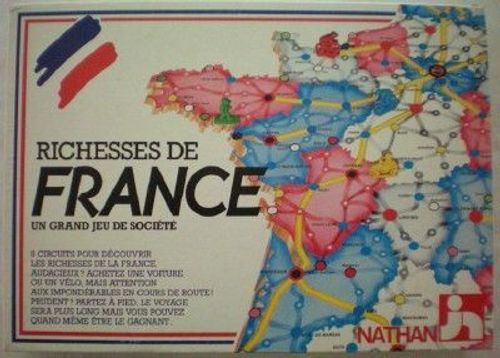
Richesses de France
Richesses de France Rulebook
Table of Contents
Table of Contents
- Principle of the Game
- Box Contents
- Setup
- Description of the Game Board
- Goal of the Game
- Course of the Game
- The Circuits
- Circuit "Économie": 10 stages (red and violet dot)
- Circuit "Monuments": 12 stages (yellow dot)
- Circuit "Casinos": 8 stages (dark purple dot)
- Circuit "Wine Routes" (Routes des Vins): 8 stages (red dot)
- Circuit "Touristique": 9 stages (light blue dot)
- Circuit "Vacances": 10 stages (salmon dot)
- Circuit "Spécialités": 12 stages (white dot with a black outline)
- Circuit "Sports": 9 events
Principle of the Game
2 to 4 players
- The players choose a common circuit.
- They place the corresponding "circuits" board under the grid.
- The players each receive the same amount of money (except for the "Economy" circuit).
- From the start, they choose their means of locomotion: on foot, by bicycle or by car. Where applicable, they immediately buy the vehicle they chose.
- They start from a town and move more or less quickly depending on their means of locomotion.
- They must pass through all the stages of the circuit, in the order of their choice. They mark each passage by placing a pawn on the "circuits" grid.
- Depending on the circuit, the players carry out certain formalities along the route.
- When a player passes certain points, they draw a "chance" card and follow what it says.
- Players may change their means of locomotion during the route.
- The game ends when one of the players has reached the destination town after passing all the stages of the circuit.
Box Contents
- 1 game board (a map of France)
- 4 "circuits" boards, double-sided (Circuit Vacances, Circuit Spécialités, Circuit Touristique, Circuit des Casinos are shown on the sides visible in the box illustration)
- 1 "circuits" grid
- 22 "region" cards
- 32 "chance" cards
- banknotes ("billets")
- 1 special die
- 4 walkers ("piétons"), 4 bicycles ("vélos"), 4 cars ("voitures")
- 48 marker pawns ("pions de marque"), 12 in each of four colours
Setup
-
Pop out the components and sort them by colour (walkers, bicycles, cars, pawns).
-
Place the game board in the middle of the players.
-
The players agree on the common circuit to travel.
-
Place the corresponding "circuits" board under the grid (see the diagram in the booklet). Each player chooses a colour and takes the 12 pawns of that colour.
-
One of the players acts as the banker and gives 1,000 F to each player, made up as follows:
- 1 note of 500 F
- 2 notes of 100 F
- 4 notes of 50 F
- 10 notes of 10 F
The remaining money forms the bank. (If playing the "Economy" circuit, no money is handed out at the start.)
-
Shuffle the "region" cards and deal 2 to each player. Each player looks at their cards secretly. These cards will be used during the game (see "The region cards", page 10 of the booklet).
-
Shuffle the "chance" cards and place them face down in a pile near the game board.
Description of the Game Board
The game board is a map of France showing various routes, circuits and towns.
The Circuits
The stage towns of the different circuits are marked by coloured dots outlined in black or blue. Each circuit has more or fewer stages than the players must cross to travel the circuit determined at the start (see the legend on the map and "The circuits", page 12 of the booklet).
Region Capitals (work towns)
Region capitals are marked by a large red dot, or a red and violet dot. Players may stop in these towns and "work" to earn money. To do so, on their next turn they roll the die and receive from the bank the sum shown.
Example: the die shows 60, so they receive 60 F.
However, a player may only work once during the same move. They may stay in the town, or return to it, and work there again.
Prefectures
Prefectures are marked by blue dots that are not outlined. They are only movement points and entail no action.
Waypoints
Waypoints are marked by blue, grey or pink dots with a white centre. When a player arrives on one of these points, they draw a "chance" card and follow what it says (see "The chance cards", page 10 of the booklet).
Goal of the Game
Travel across France on foot, by bicycle or by car, passing through all the stages of a circuit determined at the start.
Depending on the circuit chosen, the winner is either the player who arrives first, or the player who has the most money.
Course of the Game
- Before setting off, each player chooses a means of locomotion: walker ("piéton"), bicycle ("vélo") or car ("voiture"), and takes the piece of the same colour as their pawns.
- If the players choose a bicycle or a car, they must buy it from the bank:
- bicycle: 200 F
- car: 800 F
- Each player then rolls the die. The player who obtains the highest score starts. Play then continues clockwise.
- The first player moves their walker, bicycle or car from the starting town, in the direction of their choice (see "The circuits", page 12 of the booklet).
- Depending on their means of locomotion, a player moves more or less quickly (see "Movement" below).
1. Movement
- Walker ("piéton"): only 1 road section between 2 towns per turn, and never on motorways (yellow roads).
- Bicycle ("à vélo"): 1 or 2 sections per turn, and never on motorways.
- Car ("en voiture"): 1 to 4 sections per turn, on all roads and motorways.
Other movement rules:
- When a player uses a motorway, they must pay 10 F per section crossed.
- During play, players may change their vehicle. They buy a new one from the bank and, if they wish, keep the one they already have.
- If a player needs money, they may always resell their vehicle to the bank, but at half price: bicycle = 100 F; car = 400 F. If one of these vehicles interests the other players, each of them may make a purchase offer, which lets them acquire this "second-hand" vehicle at a reduced price. A player may outbid another player's offer.
- A player in difficulty then continues their route with the means of locomotion they still have.
2. The Region Cards
- At the start of the game, each player has 2 "region" cards. They must consult them secretly during play, to see whether the other players are on one of the towns of their region.
- If so, the player charges a toll ("droit de passage") as soon as the opposing player arrives in a town of that region.
- The opposing player must then roll the die and pay the sum shown on it. Example: the die shows 40, so they pay 40 F to the player holding the card for the region in which they are.
- The region card is then put back under the pile, and the player draws another, so that they always keep 2 cards.
- If a player forgets to claim the toll as soon as an opposing player arrives in a town of their region, the advantage is lost for them.
- When a player is ruined, i.e. has neither money nor vehicle, they do not have to pay tolls to the other players for as long as they have no money.
3. The Chance Cards
- Players draw a "chance" card each time they arrive on a waypoint (see "Waypoints", page 7 of the booklet), and follow what it says.
- If a card sends a player to a town occupied by another player, the player moves the other player's piece or vehicle to one of the nearest points (see the diagrams for the example of Valence in the booklet).
- If a card sends a player to Corsica, they pay no fee for the sea crossing (see "Particularities" below).
- If a card requires a payment and the player has no money, they must sell their vehicle back to the bank (at resale price) to honour all or part of the debt. If the player has no vehicle, the card is placed under the pile and the player draws another.
- If a card awards a bicycle or a car and the player already owns one or the other of these vehicles, they receive its resale value in money instead.
4. Particularities
- 2 players cannot be on the same point together.
- Players may pass through a point occupied by another player without stopping there.
- If a player is blocked by another player, they lose their turn, or detour when that is possible.
- There are sea crossings between the mainland and Corsica. Before crossing them, players must pay the amount shown on the game board for each trip.
- A ruined player may go directly to the nearest town of work (region capital) and work there until they have enough money to repay any debt or resume the circuit.
The Circuits
- At the start of the game, the players have together chosen the common circuit to travel.
- Each player may cross the stages of the circuit in the order of their choice, following the route they wish to take.
- Play is generally the same for each circuit, but some particularities are noted in the descriptions of the circuits below.
- As soon as they reach a stage, players place one of their pawns on the "circuits" grid, opposite that stage, in the column of their colour. If they forget to do so, they will have to return to that stage later.
- Players may only reach the destination town once they have crossed all the stages of the circuit.
Circuit "Économie": 10 stages (red and violet dot)
- Set aside the Corsica "region" card.
- Start: Paris. Return: Paris.
- Here the players do not receive any money at the start. However, they must work in Paris from their first turn (see "Region capitals", page 7 of the booklet), and do so several times (on their turns), until they have at least 200 F. If they wish to acquire a vehicle, they must also earn the money needed for it.
- To avoid blocking each other, players only take a walker, bicycle or car when they decide to leave Paris.
- They must work only once in each of the stage towns of the circuit, on arriving there. During play, however, they may return to a town to work there again.
- Once the 10 stages have been crossed, the players return to Paris as quickly as possible. The first to arrive receives a bonus of 300 F, the second 200 F, and the third 100 F.
- Each player then totals their assets: money and vehicles, calculated at resale price (car = 400 F; bicycle = 100 F).
- The player who has the most money is the winner.
Circuit "Monuments": 12 stages (yellow dot)
- Set aside the Corsica "region" card.
- Start: Paris. Return: Paris.
- The players must cross the 12 stages of the circuit.
- The first player who regains Paris is the winner.
Circuit "Casinos": 8 stages (dark purple dot)
- Set aside the Corsica "region" card.
- Start: a "casino" town chosen by each player. Return: Paris.
- Players must place a bet each time they arrive on a "casino" town along the route.
- They may do so from their starting town (after placing one of their pawns on the "circuits" grid), and then each time they arrive on a "casino" town.
- If they do not win on the first attempt, their stake goes back to the bank, but they have the right to stay in the town and bet again in the following turns. (Whether they win or not, they still place one of their pawns on the "circuits" grid.)
- Players may bet any sum up to 300 F. Before rolling the die, they decide on the bet they will place. There are 3 possibilities:
- Bet on red or blue: if the die lands on the requested colour, they receive twice their stake and recover their initial stake.
- Bet on a single number: if that number comes up, they win 6 times their stake and recover their initial stake.
- Bet on 2 numbers: if one or the other comes up, they win 3 times their stake and recover their initial stake.
- Players may not bet again at the casinos where they have already won. However, they have the right to pass through those towns and stop there.
- Once the 8 stages have been crossed, the players must return to Paris.
- As soon as a player reaches Paris, the game ends. Each player then totals their assets: money and vehicles, calculated at resale price.
- The player who has the most money is the winner.
Circuit "Wine Routes" (Routes des Vins): 8 stages (red dot)
- Start: Bordeaux. Return: Bordeaux.
- The players must cross the 8 stages of the circuit.
- The first player who regains Bordeaux is the winner.
Circuit "Touristique": 9 stages (light blue dot)
- Start: Ajaccio. Return: Ajaccio.
- The players must cross the 9 stages of the circuit.
- The first player who regains Ajaccio is the winner.
Circuit "Vacances": 10 stages (salmon dot)
- Start: Paris. Return: Paris.
- The players must cross the 10 stages of the circuit.
- The first player who regains Paris is the winner.
Circuit "Spécialités": 12 stages (white dot with a black outline)
- Start: Lyon. Return: Lyon.
- The players must cross the 12 stages of the circuit.
- The first player who regains Lyon is the winner.
Circuit "Sports": 9 events
This circuit offers:
- 6 matches:
- football: Bordeaux/Nantes, Nantes/Bordeaux
- basketball: Caen/Limoges, Limoges/Caen
- rugby: Clermont-Ferrand/Toulouse, Toulouse/Clermont-Ferrand
- 3 races:
- walking race: Strasbourg/Paris
- cycle race: Bordeaux/Paris
- motor race: tour of Corsica
All the players start from Paris and carry out the events in the order of their choice. They may set off on foot, by bicycle or by car (which they must buy if they do not already have it), and head for the towns concerned in order to take part in the matches or races they have chosen.
Matches. Example: Bordeaux/Nantes.
- When a player arrives at Bordeaux, they call another player of their choice to play the match against them. (The called player may not be one who is on a race route, or one who has already played this match in the other town.)
- Wherever they are, the called player comes to Nantes. (On the following turn, they must leave that town.)
- If no player is available, the player who called passes their turn.
- To play the match, each player rolls the die. The player with more points wins the match:
- If it is the player who called, they place one of their pawns on the "circuits" grid opposite "Bordeaux/Nantes".
- If it is the player who was called, they place one of their pawns on the "circuits" grid opposite "Nantes/Bordeaux".
- In either case, during play the players must go either to Bordeaux or to Nantes to play the reverse match, as indicated above.
Races (shown on the board by a central line along the road).
- As soon as they reach the start town of a race, the players, on the following turn, use the means of locomotion appropriate to that race:
- Bordeaux/Paris: by bicycle
- Strasbourg/Paris: on foot
- Tour of Corsica: by car, starting from Ajaccio, heading for Calvi, Bastia and Bonifacio, and returning to Ajaccio
- If they do not have the appropriate vehicle, they must buy it from the bank.
- Attention: on race routes, players do not draw a "chance" card when arriving on white-ringed dots.
- Each time a player completes a race, they place one of their pawns on the "circuits" grid.
- The player who first completes the 9 events, and so fills the whole grid, is the winner.
Note: whether for matches or for races, players who forget to place a pawn on the "circuits" grid must repeat the event.