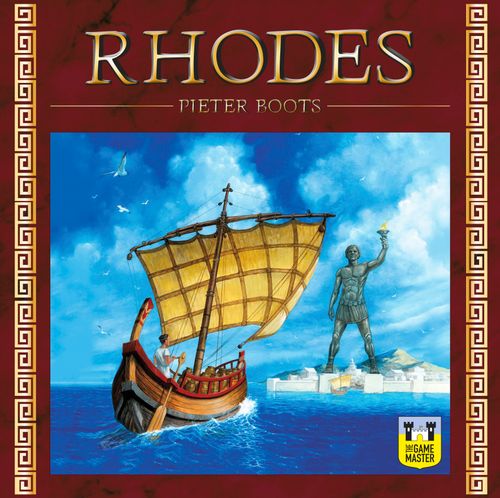
Rhodes
Rhodes Rulebook
Table of Contents
Table of Contents
Goal of the Game
The player who has gathered the most victory points at the end of the game is the winner. The player earns points by bringing fresh products from the land to the harbor, fulfilling assignment tiles and expanding and developing their farm into an estate with special buildings. At the end of the game, gold and money can result in additional victory points.
Game Preparation
-
Place the game board at the center of the table.
-
Take the 15 diamond-shaped assignment tiles and sort them by category: I, II and III. Shuffle the tiles per category and take one tile of each category and put them back in the box, without reading its contents. Make a drawing stack with III-assignment tiles at the bottom, II tiles on top of that and the tiles from category I on top. Place this stack on the designated space on the game board: the marble space with the hands. Draw the first three tiles from the stack and place them face up on the three marble spaces on the left.
-
Place the 5 production chips with the values 1, 2, 3 and 3 and 4 on the game board, face up, on the designated spaces.
-
Sort the 16 square farmland tiles - recognizable by the clump of grass on the back - and place them to the right of the board, face up.
-
Sort the 19 square development tiles – recognizable by the arrows on the back – and place them to the right of the board as well, face up.
-
For 4 or 5 players: place the large ships of the players to the right of the board. These ships are for sale for 10 drachmas a piece. Place the ships on the table, face up. Each player can purchase a maximum of one ship with a capacity of 3 units. If the game is played with 2 or 3 players, the players already have a large ship at the start.
-
Form a general supply of goods, consisting of the (fresh) products wine, (red cubes), goat milk (white), olives (green), grain (yellow) and gold bars. Place these at the side of the board.
Note: the general supply of goods is unlimited. Should there be any shortage during the game, please supplement these materials.
-
Shuffle the 10 Egyptian ships and make a stack, face down. Place it on the right sea square.
If the game is played with 2 to 4 players, take the top ship and place it – face up – in the second harbor square with value "7". Only with 5 players, all squares in the harbor are used and the first ship is placed in the first harbor square with value "7".
Symbol Overview
- Costs in drachmas
- Victory points
- Income in drachmas
Gameplay
Each round consists of 4 phases that are played in a fixed sequence:
1. Performing two actions
The player with a turn marker on the highest position in the player sequence table, pushes his marker to the next column (in the same row). He then places one of his (two) action markers on an action space of his choice. Subsequently, he instantly performs the associated action. The various player actions are explained on page 7. Then, the next player (top to bottom) is up for his first action.
After all players have performed their first action – and their turn markers are in the second column – all players will get a second turn (in the same order) in which they can place their second action marker on an action field.
Special situation: if a player is unable to perform an action, his action expires and he receives 1 drachma.
2. Supplementing gold
If there is less than two gold on the ships in the harbor, new ships will enter the harbor. Take the Egyptian ship from the left sea square and slide it into the harbor, causing the present ships to sail further into the harbor. Draw a new tile from the stack and place it in the vacant square. Repeat this supplementing process until there is at least two gold available on the ships in the harbor.
If a player ship reaches the end of the harbor – in the sea square with the image of the warehouse next to it – the owner of this ship may place the products in his warehouse. If the warehouse already holds 10 goods (products or gold bars) it is full. The player can choose whether to move the new products from his ship to the general supply or to make room by moving goods from the warehouse to the general supply.
Egyptian ships that reach the end of the harbor are placed on a discard pile. Any goods on the ship, are reverted to the general supply. If the stack of Egyptian ships is depleted, take the discard pile, shuffle them and make a new drawing stack.
3. Taking back action markers and production chips
Each player takes back his two action markers, used production chips are taken from the production field and placed back in the squares.
4. Placing turn marker
The players – in the proper sequence – place their turn marker on one of the positions in the first column of the player sequence table. The player that has his turn marker on the bottom position in the last column gets to choose first, then the other players follow, from bottom to top! It is not permitted to keep your marker on the same level! It must be placed at least one row up or down.
When placing the marker, the player must pay 1 or 3 drachmas (the top two positions), is given nothing or receives 1 or 2 drachmas and / or a product from the general supply. This must be a type of product of which the player has a farmland tile and there must be enough space in the estate.
Exception: in the exceptional situation that a player has to take a position for which he has to pay, but he has no money, he can still place his turn marker in the same row, without paying.
End of the Game
As soon as it is no longer possible to place a new assignment tile on a vacant plaza (the 3 marble squares on the board without hands), the game ends at the end of that round, which is played until every player has placed both action markers.
Exception: only in the last round, each player can perform the harbor action, at least once, even if there is no space available anymore
Final Scoring and Winner
In addition to the victory points awarded to the players during the game, the players can receive points for the value in money and gold they have at the end of the game.
Each player may convert money into victory points. Every 10 drachmas has a value of 1 victory point. Move the point marker the corresponding number of squares and give the money to the bank. If players have gold bars, they can hand them over for 2 VP per piece.
The player with the most points wins the game. In case of a draw in points, the player with the most money at the end wins. The end value of the money and gold is also specified at the bottom right of the board.
Player Actions
Per round, each player has two action markers. Each marker allows him to perform one action. The action fields on which the markers can be placed, are on the board and on your own farm.
The indicators 4PL and 5PL on certain action fields on the game board indicate that these fields are only available if you play with respectively 4 and 5 players.
The players can perform the following actions:
- Production
- Farm
- Harbor
- Market
- Temple
- Town Hall
Production
By appealing to Demeter, goddess of fertility, players can affect the yield of the lands. Place your action marker on one of two action fields in the Production Field and perform the following action:
- Place two production chips on two different production fields;
- Take as much units from the general supply as specified by the number on the chip and place them with the production field;
- Distribute this yield – clockwise – among the corresponding farmland tiles of the players. The player begins with himself and places one unit on each farmland of this type, provided that there is room.
Example in image: the green player chooses to produce 1 wine and 3 olives. When the green player has 1 olive farmland and there is one more player growing olives, green will receive the first unit, the other player the second, and green receives the third unit. His revenue is 2 olives.
Important: a tile can contain a maximum of three units. This is specified on the tile. When a tile is full, it is skipped. It is NOT permitted to place just one production chip when you produce. You must always choose two chips and place them on two different production fields!
If all farmland tiles are full and there are products left to be distributed, the excess production is placed back in the general supply.
Farm
The farm action is a personal action: only the owner of the farm can place an action marker here.
Place your marker on the action field on your farm and perform the steps in the (fixed) order below:
-
Move the point marker on the score track by as much squares as the number of victory points you have on tiles on your estate.
-
The player receives the amount of money in drachmas specified on the tiles on his estate.
-
Use the function(s) of the development tiles in a sequence of your liking. For a description, see the Development Tiles section below.
-
The player must sail one fully loaded ship into the harbor. It is not permitted to sail no ship or a ship with an incomplete cargo into the harbor! The player receives 1 Victory Point or 2 drachmas per delivered unit. The player may choose whether to receive VP's, money or a combination of both. The products remain on the ship. You can't sail more than 1 ship into the harbor, but you can determine the size of your ship!
Example: the yellow player sails one ship with two units of olives into the harbor. He may choose to receive 4 drachmas, 2 drachmas and 1 VP or 2 VP's.
-
The ship enters the harbor at the entrance, pushing the other ships further into the harbor by as much harbor squares as the new ship measures in size (1, 2 or 3). Please note! When played with 2 to 4 players, you don't use the first harbor square (5 PL).
-
Goods on a ship that ends up in the last harbor section – next to the image of a warehouse with an arrow – are placed in the warehouse of the owner. Only if the ship as a whole is in the last section, it is returned to the player. Goods of Egyptian ships are sent to the general supply and the ship goes to the discard pile.
If the warehouse of a player is full, the player may discard the products or move goods from his warehouse to the general supply, to make room.
Harbor
This action consists of two elements, in which the player may choose not to perform one of the two sub actions. It is not possible to place an action marker in the harbor without performing any of the two actions below.
The actions are carried out in a fixed order:
1. Purchasing goods
The player purchases one or more products or gold bars from the ships in the harbor. The section in which the goods are located, determines their price. The player pays the costs in drachmas to a fellow player, if he is the owner of the ship. If he purchases goods from an Egyptian ship, he pays the bank. If he purchases goods from his own ship, he pays the bank as well.
When the player purchases a brown (wildcard) cube, he must decide during the purchase what product he wants to exchange this for. Important! It is not possible to exchange for a gold bar.
The player places the goods in his warehouse. He may purchase as much as he wants, but his warehouse cannot hold more than 10 goods (products or gold). He can discard goods to the general supply, to make room.
Player ships or Egyptian ships of which all products are sold, remain in the harbor. Owned ships that are entirely in the last harbor section, or move past it, are returned to their owner. Egyptian ships are placed on the discard pile.
2. Performing one assignment
After the player has been given the option to purchase goods in the harbor, he can use goods from his warehouse to perform one assignment of his choosing. After handing over the goods, he receives the money and the VP of the assignment.
A player can fulfill no more than one assignment per action marker. He uses the goods from his warehouse, but (at an extra charge) he may also use goods straight from his estate for an assignment. The latter is only permitted to fulfill an assignment. He can use the first good at a charge of 3 drachmas from his estate for the assignment. If he requires a second good, he must pay 5 drachmas to the bank (a total of 8 if he uses two goods). He can get the goods from his farmlands or barn.
Restriction: this is only permitted if the relevant goods are not available in his warehouse and when performing an assignment the player must use at least one good from his warehouse in the harbor.
The goods the player has used to fulfill the assignment go to the general supply. Discard the assignment tile and draw a new tile from the drawing pile. Place it on the vacant plaza, face up.
Please note! If the player didn't purchase anything in the harbor, he must carry out one assignment.
Example: The blue player has one unit of wine in his warehouse (image 1), he gets one unit of olives from his estate and pays 3 drachmas (image 2). In doing so he fulfills an assignment that gives him 4 money and 3 victory points (image 3).
Note: it is not permitted to perform more than one assignment per turn (action marker) but it is permitted to place your action marker in the harbor twice in the same round and to perform two assignments in one single round.
Market
Are you in immediate need of money? On the market, you can sell a maximum of two units from your estate. You will receive 5, 4 or 3 drachmas per sold unit, depending on whether you are the first, second or third player who chooses this action. Discard the products to the general supply. Example: red sells one unit of grain and receives 5 drachmas.
Temple
Partly because of the construction of the impressive Colossus, the treasure chest of the rich island has pretty much depleted. If you are rich, you can buy victory points by adding to the treasure chest. If you are the first person in this round to do so, you will receive 1 VP for every 5 drachmas. The second player gets no more than 1 VP for every 7 drachmas. There is no limit for the amount a player can spend here. Pay the money to the bank. Example: the red player can convert 25 drachmas into 5 VP.
Town Hall
If you wish to expand or develop your estate, you can purchase a maximum of two tiles at the Town Hall. This can be both development and farmland tiles. Pay the cost of the tile to the bank. The price of a tile is specified in the upper left corner of the tile. Place the tile(s) in your estate. It doesn't matter where.
Important restriction: a player can own no more than one of each type of development tile.
Development Tiles
The development tiles all have the same structure. At the top left (in red) you'll see how much the tile costs (in drachmas). In the bar at the bottom, you'll see what the tile will bring you in points, money, products or what action you can perform with it.
Example: the Greek trader costs 10 drachmas, enables the player to convert a product in the warehouse into a product of his choosing and results in 1 drachma.
The tile is placed near the farm tile and forms part of the estate of a player. Developments can be activated at various moments, indicated in the overview below:
Please note! There can be only one development tile of each type on the estate.
Demeter's blessing
Receive 1 VP for each 2 units of the associated product on your estate. The cubes are not discarded.
Example: Hank has the Demeter tile olives. On the farmlands and the barn, he has 4 units of olives. Hank is given 2 VP for this. Would he have had 7 units, he would have received 3 VP. Can only be performed during the action Farm.
Poseidon
Receive one VP. Move your point marker one position ahead. Can only be performed during the action Farm.
Irrigation
Receive one extra unit if a product of which you own a farmland tile is being produced. This extra return comes from the general supply. Only 1 unit per production chip. Only has effect during the action Production.
Storage barn
This tile allows you to store one unit of every product type. This is only possible when a farmland tile of this type is available on the estate of the player and it is full. Has effect during the action Production and combined with the development Abundance and when determining the player sequence (when a good is received).
Wagon
Transport one product from your own farmland tile to your warehouse in het harbor and receive 1 drachma from the bank. Can only be performed during the action Farm.
Abundance
Receive one product on your own farmland tile, provided that there is enough storage space. In addition you'll receive one drachma from the bank. Can only be performed during the action Farm.
Greek trader
Exchange one product in your warehouse for one random product from the general supply. This does not enable you to make gold! In addition, you'll receive 1 drachma. Can only be performed during the action Farm.
Acknowledgements
The development and realization of the game Rhodes would not have been possible without the inspiration and limitless support of Hans van Tol and Erno Eekelschot. In addition, several test players have committed by playing the game and providing useful feedback. The game author wants to thank them for that by listing their names here: Adrian Allamby, Robert Camphuysen, Bart van Dijk, Paul Dupuis, Erno Eekelschot, Paul van der Gun, Ron Huizing, Peter Jans, Jaap de Jong, Nico van Maarsenveen, Paul Schuurman, Mark Siekerman, Jeroen Sjamaar, Hans van Tol, Michel van der Vegte, André Verheij.
The Game Master wants to thank the support and the constructive feedback of the testers Yvonne van Dijk, Muriël Kol, Frank de Man, Kelly van der Meer, Pieter de Meijer, Martijn Schuurmans, Niels van der Steenhoven, Nikki and Patrick Verlaan, Bas and Ton Verkaik, Sjoerd van der Vlugt, Nancy van der Zalm and Randy Zandbergen.
Colophon
Game design: Pieter Boots Editorial team: Hans van Tol Illustrations: Julien Delval Graphic design: Alexander Mourits
© 2016, The Game Master BV, all rights reserved
The Game Master BV Burgemeester Vogelaarsingel 9 2912 BB Nieuwerkerk aan den Ijssel The Netherlands www.thegamemaster.nl [email protected]