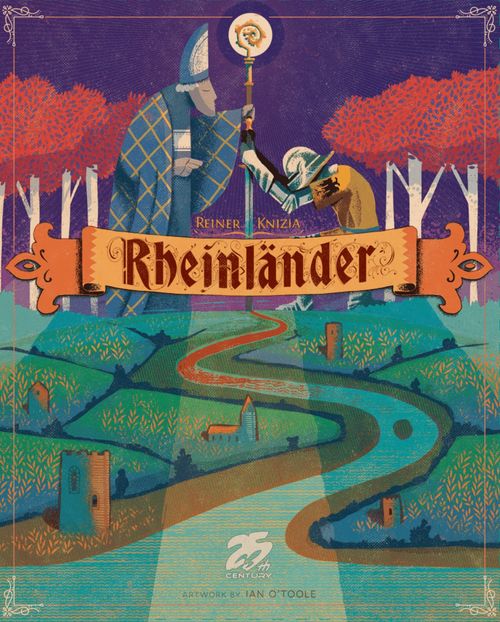
Rheinländer
Rheinländer Rulebook
Table of Contents
Table of Contents
- Contents
- Aim of the Game
- At the Start of the Game
- Playing the Game
- Placing Knights and Forming Duchies
- Playing a Card as a Reinforcement
- Using a Bastion
- Changing Ownership of Duchies and Scoring
- Joining Duchies
- Castles and Churches
- Bishops and the Archbishop
- Game End
- Final Scoring
- Strategy Tips
- The Game in Brief
Contents
- 1 gameboard
- 54 numbered cards
- 1 "shuffle" card
- 1 archbishop card
- 30 duke figures
- 125 knights
- 55 coins
- 7 bishop markers
- 15 bastion markers
- 26 realm markers (12 cities, 7 castles, 7 churches)
If you are playing Rheinländer for the first time, please remove all the Duke figures from the plastic bags, and punch out the counters carefully from the frames.
Aim of the Game
Each player forms duchies along the Rhine and in doing so will collect points. The player who achieves the highest number of points at the end of the game wins.
At the Start of the Game
-
Mix all the realm markers face down on the table. Place them face up on the round spaces on the gameboard. Thus the game is different each time you play Rheinländer. (The realm markers are castles, churches, and cities.)
-
With 3 players, each player receives 6 dukes and all 25 knights in the selected colour, as well as 3 Bastions. With four players, each player receives 20 knights, and with 5 players each player receives 17 knights.
-
Remove the archbishop card from the deck, and place it nearby. Shuffle the deck and deal five cards to each player, which they take to form their hand. Place the remaining cards as a face down deck beside the game board, in reach of all players. (If a player receives the "shuffle" card - looks like a joker - shuffle this card back into the deck and draw a new card.)
-
Choose a player to be banker. Their job is to pay out coins.
-
Put the bishop markers and the archbishop card beside the game board.
Playing the Game
Choose a player to begin the game. Play then continues in a clockwise direction.
During your turn, perform the following steps:
-
Select a card from your hand and play it openly onto a discard pile.
-
Place a knight onto the gameboard.
-
Take the top card from the deck so you are holding five cards in your hand. Your turn ends.
Note: If a player draws the card "Shuffle", that card, the discard pile, and the deck are reshuffled. The new deck is put beside the board, and a new card is drawn (the "shuffle" card may not be kept).
Placing Knights and Forming Duchies
The aim of the game is to place your knights in such a way that they form duchies along the banks of the Rhine. The larger your duchies are, the more powerful you are and the more points you will obtain. A factor later in the game that will influence your fate is the number of duchies you govern. Thus you should remember that winning does not depend on one large duchy!
Playing Cards to Place Knights
The cards are numbered from 1 to 54 and correspond to the numbered spaces on the game board. Each space on the game board covers the river space as well as the two land spaces on both sides of the river. All three spaces form an "area".
On your turn, you select one of your cards from your hand, that corresponds to where you would like to place one of your knights. Put the card face up on the discard pile beside the deck so that all players can see the card you play.
Each space may be only occupied by a single knight.
You can place your knight on one of the two sides of the Rhine, if the spaces are free.
If a space on one side of the Rhine is already occupied, then your knight must be placed on the other side of the Rhine.
You may only place a knight in a river space if both land spaces are already occupied on the sides of the river.
If all three spaces are occupied in an area, then no knight can be placed there. (You can however still play the card - see "Playing a Card as a Reinforcement" below.)
Some spaces are situated on an island, which belong to two areas, i.e. they can be occupied by the play of two different cards.
Forming Duchies
Neighbouring spaces which share a border are called "neighbouring spaces" or "adjacent spaces".
A duchy is formed if two (or more) adjacent spaces are occupied by knights.
A duchy can consist of knights of the same colour, or different colours.
Who Owns a Duchy?
At any time during the game you can take possession of a duchy, if there are two of your knights in that duchy and you have more knights in the duchy than every other player (i.e. a simple majority).
If you own a duchy, place one of your duke figures on the game board beside that duchy.
There are no limits to the number of duchies a player can possess. If you have no more duke figures available, you can use the figures of an unused colour.
Remember: A new duke can only be placed if a player has more knights in the duchy than their fellow players. If there is a tie between two (or more) players in the number of knights, then no new duke can be placed.
During the game, more and more knights are placed. Existing duchies grow and new ones develop. Also the ownership of a duchy can change, it depends upon which player has the most knights in a duchy.
Playing a Card as a Reinforcement
A card may be played as a reinforcement, instead of playing a knight on the numbered space listed on the card.
You select the card from your hand, usually a card that does not have any value to you.
If you play the card as a reinforcement, ignore the number on the card.
Place the card on the discard pile and place a knight on a space of your choosing. However, you must observe the reinforcement rules:
- You may only place your knight as a reinforcement on a free land space, which borders onto a space already occupied by one of your knights, and which does not border a space occupied by a knight of your opponent.
- You may not place your knight as a reinforcement on a river space.
If you play cards as reinforcements, they are more flexible despite the restrictions described above - it is simpler for you to support your knights and dukes who already are on the game board. Additionally it enables you to play cards that are not that interesting to you.
Using a Bastion
In addition to a knight, which you place during the game, you can also place one of your three Bastions. They are fortresses which prevent your opponents from increasing the size of their duchies, and they protect your own duchies.
You can use a Bastion on any free land space on the game board.
A Bastion cannot be placed on a river space.
You may only place one Bastion per turn.
Bastions belong to no duchy: once placed, they are neutral.
Changing Ownership of Duchies and Scoring
The development and growth of duchies is only one part of the history of the Rhine country. The game becomes interesting if duchies change ownership as the players try to strengthen their positions.
The Value of Duchies
Each duke on the game board beside a duchy has a value of 1 point. The values of duchies can be increased substantially, however, if they contain one or more realm counters - cities, castles and churches.
A duke owns a realm if a knight of the duchy occupies a space which borders the realm space (a circle).
During the game the value of a duchy consists of 1 point for the duke plus the point values of all cities, castles and churches contained in the duchy.
Points Table
- During the game a duke counts: 1 Point
- Each realm in a duchy counts as:
- Church: 1 Point
- Castle: 1 Point
- Town: 2, 3 or 4 Points
Additionally at the end of the game bonus points are awarded. See "Final Scoring" for details.
Scoring During the Game
During the game, the value of duchies can be calculated at any time. This enables players to measure and compare their opponents' strength. A duchy is only scored, however, if it changes ownership during the game, as well as at the end of the game during final scoring.
During the game, points are collected if the duchies change ownership:
If you lose ownership of a duchy (see "New Ownership of a Duchy" below), you receive the value for your old duchy in points. The banker awards you the points in coins from the bank, which you place face down in front of you on the table.
By concealing the value of your coins, you can mislead your opponents, making it difficult for them to choose their best strategy. When combined with the final scoring, some surprises can occur!
New Ownership of a Duchy
If you play cleverly, and keep an eye on your opponents, you may get a good opportunity. As well as increasing your duchies, try to take over your opponents' duchies as well.
Each duchy can only be governed by one duke. A new knight placed into a duchy can create a situation where a player now has more knights in this duchy than the owner has. The ownership of the duchy will change. The old duke is removed from the game board and is returned to its owner, who receives the appropriate points for the old duchy (see points table). The new owner now places a duke of their colour on the game board.
If you place a knight into a duchy that creates a tie in knights, the duchy does not change ownership. The present duke remains on the game board beside the duchy.
Remember: A new duke can only be placed if a player has more knights in the duchy than all his opponents.
Joining Duchies
From time to time, even placing a simple knight can have a dramatic effect on the game board. If a knight is placed on a space that borders two (or more) duchies, the duchies combine to form one large duchy.
The player who has more knights in the new connected duchy than any other player takes possession of the duchy.
If you owned none of the earlier duchies, you place a duke on the game board beside the new duchy.
If you owned one of the earlier duchies, your duke remains on the game board and now rules the new duchy.
If you owned several of the earlier duchies, then the most valuable duke from the earlier duchies remains on the game board to rule the new duchy, regardless of the number of knights who were in your earlier duchies.
All other earlier dukes are removed, and their owners receive the appropriate points for their old duchies.
Remember: If you have several dukes in a connected duchy, always remove the dukes from the lower scoring duchies.
If a situation is tied, and no player has more knights in a connected duchy than an opponent, then all dukes are removed and players receive the points according to their old duchies. The new duchy in this case is now without an owner.
Castles and Churches
As you establish duchies, they do not only bring you possession of castles and extra knights, but often also the undisputed rule over far areas of the Rhine country! On the other hand the possession of duchies with churches gains you the ultimate power of the archbishop, which can ensure opponents' knights ally to your own side.
Taking a Castle
Ownership of a castle is decided as soon as the first knight is placed onto an adjacent space to a castle.
If the new knight beside the castle belongs to a duchy with a duke, then the owner of this duchy automatically receives the castle and sets an additional knight of his colour on the castle.
If your new knight beside the castle belongs to a duchy with no duke, you receive ownership of the castle, and may set an additional knight on the castle. If you now have more knights in the duchy than your opponents, you may take possession of the duchy, and may place one of your dukes on the game board.
The above rule also applies if your new knight adjacent to a castle does not border anything at all. Place an additional knight on the castle, forming a new duchy. Place one of your dukes beside it.
Always decide who owns the new castle before deciding ownership of the whole duchy.
Remember: When counting the number of knights in a duchy, also add those in castles.
A castle may only be occupied by one knight, which then remains 'occupied' for the game. The owner, however, may change.
How Do Castles Change Their Owner?
If a duchy changes its owner, then all the castles in the duchy change their owner.
The player who is the new duke gains control automatically of all castles in the duchy. He replaces his opponents' knights in castles with his own knights. The opponents' knights are returned to the owning player.
If a duchy is without an owner, then any knights in the castles remain there.
Bishops and the Archbishop
A duke knows its power increases with control of the church.
If a duke possesses one or more churches in his duchy, then he can use a bishop. Place a bishop counter under your duke in order to display that there is a bishop in this duchy.
If you have more bishops on the game board than your opponents, then you receive the power of the archbishop. Take the archbishop card and place it in front of you on the table.
If no players have bishops, or there is a tie, then no player takes the archbishop.
The archbishop has the power to convert opponents' knights to his side.
If you possess the archbishop and you play a card using the number, which space is occupied by an opposing knight, you can replace this knight with one of your own knights. The opposing knight is returned to its owner.
It is not possible to use a card as a reinforcement in order to convert an opposing knight.
Bastions may not be replaced with knights.
If a knight adjacent to a castle is converted, then only that knight is converted, the knight in the castle is unaffected.
Knights in a castle cannot be converted.
The conversion of a knight can change the possession of a duchy.
Game End
The game ends if a player places his last knight. The current turn is still completed.
Final Scoring
At the end of the game all players add their points, which they receive for owning duchies on the game board.
In addition to cities, castles and churches, each duke on the board now counts is now acknowledged for his independence and receives 5 points (instead of the normal score of 1).
The player who possesses the archbishop card at the end of the game receives 5 points.
All points are paid out in coins.
The player with the most coins wins the game and receives the title "Ruler over the Rhine Country".
Strategy Tips
- Study your cards and make yourself aware of where your strengths are.
- Establish a power base quickly, by forming several small duchies.
- Concentrate on high scores.
- Avoid conflicts, unless you have a good chance of winning them.
- Use Bastions to contain opposing duchies and defend your own.
- Do not forget you need a high score (cities and a good number of dukes), in order to win the game.
- All duchies under your control will earn you points, even if your duke is evicted from a duchy.
- Watch out for the end of the game - it often happens faster than you think!
The Game in Brief
- On your turn, you play a number card and set a knight into the numbered area.
- Or you use a card as a reinforcement, and place a knight beside one of your other knights that is not adjacent to opposing knights.
- Two or more adjacent knights form a duchy.
- You receive the ownership of a duchy and place a duke if you have more knights in the duchy than all of your opponents.
- When two duchies join, then the player with most knights takes possession of the new duchy. When there is a tie, all dukes are removed.
- During your turn you may play a Bastion as well as place a knight.
- You may place an additional knight on a castle if you control the duchy.
- You gain a bishop for each duchy with a church. If you have more bishops than every one of your opponents, then you receive the archbishop card and can convert the knights of your opponents and replace them with your own.
- The value of a duchy is determined by its cities, castles and churches. The players receive points only if the duchies change their owner, as well as at the end of the game. See the Points Table above.
- The game ends when a player places his last knight.
- The player with the most points wins.