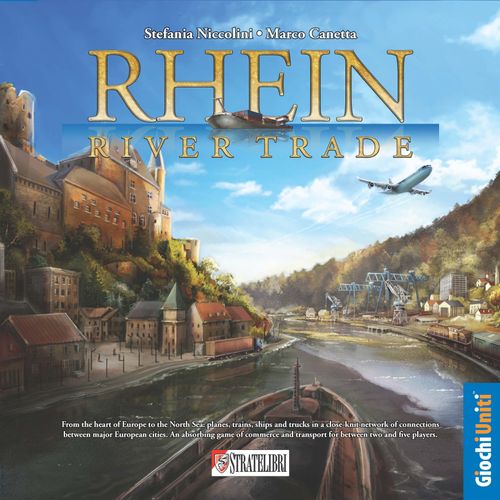
Rhein: River Trade
Rhein: River Trade Rulebook
Table of Contents
Table of Contents
The Goal of the Game
As the head of an important freight company in Basel, you receive Orders bound for cities located on or near the Rhine river - even as far away as London. Each Order lists the destination and the number of Containers to be transported, the delivery deadline, a payment offer, and a possible penalty. Using the Planes, Trains, and Ships that you share with the other players and your own Trucks, you must arrange shipments, limiting your costs and making sure you deliver on time. The player who earns the most money is the winner!
Game Components
- 1 Game Board
- 50 Time Tokens
- 50 Order Cards
- 30 Reservation Markers (2 white Planes, 2 red Planes, 2 black Planes, 4 white Trains, 4 red Trains, 4 black Trains, 4 white Ships, 4 red Ships, and 4 black Ships)
- 14 Transport Mats: 3 Planes (white, red, and black), 3 Trains (white, red, and black), 3 Ships (white, red, and black), and 5 Trucks (green, yellow, blue, purple, and brown)
- 9 Transport Pieces: 3 Planes (white, red, and black), 3 Trains (white, red, and black), and 3 Ships (white, red, and black)
- 10 Truck Tiles (2 green, 2 yellow, 2 blue, 2 purple, and 2 brown)
- 5 Capital Markers (green, yellow, blue, purple, and brown)
- 5 '100' Tiles (green, yellow, blue, purple, and brown)
- 75 Containers (15 green, 15 yellow, 15 blue, 15 purple, and 15 brown)
- 1 Phase Counter
- 1 Round Counter
Set-Up
- Place the game board - which shows the river Rhine and 13 numbered European cities - in the middle of the table. The numbers in the yellow diamonds indicate each city's distance from the starting city, Basel:
| Number | City | Country |
|---|---|---|
| 0 | Basel | Switzerland |
| 1 | Strasbourg | France |
| 2 | Karlsruhe | Germany |
| 3 | Mannheim | Germany |
| 4 | Mainz | Germany |
| 5 | Frankfurt | Germany |
| 6 | Koblenz | Germany |
| 7 | Bonn | Germany |
| 8 | Köln (Cologne) |
Each city may contain a port, a railway station, and/or an airport. All cities, with the exception of London, can also be reached by road.
-
Each player chooses a color - green, yellow, blue, purple, or brown - and places all the game pieces of his color in front of him (in his "reserve"): 15 Containers, 1 Capital Marker, 1 '100' Tile, 1 Truck mat, and 2 Truck Tiles (A and B), face up.
-
Take the Capital Markers from each player and randomly place them in a stack on the "20" space of the Capital Track of the game board. This shows your starting Capital. Each time you pay costs or collect income, move your marker up (for income) or down (for costs) on the Capital Track. If your Capital goes over 100, place your '100' Tile on the 0 space. Your Capital can never go below 0 during the game. In case of economic difficulties, you may raise money by taking out a mortgage on your Trucks (see Taking out a Mortgage on Trucks).
-
Place the Plane, Train, and Ship mats next to the game board. If there are less than 5 players, some Transports are not used: in a 4-player game, remove the black Plane; in a 3-player game, remove the black Plane and the red Plane; in a 2-player game, remove the black Plane, the red Plane, and the black Ships. The unused Transport mats have to be put back in the box, as they won't be used during the game.
-
Place the Transport pieces on the matching Plane, Train, and Ship mats: match the color of the pieces with the appropriate mats. These pieces represent the Transports, which will move on the game board. When the pieces are on their mats, this means that those Transports are in Basel, the starting point for all Transports at the beginning of the game. In games with fewer than 5 players, the unused Transport pieces have to be returned to the box.
-
Place the Phase Counter and the Round Counter on the starting positions of the corresponding tracks.
-
Shuffle the Order cards. If you are playing a 4-player game, discard 2 cards randomly; in a 5-player game, discard 1 card randomly. Put the discarded cards back in the box without looking at them. (This will ensure that the deck of Order cards runs out precisely on the last turn of the game.) Place the deck face down on the top space on the left side of the game board, in the "Orders List".
-
Divide the 30 Reservation Markers by Transport type and color (Plane, Train, Ship, and white, red, black), and place them on the corresponding Transport mats, covering the drawing of the vehicle.
How to Play
A game of Rhein River Trade is played over a set number of rounds, which varies based on the number of players (as indicated on the Round Track on the game board):
| Game | Number of Rounds |
|---|---|
| 2- and 3-player game | 10 |
| 4-player game | 8 |
| 5-player game | 7 |
Each Game Round is divided into 6 phases, which are played in order, as shown on the Phase Track. Each phase must be finished before the next one begins:
- Take Orders: New Order cards are revealed; each player may take one Order.
- Load Goods: Each player may load their Containers onto available transports.
- Reserve Transport Stops: Each player may reserve Stops in the cities for the Transports.
- Move and Unload Transports: The Transports move and make Stops in the cities reserved by the players. The players may unload their Containers at reserved Stops.
- Fulfill Orders: The players can use Containers unloaded in the cities to fulfill their Orders.
- End of the Round: The end-of-turn operations are performed.
Order of Play
In several phases, the players take turns in reverse order of their Capital. This means that the turn order begins with the player whose marker is lowest on the Capital Track, and ends with the player whose marker is in the highest position. In case of a tie, the player with the marker on top plays first, and the player on the bottom goes last.
Example: The order of play for this phase is Blue, Yellow, Brown, Green, and finally Purple.
The Phases of a Round
1. Take Orders
First, turn over a number of Order cards equal to the number of players plus 2 from the deck and place them on the Orders List along the left edge of the game board (as indicated on the Orders List spaces).
Order Cards
Orders are represented by cards. Each card shows the requirements that must be met to fulfill that Order. From top to bottom:
- The number in the yellow diamond indicates the City where the Order must be delivered;
- A number of delivery options, showing the number of Containers to be delivered and the income earned - you must choose only one option for each Order;
- The Time (in number of rounds) available to fulfill the Order; and
- The Penalty: the amount of Capital lost if the Order is not delivered within the number of rounds indicated.
In reverse order of their Capital, each player may take 1 Order card from those face-up on the Orders List, placing the chosen card in front of him, face up, and placing the number of Time Tokens shown on the card (taken from the common supply).
Example: Green chooses the Order shown in the picture above from the Orders List. He places it in front of him with 2 Time tokens on it. Within 2 turns, Green must deliver the goods to Karlsruhe (2), otherwise he must pay a penalty of 2 Capital. In Karlsruhe, he may deliver (his choice): 4 Containers to earn 9 Capital, 3 Containers to earn 7 Capital, or 2 Containers to earn 5 Capital.
Special Taking Orders Rule for 2-player Games
In a 2-player game, turn over 5 Order cards for the Orders List. In reverse order of their Capital, each player may take 1 Order card and place it in front of them with the number of Time Tokens indicated, taken from the common pool. Once both players have taken this action, they may each take a second card, but the number of Time Tokens placed on the second Order card is 1 less than the number indicated. This means that in a 2-player game, both players may take up to 2 Order cards each round, but the second Order has a penalty applied in terms of the time you have to fulfill it.
Important: The Special Rules section at the end of the rulebook describes two rules that apply during this phase in the first and last rounds.
After all players have taken their Orders, move the Phase Counter on the Phase Track to the next space.
2. Load Containers
In reverse order of their Capital, each player may load their Containers on the available transports. A player must pay 1 Capital for each Container he loads.
Containers
The goods that you will transport and deliver to fulfill your Orders are the colored cubes, which represent shipping Containers. You have a personal reserve of 15 Containers in your color. As long as they are in your reserve, it means that they are located in your warehouse in Basel.
Transport Mats
Each Transport has a matching mat that shows how that Transport can carry Containers:
Planes, Trains, and Ships. Each mat shows the following:
- At the top, the Cities where that Transport can make Stops are highlighted.
- On the left, the transport capacity is shown, with the minimum number of Containers (squares with black numbers - 4 in the example) which must be loaded before the Transport will leave Basel (0) and the maximum number of Containers (10 in the example) which that Transport can carry. Only 1 Container may be loaded on each space.
- In the middle, there is a picture of the Transport (the background color is the color of the matching Transport piece), and an icon for that type of Transport.
- On the right, the Transport's initiative value (red star), reservation cost, speed (number of spaces it can move on the game board in one round), and the maximum number of Stops which can be made each round (1 for the three Planes and the black Ship, 2 for the other Ships and the Trains) are listed. (In the example red Train mat: initiative 5, reservation cost 4, speed 3, 2 Stops.)
Trucks. Each player has two Trucks, A and B, which are shown on a single mat which lists all their characteristics:
- At the top, the Cities where Trucks can make Stops are highlighted.
- On the left, the loading capacity for each Truck is shown, with the minimum number of Containers (the square with a black "1") below which the Truck cannot stay on the game board, and the maximum number of Containers that this Transport can load (the square with a white "2"). Only 1 Container may be loaded on each space.
- In the middle, there is a picture of a Truck (the background color is the player's color), the player's logo, and the icon for Trucks.
- On the right, the Trucks' initiative value 10, movement cost -1, speed 2, and the maximum number of Stops which can be made in one round (1) are listed.
To load a Transport, a player places the Containers desired on the corresponding Transport mat, filling the spaces in ascending order starting from the "1" space. The player must pay 1 Capital for each Container loaded.
Playing Hint: You must be careful that you do not run out of Capital (indicated by your marker on the Capital Track). Remember that in order to fulfill your Orders and receive income later in the round, you will probably have to pay other costs (for reserving Stops or moving Trucks).
Once all players are done loading Containers, move the Phase Counter to the next space.
A Transport is available for loading when its piece (or a Truck tile) is located in the same city on the game board as the Containers to be loaded.
For Planes, Trains, and Ships, when the corresponding piece is located on the Transport card, this means that the Transport is located in Basel (0).
Each player's Trucks (A and B), on the other hand, can leave from any city the player chooses. When a player decides to use a Truck, he takes the tile from his reserve (if available) and places it on the game board, at a city where his Containers are located.
At the start of the game, all Containers are located in warehouses in Basel (0) (your reserve in front of you). During the game, Containers may also be in other cities, if they were unloaded there in previous rounds.
Examples: Green loads 4 Containers onto the red Train, taking them from his warehouse and placing them on the red Train mat, in the spaces left empty by Yellow, who has loaded 5 Containers before him. He pays 4 Capital (1 Capital for each Container loaded).
Purple has 4 Containers in Düsseldorf (9), transported there during a previous round. She loads them onto her 2 Trucks, paying 4 Capital and moving the 4 Containers from the game board to her Truck mat. Then she places both her Truck tiles on the game board in Düsseldorf (9).
3. Reserve Transport Stops
In this phase, each player may reserve Stops for the transports (Planes, Trains, and Ships), in reverse order of their Capital. Making a reservation will ensure that the Transport makes a Stop at the reserved city, in order to allow the players to unload Containers there. A reservation must follow these rules:
- A Stop can only be reserved for a city that is equipped to handle that type of Transport: i.e., the icon matching that Transport type must be shown under the name of the city on the game board;
- A Transport can have multiple Stops reserved in different cities, as long as it still has Reservation Markers available;
- A player cannot reserve a Stop for a Transport in the city where it is currently located;
- A player can only reserve a Stop for a Transport if he has at least 1 Container on that Transport; and
- There can only be 1 Reservation Marker for each Transport in each city.
Note: You may find that a reservation has already been made for a Transport to stop in the city you want. In this case, you can use the reservation already paid for by your opponent!
After paying the reservation cost indicated on the Transport mat, the player places a Reservation Marker for that Transport on the city where he wants the Transport to stop.
Example: The red Train already has a reservation for a Stop in Frankfurt (5), made by Yellow. Green wants the red Train to stop in Karlsruhe (2) also: he pays 4 Capital (the reservation cost for the red Train) and places a matching Reservation Marker in Karlsruhe.
Note: Since Basel (0) is the point of departure for all Containers and is never a destination, it is not possible (and would be useless) to reserve a Stop in Basel.
Trucks, on the other hand, do not require reservations and can make Stops in all cities except London (14).
Once all reservations have been made, advance the Phase Counter to the next space.
4. Move and Unload Transports
In this phase, Transports that meet the requirements for movement all move in ascending initiative order (the number next to the red star on the Transport mat):
- Planes move first: the white Plane (initiative 1), then the red Plane (initiative 2), and finally the black Plane (initiative 3). Plane pieces move along the aircraft contrails.
- Trains move next: the white Train (initiative 4), then the red Train (initiative 5), and finally the black Train (initiative 6). Train pieces move from one city to the next along the railway.
- Ships move next: the white Ship (initiative 7), then the red Ship (initiative 8), and finally the black Ship (initiative 9). Ship pieces move from one city to the next along the river.
- Trucks move last (they all have initiative 10), in reverse order of their Capital, if their owners choose to move them. Trucks move from one city to the next along the roads.
In order to move, a Transport must meet these requirements:
- Planes, Trains, and Ships located in Basel (the pieces are on the Transport mats) only move if there are Reservation Markers for that Transport on the board and if the minimum load of Containers on the Transport mat has been reached (all squares with black numbers have been filled with Containers). In this case, the Transport piece is placed onto the game board in Basel, and then moved from there as described below.
- Planes, Trains, and Ships located in any other cities (the pieces are already on the game board) always move, regardless of their load.
Each city on the game board has a number: Planes, Trains, and Ships move from the city where they are currently located towards the closest city with a higher number that also has a matching Reservation Marker. If a Transport does not have any reservations in a city with a higher number, it instead moves towards the closest city with a matching reservation and a lower city number.
On the other hand, if a Transport has no reservations on the board at the beginning of this phase, it immediately returns to Basel. The Transport piece is removed from the game board and placed on the matching Transport mat, to indicate that the Transport is once again available in Basel.
Trucks whose tiles are located on the game board are moved by the players in reverse order of their Capital, but only if required to by their owners, who must pay the corresponding movement cost (1 Capital).
All Transports always move at the speed indicated on their Transport mat. This movement may end sooner if the Transport has made its maximum number of Stops during the current round (one Stop for Planes, the black Ship, and Trucks, two stops for all other Transports), or if the Transport has no other Reservation Markers on the board.
In any city where Planes, Trains, or Ships make a Stop (due to a reservation), players with Containers on those Transports may unload some or all of their Containers by moving them from the Transport mat to the corresponding city on the game board, or transfer some or all of their Containers by moving them onto the Transport mat of another Transport located in the same city. Containers can only be transferred if the city has the right equipment for both Transports (for example, it is not possible to transfer Containers onto a Ship if there isn't a port in that city). Players may also transfer Containers onto Trucks taken from their reserve during this phase (the corresponding tile is moved from the player's reserve to the game board). As always, the maximum capacity for all Transports must be respected.
Trucks do not require reservations, and can unload in the city they occupy at the end of their movement.
Important: once a Truck has been completely unloaded (there are no more Containers on the player's Truck mat), it is removed from the game board. The Truck tile is placed face-up in the player's reserve to indicate that it is available again.
Important: to avoid any confusion about reservations, when a Transport makes a Stop, its Reservation Marker must be removed from the game board and placed back on the corresponding Transport mat.
Example: The white Plane has a Stop reserved in London (14). It has reached its minimum load and therefore can leave Basel (0). Travelling at its specified speed (9), it reaches Düsseldorf (9), but does not make a Stop there since it has no reservation in that city.
The red Train (speed 3) has a Stop reserved in Karlsruhe (2) and another in Frankfurt (5). It has reached its minimum load and can leave Basel (0). When it reaches Karlsruhe (2), the red Train makes the reserved Stop and Green unloads his 4 Containers.
There are no other players who want to unload Containers from the red Train in Karlsruhe (2) this round, so the Reservation Marker is removed from the game board. After this, the red Train sets off again towards Frankfurt (5). Its speed allows it to reach Mannheim (3), but it does not make a Stop there as there is no matching Reservation Marker.
Purple moves her 2 Trucks from Düsseldorf (9) to Duisburg (10). To make both movements, Purple pays a total cost of 2 Capital (1 Capital for each Truck that she moved). In Duisburg (10), Purple unloads all 4 Containers and removes her Truck tiles from the game board (since they don't have any more Containers on them).
During the next round, the white Plane leaves from Düsseldorf (9), and travels a distance of 5 spaces until it reaches London (14), where it makes its reserved Stop. Although its speed is 9, the Plane finishes its movement in London because it can only make 1 Stop per turn. In London (14), Purple unloads her 3 Containers and removes the Reservation Marker from the game board.
The red Train leaves Mannheim (3) and arrives in Frankfurt (5), where it has a reserved Stop. Yellow unloads 2 Containers and transfers the 3 remaining Containers to his Trucks, placing the tiles on the game board in Frankfurt (5). Then he removes the Reservation Marker from the game board. Since no other Stops are booked, the red Train remains there. Afterwards, Yellow pays 2 Capital to move his Trucks to Bonn (7), where he unloads his 3 Containers.
After all Transports have moved (and any Containers have been unloaded or transferred), move the Phase Counter to the next space.
5. Fulfill Orders
In this phase, players may fulfill Orders using the Containers they have unloaded on the game board (either during the current round or in a previous one), starting with London (14) and going by decreasing city number to Basel (0). To fulfill an Order, the player must deliver Containers matching one of the quantities (1 only) specified on the Order card. It is not possible to deliver a different quantity of Containers than those specified on the Order card.
When a player fulfills an Order:
- He receives the Capital indicated on the Order card;
- He removes the Containers from the game board and returns them to his warehouse in Basel (e.g. in front of him);
- He removes the time tokens from the fulfilled Order card and places them in the common pool; and
- He keeps the fulfilled Order card face-down in front of him (for use as a tie breaker at the end of the game).
Note: If more than one player has Containers in the same city, the Orders are fulfilled in reverse order of their Capital.
Example: Purple delivers 4 Containers in Duisburg (10), earning 20 Capital. In Karlsruhe (2), Green also delivers 4 Containers, earning 9 Capital. Both Purple and Green discard the Time tokens from their fulfilled Orders and keep their cards face-down in front of them.
Once the players have finished fulfilling any Orders they can, move the Phase Counter forward one space.
6. End of the Round
The end-of-round operations are performed in this phase:
- All remaining Order cards on the Orders List which were not taken during Phase 1 are discarded;
- All players remove one Time Token from each Order they have taken but not yet fulfilled. If a player has any Order Cards which have not been fulfilled and now have no Time Tokens remaining, he must discard those cards and he immediately loses Capital equal to the penalty indicated on the card;
- Any Planes, Trains, and Ships in Basel (0) (the Transport piece is on its mat) which have Containers on board are automatically unloaded; the Containers are put back in the warehouses of the corresponding players (in Basel (0));
- Any Planes, Trains, and Ships still on the game board that are completely empty and have no further reservations immediately return to Basel (the Transport piece is placed on the matching Transport mat);
- Each player loses 1 Capital for each Container they own that is on the game board in any city other than Basel as storage costs (Containers in the players' warehouses in Basel (0) do not incur storage costs).
If the Round Counter has not yet reached the last box (7 in a 5-player game, 8 in a 4-player game, or 10 in a 2- or 3-player game), it is moved forward one space on the Round Track and the Phase Counter returns to the starting box of the Phase Track. A new turn can then begin.
Otherwise, the game ends and the players determine their final score.
Taking out a Mortgage on Trucks
During the game, a player may find himself in financial difficulties, and may require more Capital than he actually possess in order to load Containers or reserve a Stop. In this case, he may take out a mortgage on one or both of his Trucks.
In any phase of the game, during his own turn, a player may turn over his Truck tile (which must be located in his reserve) to gain 6 Capital.
That player won't be able to use his Truck until the mortgage is paid off (the face-down tile indicates that it is not available). The player may pay the mortgage on his Truck during his own turn, in any phase of the game, by paying 9 Capital. The Truck tile is turned face-up again to indicate that it is now available.
If necessary, a player may take out a mortgage on both of his Trucks at the same time.
If the mortgage is not paid off by the end of the game, the player must subtract 9 Capital from his final total to pay off each mortgage.
Bankruptcy
In some extremely rare cases, despite the warning at the end of the "Load Containers" section, a player may spend all of his Capital, and still be unable pay his fixed costs (storage or penalties) or other fees required to fulfill an Order (loading or reservation costs), even after taking out a mortgage on both of his Trucks. In this case, that player (thanks to his great business acumen) will have to declare bankruptcy and drop out of the game early. The other players are authorized to tease him for a minute at most. After that, they keep playing the game without any changes (the number of Orders, available Transports, and number of rounds played stay the same).
End of the Game and Final Score
At the end of the game, each player loses:
- Capital equal to the penalty on each unfulfilled Order he holds (the unfulfilled Order card is discarded from the game).
- 1 Capital for each of his Containers currently on a Transport.
- 9 Capital for each of his Trucks still mortgaged.
After these final calculations have been made, the player with the most Capital wins! In case of tie, the tied player who has fulfilled the highest number of Orders wins. If there is still a tie, joint winners are declared.
Special Rules
Phase 1, Round 1 - Taking Orders
(The source prints the Italian subtitle "Fase 1 (turno 1) - Acquisire Ordini" under this heading.)
Important: This rule is applied only during the first round of the game.
The player with his Capital marker in the highest position chooses an Order among those on the Orders List and makes a bid (in Capital). This player may bid 0. Proceeding according to the turn order, from the highest marker to the lowest, the other players may either raise the bid or pass. If a player passes, he may not return to the current round of bidding. The players raise or pass until only one player remains. This player moves his marker on the Capital track down equal to his bid, and takes the Order. Then, a new round of bidding takes place according to the same rules. Only the players who have not taken any Orders yet take part in the next round of bidding. Once again, the first bid is made by the player with his marker in the highest position. This continues until all players have taken an Order.
In 2-player game, the first Order is taken using the rule described above. The second Order is taken in reverse Capital order, as usual.
Phase 1, Last Round - Taking Orders
Instead of taking an Order from the Orders List, players may choose 1 Order from those they have already fulfilled, paying 3 Capital as a delivery discount. In this case, they turn it back over and place it face-up in front of them with the indicated Time Tokens on it.
Variants
The following variants are optional. The players must agree which to use (if any) before the start of the game:
Phase 1 - Taking Orders Under Pressure (for experts)
Each Order must be fulfilled in a shorter time than listed on the Order card. When an Order is taken, the number of Time Tokens placed on the Order card is 1 less than the number indicated on the card itself. In 2-player games, all the Orders a player takes are penalized 1 Time Token.
Phase 1 - Taking Orders, Relax (for non-expert players)
The delivery time is ignored. This means that the Time Tokens are not used in the game. However, the penalty must still be paid on any Orders that are not fulfilled at the end of the game.
Summary of Transports
| Initiative | Transport | Reservation cost (Truck: movement cost) | Speed | Stops |
|---|---|---|---|---|
| 1 | White Plane | -12 | 9 | 1 |
| 2 | Red Plane | -10 | 7 | 1 |
| 3 | Black Plane | -8 | 5 | 1 |
| 4 | White Train | -6 | 4 | 2 |
| 5 | Red Train | -4 | 3 | 2 |
Summary of Stops for the Different Transports
Number of Orders is the count shown in the last column of the source table.
| City | Plane | Train | Ship | Truck (road) | #Orders |
|---|---|---|---|---|---|
| 0 Basel | yes | yes | yes | yes | |
| 1 Strasbourg | yes | yes | 3 | ||
| 2 Karlsruhe | yes | yes | yes | 4 | |
| 3 Mannheim | yes | yes | 3 | ||
| 4 Mainz |