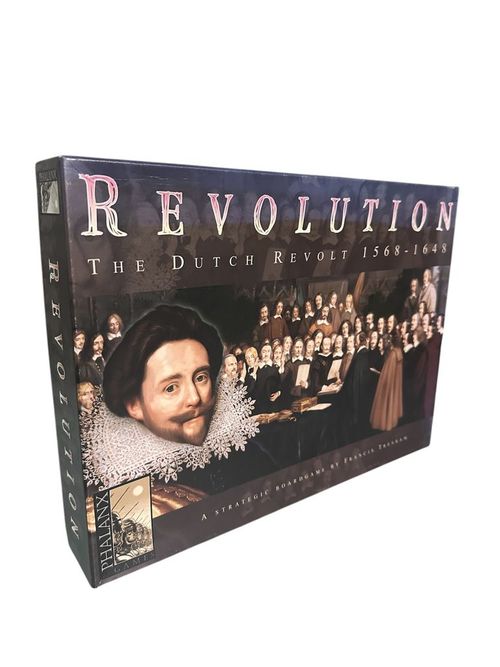
Revolution: The Dutch Revolt 1568-1648
Revolution: The Dutch Revolt 1568-1648 Rulebook
Table of Contents
Table of Contents
1.0 Introduction
Revolution: The Dutch Revolt 1568-1648 is a game that simulates, in very broad terms, the independence movement in the Spanish Netherlands during the 16th and 17th centuries. During these events, which are often known as the "Eighty Years' War", the northern provinces became independent and established the present day Netherlands. In the south the revolt was less successful and Belgium did not emerge as an independent state until after the Napoleonic era.
Revolution: The Dutch Revolt 1568-1648 is a game of skill for 2 to 5 players. It depicts a power struggle in which each player represents one of 5 principal factions involved: Catholics, Habsburgs, Nobility, Burghers and Reformers. Some factions tend to have similar outlooks but they are not allies - each has its own motives and objectives. These may be summarized, very briefly, as follows:
- The Catholics want to preserve the status quo in the area, implying the supremacy of the Catholic faith and secular rule by Spanish (Habsburg) masters.
- The Habsburgs (who are Catholic) are determined to govern the provinces under their military authority, and quell any rebellion.
- The Nobility are Netherlanders who, initially, owe their position to the Habsburgs and who obviously wish to maintain their own power and estates.
- The Burghers want to be free of the excesses of taxation and centralization so that trade and industry can flourish. They see the value of religious tolerance in helping to bring this about.
- The Reformers want religious freedom, which means in practice that many people will become Protestants, and hope that this will bring peace to the region.
Initially the Catholics and the Habsburgs are very powerful with the other factions gaining in importance as the revolt becomes more organized. The actual struggle saw periods of open warfare and others of uneasy peace with the reforming factions becoming more established, particularly in the north and along the coast. The once all powerful Habsburg armies were slowly driven out of these areas although the Catholics were allowed to retain some of their influence. The local Nobility, who were initially Catholic but with local sympathies, succeeded or failed according to their willingness to accept the changed circumstances.
This game cannot hope to be a detailed re-enactment of the Eighty Years' War, which was an extremely complex situation. But it does set out to capture the flavor of this historically interesting period. The shifting balance of power, the temporary alliances and the use of available resources, including those of foreign sympathizers and allies, and the need to focus these efforts on objectives of key significance are all well represented.
There is an element of warfare in this game in the form of battles and sieges but the main theme is built on a combination of economic and political control.
2.0 Components
Each copy of Revolution: The Dutch Revolt 1568-1648 contains:
- 1 game board
- 41 playing cards
- 416 game pieces
- 1 player aid card
- 1 rules booklet
Note: The card deck includes 4 cards for The Prince/Borgia. These are not used in Revolution but may be added to The Prince/Borgia. Check out www.phalanxgames.nl for this fine game.
If any of these parts are missing or damaged, we apologize for the inconvenience and ask that you contact us to receive any replacement parts needed. Please send your correspondence to: Phalanx Games B.V., Attn.: Customer Service, Postbus 60230, NL – 1320 AG Almere, The Netherlands, Email: [email protected]
2.1 The Game Board
The game board covers an area larger than the present day Netherlands and Belgium. The eastern boundary is taken as the Rhine although states on the left bank of this river were part of the Holy Roman Empire and not directly involved in the revolt. There is no obvious southern boundary because the French helped themselves to Artois and certain other territories at about this time.
The game board shows provinces, cities and towns. The resource potential of each province is shown by a number in a shield called the Province Limit. This is the maximum number of resource playing pieces that the province can maintain.
Several provinces (usually) form a region. To speed up play, military operations take place in regions rather than provinces. Some provinces were not very important. Most regions include several provinces, although the provinces of Holland and Utrecht are each a single region. Each region includes a Command Block of square spaces in which armies present in that region are displayed. Each region has a broad outline and the provinces in that region are shown as different shades of the same basic color.
Towns are outlined with a single square, and cities with a double square. Towns are less important and are easily taken, whereas cities can only be captured by siege.
Note: The game requires to differentiate between towns and cities. This has inevitably caused some arbitrary distinctions. In fact, most of the places featured where considered to be cities.
In these rules (not on the game board) city names are always written in CAPITALS to avoid confusion with provinces of the same name. Similarly, the term "province" is written in CAPITALS to denote the "countryside" of the named provinces and to differentiate it from the term as used to denote the entire named province (countryside, towns, and cities).
Rivers are shown as blue lines on the game board. They are important for movement (see 6.13).
A special feature of Revolution: The Dutch Revolt 1568-1648 is the concept of support. Certain factions benefit from resources provided by sympathetic groups such as the Calvinists and the London Merchants who are outside the contested area. This support is depicted in Support Boxes near the edges of the game board along with the names of the factions which can benefit from them. Each box has space for 2 or more player pieces according to the level of support which can be provided. Playing pieces may only be moved from support as allowed by the instructions in the boxes.
The game board also includes various status charts giving the following information:
- Allegiance of Bishoprics (Catholic or reformed),
- Status of established Universities (Catholic or reformed),
- Score at the end of a game turn,
- Playing order in the current game turn (called the game turn order),
- Number of game turns that have been played,
- Allegiance of Citizens
2.2 The Playing Pieces
Cardboard playing pieces are used for a variety of functions. The number of pieces available to players depends on how many are taking part in the game, see below. Each player receives a set of playing pieces in a distinctive color - Catholic - yellow, Habsburg - red, Nobility - green, Burghers – blue, and Reformers - orange.
2.2.1 Army Pieces
Each faction has army playing pieces in its color. Armies are placed in the Command Blocks of a region.
2.2.2 Resource Pieces
Each faction possesses resource playing pieces in its color. The top side of a resource piece is placed into provinces, cities, towns, and Support Boxes. The bottom side of a resource piece functions as "money" and is used in Support Boxes or near the game board on the table as treasury.
Note: The portrait on the front side of a resource piece does not necessarily depict a leader of the respective faction.
2.2.3 Neutral Pieces
The game contains 47 grey neutral or uncontrolled playing pieces that operate on the game board. They represent the uncommitted population.
2.2.4 Water beggars
During the game 1 or more of the 3 Water beggar playing pieces may enter the game.
2.2.5 Victory Point Markers
Each player records his Victory Points with the victory point marker of his color on the Scoring Track on the game board.
2.2.6 Game Turn Marker
The current game turn is recorded with the game turn marker on the Game Turn Record Track on the game board.
2.2.7 Status Markers
Each player has several status markers that are used for various game functions. There are also a few black status markers. The status markers are backprinted in a different color.
2.3 The Playing Cards
There are 41 playing cards in the game. They are divided into Province, City, and Faction cards.
2.3.1 Province Cards
The player/faction that controls a province receives the respective province card. A province card shows the amount of tax that may be raised by the province, its Province Limit, its Victory Point value, and, for provinces too small to pay tax, its Victory Point Value at the end of the game.
2.3.2 City Cards
City cards are held by whoever controls those cities. The player/faction holding a city card, receives new playing pieces each game turn. In addition, several city cards list towns and cities. If these are controlled by the same faction, they generate new playing pieces as well. Note: This represents the benefits of commerce along recognized trade routes such as rivers.
Some city cards also have symbols for being a bishopric and/or a having a university.
2.3.3 Faction Cards
Each player/faction receives its faction card. These cards are placed on the spaces numbered "First" to "Fifth" of the game board to indicate the game turn playing order which will change from turn to turn.
2.4 The Player Aid Card
The player aid card should be placed near the game board. It records the Sequence of Play and has several charts.
3.0 Starting Play
Revolution: The Dutch Revolt 1568-1648 is a 2 to 5 player game. There is no ideal number because each set-up will produce its own characteristics and challenges. It is necessary to reduce the number of factions represented when there are less than 5 players.
Methods of faction selection: Players can either have the youngest player select the first faction(s), with the other players selecting a faction afterwards. Alternatively, the faction cards are shuffled and dealt to the players.
3.1 Two Player Games
In two player games, one player controls the Catholics and the Habsburgs and the other the Burghers and the Reformers. The victory points gained by each player's factions are added together to determine the winner. Obviously, "allied" factions will support each other and it is desirable for both factions under a player's control to gain a respectable score rather than that one should succeed at the expense of the other. The Nobility does not feature in 2-player games.
3.2 Three Player Games
Three player games give rise to a wider range of possibilities than the other versions. The Catholics should always be included but the other two factions are chosen by the players from those that are available. If players find it difficult to decide it is suggested that the Catholics, Nobility and Reformers should be chosen.
3.3 Four Player Games
In four player games the Catholics, Habsburgs, Burghers, and Reformers are used. The Nobility does not feature in four player games.
3.4 Five Player Games
In five player games each player plays a different faction.
3.5 The Number of Playing Pieces
In two player games each faction receives 40 resource pieces and 6 army pieces. Each player controls two factions.
In three player games each faction receives 56 resource pieces and 8 army pieces.
In four player games each faction receives 40 resource pieces and 6 army pieces.
In five player games each faction receives 32 resource pieces and 6 army pieces.
Surplus playing pieces are put aside and not used. All neutral playing pieces are placed within easy reach near the game board.
3.6 Set Up
The game turn marker is placed in the "0" space of the Game Turn Record Track. The victory point markers are put in the "Score" space of the Scoring Track. The 3 Water beggar pieces are placed in their boxes on the game board.
Now the players set up their pieces in the following order:
- Catholics: 8 yellow resource pieces are placed on the game board, one each on Arras, KÖLN, Leuven, Mons, LIEGE, Tournai, Trier and UTRECHT. The Catholics player also turns 4 resource pieces over to their "money" side. They are his treasury.
- Habsburgs: 7 red resource pieces are placed on the game board, 2 each on ANTWERPEN and LUXEMBOURG plus 1 piece each on Duinkerken, Nijmegen and Valenciennes. The Habsburgs also start with 2 army pieces deployed. These may be placed on any of the orange squares in a Command Block (one army per orange square).
- Nobility: 6 green resource pieces are placed on the game board, 1 each on AACHEN, AMSTERDAM, Breda, BRUXELLES, Cleve and Delft. The Nobility also places 2 pieces each in the French Support Box and in the Support from the Emperor Box.
- Burghers: 5 blue resource units are placed on the game board, 1 each on Arnhem, Dordrecht, HAARLEM, Middelburg and Rotterdam. 3 additional Burgher pieces are placed in the London Merchants Support Box and 1 in the Huguenots Support Box.
- Reformers: 4 orange resource playing pieces are placed on the game board, 1 each on Alkmaar, BRUGGE, GENT and LEIDEN. 4 more pieces are placed in the Calvinists Support Box on the diagonally divided squares.
Note: Units are only placed for the factions taking part in the game.
Now 2 grey neutral pieces are placed in any unoccupied city and 1 grey piece in any unoccupied town.
Note: In 5-player games there are no unoccupied cities.
Players should keep their treasury and their unused pieces clearly separated and visible to the other players on the game board.
4.0 General Course of Play
Revolution: The Dutch Revolt 1568-1648 is played in game turns. The opening game turn (game turn "0") is somewhat abbreviated because of the limited forces in play at this stage. This game turn is followed by 5 full game turns.
The opening game turn consists of 8 phases. A full game turn may have up to 20 phases although some are not always relevant and are simply skipped.
4.1 Phases
Each phase is played separately by each faction in turn. Each faction completes a phase before the next faction does so. Factions and phases that are not represented or relevant are skipped.
Once all factions have finished a particular phase, the next one is played. Once all phases in a game turn have been completed the next game turn commences. At the end of the last game turn the players determine the winner.
4.2 Order of Play
4.2.1 Opening Game Turn
On completing the opening game turn, the players should have a much better idea of how the game works. First the game turn marker is placed in the "0" space of the Game Turn Track on the game board.
The opening game turn (game turn "0" on the game board) is played in the following order:
- Catholics,
- Habsburgs,
- Nobility,
- Burghers,
- Reformers
Non-playing factions are skipped.
The phases in the opening game turn are:
- Support Movement: from Support Boxes,
- New units: the addition of new playing pieces to the game board;
- Conflict: where Province Limits are exceeded;
- Neutral units: neutral (uncommitted) playing pieces are added;
- Overflow: when necessary;
- Movement: within provinces;
- Assignment: cities, provinces, bishoprics and universities;
- End Phase: add victory points; define the game turn order.
Afterwards, the game turn marker is placed on the "1" box on the game board.
4.2.2 Game Turns 1 - 5
Game turns 1 to 5 are played in game turn order which is defined in the End Phase of the previous game turn.
The phases in these game turns are:
- Tax Raising from provinces and cities;
- Support Movement from Support Boxes;
- Army Maintainance;
- Raising new armies;
- Battles;
- Laying Sieges;
- Water beggars;
- Army Movement;
- Military Influence;
- New units: new playing pieces are added to the game board;
- Conflict: where Province Limits are exceeded;
- Neutral units are added,
- Overflow: when necessary;
- Movement: within provinces;
- Resolving Sieges;
- Influence the allegiance of citizens (plus resulting adjustments);
- Assign provinces and cities;
- Assign bishoprics;
- Assign universities;
- Status.
Afterwards the players proceed to the next game turn, unless it was the last. In this case, the winner is determined.
4.3 Objectives
All players/factions try to amass victory points. They receive victory points for controlling cities and provinces. In addition, each faction has a specific objective.
4.3.1 Cities and Provinces
Cities score 1 victory point each. The more important provinces score 1 or 0.5 victory point each, as shown on the province card. Small provinces score the values shown on the province card at the end of the game only; never in earlier game turns.
4.3.2 Faction Objectives
The objectives specific to a faction are:
- Catholics: Bishoprics - the Catholic faction gains 1 victory point for each bishopric that remains un-reformed. (There are 6 bishoprics in all on the game board.)
- Habsburgs: Garrisons - the Habsburg faction gains 1 victory point for each region that contains a Habsburg army. Only 1 victory point per region is counted irrespective of the number of Habsburg armies there may be in that region.
- Nobility: Population owing allegiance to the Nobility score for that faction at the rate of 1 victory point for every 5 resource pieces in 3-player games and 1 victory point for every 3 resource pieces in 5-player games. The relevant population is the population present in PROVINCES or towns but not that in cities.
- Burghers: Towns - trading towns (their name is in white print on the game board) each gain 1 victory point for the Burghers if under their control. There are a total of 7 of these towns.
- Reformers: Universities - the Reformer faction gains 1 victory point for each reformed university. There are a total of 7 universities.
4.4 Scoring
The players total their victory points (provinces, cities and the respective objective) at the end of each game turn. The victory point markers are then placed in the corresponding box on the Victory Points Track of the game board.
Important: The players do not add their victory points from turn to turn (example: first turn: 10 victory points, second turn: 8 victory points = 18 victory points). Instead, the victory points are recalculated each turn anew from 0.
Factions with fewer victory points have an advantage in choosing where to be placed in the game turn order of the next game turn, see 5.8.
4.5 The Winner
The player whose faction has the most victory points at the end of the fifth game turn is the winner. In the unlikely event that two (or more) players have the same number of victory points, both (or all) win.
4.6 Negotiations
Apart from matters actually covered by the rules, players may negotiate among themselves in any way they wish: threats, promises, deceit and bribery may all be used freely. Secret negotiations are not allowed.
5.0 Game Turn "0"
5.1 Support Movement
The Nobility, the Burghers and the Reformers have playing pieces in Support Boxes which may now be brought onto the game board if desired.
- Playing pieces moved from out-lined squares are added to the game board.
- Playing pieces moved from solid colored squares may only be added to the faction´s treasury. They are placed near the game board, back (money) side up.
- Playing pieces from half white, half colored squares can be added either to the game board or the treasury.
Movement is always optional, never mandatory. The top side of a resource piece is placed into PROVINCES, cities, towns, and Support Boxes. They may later be re-positioned in specific cities and towns. The Province Limits are disregarded at this time, however, see 5.3 and 5.5.
5.2 New Units
New resource pieces are added to the game board or to Support Boxes. In this game turn the factions receive the following number of new pieces:
- Catholics: 7
- Habsburgs: 6
- Nobility: 5
- Burghers: 4
- Reformers: 3
These new resource playing pieces may be added to PROVINCES or Support Boxes. However, the factions may only add pieces to provinces in which they are already present. In addition, they are not allowed to place more than double the number of their pieces in a province.
Example: The Nobility has 1 resource piece in Jülich (in the city of Aachen). It may only place a maximum of 2 new resource pieces in this PROVINCE. It is not necessary to place pieces in a specific city or town within a province at this time.
Any vacant spaces in Support Boxes may be used if they are appropriate to the faction (see the game board). There is a maximum of 1 playing piece per Support Box space.
Note: The Huguenots Support Box may contain either Burgher or Reformer pieces but not both at the same time. The Huguenots were a French anti-Catholic faction who, among other things, preyed on Spanish treasure ships carrying bullion to pay for their campaign in the Netherlands.
5.3 Conflict
If the number of resource playing pieces in a province (including pieces in towns and cities) now exceeds the Province Limit, and there are pieces from more than 1 faction present, the excess must be removed by Conflict. This is done by removing resource playing pieces from the province, one at a time, until the necessary reduction in numbers has been completed. Each faction which is present removes 1 piece in turn, starting with the faction that has the least number of pieces present, followed by the next largest faction etc. Factions with the same number of pieces present lose a piece simultaneously. In these cases the number of pieces which remains after Conflict may be actually less than the Province Limit. This process is repeated as many times as is necessary but it ceases when either the Province Limit is reached or there is only 1 surviving faction there.
Neutral playing pieces are treated as a separate faction for the purposes of Conflict.
5.4 Neutral Units
Further neutral, uncommitted playing pieces are now added to the PROVINCES where necessary, to bring the number of all resource playing pieces in each province up to 1 less than the Province Limit.
5.5 Overflow
Design Note: It is unlikely that Overflow will be needed at this early stage in the game because Conflict will have "trimmed the number of playing pieces down" to the permitted Province Limit in most cases.
If, however, a faction has more resource playing pieces in a province than the Province Limits permit after Conflict has removed all those belonging to other factions, then the excess may overflow into adjacent PROVINCES when this is possible. See 6.13 for how this is done.
5.6 Movement within Provinces
Factions may now move their resource playing pieces within a province. The first player in turn order sets the sequence in which the provinces are checked. If movement is proposed in a province, the faction with the most playing pieces (exception: neutral pieces) in it moves all it's pieces first. This player disregards the locations of all other pieces while re-positioning his own. He may take pieces from other factions out of towns or cities and place them into the PROVINCE.
This process continues in descending order of faction size but players must respect positions already occupied. If two or more factions are the same size the players concerned move according to 4.2.1.
Note: Only 1 resource playing piece may occupy a town. There is no limit to the number of pieces placed in a city. Playing pieces from more than one faction may occupy a city.
Neutral pieces may be displaced by any faction, regardless of the number of neutral pieces in a province. At the end of the process, neutral units must be placed into any vacant city (with two pieces) or town (with one piece) where pieces are available in the surrounding PROVINCE. Other neutral units are not moved.
Example: There are 2 Catholics, 2 Nobility and 1 Neutral in Brabant. The Catholics move their pieces first (due to turn order) and place 1 unit in the town of Leuven and 1 unit in the city of Bruxelles. The Nobility then move their units and place them both in Bruxelles. The Neutral, which was added to the PROVINCE (5.4) remains unmoved.
5.7 Assignment
Now cards are handed out to players. City and province cards are given to the faction that holds a clear overall majority (having more pieces than all other factions together) in resource playing pieces in that city or province. If no faction has an overall majority – neutral pieces being deemed a faction - the card is not issued.
Note: During Assignment, resource playing pieces in cities do not count towards the overall majority in provinces, only resource pieces in towns or "in the country" (in the PROVINCE but not in cities or towns).
Example: There are 4 pieces in KÖLN – 2 Catholic, 1 Nobility, and 1 Habsburg. The KÖLN city card is not handed out to the Catholics because 2 out of 4 is not a clear majority.
Cards are not handed out if they would go to the neutral "faction".
The status of bishoprics depends on the faction controlling the province, not the cathedral city or town.
If the province card is held by the Catholic faction, the bishopric will be strongly Catholic, if the province card is held by the Burghers it will be reformed and if it is held by the Reformers it will be strongly reformed. In all other situations the bishopric will be Catholic.
Colored status markers are placed on the Bishoprics Chart on the game board to denote their status, the color denoting the faction holding the province. A black marker is placed in the Catholic (not strongly Catholic) space when no faction has an overall control or when neutral playing pieces are in the majority.
The status of universities depends on the faction controlling the town (the faction occupying it) or city. KÖLN and Leuven universities are always Catholic unless the city or town is under Burgher or Reformer control, in which case they will be reformed. The other universities only exist if the city or town is under Reformer (not Burgher) control in which case they will be reformed.
If KÖLN or Leuven are Catholic, place a yellow status marker in the space on the Universities Chart on the game board. If they are reformed, place an orange status marker. If another university exits, place an orange status marker in the appropriate space.
Finally, status markers are placed on the following positions of the Allegiance of Citizens Track (always counting from the left): Aachen: 3rd space, Amsterdam: 2nd, Antwerpen: 4th, Brugge: 5th, Bruxelles: 2nd, Gent: 5th, Haarlem: 4th, Köln: 2nd, Leiden: 5th, Liege: 3rd, Luxembourg: 3rd, Utrecht: 4th.
The colors are those of the faction which controls that city. If no one controls it, a black marker is placed.
5.8 End Phase
Now each faction adds victory points and marks them with their victory point marker on the Scoring Track (see also 4.4).
Every city card held is worth 1 victory point. Every province card held is worth 0, 0.5 or 1 victory point, as noted on the card.
In addition, each faction receives the following victory points:
- Catholics: 1 victory point for each Catholic or strongly Catholic bishopric.
- Habsburgs: 1 victory point for each Command Box in which they have an army piece. This means that they will get 2 victory points because they started with 2 armies.
- Nobility: gains victory points for all their resource playing pieces which are on the game board other than those in cities or Support Boxes. Divide this total by 3 in a five player game and by 5 in a three player game and round up.
- Burghers: 1 victory point for each town they control with the name in white print.
- Reformers: 1 victory point for each reformed university.
Finally, the game turn order for the next game turn is determined. This order applies for all phases of the next game turn.
First, the player with the most victory points places his faction card on the table. He cannot influence his position in the game turn order. Now the player with the second most victory points chooses whether to go before or after the first player (and places his faction card either in front or behind the faction card of the first player). The player with the third most victory points chooses a position relative to the first two, going in front, after, or between them as desired. This process continues until all players have placed their faction cards. They are then placed on the game board in the appropriate spaces.
If 2 (or more) players have the same amount of victory points, see 4.2.1 to determine who has to place his faction card first.
Note: In 2-player games each faction is treated separately in determining the game turn order.
Example: In a 5 player game, the Burghers and Reformers are tied for last with 4 VP each at the end of Turn 0. The Burghers place their faction card fourth and set it at the right end of the turn order. The Reformers place last and set their card at the left end of the turn order, going first for Turn 1.
6.0 Standard Game Turns
The game is now played for 5 game turns that are all following an identical sequence, see 4.2.2. The phases of a game turn are played in game turn order (see 5.8) with each player completing a phase before the next player plays. Not all phases will always be relevant and the unwanted ones are simply skipped.
6.1 Raise Taxes
Each player/faction raises tax on those provinces and cities for which it holds the relevant card. Provinces pay a fixed sum in tax as shown on the card. The tax raised on all the faction´s provinces is added together with odd fractions being ignored. Cities may be taxed at any rate from 1 to 3 money pieces each (player´s choice) but all cities controlled by a faction must be taxed at the same rate. A shortage of available playing pieces limits the amount that can be raised.
Each faction collects its provincial income and 1 unit per city card held, up to the amount of pieces in stock. The cities can then be taxed an additional 1 or 2 per city if and only if faction stock is available to raise the same amount of tax from each city card held.
The players put their money playing pieces from taxation into their treasury.
6.2 Support Movement
6.2.1 Movement from Support Boxes
Playing pieces may now be moved from Support Boxes into PROVINCES on the game board or into the faction´s treasury. Movement from Support Boxes is optional. Any number of pieces may be moved. Factions may only move their own pieces.
Pieces in uncolored spaces of Support Boxes (resource playing pieces) may be moved to the PROVINCES indicated. Pieces on solid colored spaces of Support Boxes (money playing pieces) may only be added to the faction's treasury. Pieces on half colored spaces may be used in either manner (and are turned to their respective sides).
Resource playing pieces entering PROVINCES may exceed the Province Limit although over-population will be resolved later, see 6.11.
6.2.2 Huguenot Interception of Spanish Treasury
Playing pieces moving from the Spanish Treasury Support Box may be intercepted by "the Huguenots"; i.e., playing pieces in the Huguenots Support Box, if these are present. Each piece in the Huguenots Support Box may intercept 1 piece in the Spanish Treasury Support Box if an attempt is made to move it from the box. Pieces seized in this way are placed in the treasury of the intercepting faction instead of being moved to the treasury of the original owner.
This is done by exchanging the piece with one belonging to the intercepting faction, the original piece then reverts to the original owner. Players are not allowed to retain each other´s playing pieces.
Pieces in the Huguenots Support Box used for interception do not count during the New Units phase and can not be used for the rest of the game turn. Turn over the pieces used for interception to indicate that they can not be moved onto the game board, intercept another piece from the Spanish Treasury Support Box, or count for new units. Additionally, the intercepting faction is limited by its stock available for interception. If the intercepting faction has only 1 unit in stock, they can only intercept one unit being moved from the Spanish Treasury Support Box even if it has two pieces in the Huguenots Support Box.
Example: The Burghers have 2 pieces in the Huguenots Support Box but only 1 piece remaining in their stock. The Catholics have 5 playing pieces in the Spanish Treasury Support Box which they attempt to move to their own treasury. The Burghers decide to seize 1 piece (the most available in stock) from the Catholics. The Catholics thus move 4 pieces to their own treasury and return the fifth one to their "stock". In exchange, the Burghers take their last piece from their stock and put it into their treasury and turn over one piece in the Huguenots Support Box. The other piece remains face up and can be moved onto the game board (if the Burghers have not completed Support Movement yet) or counted for New Units later.
If both the Catholics and the Habsburgs have units in the Spanish Treasury Support Box, and both decide to move these pieces into their faction's treasuries, it is important to note that each piece in the Huguenots Support Box may only seize 1 piece per game turn. Therefore, if the Huguenots have already taken action against the first faction to play, the second faction will be able to slip through without loss. Pieces in the Huguenots Support Box may, of course, decide to wait for the other faction, or even divide their forces (if there are 2 pieces in the box) so as to be able to take 1 piece of treasury from each faction.
Design Note: It is rarely worth moving pieces from the Spanish Treasury when the Huguenots are going to benefit in this manner.
6.3 Maintaining Armies
Armies may either be maintained, disbanded or abandoned. Maintaining or disbanding cost that faction 1 money piece from the treasury per army (exception: it costs 2 pieces to maintan each Catholic army).
- Maintained armies stay in place.
- Disbanded armies are removed from the game board and may be raised again, see 6.4.
- Abandoned armies "loot a town" or resource playing piece in the region (owning player´s choice). In the first case the player simply announces that the army is "looting a town" and places a neutral playing piece in the PROVINCE where the town is located. In the second case he takes away 1 resource piece in the region and replaces it with a neutral piece. An abandoned army cannot affect a piece in a city. Abandoned armies must loot to the maximum extent possible. In the event that there are no neutral playing pieces available, a resource piece must be looted. In this case, it is simply removed and no neutral piece is added to replace it. The army playing piece is turned over to indicate that it cannot take further action and is removed from the game board at the end of the game turn. For the rest of the turn, an abandoned army has minimal impact on the game. It takes up a space in the Command Block, thereby reducing the maximum number of "active" armies in that region by one as well as possibly blocking army movement into that region. It is also unavailable to the faction that abandoned it for raising in any region on the game board. Abandoned armies have no impact on battles, sieges, or Military Influence.
Note: Abandoning armies deliberately is a permitted tactic.
If you use money pieces to maintain or disband armies, they are returned to the faction's "stock" afterwards.
6.4 Raising new Armies
Each faction may now raise a maximum of 3 armies. These must be paid for from their treasury, the pieces paid then revert to the "stock". The costs of raising armies are as follows (in money playing pieces):
| Faction | 1 army | 2 armies | 3 armies |
|---|---|---|---|
| Catholics | 3 | 7 | 11 |
| Habsburgs | 3 | 6 | 10 |
| Nobility | 2 | 5 | 8 |
| Burghers | 2 | 4 | 7 |
| Reformers | 2 | 4 | 6 |
New armies are placed on the game board in a vacant space of a Command Block. A Command Block usually covers several provinces; each of these areas of military control is called a region. Armies may only be brought onto the game board in a region in which the faction is already represented by 1 or more existing armies or resource playing pieces.
All additions are made to vacant spaces in a Command Block, working from the left.
In 2-player games all 4 factions raise their own armies in the usual manner but armies on the same side are "allied" and do not fight each other. However, they count as different factions from the point of view of "stand offs" in battle (see 6.5) and Military Influence (see 6.9).
6.5 Battles between Armies
Battles occur if armies from different factions occupy the same Command Block - unless there are only 2 armies present in which case there is a "stand off". The armies remain in place and exchange insults. In 2-player games armies controlled by the same player are allied and do not fight each other.
When more than 2 factions (or more than 2 armies from 2 factions) are present the most opposed (regarding their aims and general philosophy) factions are involved first. The "alignment" of the factions is Catholic – Habsburg – Nobility – Burgher – Reformer. The Catholics and the Reformers are therefore more opposed than the Nobility and the Burghers.
The survivors may then be involved in battle again, this process continuing if necessary.
When several factions are represented in a Command Block they should be arranged regarding their "opposition/alignment" (as above). Armies are now taken from opposite ends of the Block simultaneously until either:
- There is only 1 faction left,
- Only 2 armies remain in a "stand-off" as above,
- All remaining armies are allied (2-player games only).
Example 1: A Command Block contains 1 army each from the Nobility, the Burghers and the Reformers. The Nobility and the Reformers, being the most opposed factions, will eliminate each other leaving the Burgher army untouched.
Example 2: In a 4-player game a Command Block contains 1 Catholic, 2 Habsburg and 2 Burgher armies. The Catholic and 1 of the Burgher armies eliminate each other first, then a Habsburg army and the remaining Burgher army eliminate each other, leaving the surviving Habsburg army in place.
Example 3: 2 Catholic armies and 2 Nobility armies face each other. Both sides lose an army and the remaining pair "stand each other off".
"Surviving" armies are placed in the left-most space(s) of the Command Block.
6.6 Lay Sieges
After all battles have been resolved any remaining armies may lay siege to any cities in the region. To indicate that a city is under siege, an army is placed on top of it. Resource pieces may not be added to, or removed from, a city while it is under siege. Cities which are under siege are taken in the Resolve Sieges phase (see 6.15) but in certain cases it is possible for a siege to be lifted by the Water beggars, see 6.7.
- Armies may not besiege a city controlled by their own or, in a 2-player game, an allied faction.
- Armies may lay siege to a city that contains resource pieces of the same faction, as long as resource pieces from other factions are in that city as well and it is not controlled by their own.
- Uncontrolled cities may be besieged by any faction.
- Armies which are "stood off" may not lay siege.
- Towns are not subject to siege but they may be taken by Military Influence, see 6.9.
6.7 Water beggars
The Water beggars are neutral, independent units with their own playing pieces.
They may only be "hired"/used by the Burgher or Reformer factions. Their actions are restricted to the provinces of Gelderland, Holland, Overijssel, Utrecht, Zeeland and the Lands of the Generality.
Up to three Water beggars playing pieces may be hired at a cost of 2 Guilders/money pieces per Water beggars. Only 1 faction may use the Water beggars in any game turn, the relevant factions having the opportunity to hire them in game turn order. Their services may not be retained for a future game turn but they may be hired/used again.
Each Water beggars may be used to eliminate an enemy army, raise a siege, lay siege on their own account, loot a town or prevent the exercise of Military Influence. All according to their numbers, the number of armies in the region and the opportunities offered. If several Water beggars playing pieces are hired, they may be raised in 1 or more regions.
6.7.1 Eliminating Armies
If the Water beggars pieces exceed the total number of armies in the region, they can eliminate the most Catholic army. A Catholic army is more Catholic than a Habsburg army, which in turn is more Catholic than a Nobility army. They will not attack a Burgher or Reformer army.
Afterwards, the Water beggars involved will disband and return to the Water beggars Box on the game board.
6.7.2 Raising a Siege
Water beggars pieces can raise any sieges, irrespective of which factions are involved, if they equal or exceed the total number of armies present in that region. The besieging army piece or pieces are then returned to the Command Block, leaving all pieces in the city or cities that were under siege unaltered. All Water beggars involved will then disband as above.
6.7.3 Looting a Town or Besieging a City
If there are no armies present in the region, each Water beggars piece may loot a town or, alternatively, two Water beggars pieces may besiege a city (no matter who occupies the city). In the Resolve Sieges phase the pieces in a city besieged by the Water beggars are replaced by neutral pieces, if available, or otherwise simply removed.
If a town is looted, a neutral playing piece is simply placed in the PROVINCE where the town is located. The Water beggars piece(s) involved will then disband as above.
6.7.4 Preventing Army Movement
The presence of a Water beggars piece in a region can prevent one "hostile" army (Catholic, Habsburg or Nobility) from leaving that region in the Army Movement phase (see 6.8), or from exercising Military Influence, see 6.9.
All active Water beggars units disband automatically at the end of the Resolve Sieges phase, see 6.15. Disbanded Water beggars are returned to their boxes on the game board.
6.8 Army Movement
Each army may be moved to a vacant space in an adjacent Command Block as permitted by the connecting lines on the game board. This does not cost any money.
Armies may be moved out of a "stand off" but the presence of a Water beggars piece can stop the first army from leaving that region.
Province Limits and resource playing pieces on the game board do not affect army movement.
6.9 Military Influence
An army may use Military Influence to convert 1 other faction´s resource playing piece (or a neutral piece) in the region to 1 of its own color by exchange. Military Influence may only be applied to playing pieces in towns or in the "country" (in a PROVINCE), not to those in cities. The player simply removes the piece in question and puts a resource playing piece of his color in the same place.
Military Influence may not be exercised by armies that are in a Command Block that also contains opposing armies. Each Water beggars playing piece present can prevent 1 army from applying Military Influence and then disband.
An army that is besieging a city is temporarily not in a Command Block and does not affect Military Influence. Any army returned to the Command Block by its siege being raised by Water beggars will stand off opposing armies in the same Command Block. However, if unopposed, such an army would not be able to exert Military Influence itself.
6.10 New Units
Each faction receives new playing pieces each game turn. These playing pieces are taken from the "stock" and placed on the game board in game turn order. The number of pieces taken is determined as follows:
Cities:
- 1 piece per city card held plus an additional piece for each city and town named on it and controlled by the same faction. Whether controlled cities are besieged or not has no impact on new unit generation. (A city is controlled if the faction holds the city card. A town is controlled if it is occupied by the faction.)
Towns:
- 1 piece per town controlled.
Country:
- 1 piece for every 5 pieces on the game board in a PROVINCE but not in a city or town. This total is rounded down when necessary.
Support:
- 1 piece for each piece in a Support Box.
Example: The Catholics control the Cities of KÖLN and UTRECHT. They also have a resource piece in LEIDEN but they do not control this city and therefore it is not counted. They also occupy, and therefore control, Cleve. They have additional pieces in the PROVINCE of Artois (1), Cleve (1), Köln (3) and Utrecht (2). Finally, they have 2 pieces in the Jesuits Support Box.
They gain 1 piece for KÖLN. As they do not control Dordrecht, LEIDEN or Nijmegen they do not derive an additional benefit from KÖLN. They gain 1 piece for UTRECHT plus 2 extra pieces for Cleve and KÖLN which are named on the UTRECHT card. They get the following number of new pieces: 1 + 3 = 4 for cities, 1 for towns, 8/5 = 1 for pieces in PROVINCES/in the country plus 2 for pieces in Support Boxes. This results in a total of 8 new pieces.
Important: Each faction is allowed to receive 7 new playing pieces when the above process would give a lower figure.
However, if a faction does not have sufficient pieces available in "stock", it may not get the above minimum. In this case the faction gets as many pieces as are left in "stock".
Note: It is important which faction controls a city. Individual pieces in a city do not count.
New playing pieces are added to PROVINCES in which the faction already has resource pieces, or to Support Boxes. If a faction controls a province, and has at least one piece in it, it may add any number of pieces to that PROVINCE, otherwise the faction may not add more than the number of pieces it already has in the province (cities, towns and "countryside"). It is sufficient to merely place new pieces anywhere in a PROVINCE. Their final location will be resolved in Movement within Provinces, see 6.14.
Pieces that are added to Support Boxes may be placed on any vacant space in a Box which that faction is entitled to use.
The restriction on the adding of pieces to provinces that are not controlled by a faction can be critical if the faction does not control any province. This may result in a faction being unable to place the newly raised pieces. Pieces that cannot be added to the game board or to Support Boxes are placed in the faction´s treasury, "money" side up.
6.11 Conflict
The number of resource playing pieces in a province (including pieces in towns and cities) must be reduced if the previous phases have caused the Province Limit to be exceeded. Exception: Resource pieces in cities under siege do not count for the Province Limit. Simply disregard them. Pieces are then removed 1 at a time from each faction in turn, beginning with the smallest faction, then the next smaller faction, and so on. The process is repeated until either the number of pieces remaining does not exceed the Province Limit or until only 1 faction remains. At this point the removal of pieces stops.
If 2 or more factions have the same size they lose pieces simultaneously. When pieces are lost in this manner it can result in the number of surviving pieces being less than the Province Limit.
For the purposes of Conflict neutral (grey) pieces are considered to be a faction.
Units removed by Conflict are returned to the player´s "stock".
6.12 Neutral (uncommitted) Pieces
Neutral (grey) pieces are now added to all PROVINCES where there is room. In each province the players place as many neutral pieces as to reach but not to exceed the Province Limit.
Note: For this phase, resource pieces in cities under siege do count for the Province Limit.
Neutral units are not added to Support Boxes.
In rare cases, where there are not enough Neutral pieces available to reach the Province Limit in all provinces, these pieces are distributed as evenly as possible (i.e. first one piece is placed in all PROVINCES, then a second, etc.). The first player (in current Turn Order) picks PROVINCES if an equal distribution is not possible.
6.13 Overflow
After Conflict has eliminated any opposing pieces, a faction may still have more pieces there than the Province Limit allows. These resource pieces may Overflow into adjacent provinces, if there is room for them (i.e., a player may not Overflow into a province that has reached its Province Limit). Overflow is performed in game turn order, each faction completing all its moves before the next faction starts moving.
Units may Overflow into adjacent provinces or non-adjacent provinces that can be reached by river (blue lines on the game board). Movement by river may not go beyond a city or town that is controlled by a rival faction (other than the neutral faction).
Note: Zeeland is considered to be adjacent to Holland and the Lands of the Generality.
Examples: Pieces from Gelderland may Overflow into the adjacent provinces of Cleve, The Generality, Holland, Overijssel and Utrecht. By river they may reach Geldern, Limburg, Köln, Liege, Masstricht and Venlo. If Liege is unoccupied, or controlled by the same or the neutral faction, they could even reach Namur. Similarly, pieces from Holland can reach Köln if passage through Arnhem or Nijmegen is possible. Once the Province Limit in a province is reached, Overflow must stop.
Overflow is optional (owning player´s choice) but any pieces that remain in excess of the Province Limits must then be returned to the player´s "stock".
Note: Resource pieces in cities under siege do not count for the Province Limit during Overflow. Simply disregard them.
Design Note: Although often a rare occurrence, Overflow allows for early board positioning as well as mobility later in games for factions looking to gain a foothold in new provinces with the help of their armies. Overflow also facilitates additional strategic considerations in games with fewer than the full complement of players. For players desiring more frequent Overflow situations, it is suggested that the number of Neutral units available in a game be reduced so that they are more likely to be depleted. The reduction of available Neutral units is up to the players – based on how frequent Overflow is desired – but the number of Neutral units available should not be less than those available to the factions whenever possible.
6.14 Movement within Provinces
All factions may now reposition their resource playing pieces in each province. The first player in turn order sets the sequence in which the provinces are checked. If movement is proposed in a province, the faction with the most playing pieces in it moves its pieces first. Neutral pieces and pieces in cities under siege do not count. This player disregards the locations of all other pieces while re-positioning his own. Pieces in cities under siege may not be repositioned. Pieces may not added to a city under siege. The player may take pieces from other factions out of towns or cities and place them into the PROVINCE.
This process continues in descending order of faction size but players must respect positions already occupied. If 2 or more factions are the same size, the players move according to the game turn order.
Note: Only 1 resource playing piece may occupy a town. There is no limit on the number of pieces placed in a city. Playing pieces from more than one faction may occupy a city.
Neutral pieces may be displaced by any faction, regardless of their number in that province. At the end of the sequence, neutral units must be placed into any vacant city (2 pieces) or town (1 piece) if possible. Other neutral units are not moved.
Note: The effects of movement are easy to foresee in most provinces. However, in Flanders and Holland, where there are more cities, a smaller faction may be able to exert a tactical advantage by concentrating its pieces in one city. It may thus be possible to gain a local advantage over a stronger rival.
The presence of armies has no effect on the movement of pieces within a province.
Pieces in Support Boxes are not moved during this phase.
6.15 Resolve Sieges
An army that was besieging a city is now considered to have taken that city. Pieces in the city are exchanged for pieces of the besieging faction.
Pieces in the city are exchanged for pieces of the besieging faction according to the following method: a maximum of 2 resource pieces in the city are then converted to the same faction as the besieging army. The displaced pieces are returned to the owning faction's "stock". If there were more than 2 pieces in the city the excess are replaced by neutral pieces. A shortage of pieces in the victorious faction's "stock" will cause pieces that would be converted to be removed from the game board (deprivation due to the exigencies of the siege…). For the purposes of siege resolution, "friendly" units – those of the besieging faction in the city under siege – are ignored.
Sieges are resolved in game turn order.
Armies that have taken part in sieges are now returned to the relevant Command Blocks.
Sieges performed by Water beggars are resolved in the same way; all pieces in the city being converted to neutral (or removed if insufficient neutral pieces are available). The Water beggars involved will then disband.
Pieces removed from the game board are returned to the relevant faction´s "stock".
6.16 Influence
Factions may now influence the allegiance of cities as shown by the markers on the Allegiance of Citizens Track. This is done by spending money playing pieces and is independent of which factions are present in that city. Influence is bought by funds from the faction´s treasury. Collusion between different players is possible.
The funds being expended are placed by all factions before any further action is taken. The players simply place the money on the city names of the Track. This is done in game turn order. Once all factions have completed this step, the outcome is resolved.
The Catholic and Habsburg factions can only exert influence towards the Catholic end of the scale and the Burgher and Reformer factions can only exert influence in the direction of Reform. The Nobility exerts influence towards the center band of the Track and their influence is calculated after all other influences have been resolved.
The markers on the Allegiance Track are then moved accordingly in game turn order (exception: the Nobility always acts last, see above), 1 space for each unit advantage in the appropriate direction. There is no limit to the available funds that may be committed to any city but the maximum move on the Track is 3 spaces. All committed money pieces, whether successful or not, are then returned to that faction´s "stock".
Example: The allegiance marker for KÖLN is in the center Catholic allegiance space. The Catholic player has placed 1 Guilder/money piece on KÖLN, the Habsburgs 1 piece, the Nobility 1 piece, the Burghers 2 pieces and the Reformers 3 pieces. The Catholics (first in game turn order) moves the allegiance marker to the top Catholic space. The Habsburgs cannot move the marker because it is not possible to move it "beyond the track". The Burghers move the marker to the rightmost Catholic space. The Reformers then move the marker to the center Protestant space. Finally, the Nobility move the marker to the leftmost Protestant space.
In this example, the Habsburg money had no effect because the markers can not move beyond the boundaries of the chart and the Nobility money had no real effect because the markers can not be moved more than 3 spaces in one game turn.
Play Note: It may be helpful to use a spare status marker to track the allegiance changes. After all expenditures and their effects have been resolved, the allegiance marker can then be moved up to 3 spaces towards the temporary marker.
Following this, it may be necessary to make adjustments to the resource pieces in cities on the game board. Cities in which the allegiance marker is in one of the three central spaces remain unchanged.
Resource pieces are added to and removed from the cities on the game board as required by the instructions given on the other bands of the Track. Reformer and Burgher pieces are both Anti-Catholic but, if there should be a choice of such pieces which are to be removed or added the Reformer pieces take priority. When the addition or removal of a Catholic piece is stipulated a Habsburg resource piece is used as an alternative if no Catholic piece is available. Similarly, Burgher pieces are added in lieu of Reformer ones should these not be available. If neither Burgher or Reformer pieces are present in a 3-player game, Nobility pieces are added.
When the above rules cannot be applied due to shortage of pieces, neutral units are added (this is most unlikely).
6.17 Assign Provinces and Cities
Province and city cards are given to whichever faction has a clear overall majority (having more pieces than all other factions together) of resource pieces in that province or city. Neutral pieces are regarded as a separate faction. If no faction holds an overall majority a card is not allocated. A faction holding a province or city card is said to control that province or city.
6.18 Assign Bishoprics
Bishoprics are either Catholic or reformed. A faction controlling the province of Artois, Flanders, Köln, Liege, Trier or Utrecht will influence that bishopric. Catholic and Habsburg factions exert influence in the Catholic direction and the Burghers and Reformers exert influence in the Reform direction. However, Catholic or Reformer control will exert influence towards strongly Catholic or strongly reformed, respectively. If a province is under Habsburg or Burgher control, it cannot be strongly Catholic or strongly reformed.
A status marker may only be moved 1 space per game turn and therefore a bishopric which is strongly aligned cannot be converted to the opposite belief in less than two game turns.
The Bishoprics Chart on the game board is amended accordingly, using status markers to indicate the faction which currently controls that province. A black marker is used when no faction has an overall control or when neutral playing pieces are in the majority. This marker, like the Habsburgs, will move one space each turn towards the Catholic (not strongly Catholic) space.
Design Note: The control of bishopric cities and towns has no effect on the allegiance of bishoprics because they were largely dependent on their lands for their power and influence.
6.19 Assign Universities
The established universities of KÖLN and Leuven may be either Catholic or reformed. If Köln University is Catholic it can only become reformed if the city of KÖLN comes under the control of the Reformer faction. If the university is reformed it will remain reformed unless the city passes to Catholic or Habsburg control or becomes uncontrolled, in which case it will revert to being Catholic.
Leuven University will similarly take on the relevant alignment according to the faction occupying the town of Leuven. If Leuven is occupied by a neutral piece, the university will become Catholic. Control or occupation by the Nobility or Burgher factions does not change the alignment of a university.
The other universities can only be reformed, meaning that a Reformer resource playing piece must control the appropriate city or occupy the town. If control then passes to the Catholics or Habsburgs, the university will be abolished. Burgher or Nobility control does not abolish a reformed university. If the city or town of one of these new universities goes uncontrolled the university remains reformed.
6.20 Status Phase
All abandoned armies are removed from the game board and returned to the appropriate faction's stock. All playing pieces in the Huguenot Support Box are turned resource (portrait) side up.
The players add victory points (see 5.8 and the Player Aid Card) and move their victory points markers on the Victory Point/Score Track accordingly. If it is the last turn of the game the decimal scores due to control of the minor Province Limit "1" provinces are now added. Then the winner is declared.
If there is another game turn, the game turn order for the next game turn is determined. This order applies for all phases of the next game turn. First, the player with the most victory points places his faction card on the table. He cannot influence his position in the game turn order. Now the player with the second most victory points chooses whether to go before or after the first player (and places his faction card either in front or behind the faction card of the first player). The player with the third most victory points chooses a position relative to the first two, going in front, after, or between them as desired. This process continues until all players have placed their faction cards. They are then placed on the game board in the appropriate spaces.
If 2 (or more) players have the same amount of victory points, they choose their positions in the current game turn order.
Note: In 2-player games each faction is treated separately in determining the game turn order.
Finally, the faction cards are then placed on the game board in the appropriate spaces.
Finally, the victory point markers are placed back in the "Score" box.