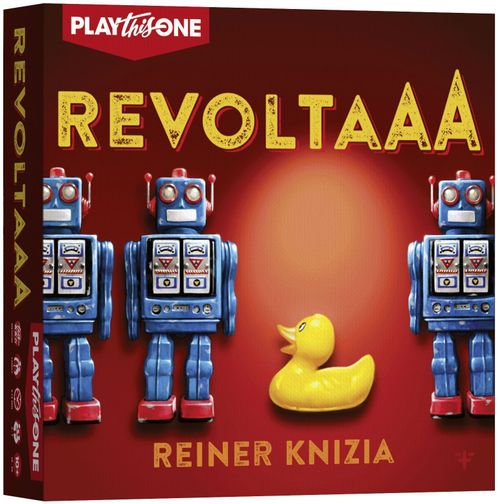
RevoltaaA
RevoltaaA Rulebook
Table of Contents
Table of Contents
Game Play
Shuffle the cards. Deal 11 cards to each player and place an additional deck of 11 cards face down to one side. All remaining cards are returned to the box until the next game.
The game is played over several rounds. At the start of each round reveal the top card from the deck and place it face up in the middle. Then each player selects one card from his hand and, when all players have done so, the selected cards are revealed simultaneously. Now determine which colour and which of the revealed cards wins the round.
-
Determine the winning colour: after all the selected cards have been revealed, first determine the winning colour. Total the values of the red cards and compare it with the total values of the blue cards. The colour with the higher total is the winning colour. In case of a tie, the card that was revealed from the deck determines the winning colour.
-
Determine the winning card after the winning colour: determine which card wins the round. This is the card with the lowest value in the winning colour (Example A, B and C). If the lowest value shows more than once in this colour, then the second lowest value in the winning colour wins the round, again provided that this value only shows once (Example D). Otherwise, consider the third lowest value card in the winning colour, and so on. If none of the values in the winning colour show only once, then the face down deck always wins the round (Example E).
Examples
The examples are shown with the card values printed on the cards.
- Example A: Frank (red 1), Daisy (red 4), Tom (blue 2), deck (blue 1). Frank wins.
- Example B: Frank (blue 1), Daisy (blue 3), Tom (red 5), deck (blue 0). Tom wins.
- Example C: Frank (blue 2), Daisy (blue 0), Tom (red 0), deck (red 2). Tom wins.
- Example D: Frank (red 0), Daisy (blue 1), Tom (blue 0), deck (blue 0). Daisy wins.
- Example E: Frank (red 2), Daisy (red 2), Tom (blue 1), deck (blue 2). Deck wins.
If the winning card belongs to a player, this player places all the revealed cards in a face up stack in front of him, with a card of the winning colour on top. If the winning card is the card from the deck which was placed in the middle, all the revealed cards are placed in a face up stack next to the face down deck, also with the winning colour on top.
Then the next round starts and the top card from the deck is revealed and placed face up in the middle again. All players simultaneously reveal one card from their hands, and whoever wins the round places all the revealed cards in a face up stack in front of him, with a card of the winning colour on top. Keep all stacks separated from each other, because the top card of each stack indicates whether the Ducks (red) or the Robots (blue) have won the stack.
End of the Game and Winner
The game ends when either the Ducks or the Robots have won four stacks. This defines the victorious colour. The players then count their points. Each stack with the victorious colour on top counts 1 point. Stacks with the defeated colour on top count nothing. In addition, the players reveal the remaining cards from their hands, with each card of the victorious colour also counting 1 point. The player with the most points wins the game.
Example: the "red" Ducks are victorious.
- 1 victorious stack + 1 victorious card = 2 points
- 3 victorious stacks + 2 victorious cards = 5 points
- 0 victorious stacks + 4 victorious cards = 4 points
Recommendation
Record the points scored for each player and carry on playing several games. The player with the highest points total at the end is the winner. You may also decide to record the points won by the face down deck. These are made up of the victorious stacks as well as any cards of the victorious colour remaining in the face down deck. Any players with fewer points than the face down deck have shamefully been defeated.
Important Tip: Note that instead of winning individual rounds, it is more important to lead your preferred colour to victory. The cards remaining in your hand have the potential of scoring more points than individually won stacks. But how do you lead your preferred colour to victory whilst maintaining a strong presence of this colour in your hand...
RevoltAAA Bananas
This game plays like RevoltAAA, however, there is no additional deck of 11 cards and it is not played simultaneously. One player starts the first round, selects a card from his hand and reveals it. Then, in clockwise order, all the remaining players do the same. When all players have revealed their card, determine the colour and the card that wins the round. If there is a tie between the two colours, the card that was revealed by the first player determines the winning colour. If none of the values in the winning colour show only once, then the first player wins the round. The player who played the winning card starts the next round, and so on.