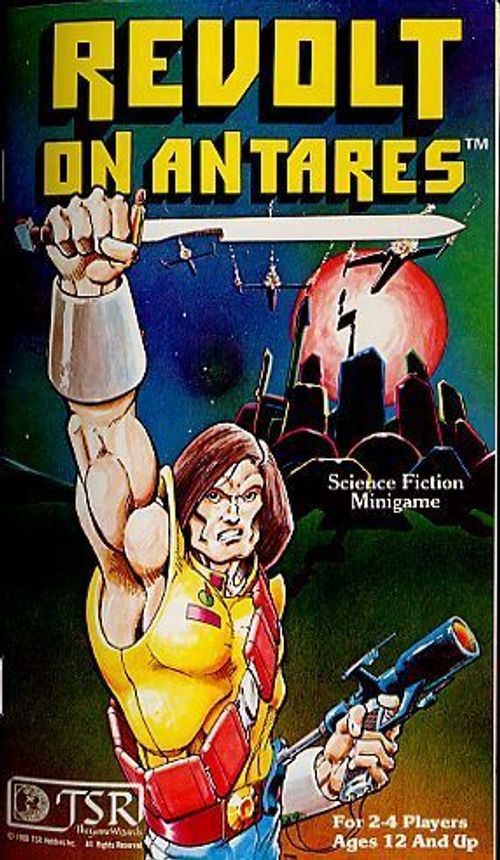
Revolt on Antares
Revolt on Antares Rulebook
Table of Contents
Table of Contents
Rules of Play
Introduction
Imirrhos, ninth planet of the star Antares, lies on the edge of Earth's Imperial Terran Empire. As the Empire grows weaker, Imirrhos boils with unrest and intrigue. The seven local ruling families (or "houses") fight for power. Some want the Terrans to leave, others need Imperial support. A few know of the Silakka, an alien race that is waiting to invade...
In three different scenarios, a player can be a household leader, the Imperial Terran consul, or the leader of the Silakka aliens. Players recruit Galactic Heroes, raise armies, and use their hereditary psychic powers and ancient alien artifacts to gain control of Imirrhos: Antares 9!
The REVOLT ON ANTARES game has three scenarios (situations): the Basic Game: Revolt Against Terra, The Silakka Invasion, and the multi-player Power Politics on Imirrhos. The rules given for the Basic Game apply in all cases unless noted otherwise under the rules for the other two scenarios. It is recommended that beginning players learn the Basic Game first.
Game Components
Counters. There are three types of counters (playing pieces) used in the game: troop counters (power infantry, laser tanks, jump troops, hovercraft, and airjet squadrons), leader counters (Faction Leaders and Galactic Heroes), and artifact counters (powerful alien weapons). Most of these counters have two numbers printed on them.
The number to the left is the combat factor (how strong the counter is in combat). The number to the right is the movement factor (how far the counter can move each turn). Faction Leader and Galactic Hero counters will have the name of the leader or hero printed on them. Artifact counters contain the name of the device. Artifacts, leaders, and some troop counters will have special abilities.
Sample counters: a Jump Troop counter (3-5), a Leader counter (Mirrhos, 4-3), an Artifact counter (Devastator), and a Galactic Hero counter (Andros, 5-5).
Sometimes counters are identified by their combat and movement factors. For example, a 3-5 jump troop is a jump troop counter with a combat factor of 3 and a movement factor of 5.
Map. The playing map depicts the planet Imirrhos: Antares 9. To regulate movement, a hexagonal grid has been printed on the map (one hexagon is known as a "hex"). The map has nine colors. Dark blue represents Sea, brown is Imperial Terran territory, and the other seven colors show the holdings of each of the seven houses. The map also contains two kinds of symbols: terrain symbols and economic symbols. The various symbols used on the map and their meanings are:
Map symbols
Terrain:
- Mountains
- Jungle
- Desert
Economic:
- Iron
- Minerals
- Coal
- Seaport
- Grain
- Textile
- Fish
- Electricity
- Industry
- Gold
- Oil
- Cattle
Basic Game: Revolt Against Terra
Revolt Against Terra. This scenario is a two-player game. One player is the house leader who starts the revolt (the Rebel player). The other player is the Imperial Terran consul (the Terran player). The gray counters (Silakka aliens) are not used and should be set aside. The players choose sides and then the Rebel player chooses which house he or she will take.
How to Win
At the end of 10 turns, the player with the greatest number of victory points wins the game. Victory points are given for economic symbols and fortresses owned at the end of the game. Each hex containing an economic symbol counts as 1 victory point. Each fortress counts as 3 victory points. Starport Imirrhos counts as 10 victory points. A hex or fortress belongs to whatever counter or counters are in it at the end of the game. If no counters are in a hex, it belongs to the house with the same color as the hex, i.e. its original owner.
How to Set Up
Setting Up. Separate the counters by color. The Artifact counters and the Galactic Hero counters are placed face-down in two separate piles and each pile is thoroughly mixed. The Rebel player places one face-down Artifact counter on each house's fortress hex. Artifact counters remain face-down until one player takes the owning house as an ally (friend). When a player gains control of a house, he or she may look at the artifact. The other players will not know what the artifact can do until the owning player uses it. The Galactic Hero counters will enter play later.
The Rebel player chooses the house he or she wishes to play, plus one allied (friendly) house. These houses are in revolt. The Terran player then chooses any other house as the ally of the Terran player. The last four houses will remain neutral (not joining either side). The Rebel player should set up the counters of each neutral house as follows: the leader, the face-down artifact, and the counter with the greatest combat factor should be placed on the house fortress. The rest of that house's counters are placed one per hex on any economic symbol in a hex of the house color.
Once the four neutral houses are set up, the Terran player places the starting Terran forces plus the counters of the Terran allied house. Starting Terran forces are: one 3-5 jump troop, one 7-4 laser tank battalion, one 4-10 airjet squadron, one 2-8 hovercraft, and the 6-3 Ward Serpentine leader. These counters may be placed anywhere in Terran territory (the brown hexes plus the Starport Imirrhos). The counters of the Terran allied house may be placed on any hex of the house's color.
The Rebel player places the counters of the two houses he or she controls. Counters of each house must be set up in hexes of that house's color. The Rebel player now chooses one Galactic Hero at random from the face-down pile of hero counters. Unlike Artifact counters, Galactic Hero counters are not kept secret. The Hero may start the game in the territory of either house. Hero counters may be placed with other friendly counters.
Sequence of Play (turn phases)
- Rebel player moves
- Rebel player combat (including Leader Combat)
- Terran player moves
- Terran player combat (including Leader Combat)
- Rebel player replaces troops and recruits Galactic Heroes
- Terran player replaces troops and recruits Galactic Heroes
- Rebel player chooses ally (from the remaining neutral houses)
- Terran player chooses ally (from the remaining neutral houses)
- Mark off one turn
- Repeat phases 1-9 for 10 turns
Movement
More Than One Counter per Hex. No more than three counters may be placed ("stacked") in the same hex. The only exceptions are the four special artifact counters with no movement or combat factors (the Devastator, Dimensional Plane, Energy Drainer, and Field Generator counters). These counters must always be stacked with another counter and will move at the rate of the counter they are placed with. All leader counters include personal troops and do count for stacking. Counters of different colors may stack together if they are controlled by the same player. Counters in the same hex may move together at the rate of the slowest counter (exception: see Hovercraft) or may move separately, as desired.
Movement. During each player's movement phase, the player may move some, all, or none of his or her counters. The number in the lower right corner of a counter is the movement factor for that counter. Moving a counter into a hex costs one movement factor. There is an additional cost of one movement factor for moving into any rough terrain hexes (mountain, desert, or jungle) during a turn. This penalty is only applied once per turn no matter how many different hexes or types of rough terrain are moved through.
Counters cannot move into or through a hex containing enemy counters. Counters may move through hexes containing stacks of friendly counters as long as no more than three counters (plus special artifacts) end their move in the same hex. A counter may use only part of its movement factor if desired. Movement factors cannot be "saved up" or given to other counters.
All-Sea Hexes. Faction Leaders, most Galactic Heroes, infantry, tank, and artillery counters may not move or attack across all-sea hexsides unless transported by a hovercraft (see Hovercraft).
Hovercraft. Hovercraft can cross land or sea hexes freely, and end movement on any empty hex (within the stacking limits). Hovercraft may also be placed with up to two additional counters. All these counters may then move at the hovercraft's movement rate. However, a counter may not move with a hovercraft and on its own in the same turn. Hovercraft must pay the rough terrain cost.
Jump Troops and Airjet Squadrons. Jump troops and airjet squadrons do not suffer terrain penalties. They may also move through hexes containing enemy counters. These units can move across neutral hexes and all-sea hexes as long as they do not end their movement there.
The Map Edges. The map represents a globe (the planet). Thus, counters may move off the east or west map edges directly to the opposite edge. The hexes on the eastern and western map edges have been numbered to help this special movement. (Players may also use the numbers on the map edge to keep track of turns, using a coin or a counter not in play.) Counters may not move off the north or south map edges.
Combat
Normal Combat. The moving player may attack enemy counters by moving next to them and saying that he or she is attacking. The attacker may look at any of the defender's counters (except Artifacts) before attacking. If desired, the moving player may choose not to attack. The moving player can attack an enemy from several different hexes at once, as long as all the attacking counters are next to the attacked (defending) counters. All defending counters in a stack must be attacked at one time. No counter can attack or defend more than once in each combat phase. Note that normal combat may be affected in various ways by Artifact counters and by the psychic powers of the House Leaders (see Artifacts and The Seven Houses). In addition, leader counters add their printed combat factors to their side in normal combat (these factors represent the troops with the leader).
To fight a combat, the attacker says whether any artifacts or special leader powers will be used; then the defender decides this, also. The attacker and defender each add up how many combat factors they have in combat. Then each rolls a die and adds the number rolled to his or her total. The side with the highest number wins. The loser must take off some counters so that the total number of combat factors taken off is at least equal to the difference between the final numbers. (This may mean the loser must take off more combat factors than the actual difference.)
If combat factors exactly equal to the difference cannot be removed, the loser must remove more factors than the difference. The loser chooses which counters are to be lost. Faction Leader counters and Galactic Hero counters must be chosen last.
COMBAT EXAMPLE: The Rebel player decides to attack a stack of Terran counters with several stacks of Rebel counters during the Rebel player combat phase. The Rebel player is considered the "attacker" for this combat and the Terran player is the "defender". The combat factors of all the counters for each side are added. Suppose the totals are 18 for the Rebel player and 14 for the Terran player. Each player rolls a die - the Rebel player rolls a 3 and the Terran player rolls a 1. These numbers are added to each player's combat factor total, giving the Rebel player a grand total of 21 (18+3) and the Terran player 15 (14+1). The Rebel player wins by 6 points, so the Terran player loses the combat. He must remove counters totalling at least 6 combat factors from the defeated counters (for example, a 4-3 infantry and a 2-8 hovercraft).
Note that such leaders have a special die roll if they lose; and that leader will still have leader combat even if they lose in normal combat (see Leader Combat). If all enemy counters in a hex are taken off (including leaders who retreat), the winner may move up to three attacking counters if he or she wants to.
Airjet Attacks. Airjet counters may make one attack in any hex they pass over during movement. The attack is declared during movement but fought at the same time as normal attack. Thus, airjet counters can attack alone or add their combat factors to a normal attack. Airjet counters may be taken off just like other types of counters if the owning player loses.
Fortresses. Each house fortress (and also Starport Imirrhos) has defensive force shields. All counters defending in the fortress have their combat factors doubled. For example a 3-5 jump troop in a fortress defends with a combat factor of 6 and attacks with a combat factor of 3.
Neutral Houses. Counters belonging to neutral houses may not be attacked until the house allies with a player.
Leader Combat
Leader Combat. In addition to normal combat, combat will also take place between leaders (Faction Leaders and Galactic Heroes). If both the attacker and defender have leader counters in combat, the leaders must fight a special combat in addition to the normal combat already described. All leaders are considered to be equal for leader combat purposes. Any special powers the leader possesses apply to normal combat but not to leader combat (exception: Corvus Andromeda, see Galactic Heroes).
Leader combat is exactly the same as normal combat, except that all leaders (except Corvus) are equal. The player who rolls the highest die roll wins. A tie means that neither leader wins or loses.
Leader combat is fought until one side has no more leaders in combat, or until all leaders in the combat have fought once. A leader who is outnumbered by enemy leaders may have to fight several times until he or she loses or manages to beat all the enemy leaders. Note that a player may lose the normal troop combat but still win the leader combat!
Defeated Leaders. Defeated leaders are not simply taken from play like other counters. For each defeated leader, the owning player rolls a die. A roll of 1-2 means that the leader has been killed and is removed from the board (and cannot be replaced). A roll of 3-4 means that the leader is wounded; remove the leader from the board. He or she may re-enter play at no cost after three turns have been completed (thus, a leader wounded on Turn 4 would re-enter on the player's Turn 7 replacement and recruitment phase). A roll of 5-6 means that the leader was forced to retreat. Move the leader counter to the nearest hex of a friendly color that is unoccupied by any other counters. The leader may not move or attack for one turn, though it may defend against attacks.
Replacement and Recruitment
Replacements. Normal troop counters lost through combat may be replaced in the replacement and recruitment phase at a cost of one replacement point per counter. The number of replacement points that each house has during the game is marked on the map in the box next to the house fortress. The Terran player begins the game with 10 replacement points.
Replacements enter the game during the replacement and recruitment phase of the turn. House replacements must enter on the house fortress hex or any house economic hex. Terran replacements enter on the Starport Imirrhos or in any brown hex. Replacements must obey the stacking rules when placed on the map (see More than One Counter per Hex). Replacement points are added up - for example, a player who begins the game as Imperial Terra and then makes an alliance with House Edistyn would then have a total of 14 replacement points (10+4) which could be spent to replace any lost Terran, native, or House Edistyn troop counters. A player with no replacement points left may no longer replace any lost troop counters. Wounded leader counters may re-enter play at no cost after three turns have passed. Dead leader and destroyed Artifact counters may never be replaced.
Recruitment. Galactic Heroes may be recruited by both players. During the replacement and recruitment phase of each player, the player should roll a die for each house under his or her control (for recruitment purposes, count Imperial Terra as a house). A roll of 1 means a hero has been recruited. Heroes are chosen at random from the face-down hero pile. If all available heroes have been recruited, no other hero recruitment is possible. Heroes do not cost any replacement points to recruit and may be placed on any friendly fortress or economic hex.
Terran Reinforcements
IMPERIAL REINFORCEMENTS. The Terran player receives more troop counters from off planet one time during the game. These reinforcements consist of two 5-3 power infantry corps, two 3-5 jump troops, one 7-4 laser tank battalion, and one 4-10 airjet squadron. These reinforcements do not cost any replacement points when they arrive. To determine when they enter play, the Terran player should roll a die during the replacement and recruitment phase beginning on the second turn - if a 1-2 is rolled, the reinforcements arrive on Turn 2. If they do not arrive on Turn 2 they will arrive on Turn 3 if a 1-4 is rolled. They will automatically enter on Turn 4 if they have not arrived before then. They can be replaced normally if lost in combat.
NATIVE TROOPS. The Terran player receives all the native counters (the dark brown counters plus the leader Mirrhos) as reinforcements on Turn 3. The native troops enter during the Terran replacement phase and may be placed on any brown hex. They do not cost any replacement points when they arrive. They can be replaced normally if lost in combat.
Alliances
Choosing allies. Each turn during the alliance phase, two houses that began the game as neutrals will join one side or the other. First the Rebel player, then the Terran player, may choose one neutral house as an ally. All counters belonging to that house will come under the control of the player who chose it. Thus, all houses will be on one side or the other by the end of Turn 3.
The Seven Houses
Imperial Terra prefers to leave local governments alone as long as the taxes are paid on time. The actual rulers of Imirrhos are seven clan-like families, descendants of the original human colonists. The seven houses are House Orsini (purple), House MacKenzie (light blue), House Kinrabe (light green), House Fitzgerald (red), House Sessedi (orange), House Braganza (dark green), and House Edistyn (yellow). Each house leader possesses a special psychic power.
Messalina Orsini has the power of fascination. In combat, there is a 50% chance she can force one enemy troop counter (not a leader or hero) of her choice in an adjacent hex to fight on her side that turn. Roll a die; 1-3 means success, 4-6 means failure (nothing happens).
If successful, Orsini can use the enemy troop counter to attack any enemy stack it is next to, or even its own! However, the controlled counter is considered to belong to the original owner when taking off losses. If it survives, the controlled counter will no longer be fascinated.
Black Dougal MacKenzie has teleportation power. He can teleport any one MacKenzie counter (including his own counter, but no allies or mercenaries) to any chosen hex (unoccupied by enemy counters) each turn during the MacKenzie player's movement.
Barracuda Kinrabe has the power to cause hallucinations. If the stack he is with loses a battle, roll a die. A roll of 1-3 means that the enemy attacked an illusion and Kinrabe's stack is unhurt. On a roll of 4-6, his stack suffers losses normally.
Simon Fitzgerald can create ion waves. They soothe the fears and raise the spirits of all troops stacked with him, raising each counter's combat factor by +1 (the combat factor of the Simon Fitzgerald counter already includes this effect).
Ariton Sessedi has long distance telepathy. When rolling for recruiting Galactic Heroes, he is successful on a roll of 1-2 instead of just 1.
Catherine "the Mad" Braganza can summon lightning. The lightning strikes for 6 combat factors that are added to any one attack her stack is making. Unfortunately, her control of the lightning is not always exact. A die must be rolled: on a roll of 1-4 the lightning strikes the enemy target; but on a roll of 5-6, the lightning strikes her stack instead (causing it to subtract 6 combat factors from its attack).
Nureb Khan Edistyn has precognition. When his stack is in combat, he rolls two dice instead of one, and the best of the two rolls is used. This bonus does not apply to leader combat.
Artifacts
An unknown alien culture once flourished on Imirrhos. The culture destroyed itself, leaving behind a number of artifacts now controlled by the seven houses. The seven artifacts are:
The Devastator destroys all life not protected by force shields in a one-hex radius (i.e. the hex it is detonated in plus the six hexes around it). It can be used only once per game during the combat phase of the owning player, and is left on the board to mark the devastated area. Leaders in the area are rolled for as if they had lost in Leader Combat. Neither side receives victory points (see How to Win) for economic hexes that have been devastated, nor can any counter move over or through the devastated area. The Devastator and the Field Generator will cancel each other out. If used against each other, both artifacts will be destroyed without the loss of any other counters.
The Dimensional Plane adds +2 to the movement factor of all counters stacked with it and allows travel through rough terrain without penalty. Counters stacked with it may move at sea or end their movement in an all-sea hex (and can be attacked normally).
The Energy Drainer drains power from attacking forces. All counters attacking the stack containing this artifact attack with a strength of 2 combat factors each, regardless of the type of counter. This artifact can only be used when defending; it adds no bonus if attacking. It does not affect penalties or bonuses due to leaders' psychic powers.
The Field Generator can be used either to cancel a fortress force shield (the defender's combat factors are not doubled on defense) or to create a force shield that acts like a fortress (counters stacked with it have their combat factors doubled on defense). The Field Generator can only be used for one function per turn; it may not be used both to attack a fortress and to create a force shield on the same turn. The Field Generator cannot create a force shield in a fortress hex.
The Force Cannon is an artillery counter with a combat factor of 8 and a movement factor of 1. It can move through rough ground (mountain, desert, jungle) at 1 hex per turn.
The Sonic Imploder is an artillery counter with a combat factor of 7 and a movement factor of 2.
The UFO is an alien flying craft which acts as a 5-10 airjet squadron.
Except for the Devastator, all artifacts are reusable. Artifacts with no combat factor are destroyed if the counters they are stacked with are destroyed.
Scenario 2: The Silakka Invasion
All the counters are used. One player is the Silakka invader, the other player is the Terran. The Terran player places the counters of the seven houses following the Basic Game rules. The starting Terran counters are placed wherever the Terran player wishes. The Galactic Hero counters are separated into two face-down piles, one contains only Dr. Death, Skarn 3, and Corvus Andromeda; and the other pile contains the remaining Heroes. The two players decide who controls each of the houses before the first turn begins. The Silakka player chooses an allied house first, then the Terran player chooses an allied house. The players alternate choices until all houses are chosen.
The Silakka player places the Silakka counters anywhere on the map (except all-sea hexes) and places the native troop counters plus Mirrhos anywhere on the brown hexes. The Silakka player can then move all counters under his or her control (Silakka, natives, and friendly houses). The Terran player can move all Terran counters and all friendly house counters. The Silakka player moves first.
The Silakka have 12 replacement points plus those of their allied houses. The Terrans have 10 replacement points plus those of their allied houses. Silakka replacements arrive at any friendly economic hex. The only Heroes the Silakka player can recruit are Skarn 3, Dr. Death, and Corvus Andromeda. Except for the natives, the Terran player receives reinforcements and replacements normally. The Terran player may not recruit Skarn 3, Dr. Death, or Corvus Andromeda. No alliance phase is necessary since all allies are chosen before Turn 1.
The game length is 10 turns. The winner is the player with the most victory points at the end of the game.
Scenario 3: Power Politics on Imirrhos
This scenario is for 2, 3, or 4 players. Each player plays one or more houses, fighting against the other houses for control of Antares. The players should roll for the first choice (highest roll chooses first) and then alternate choosing friendly houses until all the houses have been divided among the players as evenly as possible. Leftover houses should be diced for. Set up is done as in the Basic Game. However, Terran territory is considered permanently neutral. However, counters can move through Terran hexes freely, except that no counters may move through or over the Starport Imirrhos (even jump troops or airjets). The native counters are not used, nor are the Ward Serpentine or Magron the Invincible leader counters. The Silakka and Terran counters should be placed face-down in a pile off the map. They represent off-planet mercenaries and are divided evenly among the players as were the houses, each player alternately drawing a counter from the pile. Leftover counters should be diced for. Mercenaries are placed on the map like house counters.
The order of play is determined at the beginning of each turn by rolling a die. The player rolling highest will move and have combat first, followed by the player rolling second highest, etc. Players begin the game with zero replacement points. Eliminated mercenary troop counters are placed face-down in a common "dead" pile, while eliminated house counters are kept in separate piles. Galactic Heroes are recruited as in the Basic Game. There is no alliance phase necessary in this scenario.
At the end of Turn 3, each player should determine how many fortresses and economic hexes he or she controls (see How to Win). Each player gains 1 replacement point for every economic hex controlled and 3 replacement points for every fortress controlled. These replacement points may be used to replace destroyed counters in the normal fashion during a player's replacement and recruitment phase each turn. These are the only replacement points given to the players during the game. In a 4-player game, the player who started with only one house receives double the usual number of replacement points. The only restriction on replacements is that all house counters must be replaced before any mercenaries can be replaced. Mercenaries cost twice as much to replace as house counters (i.e. 2 replacement points per counter) and only one mercenary counter may be replaced per turn per player. Mercenary replacements are drawn at random from the face-down mercenary troop "dead" pile. If there are no mercenaries in the dead pile, none may be recruited.
The length of this game is 8 turns. At the end of the game, the player with the most victory points (see How to Win) is the winner.
Active diplomacy, and wheeling and dealing on the part of the players is encouraged when more than two are playing.
Galactic Heroes
Andros. Android of unknown alien manufacture. Andros can summon and command The Phantom Regiment, a 5-5 corps of other-dimensional warriors who move across terrain like the Dimensional Plane (see Artifacts).
Corvus Andromeda. Intergalactic assassin. He has a bonus of +1 to the die roll for leader combat only.
Doctor Death. An outlaw who creates zombie-like troops from the dead. He can take immediate control of any two troop counters that die in a battle he is in, be they friendly or enemy troops. No replacement points need be paid for these counters and they must always remain stacked with Dr. Death. If Dr. Death is killed or wounded, the "zombie" counters are removed from play (as if destroyed) and can be replaced normally by the original owner.
Emerald Eridani. Commander of the Emerald Company, a mercenary 7-4 laser tank formation.
The Iron General. Cyborg commander of a mercenary 7-4 laser tank battalion.
Lyra Starfire. Intergalactic adventuress and pilot of a 5-10 airjet squadron.
The Nullspace Kid. Youthful intergalactic adventurer and pilot of a 5-10 airjet squadron.
Skarn 3. Alien mercenary captain of a 4-5 jump troop.
Subadai O'Reilly. Commander of O'Reilly's Raiders, a 6-3 power infantry battalion.
Tovan Palequire. Intergalactic smuggler and weaponsrunner. The player who recruits Tovan receives an additional 2 replacement points immediately to represent the cargo of Tovan's ship. These points are not lost, even if Tovan becomes a casualty.
Other Leaders
Magron the Invincible. Alien leader of the Silakka invasion force and commander of a 7-4 laser tank corps.
Mirrhos. Popular leader of the original, primitive alien inhabitants of Imirrhos. Each native counter stacked with him gains a +1 bonus to its combat factor due to high morale.
Ward Serpentine. Consul for Imperial Terra on Imirrhos: Antares 9. Commander of the Berserkers of the Imperial Guard, a 6-3 power infantry battalion.
Antares Counter List
Format: combat factor-movement factor, (quantity) type. Replacements are the house's replacement points.
The Houses
- Orsini (purple), Replacements 4: 5-3 Messalina; 4-3 (x3) Power Infantry; 2-8 (x2) Hovercraft
- Mackenzie (light blue), Replacements 5: 5-3 Black Dougal; 6-4 Laser Tank Battalion; 4-3 (x3) Power Infantry; 2-8 Hovercraft
- Kinrabe (light green), Replacements 4: 5-3 Barracuda; 6-4 Laser Tank Battalion; 4-3 Power Infantry; 3-5 (x2) Jump Troop; 2-8 Hovercraft
- Fitzgerald (red), Replacements 4: 6-3 Simon; 6-4 Laser Tank Battalion; 4-3 (x2) Power Infantry; 3-5 Jump Troop; 2-8 Hovercraft
- Sessedi (orange), Replacements 5: 5-3 Ariton; 6-4 Laser Tank Battalion; 4-3 (x2) Power Infantry; 2-8 Hovercraft
- Braganza (dark green), Replacements 5: 5-3 Catherine; 6-4 Laser Tank Battalion; 4-3 Power Infantry; 3-5 Jump Troop; 2-8 Hovercraft
- Edistyn (yellow), Replacements 4: 5-3 Nureb Khan; 6-4 (x2) Laser Tank Battalion; 4-3 (x2) Power Infantry; 3-5 Jump Troop
The Terrans (brown), Replacements 10: 6-3 Ward Serpentine; 7-4 (x2) Laser Tank Battalion; 5-3 (x2) Power Infantry; 3-5 (x3) Jump Troop; 2-8 Hovercraft; 4-10 (x2) Airjet Squadrons
The Natives (tan), Replacements none: 4-3 Mirrhos; 3-2 (x2) Native Infantry; 2-2 (x3) Native Infantry
The Silakkans (gray), Replacements 12: 7-4 Magron; 5-5 (x6) Powered Infantry; 3-5 (x3) Jump Troop
Galactic Heroes (white): Andros (5-5), Corvus Andromeda (3-3), Doctor Death (3-3), Emerald Eridani (7-4), The Iron General (7-4), Lyra Starfire (5-10), The Nullspace Kid (5-10), Skarn 3 (4-5), Subadai O'Reilly (6-3), Tovan Palequire (3-3).
Artifacts (violet): Devastator (), Dimensional Plane (), Energy Drainer (), Field Generator (), Force Cannon (8-1), Sonic Imploder (7-2), UFO (5-10).