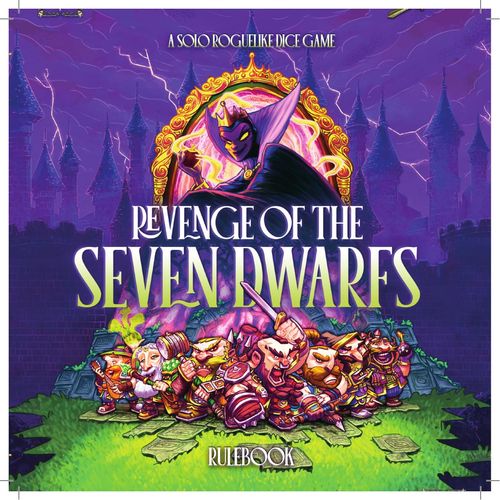
Revenge of the Seven Dwarfs
Revenge of the Seven Dwarfs Rulebook
Table of Contents
Table of Contents
Components
- 12 Terrain Cards (with the crown symbol, green shield symbol, purple mask symbol, or heart symbol on their back)
- 7 Dwarf Cards
- 5 Henchman Cards (without an icon on their front)
- 13 Boss Cards (5 with the green shield symbol on their front and 8 with the purple mask symbol)
- 1 Queen Card
- 1 Witch Card
- 1 Rewards Card
- 15 Item Cards
- 1 White Dwarf Die
- 3 White Dwarf Action Dice
- 2 Black Henchman Dice
- 1 Black Henchman Action Die
- 1 Red Boss Die
- 1 Red Boss Action Die
- 12 Gems
- 1 Time Counter
- 1 Forge Counter
- 1 Rewards Counter
Game Setup
- Shuffle the Henchman Cards and place the deck face down in the centre of the table.
- Prepare the Boss Deck as follows:
- Place the Queen Card face down to the right of the Henchman Deck.
- Shuffle the green-shield Boss Cards and the purple-mask Boss Cards separately.
- Draw 2 Cards at random from each deck, without looking at them, and place them face down on top of the Queen Card, first the 2 purple-mask Boss Cards and, on top of these, the 2 green-shield Boss Cards.
- Remove the remaining green-shield and purple-mask Boss Cards from the game, as well as the Witch Card.
- Prepare the Terrain Deck as follows:
- Shuffle the crown-symbol Terrain Cards, draw 1 at random without looking at it and place it face down above of the Henchman and Boss Decks.
- Shuffle the green-shield and purple-mask Terrain Cards separately.
- Draw 2 Cards at random from each deck, without looking at them, and place them face down on top of the crown-symbol Terrain Card, first the 2 purple-mask Terrain Cards and, on top of these, the 2 green-shield Terrain Cards. Place the Time Counter next to the Terrain Deck.
- Remove the remaining crown-symbol, green-shield and purple-mask Terrain Cards from the game, as well as the heart-symbol Terrain Cards.
- Place the Henchman Dice, the Boss Die and their Action Dice next to the Terrain Deck.
- Place the Rewards Card to the left of the Henchman Deck and place the Forge Counter on space 1. Place the Rewards Counter next to the Card.
- Shuffle the Item Cards and place the deck face down to the left of the Rewards Card.
- Shuffle the Dwarf Cards, reveal one at random and place it below the Rewards Card. This will be the main Dwarf for this game. Leave the rest of the deck face down to the left of the Dwarf Card.
Dwarf, Henchman and Boss Cards
Dwarf Card
- Name
- Movement
- Attack
- Defence
- Ability
- Illustration
Henchman Card
- Name
- Associated Terrain
- Life and Defence
- Ability
- Illustration
Boss Card
- Name
- Associated Terrain
- Life and Defence
- Ability
- Illustration
Both the green-shield and purple-mask Boss Cards show 2 different sets of Life and Defence values: one when they act as Bosses (on the right, on a red background) and another when they act as Henchmen (on the left, on a black background).
As explained later, after winning a Combat, defeated Bosses are moved to the Henchman Deck. If you face any of them again in a later Combat, you must take into account only their values as a Henchman.
Dwarf, Henchman and Boss Dice
Each Die represents a character and their current Life Points. Therefore, whenever a character loses or recovers Life Points, you must reduce or increase the value of their corresponding Die accordingly, never exceeding the maximum value shown on the Die.
If a character's Life is reduced to 0, they are defeated and you must discard their Die. If the defeated character is the Dwarf or the last Enemy, the Combat ends immediately (see End of Combat).
From now on, these characters will be referred to as Dwarf, Henchman and Boss, although we will also use the term Enemies to refer collectively to Henchmen and Bosses.
How to Play
A game of Revenge of the Seven Dwarfs is played over 5 Combats, the last being the final confrontation with the Evil Queen, if you manage to reach it.
Each Combat is divided into 4 Phases:
- Reveal Enemies and Terrain
- Dwarf Turn
- Enemies Turn
- End of Round / End of Combat
These Phases are explained in detail below.
1. Reveal Enemies and Terrain
This Phase consists of the following steps:
A. Reveal the top Henchman Card and place it on top of the deck. B. Reveal the top Boss Card and place it on top of the deck. C. Reveal the top Terrain Card and place it below the Henchman and Boss Decks.
The Terrain Card indicates:
- The hexagons where the Enemies and the Dwarf appear.
Place the Henchmen, the Boss and the Dwarf on the starting hexagons, marked with the colour and symbol corresponding to their Dice.
The Henchmen and the Boss begin the Combat with the Life Points indicated on their respective Cards. The Dwarf begins the first Combat with 4 Life Points; in later Combats, they begin with their current Life Points (see End of Combat).
- The time available for the Dwarf to win the Combat.
Place the Time Counter on the leftmost space of the Time Track. If the Counter reaches the last space, the Combat ends immediately (see End of Combat).
2. Dwarf Turn
This Phase consists of the following steps:
A. Roll the Action Dice you have available, one at a time. Normally this will be the 3 Dice, unless in the previous Round you chose not to recover those that remained assigned (see End of Round).
You are not required to roll all your Dice.
When you roll a Die, you may reroll it as many times as you wish, spending 1 Gem for each reroll. When you decide to stop, keep the final result and place the Die on the illustration of the Dwarf Card. That Die is now reserved.
You are now ready to take action!
What happens if you roll an Anvil?
The Anvil converts all the Dice you have reserved to the Forge Value.
You begin the game with a Forge Value of 1, so an Anvil result during the first Combat will convert all reserved Dice to values of 1.
After applying this effect, you must roll the Anvil Die again until you obtain a numerical result (you may never reserve an Anvil).
If you reroll by spending 1 Gem, the Anvil is ignored and does not convert the reserved Dice to the Forge Value.
B. Assign the reserved Dice to the actions the Dwarf can perform: Move, Attack and Defend. The value of the Die determines the strength of the corresponding action.
From now on, the assigned Dice will be referred to as Move Die, Attack Die and Defence Die.
Before assigning them, you may increase the value of the reserved Dice in 2 ways; you may combine them freely:
- Spend Gems
1 Gem increases the value of one Die by 1. You may spend several Gems to increase the same Die multiple times or distribute them among several Dice.
- Discard reserved Dice
Discard 1 reserved Die to increase the value of another Die by 1. You may discard up to 2 Dice to increase the value of the third by 2.
You may increase only the value of reserved Dice, not assigned Dice.
C. Once the Dice have been assigned, you may perform actions with them. If an Action Die is reduced to 0, you must discard it.
The Move and Attack actions are explained in detail below. The Defend action is explained during the Enemies Turn, as it is a reactive action.
You may freely combine Move and Attack actions as far as the Dice allow, for example: move, attack, move again, and so on.
Move
You may move the Dwarf a number of hexagons equal to the value of the Move Die.
Each time you enter a hexagon, spend 1 Movement Point, reducing the value of the Move Die by 1.
Example: You spend the 3 Movement Points to place the Dwarf adjacent to the nearest Gelatinous Cube. As the Move Die is reduced to 0, you must discard it.
Movement Restrictions
- Obstacles
Rocks block movement. You may not enter those hexagons.
Forests do not block movement, provided the Attack Die has a value of at least 1. In addition to spending 1 Movement Point as usual, reduce the value of the Attack Die by 1 in order to enter the hexagon (you force your way through the undergrowth).
- Enemies
Enemies block movement. You may not enter those hexagons.
- Traps
Traps do not block movement, but they have negative effects:
When entering a Damage Trap, the Dwarf suffers 1 Damage, which may be absorbed by reducing the value of the Defence Die by 1. If the Dwarf has no Defence, he loses 1 Life Point.
Entering a Movement Trap costs 1 Movement Point, like any hexagon, but getting out of it costs 2 Movement Points.
Attack
You may attack an Enemy as long as the Dwarf is adjacent to it.
The strength of the Attack is equal to the value of the Attack Die.
The Enemy reduces that strength by the Defence value shown on its Card. If the Attack is greater than the Defence, the excess becomes Damage. Each Damage removes 1 Life Point from the Enemy.
If all Enemies are defeated, the Combat ends immediately (see End of Combat).
You may attack each Enemy only once per Turn. After each attack, reduce the value of the Attack Die by 1 (your weapons suffer wear).
Example: You attack the Gelatinous Cube with strength 3. It has no Defence, but its ability limits the Damage received to 1, so it loses only 1 Life Point. Then reduce the value of your Attack Die by 1.
3. Enemies Turn
This Phase consists of the following steps:
A. Henchmen
The Henchmen always act first.
- Roll the Henchman Action Die. The result applies to both Henchmen.
- First activate the Henchman closest to the Dwarf. If both are at the same distance, activate the one furthest to the left when facing the Dwarf, from the Enemy perspective. If there is no difference between them, you decide which to activate.
- Move the activated Henchman towards the Dwarf a number of hexagons equal to the value of their Action Die. If they are already adjacent to the Dwarf, they do not move.
If they end their movement adjacent to the Dwarf, two situations may occur:
- They have Movement Points remaining → They attack
The remaining Movement Points represent their Attack Strength.
The Dwarf reduces that strength using the value of their Defence Die. If the Attack is greater than the Defence, the excess becomes Damage. Each point of Damage removes 1 Life Point from the Dwarf.
If the Dwarf is defeated, the Combat ends immediately (see End of Combat).
- They have no Movement Points remaining → They do not attack
They perform no attack. This is relevant for abilities that depend on whether the Enemy attacks, as they would not be activated in this case.
Once the first Henchman has been resolved, activate the second one in the same way to move and attack.
B. Boss
Once the Henchmen actions have been resolved, the Boss acts. Roll the Boss Action Die and activate the Boss in the same way as the Henchmen to move and attack.
How do Enemies move?
Enemies always seek the shortest route to an empty hexagon adjacent to the Dwarf from which they can attack.
The route must be free of Obstacles, Traps and other Enemies. If there are two routes of equal distance, the Henchman takes the one furthest to the left when facing the Dwarf, and the Boss the one furthest to the right, always from the Enemy perspective.
If an Enemy cannot reach an empty hexagon adjacent to the Dwarf, they will still move to get as close as possible, following the rules above. If no route brings them closer than their current position, they do not move.
Example: You roll the Henchman Action Die and obtain a 4. The Gelatinous Cube adjacent to the Dwarf is activated first. As it is already next to the Dwarf, it does not move and attacks with strength 4. The Dwarf absorbs the entire attack with their Defence of 4 and takes no Damage; as the Die is reduced to 0, you must discard it. Next, the more distant Gelatinous Cube is activated. The only route that allows it to attack is 4 hexagons away, so it spends all its movement to get closer. It ends adjacent to the Dwarf, but as it has no Movement Points remaining, it does not attack.
Example: You roll the Boss Action Die and obtain a 5. There is no hexagon from which they can attack the Dwarf, but they still move to get closer. As there are several routes that leave them the same distance away, as a Boss they take the route to the right from their perspective.
4. End of Round / End of Combat
The Round ends when all Enemies have performed their actions. Then proceed as follows:
- Move the Time Counter to the next space on the Time Track. If it reaches the last space, the Combat ends immediately. Skip the following steps and proceed to End of Combat.
- Decide whether to recover all or none of the Action Dice that remain assigned. You may not recover only some of the Dice.
- Return to Phase 2: Dwarf Turn and continue the Combat.
End of Combat
Combat can end in only two ways: Defeat or Victory.
Defeat
Defeat occurs in either of the following cases:
- The Time Counter reaches the last space on the Time Track.
- The Dwarf's Life Points are reduced to 0.
In both cases, you lose the game and must start again from the first Combat.
Victory
If you manage to defeat all Enemies, you win the Combat. In the fifth and final Combat, defeating the Queen is enough to win, even if Henchmen remain in play.
In case of victory, resolve the following steps in order, except in the final Combat (see below):
A. Remove the Card of the defeated Henchmen from the game. Move the defeated Boss Card to the Henchman Deck and shuffle it.
B. Discard all Action Dice that remain on the Dwarf Card. Then place the Dwarf Die on the Card, keeping its current Life Points for the next Combat.
C. Gain a number of Gems equal to the Gem icons to the right of the Time Counter. Then set the Time Counter aside and remove the Terrain Card used in the Combat from the game.
D. Reveal 1 Dwarf Card at random from the Dwarf Deck. You have freed one of your companions captured by the Queen's servants. Then choose one of the following options:
- Send him back home and take 2 Gems from the supply. Despite his captivity, he had hidden a small stash, which he gives to you before leaving.
- Add him to your team and grow stronger: overlap his Card beneath the main Dwarf Card, leaving only his ability visible. If you add more Dwarfs, overlap them in the same way.
You may have up to 3 abilities, including that of the main Dwarf. If you add a new Dwarf when you have already reached this limit, you must discard one ability (never that of the main Dwarf) before adding the new one.
E. Choose a Reward:
- After the first Combat, place the Rewards Counter on one of the 3 available options and gain the corresponding Reward.
- In later Combats, move the Counter to one of the 2 available options and gain the corresponding Reward. From then on, you will have only 2 options available at the end of each Combat.
Refer to the Rewards section to learn the effect of each one.
Once these steps have been resolved, return to Phase 1: Reveal Enemies and Terrain to begin a new Combat.
If you win the final Combat against the Queen, skip all the previous steps. You have freed Snow White and won the game.
Peace finally returns to the kingdom.
Rewards
At the end of each Combat you win, you may gain one of the following Rewards:
Rest (campfire icon)
Rest and recover your strength.
- If the Dwarf's Life Points are below 3, recover 2 Life Points.
- If the Dwarf's Life Points are 3 or higher, recover 1 Life Point.
Forge (anvil icon)
Improve the Forge Value by one step.
- If the Forge Value is 1, spend 1 Gem to increase it to 2.
- If the Forge Value is 2, spend 2 Gems to increase it to 3.
Explore (treasure chest icon)
Explore the terrain and discover items left behind by the defeated Enemies.
- Reveal the top 3 Item Cards from the Item Deck, keep one and return the other two to the bottom of the Deck.
Abilities and Effects
The explanation of the abilities of the Dwarfs and the Enemies, as well as the effects of the Items, is included on the Cards themselves. However, some of these Cards are marked with an asterisk (*) next to their name to indicate that they have an additional clarification in this section.
The abilities of the Dwarfs are optional and are applied only if you choose to use them.
Items are single-use only and are removed from the game once used. You may use as many Items as you wish in a Round.
Dwarfs
Archer
The following examples illustrate situations involving ranged attacks.
Warrior
You may not move an Enemy to a hexagon that contains another Enemy or an Obstacle. You may move an Enemy to a hexagon that contains a Trap, applying the following effects:
- Damage Trap: the Enemy loses 1 Life Point.
- Movement Trap: the Enemy will require 2 Movement Points to get out of it.
Enemies
Witch
If only one Henchman reappears, choose which of its starting hexagons to place it on. If both starting hexagons are occupied, place the Henchman adjacent to one of them.
Hunter
If the Hunter is already adjacent to the Dwarf, he attacks as usual; he does not need to move away. When he moves towards the Dwarf, he prioritises ending 1 hexagon away to maximise his attack.
Refer to the illustrated examples of ranged attack in the Archer ability.
Giant Bat
Its ability applies only when it moves during its Turn. If it is moved by the Warrior onto a Damage Trap, it loses 1 Life Point as normal.
Items
Bomb
Refer to the Warrior clarification.
Game Variants
The following variants will make the game more difficult. You may combine them freely.
The Witch
In the fifth and final Combat, face the Witch instead of the Queen. As with the Queen, defeating her is enough to win the Combat. Apply the following changes during Game Setup:
- When preparing the Boss Deck, use the Witch Card instead of the Queen Card and remove the Queen Card from the game.
- When preparing the Terrain Deck, use the heart-symbol Terrain Cards instead of the crown-symbol Terrain Cards and remove the crown-symbol Terrain Cards from the game.
Bosses and Terrain
Change the distribution of Bosses and Terrain during Game Setup:
- When preparing the Boss Deck, draw 3 purple-mask Boss Cards instead of 2 and 1 green-shield Boss Cards instead of 2.
- When preparing the Terrain Deck, draw 3 purple-mask Terrain Cards instead of 2 and 1 green-shield Terrain Card instead of 2.
Henchmen
During Game Setup, remove 1 Henchman Card at random from the Henchman Deck.
The Fifth Combat
In the fifth Combat, do not reveal a Henchman as indicated in the rules. Instead, reveal 1 Boss Card at random from the purple-mask Boss Cards set aside during Game Setup. This will be the Henchman that accompanies the Queen or the Witch in this final Combat.