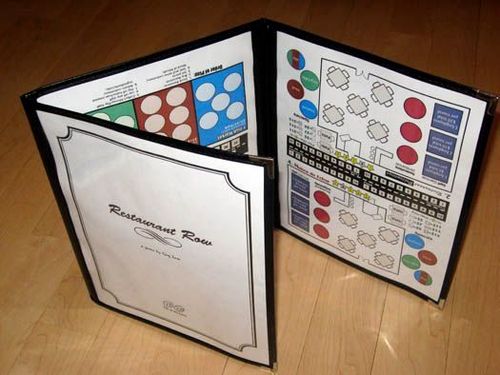
Restaurant Row
Restaurant Row Rulebook
Table of Contents
Table of Contents
Object of the Game
To become the most well-regarded restaurant on Restaurant Row by the time the neighborhood's reputation for food matures. To do this you need to be the dominant restaurant in the qualities that this neighborhood's restaurants become best known for by the end of the game.
Contents
- 1 game board
- 1 instruction booklet
- 4 Privacy/Reference Screens
- 29 large Customer tokens in a cloth bag (all except the Critic)
- 18 small Ingredient tokens in a cloth bag
- 25 white $1 chips, 10 red $5 chips, 15 blue $10 chips
- 4 small wooden $50 tokens
- The Critic token (large)
- 4 six-sided dice, 1 four-sided die
- 1 dry-erase marker
- 12 large Staff tokens
- 12 small Renovations tokens
- 6 Word of Mouth tokens
- 1 Start Player pawn
Types of Tokens
- Employees (12): Hostess (5), Sous Chef (2), Sommelier (10). The Hostess "Seats 1 more customer." The Sous Chef "Can buy 1 early ingredient/trip." The Sommelier "+$2/customer."
- Ingredients (18): Seafood, Meat, Vegetables (for example Ahi Tuna, Grassfed Beef, Fresh Corn).
- Renovations (12): Dance Floor (2, $20, "1st Scenester") and New Furniture (4, $30).
- Word of Mouth (6): Ambiance (Executives), Service (Locals).
- Customers (29): Cheapskate (Charla, marked $1; the customer's icons are minus money, food, service), Tourist (Tom; icons are star, minus money, food), Local (Laura; icons are service, minus money, popularity).
- The Critic (1): Star, popularity, food. The Critic token reads: "1 star minimum. +2 star for best food, ambiance, and/or service. 1 star for 2nd best."
Set Up
These rules outline how to play with three or four players using the 3-panel board on the interior of the menu. To play with two players, use the 2-panel game board on the exterior of the menu and see the addendum at the end of this ruleset.
Each player chooses a restaurant to run and takes their starting budget of $25 (one blue $10 chip, two red $5 chips, and five white $1 chips). In the three player game, one restaurant will be vacant. Money amounts may be kept secret throughout the game. Mark the number "10" on the customer track with the dry-erase pen. Each player circles the number "2" on the star rating meter. The ingredient tokens should be in one cloth bag, the customer tokens should be in another.
Place the Renovation and Employee tokens off of the board, face down. Randomly place the Word of Mouth tokens face up on the board, one in each of the ranking spots. Place The Critic on the allotted spot.
The player who most recently dined out at a restaurant takes the start player pawn.
There are a number of small but important differences between playing with three or four players. These are outlined in the tables like the one on the next page.
Set Up Differences
| # in game | 3 players | 4 players |
|---|---|---|
| Employees | Remove two randomly from supply at the start of the game. | Use All |
| Renovations | Remove two randomly from supply at the start of the game. | Use All |
Game Play
The game action is broken down into rounds. In each round, the following phases occur:
- Stock resources
- Visit stores
- Set prices
- Seat and serve customers / adjust Word of Mouth
- Collect money / Pay staff
- Pay off loan interest / loans
- Lay off any staff desired
- Reset board
1. Stocking Resources
In this phase, stock the ingredients into the food stores, renovations into the market, and new employees to the Help Wanted office. There are slight differences in how to fill the markets depending on number of players. For each good, add the number of items as outlined below:
| # added/rd. | 3 players | 4 players |
|---|---|---|
| Employees | Always display a total of three per round. | Add up to three each round or until full. |
| Renovations | A total of 4/round | A total of 5/round |
| Ingredients | Roll three dice, and add the sum of the highest two values. | Roll three dice, and add the sum. |
Ingredients must be placed into the respective markets. Employees must be placed with the highest numbered employee placed in the spot with the highest asking price, and the second highest numbered employee placed in the second highest spot, and so on. At the end of a round, clear Ingredients but leave Renovations and Employees for the next round.
2. Visiting Stores
During this phase, players have up to three trips in which they can visit the stores to buy items for their restaurants. Each player takes a die and secretly chooses which number store or market they will visit in that trip. For example, if they choose "3" they will go to the Farmer's Market. Once each player has chosen, all players reveal their choices.
Store visits are resolved in the order of the store numbers. If a player is alone at a store, the player is able to buy item(s) for the stated price. A player may buy only one renovation or hire one employee for each trip. In the markets, a player may buy as many ingredients as the restaurant can use.
Bidding: If two or more players are in the same store during the same trip, they must bid between for the item or items desired. The player closest to the Start Player pawn in turn order chooses which item(s) to bid upon, and the pawn then passes to the left.
To bid, each eligible player chooses an amount of money and hides it in his or her hand. After each player has done this, all reveal the bids at once with the highest bid winning the item(s), paying the amount bid. The losing players keep their money. In case of a tie, the player closest to the Start Player pawn in turn order wins the bid. Every time the Start Player pawn is used to break a tie or determine which player can choose what is being bid on, the pawn is passed to the left of the player who benefitted from the tie-breaker.
If a player wins a bid on a set of ingredients chosen by another player, he or she may wind up with more ingredients than can be used. In that case, the extra ingredients are discarded. After the player that wins a bid buys, the remaining players can continue shopping in that store from what's still available. If there are still two or more players, another bid round will occur.
All bids must be at least the minimum price of the item(s). Players cannot spend or bid more money than they currently have. A player choosing the item(s) to bid upon must make a valid bid, but other players may pass on bidding for that item by showing an empty hand on the reveal.
After the first trip, players choose again up to two more trips if there are at least three of the five shops that have anything to sell at the beginning of the trip. If there are not at least three shops with merchandise at the start of a trip, end the shopping phase and go to the next phase.
No stores are adjusted to reflect vacated spaces. A player may choose not to purchase anything in any trip. After three trips, clear away any unsold ingredients from the food markets but leave Renovations and Employees in place.
Sous Chef: If a restaurant employs the Sous Chef, it may buy any one ingredient at face value at the start of and in lieu of a normal trip. This must be announced before shopping choices are made in that trip.
Food Markets
Restaurants may buy as many of these special ingredients as they can use to offer in their Daily Specials section. There are one of each of these items in the game. The fork symbols indicate their quality. Quality is shown below as the number of forks.
- Fish Market (5): Maine Lobster (5 forks), Ahi Tuna (4 forks), Wellfleet Oysters (3 forks), Wild Salmon (2 forks), Diver Scallops (1 fork).
The minimum price for seafood is $2 plus one dollar per fork.
- Butcher Shop (6): Grassfed Beef (4 forks), Rack of Lamb (3 forks), Muscovy Duck (3 forks), Niman Ranch Pork (2 forks), Prosciutto (2 forks), Free Range Chicken (1 fork).
The minimum price for meat is $1 plus one dollar per fork.
- Farmer's Market (7): Truffles (3 forks), Porcini Mushrooms (3 forks), Heirloom Tomatoes (2 forks), Organic Greens (2 forks), Fresh Corn (2 forks), Garden Herbs (1 fork), Fingerling Potatoes (1 fork).
The minimum price for vegetables is one dollar per fork.
The purchased ingredients are placed in the Daily Specials area in the corresponding spaces, one per space. The "Any" space can accommodate any type of ingredient. A restaurant that employs the Master Chef may play one ingredient in the wrong space in every round. All ingredients must be played or discarded in every round, except if a restaurant has a Walk-In Freezer, in which case the restaurant may save one ingredient for one round instead of being played that round. The saved ingredient must be placed in the next round.
Hiring Employees
You can hire up to three additional employees to improve your restaurant during the Visit Stores phase, placing them in the Staff area. You can hire only one employee per store visit. Employees have different abilities which take effect immediately after they are hired. They also have a number by their name which indicates their service rating. All of the employees present in the Help Wanted office are sorted so that the employee with the highest service number is placed on the highest asking price slot of $10. The next highest rated employee is placed on the next highest slot, and so on. If an employee is hired, the remaining workers do not adjust their asking price until the end of the round. Employing a Manager enables you to have four employees.
These are the available employees:
| Employee | Service | Ability |
|---|---|---|
| Master Chef | 12 | Can ignore one food category and play one ingredient in a non-matching spot. |
| Celebrity Chef | 11 | Attracts the first Foodie if two ingredients are displayed. Has priority over renovations like Vegetable Garden, Barbecue, and Fish Tank. |
| Sommelier | 10 | Earn $2 more per customer; does not affect customer decisions. |
| Manager | 9 | Allows a 4th staff member or feature. Is always paid $10/round. Ignore the usual pay scale. |
| Maitre D' | 8 | Attracts the first Executive if restaurant has at least 1 renovation. |
| Pastry Chef | 7 | Earn $1 more per customer; does not affect the customer decisions. |
| Designer | 6 | +1 Ambiance point per renovation purchased. |
A restaurant may only have up to 3 employees unless they hire the Manager, in which case it can have up to 4. Every employee on the payroll must be paid in every round (See phase 6). A restaurant may lay off employees if they wish, but only in phase 7. Those employees would go back to the draw pile.
Visiting Renovations
Renovations can be bought for their base price. These items improve your restaurant's ambiance ratings immediately. Your restaurant's ambiance is the sum of the large numbers on the Renovations tile. You can buy only one item per store visit. Purchased Renovations are placed in the Renovations area. Functional Renovations also add an additional benefit listed below. No restaurant may have more than three renovations unless they employ the Manager, in which case a restaurant can have four different renovations.
| Renovations (white) | Ambiance | Cost | Add. Benefit |
|---|---|---|---|
| Complete Renovation | 6 | $50 | None |
| Interior Decor | 5 | $40 | None |
| New Furniture | 4 | $30 | None |
| Place Settings | 3 | $25 | None |
| Functional Renovations (pink) | Amb. | Cost | Additional Benefit |
|---|---|---|---|
| Patio Seating (2) | 2 | $20 | Seat +2 customers |
| Valet Parking | 2 | $20 | Earn +$1 per customer |
| Walk-In Freezer | 2 | $20 | Can save one ingredient for 1 round instead of using |
| Dance Floor | 2 | $20 | Attracts the 1st Scenester |
| Vegetable Garden* | 1 | $10 | Attracts the 1st Veg. Foodie if at least 3 of veg. |
| Barbecue Grill* | 1 | $10 | Attracts the 1st Meat Foodie if at least 2 of meat. |
*These abilities are overridden by the Celebrity Chef.
If a restaurant purchases a renovation, the token should be placed in the respective area. Renovation tokens may not be removed. One restaurant cannot buy both Patio tokens.
Visiting the Bank
A player visiting the bank can take out a loan. If they take a loan, they take any multiple of $10 that they wish from the bank up to $50 per visit. Loans are indicated by writing the amount borrowed by the restaurant in the appropriate space in the bank. A player with a loan must pay $1 of interest at the end of every round for every $10 in their space in the bank at that point in time. Also, they may repay the loan in full in phase 8. Note: Unpaid loans will be penalized in Victory Points at the end of the game. See End of Game section.
3. Setting Prices
In this phase, players must simultaneously choose their prices for the daily specials by choosing the numeral on a die and matching it to the chart on their restaurant board.
| Die face | Price |
|---|---|
| 1 | $5 |
| 2 | $7 |
| 3 | $9 |
| 4 | $11 |
| 5 | $13 |
| 6 | $15 |
The maximum number any player can select is one more than the number of stars that the restaurant has. When all the players have chosen their price, they reveal their choice simultaneously. Each customer to dine at the restaurant will earn the restaurant the amount indicated by the number on the die. If a restaurant has the Sommelier, the Pastry Chef, and/or the Valet Parking, the amount earned will be increased, though that will not affect customers' decisions in going to that restaurant.
4. Seating Customers / Adjusting Word of Mouth
The number of customers to be served that day is found by rolling the four sided die and adding the result to the previous number. This happens every day, including the first day. The count begins at "10" at the start of the game. Move the die up to reflect the new number of customers that will be drawn.
| Seating Customers Differences | 3 players | 4 players |
|---|---|---|
| Maximum # of Customers per restaurant | 6, one per table and one at the bar. | 5, one per table. |
Customers are drawn randomly and placed on an open table as they are drawn, according to their preferences. If there is a tie in their main preference, each customer will have a secondary preference to help choose between the tied restaurants. The secondary preference for all of the customers except for the Cheapskate is the lowest price. For the Cheapskate, the secondary preference is food. The third preference is distributed among the other categories. If none of these preferences apply, the customer will go to the player closest to the Start Player pawn in turn order. The pawn is then passed to the left.
If a customer's first choice restaurant is filled, he or she will go to their second choice, and so on. Restaurants have five tables in which they can seat customers. In a three player game, one customer can also sit at the bar. Having the Patio will add two spaces to the seating, and employing the Hostess will allow a restaurant to seat one more customer. Restaurants with the Patio must fill the Dining Room before using the Patio.
The 30 customers are as shown below:
- 4 Cheapskates (Chip, Chuck, Christine, Charlotte): Will go to the cheapest place available. Pays $1 less than other customers.
- 4 Executives (Eric, Eddie, Erika, Emily): Will go to the place with the best cumulative Ambiance ratings. A Maitre D' can affect their decision. Pays $2 more than other customers.
- 8 Foodies (Frank, Fred, Felipe, Felix, Frida, Felicia, Faith, Fiona): Will go to the best food available as judged by the forks on the ingredient list. However, two of them prefer meat above all else, two prefer seafood, two prefer vegetables, and two prefer all around food ratings. The Celebrity Chef, the Vegetable Garden, the Barbecue Grill, and the Fish Tank can affect their decision.
- 4 Locals (Larry, Luke, Lana, Laura): Will go to the place with the best service, as judged by the cumulative total of the employees' service ratings. The Bartender can affect their decision.
- 4 Scenesters (Sam, Sid, Sally, Sarah): Will go to the most popular place available, as judged by the number of tables filled at the restaurants when drawn. The Dance Floor can affect their decision.
- 4 Tourists (Ted, Tom, Tina, Talia): Will go to the highest rated restaurant on the star ratings. The Marketer can affect their decision.
The Critic and The Shill
In addition to the main customers, there are two special customers: The Critic and The Shill.
The Critic must be placed as the 10th customer in every round. When placed, treat The Critic like any other customer. The first preference is to go to the restaurant with the lowest star rating. The secondary preference is to go to the least popular place, and then to go to the place with the best ingredient ratings. The Critic pays as would a normal customer, but after a critic arrives the restaurant's star rating can immediately change.
When a Critic sits at the restaurant, reset the rating to one star. Additional stars are then awarded due to the quality of the restaurant, up to the maximum of five. A restaurant can earn two more stars from The Critic for having the best total ingredient rating at the time of his visit, two stars for the best total renovation ratings, and/or two stars for the best total service. A second place rating in any of the categories is worth one star. Immediately circle the restaurant's new star rating to reflect the new value. If a restaurant is tied for any of these categories, it still qualifies for the higher value award.
If The Shill is drawn, an immediate auction is held in the same manner as auctioning off of goods. The player who wins the bid seats The Shill and may immediately add one star to the restaurant's star rating or else use him in some other way to affect the Word of Mouth rankings (see next section). The Shill can only raise a restaurant's rating up to 4 stars. Only The Critic can award the maximum number of stars. A restaurant does not collect any money for seating The Shill. If no one bids on The Shill, he is discarded and is not replaced by another customer.
Once rated, the star rating stands until the next visit by The Critic or The Shill. A restaurant cannot sit both The Critic and The Shill in the same round.
Word of Mouth
As soon as the first restaurant has filled its dining room (or at the end of the round if none are full), the Word of Mouth indicator is adjusted based on the overall reputation of the restaurants in the neighborhood and is also how victory points are determined in the end. Each preference category is associated with one customer type. The Service category is associated with Locals. The Ambiance category is associated with Executives. The Profit category is associated with Cheapskates. The Star Rating category is associated with Tourists. The Food category is associated with Foodies. The Popularity category is associated with Scenesters.
Every round, as soon as the first restaurant in the game fills its dining room, move any Word of Mouth category with at least one associated customer in the dining up one rank if possible, sliding down the other categories as necessary, beginning with the top category and continuing until the bottom category.
For example, suppose the Word of Mouth rankings are as shown above. If the first full restaurant has one Tourist, three Foodies, and one Local, the Star Rating (Tourist) will remain at 1 since it can't move up any higher, Food (Foodies) will move up one spot to 2, Service (Local) will move up one spot to 3, Profit will fall two spots to 4, and Renovations and Popularity will remain at 5 and 6. The end result will change to this:
Editor's note: the printed example says "Renovations" for the sixth-ranked category, but the Word of Mouth track has no Renovations category; the sixth category on the track is Ambiance. The example is transcribed as printed.
After the Word of Mouth has been adjusted automatically, if any restaurant has seated The Shill and has not had its rating boosted, that player can promote any one Word of Mouth category by one rank, swapping with the category above it.
Food and Popularity Tracks
After all of the restaurants' patrons have been seated, adjust the cumulative food and popularity ratings, marking them on their tracks with the dry-erase marker. This is how food and popularity will be judged at the end of the game. Mark two spaces on the track of the first restaurant to fill its dining room, one on the second restaurant to fill its dining room (or else the one with the second most customers). When ties occur, all tied restaurants receive the higher amount. If no restaurant is full, then the restaurant with the most customers receives two marks, and the 2nd most full restaurant receives one.
The restaurant with the most number of forks in its specials section receives two marks on its cumulative food track. The restaurant with the second most forks receives one mark. When food ratings are tied, all tied restaurants earn the higher score.
5. Collecting Money / Paying Staff
In this phase, each restaurant takes money equal to the number of customers served multiplied by the chosen price. Valet Parking allows a restaurant to earn $1 more per customer, Pastry Chefs $1 more, and Sommeliers $2 more. For the purposes of collecting money, The Shill is not counted. For each Cheapskate seated, collect $1 less than the calculated total. For each Executive seated, collect $2 more.
Restaurants must pay their employees in this phase. If a restaurant employs 1 employee, it must pay $5. If a restaurant employs 2 employees, it must pay $10 total. If a restaurant employs 3 employees, it must pay $20 total. If a restaurant can't afford to pay all of its employees, it automatically must take a loan that enables it to pay the employees and cover the interest of the loan. Note: A restaurant with the Manager must pay $10 for that employee, ignoring the usual pay scale.
6. Paying Off Interest / Loans
In this phase, restaurants must pay $1 in interest for every $10 in loans they owe to the bank. Restaurants may pay off part or all of their loans by repaying the bank the full amount of the original loan in $10 increments, but only after they've paid off their interest for that round. (For example, if a restaurant has $50 in loans out, and they want to repay $30 of the loans, first they pay $5 for interest, and then $30 to reduce the loan amount to $20 going forward.) A restaurant does not have to repay any part of the loan if they wish, even if they can afford it. If a restaurant can't afford to pay interest, it automatically receives more in loans until it can pay it, including on that new loan.
7. Laying Off Staff
A player may lay off any staff member(s) in this phase. These staff members go back to the draw pile.
8. Reset Board
After each round, return the Critic to its spot, the customers to the customer bag, and the ingredients to the ingredients bag (except for an ingredient saved by the Walk In Freezer).
End of Game / Final Scoring
The game ends after the round in which any one of these events occur: 1) The last Employee has been placed into the Help Wanted section. 2) The last Renovation has been placed into its shop. or 3) All seats in every dining room have been filled (not including patio seats).
When any of the conditions have been met, continue play until the end of the round, then apply the Victory Point scoring.
Scoring in the final round will reflect the restaurant that has performed best in service, ambiance, profit, rating, food and popularity. For food and popularity, use the cumulative ratings the restaurants have earned represented by the Food and Popularity Tracks. For profit, it's the amount of cash on hand minus any loans unpaid.
During the game, the neighborhood's restaurants as a whole will become more well known for some aspects and less well known for others, as measured by the Word of Mouth indicator. The restaurants that excel in the most vital categories are rewarded.
The player with the most total victory points at the end wins.
| Victory Pts. | 1st Category | 2nd | 3rd | 4th | 5th | 6th |
|---|---|---|---|---|---|---|
| Best Restaurant | 10 | 7 | 5 | 3 | 2 | 1 |
| Second | 6 | 4 | 3 | 2 | 1 | 0 |
| Third | 3 | 2 | 1 | 1 | 0 | 0 |
In the case of ties in a category, the players receive the average of the placements for that category, rounding up.
In case of a tie in overall score, the top category is the first tiebreaker, the 2nd category is the 2nd tiebreaker, etc.
Debt Penalty: For every $10 in unpaid loans a restaurant has at the end of the game, subtract one victory point from the restaurant's score.
Playing with Two Players
To play with two players, use the board on the opposite side of the playing mat. There are now only two restaurants, with 10 tables for customers each. Make the following changes in gameplay:
Set Up: The star rating for each restaurant begins at 1 star.
Remove the following tokens from the game: Renovations: 1 Patio, Complete Renovation. Employees: Consultant, Hostess.
Stock Resources Phase: Use the sum of two dice to determine the number of ingredients in the Stocking Resources phase. If you draw more of any one type of ingredient than fits in the store, discard the excess ingredient(s) chosen randomly.
Fill the Help Wanted and Renovations market completely in this phase.
Visit Stores Phase: There are only two trips for shopping in each round. However, both players use two dice per trip to choose two different shops to shop in each trip. In both restaurants, there are four spots for staff, four spots for renovations, and an extra spot for ingredients. Instead of one "any" space, there is one in which you can place meat or vegetables, and one in which you can place seafood or vegetables. The ingredients and Help Wanted are now more expensive than in the base game.
- 1. Fish Market: Minimum price: $2/Fork
- 2. Butcher Shop: Minimum price: $2 + $1/ per Fork
- 3. Farmer's Market: Minimum price: $1/Fork
The Sous Chef can only be used once per trip. Use only one of the two location choosing dice when the Sous Chef is used.
Set Prices Phase: The maximum price marker a restaurant can choose is two more than the current star rating.
Seat and Serve Customers / Adjust Word of Mouth Phase: The restaurant with the most customers (or the one to fill all ten tables first) is the most popular and triggers the Word of Mouth adjustment, but only the six patrons in the main dining room are counted in the Word of Mouth adjustments. Restaurants may choose to seat patrons in the main or secondary dining rooms as they please. Again, the dining rooms must be filled before using the patio.
The Critic: The Popularity and Food rating adjustment from the critic is now to add one star for being better than or equal to the other restaurant in any category: food, service, and/or ambiance.
The Shill: May only award up to three stars, maximum.
Popularity & Food Tracks: The restaurant that wins a round in either popularity or food gets one mark on the respective track.
Collect Money / Pay Staff Phase: The prices per customer are now 1=$3, 2=$5, 3=$7, 4=$9, 5=$11, 6=$13.
If you have four employees, the overall salary payment is $30.
Pay Off Loan Interest / Loans Phase: The interest is now $2/round per chip.
Bank (Two-Player Board): Limit $50/trip. Interest: $2/round per $10 in loans.
Lay Off Any Staff Desired Phase: No changes.
Reset Board: No changes.
End of Game / Scoring: The End of Game conditions are the same. For final scoring, the restaurants are compared with one another, with the better restaurant scoring the Victory Points. In the case of ties in a category, the victory points are split evenly between the two restaurants, rounded down.
| Victory Pts. | 1st Category | 2nd | 3rd | 4th | 5th | 6th |
|---|---|---|---|---|---|---|
| Better Restaurant | 10 | 7 | 5 | 3 | 2 | 1 |
Playing with Five or Six Players
An additional expansion is available for free download for play with five or six players. This includes the game board, rules additions, and assembly instructions. The expansion is at http://www-pair-of-dice.com/games/restaurantrow/5and6.pdf. The five and six player rules are transcribed in the addendum section below.
Five or Six Players Rules Addendum
To play with five or six players, use the standard board along with the additional mat to add two more restaurants to the game. Two additional six sided dice will be needed, and additional white chips are recommended. Make the following changes in game play from the standard four player game:
-
Have only two shopping trips per round instead of three.
-
Each restaurant can seat only four customers in their dining room. Cross off one table in each restaurant of the four-player game board.
-
In a six-player game, use the roll of a six-sided die instead of a four-sided die to determine the increase in the number of Customers. In a five-player game, use the roll of a four-sided die.
-
Fill the employees section completely after every round instead of adding at most three.
-
Any restaurant can now take out a loan from the bank in between rounds if they wish, just like any other visit to the bank. Consider this Phase 9.
-
The game can now also end if the Customer counter track reaches 30 customers.
The additional mat has the two extra restaurants, Cafe Au Lait and Chez Cher. These restaurants have spots for their own bank deposits. In addition to the mat, two extra privacy/reference screens should be made and assembled as well following the instructions below and two extra D6 dice should be added.
Additional Mat Assembly Instructions
Component handling, transcribed as printed: To use the additional mat in the same way as the original game board, the mat should be laminated in order to be able to mark the sheet with the dry erase pen. First, print out the mat page (P.2 of the PDF) using the best printer and paper that you have available. Then bring the printed sheet to an office supplies store such as Kinko's or Staples. Any such store should be able to laminate the sheet.
Privacy Screen Assembly Instructions
Component handling, transcribed as printed: To make the privacy screen, print out the third page of this PDF on a card stock weight sheet. You may either print the sheet again on the other side, or fold the sheet in half to create your menu/reference screen. In either case, cut the sheets lengthwise to create the two screens. Fold and crease the cut sheets to make the screens freestanding.
The third page of the addendum PDF is the menu/reference screen art (the Employees, Renovations and Order of Play tables for Cafe au Lait and Chez Cher). Those tables restate the rules above, and the one new item they add is "9. Take out loans (5-6 player game only)," which is covered by item 5 above.