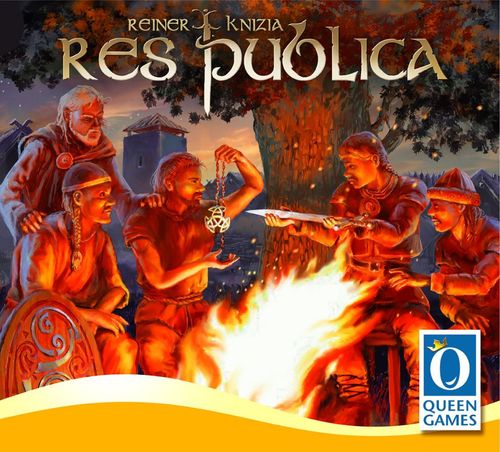
Res Publica
Res Publica Rulebook
Table of Contents
Table of Contents
Game Components
- 65 People cards: 12 each of Anglo-Saxons, Huns, Vikings, Goths, Langobards; and 5 Monks
- 65 Civilisation cards: 12 each of Alchemy, Architecture, Trade, Metalworking, Shipbuilding; and 5 Books
- 24 Scoring cards: 10 settlements (each value 3), 2 churches (each value 7), 10 cities (of values 9, 8, 8, 7, 7, 6, 6, 5, 5, 4), 2 libraries (they allow the placement of only 4 instead of 5 civilisation cards)
- 1 Rulesbooklet
Game Preparation
The Score cards are separated into 4 scoring piles:
- The first pile contains all City cards, in descending order — the 9 on top, then both 8's and so on, down to the 4 as the last card.
- The second pile contains all 10 Settlement cards (value 3).
- The third pile contains both Churches.
- The fourth pile is made of both Libraries.
All 4 Scoring piles are placed face-up in the middle of the table.
The Civilisation cards are shuffled and placed as a face-down deck beside the scoring piles.
The People cards are also shuffled; 4 are dealt into each player's hand. The remaining People cards are placed as a face-down deck beside the Civilisation card deck in the middle.
The oldest player begins. Play proceeds clockwise.
Object of the Game
The players try to found settlements and cities and to promote cultural and technological progress.
To found a settlement, 5 identical people cards are displayed. This brings 3 points and the right to draw a civilisation card each turn.
Display 5 identical civilisation cards to found a city, scoring the most points for the first city, and further cities scoring fewer points.
Through cunning trade and some fortunate cards a player will gain the most points and be victorious.
Playing the Game
Res Publica is played in game turns. The players are conducting their player turns in clockwise order. In his player turn a player may conduct the following actions in the order below or pass:
- Trade
- Display cards:
- 5 People cards result in a settlement card.
- 5 Civilisation cards result in a City card.
- 2 Monks result in a Church.
- 2 Books cards result in a Library.
At the end of his turn, a player draws 1 people card from the deck. For each of his settlements displayed in front of him, he draws 1 civilisation card, up to the maximum of 3 cards.
The Actions in Detail
Trade
When a player decides to trade, he selects one of the two following options:
A. Request one or more cards, or B. Offer one or more cards
Note: In his turn a player may only conduct one of the trade options. He may only perform one trade per turn.
A. Request one or more cards
The player names the card or cards he is requesting. He does not indicate which card(s) he is willing to give up as part of the trade.
In clockwise order, each other player who is able and willing to trade, names the cards he demands in return for meeting the request.
The requesting player decides which response to accept. Of course, he may choose to decline all responses.
If he accepts a response, he swaps the named cards face-up with his chosen trading partner.
Example: I request 1 Viking. I request 1 Monk. I request 2 Huns and 1 Shipbuilding. I request 3 Alchemy or 3 Metalworking.
Example Response: For 1 Hun. For 2 Books or any 2 Civilisation cards. For 1 Anglo-Saxon and 2 Trade. For 2 Shipbuilding or 2 Architecture.
B. Offer one or more cards
The player names the card(s) he is offering. He does not indicate which card(s) he wishes to receive.
In clockwise order, each other player who is interested in the offer names the cards he is willing to tender in exchange.
The offering player decides which (if any) response to accept.
Example: I offer 2 Goths. I offer 1 Monk and 2 other People cards. I offer 1 Hun and 1 Shipbuilding. I offer 2 Metalworking.
Note: When a player makes an offer like "I offer 1 Langobard or 1 Anglo-Saxon" he leaves the other players in the dark as to what they will receive. Consequently their responses are likely to be very unattractive. It is not allowed to negotiate which card the other player will get.
Trading Rules
- When requesting, offering or responding, a player may never name more than 2 types, combining them with and/or.
Examples: 2 Goths and 1 Hun. 2 Architecture or 3 People cards. 1 Metalworking and 2 additional cards. 2 pairs or 3 Civilisation cards.
Not permitted: 1 Goth, 1 Hun and 1 Anglo-Saxon. 1 Civilisation card, but no Alchemy.
- A player may never combine the two trading options. However, individual playing groups may develop 'house-rules' on the general disclosure of information.
Example: Not permitted is therefore: "I request 1 Hun and offer 1 Goth."
- A player who reveals more information than allowed is disqualified from the current trade.
- Each player has only one attempt!
Example: Ani is looking for a Goth card. However, she does not get a response (as the other players cannot or will not trade with her). Ani cannot attempt a second trade.
- A player's word is his bond!
- He must swap the cards he named.
- He may only offer cards which he possesses.
Of course no cards are swapped if the acting player refuses all offers.
- There is no obligation to trade the same number of cards. However, each partner in a trade must swap at least one card.
- Scoring cards may never be traded.
Display Cards
If a player holds a group of 5 identical People or Civilisation cards respectively 2 Monks or 2 Books in his hand, he may display them in front of him. A player may display several groups in one turn.
For each displayed group of cards, the player immediately receives a score card:
- For 5 identical People cards (except Monks), he receives 1 settlement card from the appropriate pile. All of these cards score 3.
- For 5 identical Civilisation cards (except Books), he receives the top card from the city pile. According to the sorting of the city pile, he will always receive the highest available card.
- For 2 Monks he receives a Church. All Churches score 7.
- For 2 Books, he receives a Library. A Library allows the owner to display 4 (instead of 5) identical civilisation cards to take a city card.
Each Score card is placed cross-wise on top of the corresponding displayed group, so that the cards in the group remain visible.
Note: Like that you can always know which cards are already out of the game.
End of a Player Turn
At the end of his turn, a player draws 1 people card from the respective deck, as long as these cards are still available. Once the deck is used up, no more people cards may be picked up.
In addition, for each of his displayed settlements, he receives 1 civilisation card from the respective deck.
Note: He receives these cards irrespective of whether he displayed the Settlements on this round or in previous rounds.
Important: A player may not draw more than 3 cards in total at the end of his turn!
Note: If he has more than 2 Settlements displayed in front of him, he must decide whether to take 1 People and 2 Civilisation cards or just take 3 Civilisation cards (and abandon the People card).
Game End and Scoring
As soon as a player draws the last civilisation card from the respective deck, the final game round begins.
Each player has one complete final turn; the player drawing the last civilisation card going last.
Then, before the scoring, all players have one more opportunity, in clockwise order, to display groups of five identical People or Civilisation cards from their hands. Moreover, they may display 2 Monks and/or 2 Books.
Afterwards the game is scored:
- Each player totals the values of his Score cards (Settlements, Churches and Cities). Libraries do not earn points.
- Each pair of identical cards remaining in a player's hand scores 1 point.
The player with the most points wins the game. If several players have the most points, all of them win.
Res Publica Classic
The first edition of Res Publica did only contain 140 cards. Monks, Books, Churches and Libraries were not included. If you prefer this "classic version", please only change the following:
- Before play begins, all Monk, Book, Church, and Library cards are taken out and put back into the game box.
- Only 2 scoring piles are formed (Settlements and Cities).
Note: Without Monks and Books a player always has to display 5 identical civilization cards.
Summary
Game Preparation
The score cards are separated into 4 scoring piles:
- 1st pile: City cards, in descending order.
- 2nd pile: Settlement cards (all of value 3).
- 3rd pile: 2 Churches.
- 4th pile: 2 Libraries.
These 4 piles are placed face-up in the middle of the table.
Thoroughly shuffle Civilisation and People cards and place them as 2 separate face-down decks beside the Scoring piles. Each player receives 4 People cards.
Game Turn
In his player turn a player may conduct the following actions in the given order:
- Conduct 1 Trade
- request one or more cards or,
- offer one or more cards from his hand.
- In either case, not more than two types may be named.
- Display Identical Cards
- 5 People cards result in 1 Settlement card;
- 5 Civilisation cards result in the top-most city card.
- 2 Monks result in a Church.
- 2 Books result in a Library.
- End of turn: Draw cards
- draw 1 People card from pile (as long as available)
- for every Settlement draw 1 Civilisation card.
Important: A player may not draw more than 3 cards in total at the end of his turn!
Note: More than 2 Settlement cards: 1 People and 2 Civilisation cards or 3 Civilisation cards.
Game End
When the last civilisation card is drawn there is one final round.
After that, all players may display cards one last time, in clockwise order.
Scoring
Every player totals the value of his Score cards (Settlements, Cities, and Churches) and adds 1 point for each pair of identical cards in his hand. The player with the most points wins.