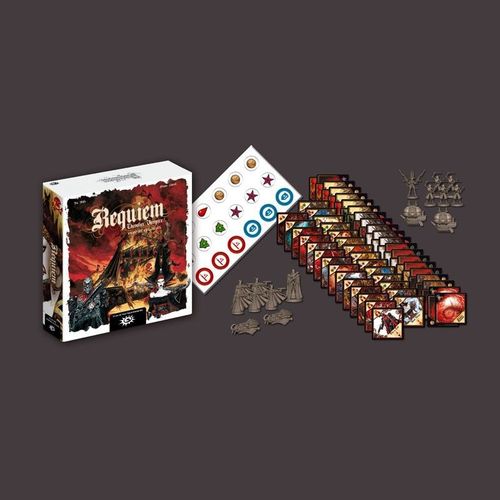
Requiem: Vampire Knight
Requiem: Vampire Knight Rulebook
Table of Contents
Table of Contents
Foreword
This rulebook is the edition for Ghouls Pirates VS Vampires Resurrectionists. It is suitable for the material of these two factions. If you play with other factions, you should refer to the rulebook that corresponds to them for details.
We suggest you start with the initiation rules for 2 players to become familiar with the "gymnastic" of the game. Then you will play the "normal" rules with 2 or 4 players.
To simplify the reading, the rules you need to know for initiation are written on the left page, sometimes with examples on the right page.
The additional rules for playing "normally" are described in boxes, usually on the right page. Means you can leave them out at your first game, you will come back before playing with the "normal" rules.
Game's Principle
On a check-board composed of random territories, move your soldiers to tap lands around and take strategic positions. These lands give you resources you will use to activate development cards, to improve your soldiers or recruit heroes.
Each player know his cards and those of his opponent, which leaves nothing to chance.
Aim of the Game
If, at the end of a turn, one of your characters occupies the territory of one of the opponent's capital with no opponent's character, you win.
If, at the end of a turn, you don't have any more characters on the board, you loose.
The Components
When you open the box for the first time, do not shuffle the deck of cards. You'll start with an initiation game and the cards are already set for that purpose. First surprise: cards have the peculiarity of being rhombuses, not square.
The territories of the board
Take the deck white border face up, the 21 first cards are the territories of the iniitiation board.
If you already shuffled the cards here is the order of the 21 territories:
- Monastry of Darkness
- Thanatos
- The Limbs
- Black Haven
- Battle Field
- Suburb
- Lonava
- Tower of the Damned
- Lonava
- Battle Field
- Dimensional Shift
- Aerophagia
- Necropolis
- Suburb
- Tower of the Damned
- Necropolis
- Monastry of Darkness
- Aerophagia
- The Limbs
- Black Haven
- Thanatos
They are the same both sides, only the border changes:
- on one side you have the land wtih the white border;
- on the other, the ruin with the black border.
There are 40 territories: 11 distinct ones (same name and same resources, shown by the letters "a", "b" and "c" on each card):
In 5 copies (resources shown as icons on the card):
- Suburb: Gold, Blood
- Black Haven: Gold, Science
- Monastery of Darkness: Magic, Blood
- Aerophagia: Magic, Gold
- Tower of the Damned: Science, Blood
- Battlefield: Magic, Science
In 2 copies:
- Thanatos: 2 Science
- Lonava: 2 Gold
- The Limbs: 2 Magic
- Necropolis: 2 Blood
- Dimensional Shift (only one resource of your choice)
The 4 ressources you'll find on cards are:
- Science
- Magic
- Gold
- Blood
Set Up
Initiation is a 2 player game. Pick a faction and one side of the table.
The Vampire player takes the whole deck, white border up. The first 21 are the territories of the board; the 6 following are his opponent's cards, numbered from 01 to 06; the 6 afterward are his cards, numbered from 01 to 06. The few last are kept in the box.
If you already shuffled the cards, the order is indicated page 4.
The boards territories
Taking the territories in the order you find them, white border up, the Vampire player place them as shown in the picture below, starting in front of him: a line of 3, then 3 lines of 5, then 3.
Leave all the activation costs visible; that will allow you to plan your movements ahead.
Dimensional Shift is in the center.
Start territories set up there, then from left to right!
The number 1 in each type must be on top of the the number 2 and 3.
Your cards
See picture below. You'll play only with the first 6 cards of your faction (fight and movement), read them before playing. Place them in front of you, inactive side up (black border), in columns by type: fighting (type Fight, n° 01 to 03) and moving (type Movement, n° 04 to 06). The Level 1 (n° 01 and 04) should be on top of the 2 columns.
Your tokens
Take 3 of your soldiers and one of your capitals. Place them on the centre territory of the first line in front of you.
Set Up for 2 Players
If you play with complete rules for the first time, only play with the 10 cards from "a" series. To play with alternate cards read deck building rules on page 17.
Your cards (2 players)
Take your 10 cards and place them before you, inactive side up (black border), fighting and moving cards in 2 columns, separately for others.
The random board (2 players)
Set aside the 2 Dimensional Shifts. Shuffle all other territories and place them at random in a 6-by-6 square, land side up. You will have 2 territories left, place them with Dimensional Shifts.
Consolidation: if he wishes to, the player, whose initiative* is the lowest, can replace the territory of his choice with one of the 4 territories set aside. The territory he chooses to take out of the board is put back in the box. His opponent can do the same thing twice. Then the first player can replace one last territory. Obviously, you cannot replace a territory previously switched!
Your tokens (2 players)
Take your 5 soldiers and your 2 capitals. If you play with alternative cards, take the heroes' token if needed and place them next to the board.
The player, whose initiative* is the highest, chooses 2 non-adjacent territories in the first line in front of him. He places a capital in each and divides all his armies between them as he wishes (he can choose to place them in only one capital). Then his opponent does the same.
*Initiative is indicated on pages 18 and 19.
Set Up for 4 Players
If you have at least 2 copies of the game you can play with 4 players, you then play in 2 teams of 2. Each player chooses one side of the table, per team, one opposite the other.
Shuffle all territories, without Dimensional Slidings. Make a square of 9 by 9 lands (see picture below). Each corner and the central territory (line 5, column 5), will remain empty: they will be impassable voids. (The diagram on page 7 marks the void positions with an X.)
Use the 4 Dimensional Slidings to make a consolidation: each player replaces one territory in increasing initiative order.
In the reverse order, place one capital and a number of your soldiers where you want in the first line before you, except the 2 territories at each end.
Do the same thing a second time maintaining at least one territory between your capitals.
A Player's Turn
The player whose faction has highest initiative starts. In this box this is the Resurrectionists Vampires.
Each player plays a full turn, then passes to the next player.
A player's turn consists of 3 phases:
- the beginning of the turn
- the 3 actions
- the end of the turn
Beginning of the turn
In initiation rules you do not use this phase.
The 3 actions
- Tap (activate cards)
- Fight
- Move
You are not required to do each of the 3 actions. You can do the 3 actions in the order of your choice. You can use 3 of your soldiers for each action.
Play each action with any character you want or can. Once you started a new one you will not play the previous action before next turn.
Attention: a character can not attack and tap a territory in the same turn!
Each action has it's own rules: they are described in following pages.
End of the turn
The characters that were removed from the board after a fight in previous turns, come back into play on your capitals during this phase (see fighting rules page 10).
It is also during this phase you check for victory or defeat conditions.
After this phase your turn ends, it's your opponents turn.
Victory and defeat conditions
- If, at the end of a turn, there is one of your characters on an opponent's capital and none of his/her characters, you win!
- If, at any moment, you don't have any more character on the board, you lose!
for 2 Players
The beginning of the turn
During this phase you may use card effects, especially special actions strength attack and plunder. The first one is bound to fighting action, the second to tapping action. They are explained in the pages that relate to these actions.
If several effects activated during the beginning of the turn, first perform those from active player in the order he chooses, then perform those from the opponent.
In card effects, this phase has the following pictograms:
- black flag: at the beginning of a turn
- red flag: at the beginning of your turn
- blue flag: at the beginning of an opponent's turn
The 3 actions
The action rules are the same as in the Initiation game, but you now have 5 characters not 3. You may not use more than 3 per action. You do not have to use the same characters from one action to another.
Some effects may allow you to use more soldiers for your actions. Attention, it only concern soldiers and not characters, your heroes are not affected by these effects.
- Tap with +1 soldier
- Tap with +2 soldiers
- Attack with +1 soldier
- Attack with +2 soldiers
- Move +1 soldier
- Move +2 soldiers
End of the turn
Your characters removed from the board come back on board only if you don't have more than 5 characters on board. Attention, when you play heroes make sure you don't bring back too many characters.
for 4 Players
Add the initiative of the 2 players of each team, to obtain the team initiative. The team that has the highest initiative goes first.
The player with the highest initiative in each team is the first player of that team.
The first player of each team play their turns in team initiative order, then the second players of each team play their turns in team initiative order.
The beginning of a turn
The active player plays his beginning of a turn effects, then play other players' in decreasing initiative order.
The end of the turn
If there is one of your characters on an opponent's capital and none of his characters at the end of a turn, take the capital token and place it in front fo you out of the board.
Once a plyer loses his 2nd capital, he can't bring back on board his characters previously removed.
Victory and defeat conditions
When your team has taken one capital from each opponent player, you win!
If, at any moment, a player has no more characters on board: he loses. His team-mate will continue playing alone!
Tapping / Activating cards
A character cannot tap if he already attacked this turn.
You cannot tap a territory where there is an opponent's character or capital.
- Move as many characters as necessary onto the lands (white border face up) you want to get the resources.
- Flip concerned territory ruin face up (black border).
- You now have one of each resources from that territory.
- Activate the development cards you wish, you must have all of the resources needed for their activation cost. Flip these cards to their active side (White border).
- Fighting and moving cards are from 3 levels. These must be activated in increasing level order, one of a type per turn maximum. Once you activated the card of the next level, it replaces the one from previous level, put it above, their effects do not stack.
- Each resource can be used to activate one card only: the resource is spent.
- You are not required to spend all collected resources.
- Remaining resources at the end of the action are lost.
- A Dimensional Shift only gives one resource you choose among the 4.
- A card's effect activates at the end of the action during which the card is activated.
- If several of your characters are on a territory you tap, they are all considered tapping: they can not attack this turn. However you only tap one territory and it does not give you more resources, nor activates more effects.
- You must justify every tapping by acheiving an effect or activating a card: tapping for nothing is forbidden!
Tapping limits for 2 or 4 Players (page 11)
Without a bonus you can not tap with more than 3 characters.
Some bonuses allow you to tap with 1 or 2 more soldiers.
Attention, we are talking of using more soldiers beyond the 3 characters normally allowed, not heroes.
- Tap with +1 soldier
- Tap with +2 soldiers
Besides tapping lands to obtain resources, some of your cards may allow you to tap territories to activate effects. These 2 reasons to tap take place simultaneously and within the tapping limits.
In effects it will depict with following pictograms:
- Tap a territory
- Tap a land
- Tap a ruin
It may be a specific territory (where you'll find specific resources, a land or a ruin...).
Tapping a ruin allow you to flip it back land face up, but attention, a ruin never gives resources.
Tapping a territory may be a condition to activate an effect, if it is a land it does not give you resources.
The effect activate immediately after you tap the concerned territory. This effect may be active until the end of the turn but never beyond.
Fighting
A character can not attack if he already tapped a territory this turn.
If you did not use your fighting action during this turn and there is an opponent on the same territory as one of your characters, you must attack.
- Each soldier has a strength of 1.
- Attacker chooses the order when resolving fights.
- A fight on a territory is independant from others. Attention, your cards' bonuses may change depending of previous fights.
- Your characters fight one or more opponent's characters if they are on the same territory.
- Except for effects, each character on the territory are involved in the fight: add their strength to obtain the cumulative strength of your characters.
- Fighting cards' bonuses (and some of other cards) can increase the cumulative strength. They may depend of the type of the territory where the fight takes place and apply in attack or defense.
Bonus icons for fighting cards:
- +1 attack (on a territory)
- Lands: +1 attack
- Ruins: +1 attack
- +1 defense (on a territory)
- +1 defense on lands and ruins (same icon, depending on the territory type)
Samples of association:
- Lands: +1 attack and +2 defense
- Lands: +1 strength (+1 attack and +1 defense)
- Ruins: +1 attack and +2 defense
These bonuses add to cumulative strength and not to each charater's strength.
Resolving
- Compare the cumulative strength from your characters to that of opponents' on the same territory: Sum of your characters' strength + your cards' bonuses.
- The player whose cumulative strength is the hightest, wins the fight.
- In case of a draw the attacking player wins.
- The loosing player removes all his involved characters from the board.
Respawn
Characters removed from board in fights are brought back at the end of your next turn. Distribute them as you choose on your capitals.
Attention, remember to differenciate between the characters removed in previous turns from those removed this turn. The first will be brought back on board at the end of this turn. The seconds at the end of the next turn.
Fighting examples
It's your turn, you play Vampires and you have the following fighting bonuses: +X in fight (X is the number of allied characters on adjacent territories).
Your opponent plays Pirate Ghouls.
- Land: +1 attack
- Ruins: +1 defense, +2 attack
Here is the situation when you attack: the example uses the cards Black Opium and Magic from Hell.
You decide to resolve the fights in following order:
- Your Vampire has 1 strength, but has no bonus. The Zombie has 1 +1 in defense on a ruin = 2 strength. The Zombie wins, the Vampire is removed from the board.
- Your Vampire has 1 strength. Add the support of the 2 soldiers on adjacent territories (a) = 3 strength. The Zombie has 1 +1 in defense on a ruin = 2 strength. The Vampire wins, the Zombie is removed from the board.
- Your Vampire has 1 strength + 2 (a) = 3 strength. The 2 Zombies have 1 + 1 = 2 strength; +1 defense on ruins = 3 strength. Draw, attacker wins: Zombies are removed from the board.
Fighting limits for 2 Players
Without a bonus you can not attack with more than 3 characters.
Some bonuses allow you to attack with 1 or 2 more soldiers.
Attention, we are talking of using more soldiers beyond the 3 characters normally allowed, not heroes.
- Attack with +1 soldier
- Attack with +2 soldiers
Heroes have their own fighting capacities. Fighting cards' bonuses do not benefit to heroes.
Other pictograms linked to fight:
- Won fight
- Lost fight
- Character is removed from board
Fighting for 4 Players
During your allies turn you are also attacking.
The active player chooses the resolving order.
Every allied character in the territory are involved in the fight: their strengths add to cumulative strength and they are removed from board if the fight is lost.
Moving
- Basically a character moves horizontally and/or vertically - not diagonally!
- A soldiers normal move is 1 territory.
- You are not obliged to move your characters.
- The movement of each of your characters is independent. They benefit from your cards' bonuses individually.
- Moving cards' bonuses (and some from other cards) allow you to move characters along more territories.
Movement bonus icons:
- +1 movement
- Land: +1 movement
- Ruin: +1 movement
They may concern a type of territory: land or ruin. An effect may give you a bonus for each type of territory, they do not stack.
It is the normal move that applies the conditions of these bonuses: depending on the territory where you choose to move with your normal move, you may activate either one or the other bonus (see example on the next page).
- You are not obliged to use the whole bonus.
- Barring the effect below, a character's movement stops as soon as it enters a territory occupied by an opponent's character. A character can always move out a territory an opponent occupies.
- Opponent's characters do not stop your movements (when the effect below applies).
- You can't interrupt the movement of one of your charaters to use an effect on one territory while "passing".
A character can not attack and tap during the same turn: do not move a character that already tapped toward an opponent's character he'll have to fight.
Do not move more characters toward opponent's characters than the number you are allowed to.
Movement examples
You have the following movement bonus: Ruins: +2 movement.
You choose to move one soldier (green) starting with a land: he can not use his bonus and stops there (1 territory).
Another soldier (yellow) starting with a ruin may use the bonus. Afterward he can so move 2 territories further what ever their type (3 territories maximum).
Moving for 2 or 4 Players
Without a bonus you can not move more than 3 characters.
Some bonuses allow you to move 1 or 2 more soldiers.
Attention, we are talking of using more soldiers beyond the 3 characters normally allowed, not heroes.
- Move +1 soldier
- Move +2 soldiers
Like soldiers heroes have 1 point movement, but they are not affected with your moving cards effects. On their card you'll find their own bonuses, working like your soldiers bonuses.
Your Development Cards
Read your cards before playing: you'd better know if the next bonus is more interesting than the previous one.
Each player's cards are placed on the table in front of them: starting inactive side up (black border).
Once activated, your cards remain active until the end of the game.
Your cards should never be hidden from your opponent!
The Cards' effects are always written in text and icons. This will help you reading them quickly once you know their meaning. Moreover it's easier to read icons on your opponent's cards than texts, from the other side of the table.
At the end of this rulebook you'll find all the icons and the pages which to refer if you need clarifications.
Cards types
The fighting and moving cards are of 3 levels. Once activated, place the new card above the previous one, their effects are not added, the new one replaces the previous one.
A few icons
One territory from the board is represented in grey, a ruin is a black territory and a land is a white territory.
- Territory (grey)
- Ruin (black)
- Land (white)
- Adjacent territories (which touches concerned territory with at least a corner)
- The allied characters on adjacent territories
A moving bonus is represented with a wheel +1. A fighting bonus is represented with a sword to attack and a shield to defend.
Combining these icons you obtain effects:
- Lands: +1 movement
- Ruins: +1 in attack and +2 in defense.
for 2 or 4 Players
The effects may modify or break the rules of the game: effects always have priority over the rules!
You'll have to distinguish your various characters, heros and soldiers:
- Character
- Soldier
- Hero
Your effects may concern your characters, allied characters or the opponent's characters. This is all about colors:
- Red: one of your characters
- Black: one of your characters or an allied one
- Blue: an opponent's character
Using conditions
An effect preceded by a sign "=" is subject to conditions. All these conditions must be fulfilled to apply the effect.
Such an effect only applies until the end of the turn: next turn you'll have to fullfiled the conditions to activate it.
Limitation
1x Some effects are limited to one use per turn, this means for only one character.
Others need to be played at the beginning of a turn:
- at the beginning of a turn (black flag)
- at the beginning of your turn (red flag)
- at the beginning of the opponent's turn (blue flag)
Ritual effects (pentagram icon) can not be used on a territory where an opponent activated dispelling (pentagram icon).
A few icons
- Red down arrow: this territory
- Black character icon: territory one of your characters occupies
- Territory where you'll find a precise resource (star icon): here Magic
- Precise territory (star and triangle icons): here Battle ground
- Flip a territory (arrow icon)
- Development card (yellow diamond)
Particular effects usable before, after or between actions
The Strike is not a normal attack, but a remote effect, usable at any time (under condition). It does not count in attacking limits.
One of your characters attacks one only opponent character in an adjacent territory (even if there more than one in that territory). The attack strength is given (X), no bonus may improve it.
The defender has benefit of it's defense bonuses, but not of the support from other characters in the same territory. The strike resolves like a normal fight, but if attacker loses it's character is not removed from the board.
Plundering is not tapping, it is an effect usable at any moment (under condition). It does not count in taping limits.
As in a taping, flip the territory one of your characters occupies. Plundering is used to obtain effects, never for resources.
Deck Building
Depending of the expansions you own, you may have alternate cards for your factions.
Before the game you may replace as many cards from your faction as you wish. However, you can not have more than 10 cards, nor more than one card with the same number (01 to 10 below). If a card has two numbers, choose the one it replaces.
Heroes
Heroes are characters with their own token and a card on which you'll find their effects.
Once you activated the hero's card, remove from the board one of the soldiers you used to collect the needed resources and place the hero token on one of your capitals.
Like soldiers, heroes have 1 point strength and 1 point movement, but they have personal bonuses indicated on their cards. Effects from your fighting and moving cards do not affect your heroes.
When a hero is removed from the board in a fight, deactivate (flip) his card and place his token beside the board. You will have to collect resources to re-activate this hero: at the end of the next turn you will put a soldier back into play.
Act the same way if an effect deactivated a hero's card.
Effects bound to heroes
Ethereal: the hero is invisible. This hero cannot take part in fights, even if he occupies a territory where a fight takes place. If he stands alone on an opponent's capital you don't win. If his token is the last on the board, you lose. If he stands on a territory where dissipation acts, deactivate his card.
Regeneration: When the hero is removed from the board in a fight you can put him back into play like a normal soldier: don't deactivate his card.
Aura: The following effect concerns the adjacent territories to the one the hero occupies but not his own.
The Resurrectionist Vampires
On Resurrection, Vampires are certainly the creatures most satisfied with their lot! Re-incarnations of the greatest criminals Earth ever spawned, they committed there the worst atrocities. This world offers them the opportunity to continue their work! They assume the title of Resurrectionists!
The Count Dracula leads them to the ball as into the fray! Unlike others who were humans before reaching Resurrection, Dracula is a permanent Vampire. Never rejuvenating, he is therefore immortal. He can pass on that gift by the "Kiss of Darkness" to those he finds worthy of joining his family.
On lands the Resurrectionist Vampires are really strong.
But if your opponent drags things along, ruins will multiply and disadvantage you.
You'll then have to think hard about how to recover.
The Vampires have an initiative of 5.
A few clarifications about some of your cards
Black Opium: X = number of allied characters on adjacent lands. Your characters and those of your team-mate when playing 4 players.
Ghost Shield: Dissipation on Battlefields one of your characters occupies and adjacent territories. Ritual effects are cancelled on these territories; the ethereal heroes are removed from the board, their card deactivated.
The Terrible Judgment: At the beginning of your turn: plunder a Magic land to realise a 2 strength attack on one adjacent character. You only attack one character even if there are more on this territory! This effect does not count towards the limit of attacks in that turn.
Blood Convent: Tap a ruin. During tapping use one character to flip a ruin he occupies, it does not provide resources!
Berserker: Flip this card and win this fight. Flip this card inactive side up when you use it's effect. You will have to re-activate it later.
Alternate card: Otto von Todt: Resurrectionnist hero. Replace n°9 or n°10 cards. Aura, ruins: +1 attack. Your characters on adjacent ruins get a +1 strength bonus.
Icons
Board and territories
- Territory (grey)
- Ruin (black)
- Land (white)
- Territory where you'll find a precise resource (star icon): here Magic
- Precise territory (star and triangle icons): here Battlefields
- Territory one of your characters occupies (red bar)
- This territory (red down arrow)
- Flip a territory (arrow icon)
- Adjacent territories (which touch the concerned territory with at least a corner)
- The allied characters on adjacent territories
Cards
- Development card (yellow diamond)
- This card (red down arrow on yellow)
- Flip this card: it is deactivated
Characters
- Character (black bar)
- Soldier (black bar with a corner cut)
- Hero (black pawn)
- Your character(s) (red)
- Allied character(s) (black)
- Opponent(s) character(s) (blue)
- This character (red arrow)
Capitals
- Capital (grey)
- Your capital (red)
- Opponent's capital (blue)
- Returning of your character (grey capital with a black bar)
Particular effects (page 17)
- Plundering (fire icon)
- Strike (red X on a territory)
Tap (pages 10 and 11)
- Tap with +1 soldier
- Tap with +2 soldiers
- Tap a territory
- Tap a land
- Tap a ruin
Fight (pages 12 and 13)
- Attack with +1 soldier
- Attack with +2 soldiers
- +1 attack
- Land: +1 attack
- Ruin: +1 defense
- Examples of association: +1 strength
- Land: +1 attack and +2 defense
- Won fight
- Lost fight
- Character is removed from the board
Move (pages 14 and 15)
- Move +1 soldier
- Move +2 soldiers
- +1 movement
- Land: +1 movement
- Ruin: +1 movement
- Opponent's characters do not stop your movements
Particular conditions (page 17)
- At the beginning of a turn (black flag)
- At the beginning of your turn (red flag)
- At the beginning of opponent's turn (blue flag)
- What's before is a condition to use following effect (equals sign)
- Effect usable once per turn (1x)
- A ritual effect which can be canceled with dissipation (pentagram icon; crossed-out pentagram for dissipation)
Heroes effects (page 17)
- Ethereal (red hero on pentagram)
- Regeneration (hero returning to play)
- Aura (red hero on a territory)
The Pirate Ghouls
On Earth, Ghouls were women who elevated hypocrisy to art. They hid their inclinations towards inflicting pain under the guise of justice, fairness, even piety. Scheming, jealous, cynical, hypocritical, venal... Mitra - John Edgar Hoover in her earthly incarnation - leads the Guild. She must always be on her guard to keep that nest of vipers under control!
The ruins favour the Pirate Ghouls.
Plunder, tap, find resources where they are!
Survive at first, the longer the game goes on, the more this advantage grows.
The Ghouls have initiative of 3.
A few clarifications about some of your cards
Pirate City: Dissipation on Darkness Monastry one of your characters occupies and adjacent territories. Ritual effects are cancelled on these territories; the ethereal heroes are removed from the board, their card deactivated.
Boarding: Tap a land: Flip one adjacent territory. You do not get the resources from this land!
What brings us together...: At the beginning of a turn, plunder a Gold land: +1 in strength for this character. Enable during your turn or your opponent's, with as many characters as you wish.
Guild's Throne: Your characters are put back into play at the beginning of your turn. On your capitals of course!
Alternate card: Lady Venus: Pirate heros. Replace n°8 or n°9 cards. Aura, tap a Gold land: receive +1 Gold. If one of your characters tap a land, adjacent to Venus, where there is Gold: receive 1 Gold more than normal resources.