Repubblica Ribelle
Repubblica Ribelle Rulebook
Table of Contents
Table of Contents
Game Overview
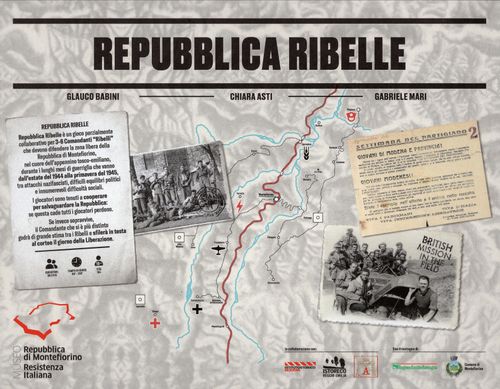
Repubblica Ribelle is a partially cooperative game for 1-6 "Rebel" Commanders who must defend the free zone of the Republic of Montefiorino, in the heart of the Tuscan-Emilian Apennines, through the long months of guerrilla warfare from the summer of 1944 to the spring of 1945, amid Nazi-Fascist attacks, delicate political balances and countless social difficulties.
The players must cooperate to safeguard the Republic: if it falls, all players lose. If instead the Republic survives, the Commander who has distinguished themselves most will enjoy great esteem among the "Rebels" and will lead the procession on the day of Liberation.
A complete game is divided into two Phases:
- Phase I covers the events from June to August 1944;
- Phase II covers the events from August 1944 to April 1945.
A game lasts 60 to 120 minutes, or about half that in Demonstration mode (see the section of that name).
Contents of the Box
- 1 Game board (Map)
- 6 Rebel boards (Phase I on the front, Phase II on the back)
- 12 Leader cards (6 for Phase I, 6 for Phase II)
- 24 Mission cards (12 for Phase I, 12 for Phase II)
- 114 Action cards
- 18 Wooden cubes (3 per colour)
- 12 Wooden discs (2 per colour)
- 18 Wooden cylinders (3 per colour)
- 6 White wooden discs
- 5 White wooden cylinders (3 for the resources on the map, 1 for the Republic's health, 1 for the First Player)
- 1 Black pawn
- 1 Sheet of labels
- 1 Rulebook
Materials
Map
The game map is divided into territories (blue borders), each showing various locations. The most important locations are written in larger letters, the secondary ones in smaller print. These locations are connected by secondary roads (white lines) and by the Strada delle Radici, the Road of the Roots (in red).
Movement takes place only along roads, and once a piece has arrived in a territory, its pieces (Mobile Detachments and Political Commissars) may be placed in any location within it.
Some locations show resources, depending on the game Phase (black for Phase I, red for Phase II). These resources can be used to activate effects on the cards played in Missions (see the section "How to Play").
At the bottom is the Republic Health track: if it reaches 0 during the game, the players lose because the Republic has been overwhelmed!
Rebel Boards
Each Rebel board is divided into 3 parts:
- In the upper part are shown the game Phase in which it is used, the Territory where the Commander's base is deployed, and the Faction the Commander belongs to (Star or Fire).
- In the central part is the Population Support track, which shows how many cards the player may hold in hand at the end of each game turn and how many Movement Points they have available to move their pieces on the map (Mobile Detachments and Political Commissars).
- In the lower part are 3 Score boxes: Military, Political and Social. During the game each player places in these boxes the Action cards they earn as rewards for the Missions they face, keeping them face down until the final count.
Wooden Pieces
Each player's wooden pieces are of three types:
- 1 Brigade Base (disc): represents the Brigade in all its functions and must be deployed by the player on the Territory shown on their Rebel board. The Brigades are military organisations but, in the power vacuum left by the previous authorities, they also take on civil functions (for example judicial and police functions). The Brigade Base is immovable.
- 3 Mobile Detachments (MD, cubes): represent the groups of armed partisans who move around the Republic's territory, providing military support as needed.
- 3 Political Commissars (PC, cylinders): represent the political arm of the Brigade, tasked with supervising the territory of the Republic.
- 1 Population Support marker (disc): represents the level of support the Brigade receives from the Republic's population. Specifically, it shows how many cards a player may hold in hand at the end of each turn (excluding the Leader card) and how many Movement Points they have available to move their pieces each turn.
Preparing the Labels
Before sitting down to play Repubblica Ribelle for the first time, you must attach the labels to certain specific wooden pieces. Follow the instructions printed alongside to apply each label correctly.
- RESOURCES: Take 3 white cylinders; attach the black icons to one face of each cylinder and the red icons to the other face. Once done, each cylinder will have one face with a black icon and the other with a red icon. It does not matter how they are paired.
- SUCCESSES: Take 6 white discs; on each, attach a label to one face only.
- POPULATION SUPPORT: Take 1 disc of each colour (except white) and attach an icon to one face only of each disc.
- REPUBLIC HEALTH: Take 1 white cylinder and attach the label to one of its faces.
- CUMER + ALLEATI: Take 1 white cylinder and attach CUMER to one of its faces and ALLEATI to the other.
Action Cards
All Action cards have three characteristics (Military, Political, Social), an activation condition (the Resource that must be occupied with a DM or PC piece) and the description of the effect that may be activated. The Military, Political and Social characteristics are shown with three icons, each beside a numerical value between 0 and 4.
Card layout, as shown on the printed diagram:
- Title of the card.
- Characteristics (from left to right): Military, Political, Social; Partisan icon (Automated Partisan).
- Effect and descriptive text.
- Activating resource: Phase I (black) and Phase II (red); card number.
Leader Cards
Each player has 2 Leader cards for their colour: one for Phase I and one for Phase II. Until it is played in a Mission, the Leader card must be kept in hand together with the other Action cards and has certain privileges:
- it can never be discarded as the result of using a resource;
- it never counts towards the card limit provided by Population Support.
Each Leader card shows the values of the characteristics used in Missions (Military, Political, Social).
Card layout, as shown on the printed diagram: card title; game Phase; Victory Points at game end; characteristics (from left to right: Military, Political, Social); descriptive text; card number.
Mission Cards
Mission cards represent the challenges the players must face to keep the Republic alive. The events described on Mission cards come in three types:
- Military (green): this Mission has a single difficulty value, which must be multiplied by the number of players, represented by the Success pieces. To reach the total required, the Military values of all players are added together (see the section "Resolution"). When facing these Missions, the players may discuss freely aloud during the "Staff Meeting" step (see the section "How to Play").
- Political (yellow): this Mission has two difficulty values. A number of Objective tokens equal to the number of players is placed on the Mission card. Each player totals their own Political value (see the section "Resolution"); if they reach the first value they remove only one Objective, while if they reach the second they remove two. When facing these Missions the players may NOT speak to each other (see the section "How to Play").
- Social (light blue): this Mission has two difficulty values. A number of Objective tokens equal to the number of players is placed on the Mission card. Each player totals their own Social value (see the section "Resolution"); if they reach the first value they remove only one Objective, while if they reach the second they remove two. When facing these Missions the players MAY speak to each other (see the section "How to Play").
Missions also have further effects depending on whether all Objectives are removed or not, and on who scored the highest. See the Mission card legend in the Appendix.
Card layout, as shown on the printed diagram: title; location; descriptive text; consequences; difficulty; card number; game Phase.
Note: the rulebook's Demonstration Game section describes the Social Missions as "brown" (marrone) in one place, while the Mission-type list above, and the Mission card colour key on page 10 of the original, give "light blue" (azzurro). The text above follows the Mission-type list.
Game Setup
Repubblica Ribelle must always be played with at least 3 factions on the table. If there are fewer players, "Automated Partisans" must be used (see the section of that name).
- Place the map in the centre of the playing area.
- The player whose birthday is closest to the date the Republic was founded (18 June) receives the First Player token and places it in front of them, with the Cumer side revealed.
- In turn, starting with the holder of the First Player token and proceeding clockwise, each player chooses a Rebel board and places it in front of them on the Phase I side.
- Depending on the colour of the board, each player also takes the following wooden pieces in the chosen colour: 2 discs, 3 cubes, 3 cylinders, 2 Leader cards. They then distribute their pieces as follows:
- 1 disc (Base) and 1 cylinder (PC) on the map at the location shown on the board;
- 1 disc with a label in the central position of the Population Support track (5 cards, 3 Movement Points);
- 1 cube (MD) at Montefiorino;
- the remaining 2 cubes and 2 cylinders beside the board, in the reserve;
- the Phase I Leader card in hand, and the Phase II Leader card beside the board.
- Divide the Mission cards according to the Phase of the Republic (Phase I and Phase II, as shown on the back of the cards) and shuffle them separately. Then randomly select cards from both decks to form two piles: one with 4 Phase I cards and the other with 6 Phase II cards. Place the Phase I deck on top of the Phase II deck.
- Shuffle the Action card deck: each player creates their own hand by drawing 5 cards from the top. Place the remaining deck in a convenient position beside the game board.
- Set the Republic's Vital Parameter (Republic Health) to the space numbered 3 on its track on the map. Keep as many white discs (successes) at hand as there are players, returning any surplus to the box.
Demonstration Game
A Demonstration game is played with a slight variation in setup. The Mission deck (step 5) is composed as follows:
- For Phase I, one Mission of each type is chosen at random: one Military (green), one Political (yellow), one Social (brown).
- For Phase II, 2 Missions are chosen at random.
Finally, the Republic's Vital Parameter (step 7) is placed at the value 2.
Note: the original sets the Social Mission colour to "brown" (marrone) here, whereas the Mission-type list describes it as light blue (see the Mission Cards section above). Both are reproduced as printed.
Story Opening
It is 18 June 1944, the Repubblica Ribelle has just been born: are you ready to rewrite History?
Automated Partisans (games with 1 or 2 human players)
If there are only 2 players at the table, or even if you are alone, you may use Automated Partisans: 1 if you are 2, 2 if you are alone. The chapter on this subject in the rulebook explains how they work (see the section "Automated Partisans" below).
The Story Already Written
The Republic of Montefiorino is one of the first, most extensive and most important experiences of the "Free Zone" during the war of liberation. After the armistice of 8 September, the first rebels arrive from the plains and join the many young locals who refused conscription, forming the first bands. Following the atrocious massacres of civilians at Monchio and Cervarolo, between 18 and 21 March 1944, the mountain population rises up against the occupier. The partisans reorganise, gradually checkmating the enemy forces, repelling Nazi attacks and forcing the Fascists to abandon their military posts in the territory. On 18 June 1944, after isolating it, the partisans rout the most important garrison and liberate Montefiorino. On 25 June 1944 a popular council is elected, which takes office the following day, and in similar time frames the same happens in the other six communes of the Free Zone. Among the most significant measures, an attempt is made to administer supplies, prices and assistance to the population, also restoring the functionality of the main services.
On 30 July 1944, however, the Nazi-Fascists launch a large-scale attack, with a battle group of 5,000 men supported by armoured car units and heavy artillery (it is considered the largest pitched battle of the Italian Resistance), and the partisans cannot withstand the onslaught. Within two days the Nazi-Fascists break through on all fronts, and the Divisional Command orders the disengagement on the evening of 31 July.
On 6 August 1944 Montefiorino burns. The First Republic has fallen, but its legacy remains strong: in the following weeks the democratic experience will be reborn as the Second Republic, and elsewhere in Italy other experiences like that of Montefiorino are born.
How to Play
A game of Repubblica Ribelle is characterised by two Phases. In each Phase, each game turn is made up of 6 steps.
In each step the players carry out all the actions provided for before moving on to the next step. In each step the players always act clockwise, starting from the holder of the First Player token.
The steps of a turn are as follows, then described in detail:
- Staff Meeting (Stato Maggiore)
- Manoeuvres
- Mission
- Resolution
- Resupply
- End of Round
Step 1: Staff Meeting (Stato Maggiore)
The holder of the First Player token takes the top card from the Mission deck and reads it aloud, for the benefit of all players. They then place the Mission beside the map, putting on it a number of Objective tokens equal to the number of players if the Mission is Political or Social. Finally, they place the black pawn on the map at the location of the Mission, so that it is visible to all players.
If the current Mission is Military (green) or Social (light blue), the players may now confer verbally, without being able to show each other cards from their hand, to coordinate how they intend to tackle the Mission. If the Mission is Political (yellow), by contrast, after the effect has been read the players proceed to the next step without speaking.
Step 2: Manoeuvres
The players, in turn order, may choose to move their DM and/or CP up to the limit of Movement Points (MP) given by the Population Support track on their Rebel boards. Pieces move only along roads, and each piece pays 1 MP to enter an adjacent Territory. When making the first move along the Road of the Roots (red line), no points are paid, while subsequent movements cost the usual 1 MP.
When a player finishes moving a piece (because they have no more MP available or because they wish to move other pieces), they may place the piece in the Territory at any of the locations represented within it.
Step 3: Mission
Depending on the type of Mission, the players will play face-down cards in front of them to try to overcome the Mission's difficulty, starting from the player to the left of the holder of the First Player token.
- Military Mission: each player, on their turn, plays as many cards as they wish from their hand (even none), placing them face down in front of them. When all players have had the opportunity to play, the game proceeds to the next step.
- Political/Social Mission: each player, on their turn, either plays a card or passes. If they pass, they may no longer play cards in that Mission. When all players have passed, the game proceeds to the next step.
Step 4: Resolution
All players reveal the cards they have played, simultaneously. Then, starting from the holder of the First Player token, each player carries out, in turn:
a) Activation of resources b) Counting of Mission points
a) Activation of Resources
During the activation of resources, the player checks whether they have pieces on any of the resources shown on the Action cards they have played. For each of their own pieces (DM and/or CP) present on that resource on the map, they may activate 1 of the effects of the cards they have played.
Example: if Lucia has played 3 cards with the grain-heap symbol (Cerredolo), but has only 1 DM and 1 CP at Cerredolo, then she may activate only 2 of the 3 cards she has played.
If the Action cards instead have a "star" or "flame" symbol in place of the resource symbol, their effects may only be activated if the same symbol is shown on the player's own Commander board. Only 1 effect per Mission card may be activated.
Note: even without pieces on the map at the resources, it is always possible to play an Action card in order to use its Military, Political or Social characteristic value.
b) Counting Mission Points
When counting Mission points, the player adds up the points on the played Action cards that correspond to the type of Mission in progress, and consults the Mission card to resolve the effect corresponding to the score they played (see the Appendix).
Pieces on the map in the Territory where the Mission takes place may provide bonuses depending on the type of piece and the type of Mission:
- each DM for Military Missions provides +1 to the Military score played;
- each CP for Political Missions provides +1 to the Political score played;
- the Brigade Base for Military and Political Missions provides a +2 to the Military and Political value, respectively.
Note: the modifiers are added to the total of the values on the player's Action cards, and not to each of the individual cards played.
Mission Success
A Mission is considered successfully overcome if:
- in the case of a Military Mission, the players, all together, have totalled a Military score on the Action cards played equal to the difficulty of the Mission multiplied by the number of players (example: difficulty 7, 4 players, target score 7 x 4 = 28);
- in the case of a Political or Social Mission, all the target tokens on the Mission card have been removed.
If the target score (Military) has not been reached, or at least one target token remains (Political/Social), the Mission is not overcome. Each Mission card shows the consequences of reaching a certain score played and what happens in case of failure of the Mission (see the Appendix).
Score Pads on the Rebel Boards
Many of the effects of Mission cards allow players to place cards on the Score pads on their Rebel boards, depending on the type of Mission. When a player must place cards here, they first draw a card from the deck, then place a card from their hand, face down, on top of one of these Score pads, on top of any other cards already played.
In no case is it possible to alter the order of the pile played on each Score pad, although the owner of that board may look at the cards they have played at any time, provided they keep them separate from their hand of cards.
Resource effects that make an opponent discard cards from a Score pad always and only target the card on top of the Score pad.
Lose Everything!
A Mission effect (not a resource on a played Action card, but only those of the Mission itself) that requires discarding a card from an empty Score pad, or a Leader that has already been used, is ignored, and instead 1 point of Population Support is lost.
Step 5: Resupply (Rifornimenti)
Each player, in turn order, draws cards from the deck according to the Phase they are playing and adds them to their hand:
- 1 card for Phase I
- 2 cards for Phase II
Finally, the players indicated by the revealed side of the First Player token (if any) draw 1 additional Action card: with Cumer revealed, the players of the Star (Stella) faction draw the additional card; with Alleati revealed, the players of the Fire (Fuoco) faction draw. If, at any moment, the deck runs out, the discards must be shuffled to recreate it.
The Two Factions
The Rebels can be traced to two factions. The "red" Rebels (of socialist and communist background) have the Star (Stella) as their faction symbol. The other Rebels (Catholics, independents and Action Party members) have the Fire (Fuoco) as their faction symbol. The "Star" faction is favoured when the First Player token is on the Cumer side, the "Fire" faction when it is on the Alleati side. In addition, some Action cards activate only for Rebels of the Star faction, others only for Rebels of the Fire faction.
Note: the original calls the Fire symbol "fiamma" (flame) in the Resolution step and "Fuoco" (Fire) in this section; both refer to the same faction symbol and are rendered as Fire above.
Step 6: End of Round (Fine del Round)
At the conclusion of the current round, the holder of the First Player token passes it to the player on their right, who turns it over to the other side (if it was on the Cumer side the token passes to the Alleati side, and vice versa).
All players check that the number of Action cards in hand (not counting any Leader card) does not exceed the limit set by the Population Support track.
Finally, it is checked whether a Phase change is triggered:
- if a Phase II card is on top of the Mission deck, Phase II is prepared (see "From Phase I to Phase II");
- if the Mission deck has no more cards, the game proceeds to the end (see "Final Score and Victory").
If there are still Missions to face, a new round then begins in which all the steps just described are repeated.
Defeat
If, as the result of a Mission card, the Republic's vital parameter falls to the value 0, the players have lost and the game ends immediately!
From Phase I to Phase II
If all the Missions of Phase I have been resolved (without reaching zero on the Vital Parameters), the game proceeds to Phase II:
a) the players note how many pieces on the map, bases excluded, they had at the end of the Phase (letter a of this list); b) all pieces on the map are removed, including the Phase I resource markers (black symbols); c) the Phase II resource markers (red symbols) are placed on the map at the red resources; d) the player boards are turned to the Phase II side, keeping the decks in their respective Score pads; Population Support restarts from the centre of the track; e) if the players have used their Phase I Leader cards, they return them to the box; if they still have them in hand, they place them beside the board, because at the end of the game they will provide 2 Victory Points; f) each player then takes into hand the Phase II Leader card corresponding to the board they are playing; g) the player who has the highest value between cards in hand and pieces on the map at the end of the Phase (letter a of this list) gains one additional piece of their choice (DM or CP) to place on the map (DM at Montefiorino, CP at the base); in case of a tie between several players this bonus is not awarded; h) finally each player draws cards from the deck until they reach their hand limit given by the Population Support track (5 cards); i) the game resumes normally.
Important: if the Republic has lost one or more Vital Parameters in Phase I, play restarts from that value, without recovering it.
Final Score and Victory
If all the Missions of Phase II have been resolved without reaching zero on the Vital Parameters, each player must calculate their own score by adding the following values:
- Military Points present on the cards played in the Military Score pad;
- Political Points present on the cards played in the Political Score pad;
- Social Points present on the cards played in the Social Score pad;
- 2 points if the Phase I Leader was not played;
- 3 points if the Phase II Leader was not played;
- points equal to the Movement Point value given by the current position on the player's Population Support track;
- 1 point for each card in hand;
- 2 points for each DM on the map;
- 2 points for each CP on the map;
- 2 points for each Mission card won (only some Mission cards have this effect).
The Commander who has obtained the most points is the one who has distinguished themselves most in the defence of the Republic: they will enjoy great esteem among the Rebels and will lead the procession on the day of Liberation!
In case of a tie, the victory is shared.
Automated Partisans
The use of Automated Partisans is particularly immediate and intuitive.
First, no game material is used for them, but their contribution to the Missions is evaluated using the cards from the deck.
When you reach step 3 of the turn sequence, first draw 3 cards for each Automated Partisan and place them face up near the board, keeping these two hands of cards separate in case you have 2 Automated Partisans.
Each card shows green or red gears, and depending on the type of Mission, their combinations tell you what score they obtain.
For a Military Mission, the results are as follows:
- Three green gears: the score played is equal to the difficulty of the Mission +2
- Two green gears: the score played is equal to the difficulty of the Mission
- One green gear: the score played is equal to the difficulty of the Mission -2
- No green gears: the score played is equal to the difficulty halved, rounded up
For a Political/Social Mission, the results are as follows:
- Three green gears: the score played is equal to the greater difficulty of the Mission +2
- Two green gears: the score played is equal to the greater difficulty of the Mission -1
- One green gear: the score played is equal to the lesser difficulty of the Mission
- No green gears: the score played is equal to the lesser difficulty halved, rounded up
Historical Adaptation Note
All the characters, places and historical events cited in this game are real. However, some adaptations were necessary to allow playability (in particular, the members of the Command represented on the Action cards are always playable, including in the phase in which they were not present). All events, places and characters have been matched with the Cards as accurately as possible, to bring the player as close as possible to the complexity of the experience of the Repubblica Ribelle, while at the same time safeguarding a fun and functional game mechanism.
Appendix: Card Legend
Mission Cards
Cards M11-M12-M13 and M21-M22-M23
- Objective reached: each player places 1 card in the Military Score pad.
- If the objective is reached, the player who contributed the highest Military value places one additional card in the Military Score pad and places 1 DM in the base (in case of a tie no one obtains this bonus).
- Objective failed: each player loses 1 card from the Military Score pad and 1 DM from the map; finally, the Republic's Health drops by 1 point.
Card M14 and M24
- Objective reached: each player places 1 card in the Military Score pad and then draws 1 Action card from the deck.
- If the objective is reached, the player who contributed the highest Military value places one additional card in the Military Score pad and obtains this Mission card (in case of a tie no one obtains this bonus).
- Objective failed: each player loses 1 card from the Military Score pad and 1 DM from the map; finally, the Republic's Health drops by 1 point.
Cards P11-P12-P13-P14 and P21-P22-P23
- Played value is greater than or equal to X (number shown): remove 2 objectives from the Mission card, place 1 CP in your base, play 1 card in the Political Score pad, increase Population Support by 1.
- Played value between the two values indicated: remove 1 objective from the Mission card, play 1 card in the Political Score pad.
- Mission overcome: the player who played the lowest value loses 1 point of Population Support (also in case of two or more tied).
- Objective failed: each player loses 1 card from the Military Score pad and 1 DM from the map; finally, the Republic's Health drops by 1 point.
Card P24
- Difficulty reached: recover the Leader card (if it was used) or play 1 card in the Political Score pad.
- Difficulty reached and highest played score: gain the Mission card (in case of a tie, no one obtains it).
- Mission failed: lose the Leader (if it had not been used) and 1 card from the Political Score pad; finally, the Republic's Health drops by 1 point.
Cards S11-S12-S13-S14 and S21-S22-S23-S24
- Played value is greater than or equal to X (number shown): remove 2 objectives from the Mission card, play 1 card in the Social Score pad, increase Population Support by 1.
- Played value between the two values indicated: remove 1 objective from the Mission card, play 1 card in the Social Score pad.
- Objective failed: each player loses 1 card from the Social Score pad and 1 point of Population Support; finally, the Republic's Health drops by 1 point.
Action Cards
The icons are printed on the card legend; each effect is listed here in the order in which it appears on the printed legend.
- Draw 1 Action card from the deck.
- 2 Movement Points (to be spent immediately).
- Discard 1 card from an opponent's Score pad.
- For each card played, +1 for the Mission.
- Place 1 CP or 1 DM in your base on the map.
- Take 1 card from an opponent's hand.
- Move Population Support right by 1.