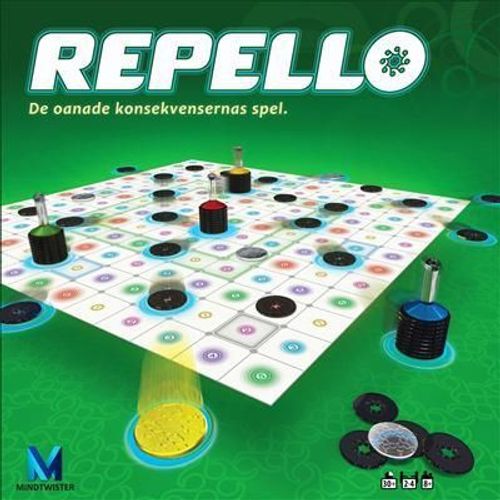
Repello
Repello Rulebook
Table of Contents
Table of Contents
Repello in Brief
- Move Your Stack: Find the best direction for your Stack in order to create rewarding chain reactions.
- Resolve The Conflicts: A move is completed when all conflicts are resolved; there is a gap between all remaining objects and balance has been restored on the gameboard.
- Collect Your Earnings: All objects you have pushed off the board score you points!
Preparations
Each player chooses a Stack color. Take a seat at the correspondingly colored side of the gameboard.
Load the Stack with black Repellers. The game length can be adjusted by the number of Repellers loaded on the Stacks. For a game of normal length, the following is recommended:
- 2 Players: 15 Repellers each
- 3 Players: 12 Repellers each
- 4 Players: 10 Repellers each
Also place Repellers on the board: 1 gold, 4 silver and 4 black, according to the figure. This is the starting set up. The starting zone is shaded in green.
Starting the Game
Decide who starts. In clockwise turn, each player takes a starting position by placing the Stack on any of the green-shaded squares in the starting zone. There must be at least one empty square between the Stacks!
Press gently on the colored top every time you place your Stack. The stacked Repellers are pushed flat against the board, making the Stack stand steady and upright. When all Stacks are placed in the starting zone, player one makes the first move.
Making a Move
You make your move with your own Stack. When lifting it, your Stack shall always leave a Repeller in the square it just left. This will happen automatically when placed properly.
You may move your Stack in any straight or diagonal direction. The first square in each direction tells you the number of squares to move in that direction. Since the Stack may not pass through or stop at an occupied square, some directions may be blocked.
When moving your Stack it may bounce on the edges of the board. If hitting the edge diagonally (in a 45 degree angle), the Stack will bounce back out diagonally the other way. If it comes in straight (90 degrees) or into a corner, it will bounce back along the same way it came in. Remember that the Stack leaves a Repeller where it stood, and that this Repeller may not be passed when bouncing back!
(Explanatory image: possible movements of each Stack. Some directions are blocked by objects. Red may bounce straight while green can't: the Repeller left behind is blocking its way on a straight bounce, but green can do a diagonal bounce.)
On rare occasions, a Stack is blocked in all directions so that the player is unable to move. The Stack shall then be placed on any free square in the green starting zone (leaving a Repeller behind as usual). If the Stack is placed next to another object, the conflicts need to be resolved before the turn is done (see Resolving Conflicts).
Resolving Conflicts
If a Stack or a Repeller ends up in a square next to another object, there is a conflict. The two will repel each other, meaning that they will push each other, and it is up to you, who are making the move, to decide which object pushes which! An object is always pushed one square and always straight away from the pushing Stack or Repeller.
Sometimes, three or more objects can end up in a row, so that one or more objects are "locked" in the middle. When this happens, the "outer" objects are always pushed first. In the case of three objects, the middle object is locked until one of the outer objects is pushed. Then you can push either of the remaining two objects that are still in conflict with each other. Resolved cleverly, situations like this can work out very well! (In the example, the player scored 5 points by pushing the gold Repeller off the board.)
Note that the square numbers only apply to the initial Stack movement, and that a Stack does not leave a Repeller behind if it is pushed around later in the move! A pushed object might end up next to a third object, and a new conflict has occurred. When moving your Stack you will set off chains of reactions.
At some points a single move will start a major reaction causing many simultaneous conflicts. You resolve conflicts one at a time and there is no priority to the order of resolving conflicts. Your goal is to find chain reactions that push objects off the board to score points, and in each conflict you choose which object pushes which.
A move is completed when no more pushes are possible, meaning that there is now a gap between all remaining objects and "balance" has been restored on the gameboard.
(Example: Red decides to move three steps straight to the left. The bottom Repeller is left behind. Red has now caused a conflict that needs to be resolved. Red may push the two Repellers one step away from the Stack. This way, the conflicts are resolved without scoring. However, red could just as well let the left Repeller push the own Stack to the right. This way, the gold is pushed over the edge and you score 5 points!)
Over the Edge
The goal is to use the chain reactions to push objects over the edge. Note that edge bounces only apply to the initial movement of the Stack! When your move is finished you collect and save the Repellers that have been pushed off the board. These are worth points at the end of the game.
Stack Over the Edge
Another great way of gaining valuable Repellers is pushing your opponents' Stacks out. Note that you are not allowed to push your own Stack off the board. When a Stack gets pushed out the following happens:
- The pushed-out opponent has to pay you the bottom Repeller from his/her Stack (if there is any left! During the last round, Stacks may be out of Repellers).
- You also get to choose any one Repeller from the pushed-out opponent's collection (if any). So aim for players who have silver or gold Repellers!
- The pushed-out player re-enters the game (at his/her next turn) by placing the Stack on any free square in the green starting zone. If the Stack is placed next to other objects, the conflicts need to be resolved before the move is completed.
End of the Game
The number of Repellers on the Stacks marks the number of rounds left to play. Tip: By altering the number of Repellers loaded when starting the game, you can adjust the duration of the game!
During the last round of the game all Stacks will run out of Repellers. Although a player has made his/her final move, the empty Stack is still in the game and can still be pushed off the board (see above). Not until the last player has ended his/her last move is the game over!
Points
- Black Repeller: 1 point
- Silver Repeller: 3 points
- Gold Repeller: 5 points
When the last round is finished, all players count their points and the one with the highest score wins! If two or more players end up with the same score, the player with the golden Repeller wins. If none of them has the golden Repeller, the player with the most silver Repellers is the winner. If the score, most unlikely, is still the same, it's a draw after all...