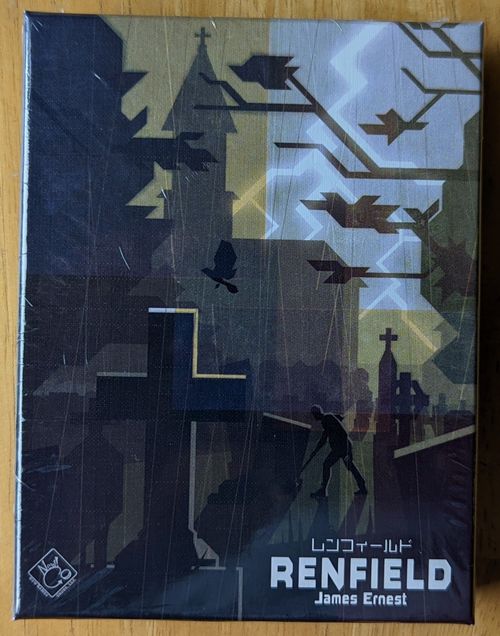
Renfield
Renfield Rulebook
Table of Contents
Table of Contents
Components
What You Get: The Renfield Deck, 54 cards in three suits.
What You Need: Money. If you aren't playing for real money (a choice against which we strongly advise), then you can start each player with the same amount, at least $100, and compare scores at the end. If you end up with more than you started with, you're winning.
As with poker, this game plays best with 4, 5, or 6 players, though it is possible to play with as few as 3 or as many as 8. Expect a good deal of chaos in the larger games, and a lot more order in the smaller ones.
The Goal
The object of this game is to take the fewest points, as long as you take at least one. The points are represented as yummy, delicious bugs.
You must eat at least one bug (take at least one point) to win the hand, but among the players who take bugs, the one who takes the fewest wins.
The Format
Renfield is a trick taking game. Each hand is played in six rounds, or "tricks," in which each active player plays one card onto the table, and the highest card takes them all. The winner of each trick leads the next one, for a total of six tricks.
Renfield is also a gambling game, like poker, in which every player has their own stake, and money is played into a pot in the center of the table. Like poker, it has a few odd variants, which are listed at the end of the rules.
These variants as extensions of the core rules, so learn the basic game before moving on to the rest.
The Cards
Each card has four important details down the side. A rank (1 through 17); a suit (Tools, Parts, or Stones); a number of bugs (zero through six); and a dollar cost (zero through five).
The order of the suits is set by the high bidder at the start of each hand, and is represented by the arrangement of the Key Cards (the zeroes of each suit, which do not shuffle into the deck.) The bugs represent how many points the card is worth, and the dollar cost is the amount you must pay to the pot when you take the card. (Not when you play it.)
Doublers: Some of the cards, the 2's and 12's, are doublers. The "x2" in the dollar slot doubles the money you must pay when you take the trick containing that card. "Double" on the bug line doubles your score for the entire hand.
Arranging the Key Cards (Tools is high here.)
To Begin
Remove the three key cards (the zeroes of each suit) and put them in the middle of the table. These are the indicator cards for their suits, and they will be arranged by the high bidder to show the order of suits on this hand.
Choose a dealer, who shuffles the deck and deals a hand of six cards to each player. Set the rest of the deck aside.
After each hand, the role of dealer will pass to the left.
The Bidding
Before playing the hand, players will bid to determine who will set the suit order, and lead the first trick.
Starting to the dealer's left, each player must make a bid in dollars, or pass. The bid goes around the table just once, ending with the dealer.
Players must bid higher than the current bid, or pass. If no one bids, the dealer must take the lead for $5.
Whoever wins the bid pays their bid to the pot, and then arranges the key cards with the highest suit on top, and the lowest on the bottom. Every card in a higher suit outranks every card in the suits below it.
Playing the Trick
The leader (on the first trick, this is the player who won the bid) plays a card face up onto the table. Proceeding to the left, every player must play one card, or fold.
Following Suit: If a particular suit was led, players must play a card of the same suit if they can. So, for example, if a Stone was played first on this trick, you must play a Stone if you have one. If not, you may play any card.
There is no other "following" rule; you may play higher or lower than the lead, and you may play anything if you do not have the suit that was led.
Folding: If you have taken at least one bug, you may fold instead of playing a card. When you fold, turn over the cards you have collected, and lay down your hand. You are out of the game, and cannot win the hand.
Note: You may only fold at a moment when you would play a card. If you do take a trick, you must pay for the cards you've taken before you have the opportunity to fold.
Taking the Trick
If you played the highest card, you take the trick. "Highest" means the highest ranked card in the highest suit, as dictated by the order of the key cards.
Pay the pot for all the cards in this trick. A "x2" in the dollar slot doubles the price of the trick. Arrange the cards on the table in front of you, so that other players can see how many bugs you have, and which cards have been played.
Whoever takes the trick leads the next one. If a player folds instead of leading, the lead passes to their left.
Winning
After six tricks have been played, players who have not folded will compare their scores.
Whoever has the smallest number of bugs, but at least one, wins the pot. A "Double" in the bug area (found on the 12's) doubles all your bugs, not just the bugs from that trick! Two 12's means your bugs are x4; three 12's means x8.
If two or more players are tied for lowest score, they split the pot, and leave the odd coins for the next hand.
After each hand, the deal passes to the left. Play as many hands as you wish, and quit whenever you like.
At the end of the game, your goal is to have more money than you started with. Just like in real life.
Variants
Once you know the basics, you'll probably want to try some variations. You might settle on a favorite house variant, or let the dealer call a new game with each hand. Most of these options can be combined to form more complex variants; and don't be afraid to make up your own.
Auction: Seven players max. After the deal, players buy different cards as follows: deal seven cards into a facedown pack. Reveal the top card. Players bid in an open auction to buy the card. Players must bid in dollar increments, with a maximum bid of ten dollars, which buys any card outright. The player who buys the card pays the pot, and adds it to his hand. He then puts another card from his hand up for auction in the same manner, but splits the proceeds of this auction with the pot, with any odd dollar going to the pot. (Mean players tend to bid in odd numbers.)
If a card is not bought, it is discarded and the next card is revealed from the pack. Once the pack is exhausted, the game resumes with the normal bidding round.
Blaze: The object of Blaze is to take the most bugs. Players ante one dollar to begin. The bidding goes around the table multiple times, until everyone passes. (You can't pass and then come back in.)
You are not bidding in dollars, but in bugs. Whoever bids the highest arranges the key cards and leads the first trick. Play six tricks as usual.
If the bidder makes his bid in bugs, he wins the pot. If he does not, he must match the pot, (or pay some other established penalty) and the game restarts. If a player folds, he stays out until someone wins the pot.
The Death Card: Before dealing, the dealer declares one or more cards to be Death. Any trick including the Death Card is not taken by anyone, and those cards are removed from the game. The lead goes to the player who would have otherwise taken the trick.
The Death Card has no suit, and cannot be played unless its owner has no cards matching the lead. (Option: If you prefer, the Death Card has all suits, and can be played anytime.) In either case, the Death Card can never be led, and if it is a player's last card, they must fold (points or no) rather then lead the trick with it. This is actually good, if you need to get out of the game for free.
Draw: After the deal, there is a betting round as in poker, in which players may check, bet, call, raise, or fold. Then there is a drawing round, in which players first discard up to four cards, and then all discards are reshuffled into the deck, and the players' hands are refilled to six cards. The normal game resumes at the bidding round.
Flatline: There are no key cards. Players bid only to lead the first trick, with the dealer taking an unbid lead for only $2. Players must follow suit, but all suits are considered to be of equal value. Cards in tricks are compared on the basis of rank only, with ties broken in favor of the card that was played last. In other words, if two 15's are played on the same trick, the second one is higher.
It is possible to shuffle the zeroes into the deck for Flatline. In this variant, if a Zero is led, that suit is high for that trick.
Stud: Seven players max. Players get seven cards, of which they will play only six. Deal three cards facedown, and four face up. After the cards are dealt, play proceeds as normal. Players may play upcards or downcards as they wish.
Wild Cards: Before dealing, the dealer declares one or more cards to be wild. Wild cards may be played as any suit or rank, but they revert to their actual value once taken.
In other words, play these cards as anything, determine who takes the trick based on the made up value, and then pay for and score them as their face value.
Breathing Room: Maximum of six players. Players are dealt eight cards, of which they will play only six.
Buying the Trick: In this variant, you may fold with no points. To do so, wait until your chance to play a card, and then pay the pot for every card currently in the trick. It's often cheaper than taking the whole trick.