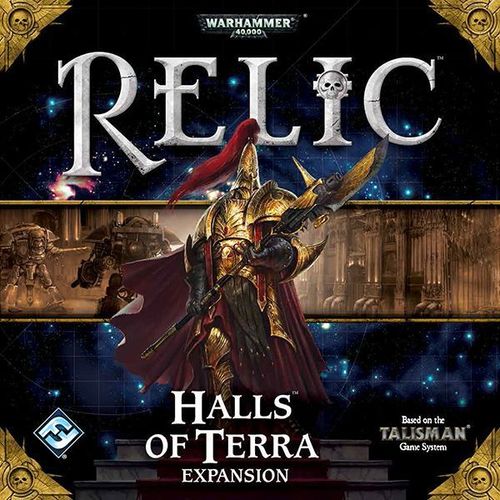
Relic: Halls of Terra
Relic: Halls of Terra Rulebook
Table of Contents
Table of Contents
Components
The Relic: Halls of Terra expansion contains the following components:
- 1 Sol System Game Board
- 3 Plastic Character Pieces
- 3 Character Sheets
- 12 Blue, Red, and Yellow Threat Cards
- 5 Corruption Cards
- 10 Mission Cards
- 4 Relic Cards
- 9 Champion Cards
- 40 Orange Threat Cards
- 3 Scenario Sheets
- 54 Affiliation Tokens
Nemesis Components. The following components are used with the previously released Relic: Nemesis expansion. Rules for incorporating these components are on page 8. If you do not own the Nemesis expansion, do not use these components.
- 1 Nemesis Sheet
- 1 Plastic Nemesis Piece
- 9 Imperium Tokens
- 15 Nemesis Cards
Introduction
The Relic: Halls of Terra expansion contains a new board that allows players to expand their play experience, taking them on a voyage to the hallowed birthplace of the Imperium—the Sol System. By exploring the Sol System, players can gain personal power in the form of levels and relics, and political power in the form of affiliations and Champion cards. With enough of each, players can earn passage to the Inner tier through the Sanctum Imperialis space. Relic: Halls of Terra includes new Threat cards, Mission cards, Corruption cards, and Relic cards as well as character and scenario sheets that players can use to enrich their game experience. Some of the new assets and relics convert players into apostates, making them susceptible to skill duels from other players.
Using this Expansion
To use this expansion, players mix all Mission, Corruption, Relic, and Threat cards from Relic: Halls of Terra into the respective decks from the Relic base game. Then, players mix all the character and scenario sheets with the corresponding sheets from the base game; players can choose these characters and scenarios during setup like any other character or scenario.
While the Relic: Halls of Terra expansion is intended to be used as a whole, players may play Relic using only some of the elements from this expansion. However, if players are not using the Sol System board, the Mission cards included in this expansion must be removed from the game or ignored when drawn as they are specifically designed to interact with the Sol System board.
Modifying Setup
To set up a game of Relic: Halls of Terra, players follow the setup instructions on page 4 of the Relic base-game rulebook. For some steps, players need to modify the instructions presented in the base-game rulebook with the steps in this section. The numbers in this section correspond to the matching steps from the base game.
-
Place Game Board: Unfold and place the Sol System board in the play area as shown in the diagram below. The Sol System board must be next to the base game's board so that the Luna space is adjacent to the Battlefleet Antias space and so the Titan space is adjacent to the Grey Knight Envoy space. The Sol System board functions as an extension of the board from the Relic base game, adding new tiers for players to explore.
Diagram: Sol System Board (left) placed beside the Base Game Board (right), with arrows indicating the join.
3. Prepare Decks: Shuffle the orange Threat deck and place it next to the three base-game Threat decks. Then, place the Champion cards near the game board. The Champion cards do not need to be shuffled and players are free to look at them any time they choose.
4. Prepare Tokens: Separate the affiliation tokens by types and place them in distinct supply piles near the game board where all players can reach them.
8. Prepare Character Board: Each player takes the affiliation token associated with his character (see "Affiliation" on page 6).
Sol System Board Anatomy
Diagram: the Sol System board, with numbered callouts 1 to 5 as described below.
- Sol Tier: The 12 spaces shaded in green compose the Sol tier.
- Titan and Luna: These two spaces are the only two access points between the Sol System board and the Relic board. They are not part of any area, but they are part of the Sol tier.
- Mars Area: These five spaces compose the Mars area. This area is also a Forge World area and is part of the Sol tier.
- Holy Terra Area: These five spaces compose the Holy Terra area. This area is also a Hive World area and is part of the Sol tier.
- Imperial Palace Tier: The five spaces shaded in yellow compose the Imperial Palace tier. Players can only enter the Imperial Palace tier by using the movement box on the Palace Gates space.
Expansion Rules
When using the Relic: Halls of Terra expansion, the basic rules for Relic are unchanged, and players win according to the condition stated on the chosen scenario sheet. Rules unique to this expansion, such as navigating the Sol System board and acquiring Champion cards, are described in this section.
The Sol System board is treated as part of the Relic board for purposes of game effects, unless specified elsewise.
The Sol System Board
The Sol System board comprises two tiers: the Sol tier and the Imperial Palace tier (see the "Sol System Board Anatomy" above). The Sol tier functions similarly to the Outer and Middle tiers on the Relic board (see "Movement in the Sol Tier" on page 5), and the Imperial Palace tier functions similarly to the Inner tier (see "Movement in the Imperial Palace Tier" on page 5).
Moving between the Relic and the Sol System Boards
To move between the Relic board and the Sol System board, a player must move through a GATEWAY ARROW. Each gateway arrow points to two spaces, which are adjacent to each other. To use a gateway arrow to move between two adjacent spaces, a player must spend two influence and all of his remaining movement points. If a player uses a gateway arrow during his Movement phase, he skips his Exploration and Engagement phase that turn.
If a player does not have enough influence or remaining movement points, he cannot move between spaces connected by a gateway arrows.
Movement in the Sol Tier
Movement in the Sol tier follows the normal movement rules presented in the Relic base-game rulebook. That is, a player makes his movement roll and moves a number of spaces equal to his movement score.
The Luna and Titan spaces are adjacent to both the Holy Terra area and the Mars area. Thus, the Sol tier's spaces are arranged in a loop that functions similarly to the Outer or Middle tiers on the Relic board.
When resolving game effects that refer to clockwise or anticlockwise movement, treat each game board as an independent loop. Game effects that instruct a card or player to move clockwise or anticlockwise move that card or player within its current loop.
Movement in the Imperial Palace Tier
The Imperial Palace tier functions similarly to the Inner tier. A player can only enter the Imperial Palace tier through the Palace Gates space. After a player enters the Imperial Palace tier, he does not roll a die for movement and cannot spend movement points. Instead, during his Engagement phase while on the Titanolith space, he must resolve the text box, which allows him to determine the direction he moves during his next Movement phase. During subsequent Movement phases, he moves one space forward following the directional arrow on his current space.
A player cannot use effects and special abilities that modify his movement in the Imperial Palace tier except those presented in the text boxes printed on his current space. After entering the Imperial Palace tier, a player must remain in that tier and must follow the directional arrows unless he is vanquished, corrupted, or the text box on his space specifically dictates that he moves elsewhere.
A player cannot move to or from any spaces in the Imperial Palace tier by any means other than those described in this section. Any game component (other than the board itself) that references the Inner tier refers to both the Inner tier and the Imperial Palace tier.
A player cannot draw or resolve Threat cards while in the Imperial Palace tier.
The Titanolith Space
When a player lands on the Titanolith space, his Movement phase ends immediately.
During a player's Engagement phase, the text box on the Titanolith space gives the player the option of which direction to proceed in the following Movement phase.
Gray Skill Bonus
Some cards feature a new type of skill bonus. The gray skill bonus can be added to any attribute when making a skill test. A gray skill bonus cannot be added to any skill test that does not test an attribute (such as the Maze of Tzeentch space, which tests a player's level).
Icons: Directional Arrow (the arrow on Imperial Palace tier spaces that a player follows). Gray skill bonus icon: adds 1 to any attribute skill score.
Orange Threat Deck and Icons
Some of the spaces in the Holy Terra and Mars areas contain orange threat icons. Orange threat icons function identically to other threat icons as described on pages 8 and 9 of the Relic base-game rulebook. The orange threat icon corresponds to the orange Threat deck in the same way that red, blue, and yellow threat icons correspond to the red, blue, and yellow Threat decks.
Orange Threat Card and Icon: each orange Threat card provided in Halls of Terra contains an indicator icon (an orange skull located to the right of the trait box) so that players can easily identify these Threat cards when they are positioned faceup on the game board. This orange threat indicator icon has no direct game play purpose and is only used to identify the origin of those Threat cards.
Orange Threat Deck Composition. The orange Threat deck includes enemies, encounters, assets, and events just like the three Threat decks from the Relic base game, but the cards are thematically tied to the Relic: Halls of Terra expansion and, specifically, the Sol System board.
Affiliation
The Relic: Halls of Terra expansion introduces affiliations. Affiliations represent powerful groups that govern the Imperium of Man. Each affiliation is distinguished by a unique name and icon. Gaining various affiliations provides players with benefits as they explore the Sol System board. Each of the nine affiliations is described in detail on the back page of the rulebook.
Many card and text box effects contain affiliation icons. Each time a player is instructed to gain an affiliation, he takes the affiliation token that corresponds to the icon from the supply and places it in his play area. When a player is instructed to lose an affiliation, he takes the corresponding token from his play area, if possible, and places it in the supply.
Affiliation icons: the nine affiliation icons are lettered A through I (see Affiliation Descriptions below).
Affiliation Icons. Players cannot have more than one token from a single affiliation. Any effect that would allow a player to gain an affiliation he already has is ignored.
Each player begins the game with one affiliation. During setup, each player takes the affiliation token that corresponds to the affiliation written near his character name on his character sheet.
Affiliation tokens can also be spent as influence. Whenever a player may spend influence, he may discard any number of affiliation tokens, gaining two influence for each affiliation token discarded in this way. This does not apply when a game effect forces a player to lose influence.
Sol Tier Movement Example
Diagram: the Sol System board with the Ecclesiarchal Palace space, the Orbital Spire space (A), the Scholastia Psykana space (B), the Grey Knight Envoy space (C), and the Titanolith space (D) marked.
The Ultramarines Captain player begins his Movement phase on the Ecclesiarchal Palace space. He rolls a movement die for his movement score, and he has several different options for where he can move. He may choose to move clockwise to the Orbital Spire space (A), anticlockwise to the Scholastia Psykana space (B), or back to the Relic board on the Grey Knight Envoy space (C) by spending two influence and his remaining movement point to pass through the gateway arrow. Additionally, if he has at least three affiliation tokens, he may choose to spend all his remaining movement points to resolve the movement box on the Palace Gates space and move to the Titanolith space (D).
Champion Cards
There are nine Champion cards, one Champion card for each affiliation.
When a player resolves the text box on the Sanctum Imperialis space, he acquires a Champion card. When acquiring a Champion card, a player takes any unacquired Champion card of his choice that corresponds to an affiliation token he has. He places the Champion card in his play area and permanently gains that card's effect. A player cannot be forced to discard any of his Champion cards or any corresponding affiliation tokens. If a player is removed from the game, any Champion cards he has are removed from the game as well.
All players are free to look at all Champion cards any time they choose.
Intensifying the Conflict: If players are interested in additional apostate gear to cultivate a robust player-versus-player environment, more can be found in the Relic: Nemesis expansion, where apostate gear and skill duels were originally introduced.
Halls of Terra and Nemesis
Relic: Halls of Terra includes a nemesis sheet, nemesis deck, a plastic nemesis piece, and Imperium tokens. These components allow players to combine both the Relic: Halls of Terra and the Relic: Nemesis expansions to play the "Enemies of the Imperium" game mode, which was introduced in Relic: Nemesis. If players do not have the Relic: Nemesis expansion or are not using the "Enemies of the Imperium" game mode, place the components mentioned in this section in the game box during setup; they are not used in the standard Relic: Halls of Terra game.
Enemies of the Imperium Setup
If players are using the "Enemies of the Imperium" game mode found in Relic: Nemesis in combination with this expansion, players mix the Relic: Halls of Terra nemesis sheet with their other nemesis sheets and then follow the setup instructions from the "Enemies of the Imperium" section found on page 5 of the Relic: Nemesis rulebook.
Additionally, players must place one Imperium token on each space that contains a text box in both the Mars and Holy Terra areas and two Imperium tokens on both the Titan and Luna spaces (see "Imperium Tokens" on page 9).
Note: The Palace Gates space contains a movement box, not a text box, and so does not receive an Imperium token.
Nemeses and the Sol System Board
When playing the "Enemies of the Imperium" game mode using the Relic: Halls of Terra expansion, the basic rules for that game mode are unchanged. However, additional rules for how nemeses interact with the Sol System board are described in this section.
Movement on Sol System Board
Nemeses move around the Sol System board using most of the same rules as characters. However, unlike characters, they can freely move between the Sol System board and the Relic board ignoring the gateway arrows. Like the Inner tier on the Relic board, a nemesis cannot enter the Imperial Palace tier.
Imperium Tokens
The Imperium tokens begin the game on all spaces in the Sol tier that contain text boxes. These tokens function as temporary threat icons that only affect nemeses. Each time a nemesis lands on a space that contains one or more Imperium tokens, he draws Imperium cards following the normal rules and then discards one Imperium token from that space, removing it from the game. As such, if a nemesis lands on the Titan space, he draws two Imperium cards—one for each Imperium icon—and then discards one of those Imperium tokens. If a nemesis lands on the Titan space during a later turn, he draws another Imperium card and discards the final Imperium token from that space.
If a nemesis does not draw an Imperium card while on a space with an Imperium token because there is already an Imperium card on that space, he cannot discard that Imperium token. If a nemesis lands on a space in the Sol tier that contains a text box and that space is clear of both Imperium cards and Imperium tokens, he draws a Nemesis card following the normal rules.
Apostates
(These rules are identical to those printed in other Relic expansions.)
During a game of Relic: Halls of Terra, each character is either an apostate or a devotee. A character begins the game as a devotee; however, he can become an apostate by acquiring an asset that contains the "Apostate" trait. Players can identify apostate cards by their yellow-green hue. During his turn, the active player may choose to engage in a skill duel against any apostate on his space (see "Skill Duels" below).
Skill Duels
If the active player ends his Movement phase on the same space as one or more apostates, he may initiate a skill duel against one apostate of his choice instead of resolving his Exploration phase normally. Then, instead of resolving his Engagement phase normally, the active player resolves a skill duel. After resolving a skill duel, the active player proceeds to his Experience phase.
When resolving a skill duel, the active player is the challenger and the targeted apostate is the defender. During a skill duel, the challenger can be either an apostate or a devotee. The defender must be an apostate. A player cannot initiate a skill duel in the Inner tier. If a character does not initiate a skill duel, he resolves both his Exploration and Engagement phases following the rules described in the Relic base-game rulebook. To resolve a skill duel, a player follows these steps:
- Determine Challenge Form: The challenger chooses an attribute; this is the attribute that both characters test. The chosen attribute determines the consequences when the duel is finished (see the "Apply Consequences" step).
- Set the Challenge Value: The challenger sets the challenge value by making a skill roll of the chosen form with a target number of 2. To make a skill roll, the player uses the identical rules for resolving skill rolls as described in the Relic base-game rulebook. If the challenger passes the skill test, the challenge value is equal to the result of the skill roll including all modifiers. If the challenger fails the test, the skill duel immediately ends and the challenger proceeds to step 6.
- Make Defender Skill Roll: The defender performs a skill test of the chosen form with the previously established challenge value as the target number. If the defender passes, he is the winner of the skill duel. If he fails, the challenger is the winner.
- Apply Consequences: Players apply one of the following consequences as determined by the challenge form:
- Strength: The loser loses 2 Life.
- Cunning: The winner may steal 1 of the loser's assets (except relics). If a player steals an asset that contains charge tokens, all charge tokens on that card also transfer.
- Willpower: The winner looks at the loser's hand of Power cards and chooses to take either 1 of those cards or 3 influence from the loser.
- Steal Apostate Asset: If desired, the winner may also steal one of the loser's apostate assets (except relics).
Example: The Commissar initiates a Strength skill duel against the Rogue Trader who has an apostate asset. The Commissar's Strength is 6. The Commissar also has the Renegade Ogryn as an ally asset, adding 3 to his score. Then, he rolls a die which produces a 2 result. The Commissar passes the skill test with a skill score of 11 (6 + 3 + 2). The Rogue Trader must test Strength 11 (the Commissar's skill score). The Rogue Trader's Strength is 3, and he has the Reverent Fist relic which provides a skill bonus of 4. Then, the defender chooses to substitute a "4" Power card for his skill roll. The Rogue Trader's skill score is 11 (3 + 4 + 4). Since the defender has matched the required score, he wins the skill duel. The Commissar loses 2 Life (the consequences of a Strength skill duel), but has no apostate asset, so there is nothing for the Rogue Trader to steal.
Affiliation Descriptions
The following is a list of the nine Imperial affiliations found in Relic: Halls of Terra. Each affiliation has an affiliation icon that represents its corresponding affiliation token and appears on various cards, board spaces, and text boxes.
- Adepta Sororitas (A): The women of the Orders Militant of the Sisters of Battle make up the fighting strength of the Ecclesiarchy, possessing zeal and devotion unmatched among the forces of the Imperium. With faith and fire, the Adepta Sororitas purges the galaxy of that which would profane all the God-Emperor has built.
- Adeptus Arbites (B): The men and women of the Adeptus Arbites enforce Imperial law throughout the galaxy. They value loyalty, prudence, and absolute discretion above all else. The Arbitrators and Judges of the Adeptus Arbites regard the enforcement of the law as a sacred duty and their jurisdiction is limitless.
- Adeptus Astartes (C): The Battle-Brothers of the Adeptus Astartes are the finest fighting force ever created by man. Genhanced post-humans of mythic might and unflinching resolve, these demigods of battle are the genetic inheritors of the Emperor's legacy. Clad in ceramite and adamantine power armour and bearing arms capable of catastrophic devastation, Space Marines are pure warriors, the match of any threat that the galaxy might offer.
- Adeptus Mechanicus (E): The Priests of Mars are the chroniclers of forbidden knowledge and secret lore concerning the machines of the age. Their forge worlds supply the eternal war effort of the Imperium. Their arcane craft is the genesis of the Emperor's Golden Throne and their forges the birthplace of the mighty god-machines of the Collegia Titanica.
- Imperial Guard (F): Standing steadfast alongside the other warriors of the Emperor are the men and women of the Astra Militarum, the Imperial Guard. Thanks to their constant efforts and courageous sacrifice, the Imperium of Man is able to hold against the threats that close in on its borders.
- Imperial Nobility (G): Guiding the myriad masses of humanity to their destiny are the high and mighty of the Imperium, the lords of sectors, the governors of planets, and the masters of mighty fleets of ships. From the scheming scions of the Navigator houses, to the ambitious inheritors of the Rogue Trader dynasties, many members of the Imperial Nobility wield tremendous military and political power, bringing to bear their wealth and influence.