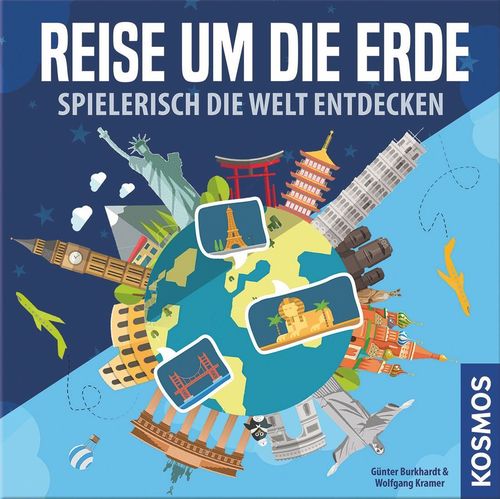
Reise um die Erde
Reise um die Erde Rulebook
Table of Contents
Table of Contents
Components
- 1 game board (depicts 47 cities)
- 94 city cards (2 of each of the 47 cities)
- 8 passenger pieces (wood-coloured) – for the assignment variant only
- 4 player pieces (yellow, orange, blue, green)
- 3 airplanes (white, silver, gold)
- 16 assignment cards – for the assignment variant only
- this rulebook
City Card Layout
Each city card shows the following (the key uses the letters printed on the card):
- a: City name and colour of the continent
- b: Illustration of the landmark
- c: Symbol of the continent (for colour-blind players)
- d: Name of the country in which the city lies
- e: Point value
- f: Name and short description of the landmark
For the rules, only a (city name and continent colour) and e (point value) are important.
Setup
- Place the game board between you in the middle of the table. It shows 47 cities.
- Place 1 airplane on each of the following cities: Kinshasa, New York, Beijing (Peking). The colour of the airplane does not matter. Place the airplanes so that their front side points up into the air.
- Shuffle the 94 city cards well and deal 8 city cards face down to each player. You may look at your hand cards, but make sure no one else can see them.
- Place the remaining city cards as a face-down stack on the large field in North America. This is the draw pile.
- The field in Siberia is the discard pile.
- Finally, each player chooses a player colour and places the matching player piece on the start field of the score track.
- The assignment cards and passenger pieces are not needed for the basic game and stay in the box.
Game Flow
The game is played over 3 rounds. The youngest player begins.
A round proceeds as follows:
The player whose turn it is flies one airplane of their choice from its current position to a neighbouring city. Neighbouring cities are connected by dashed lines. More than one airplane may stand on the same city.
The player whose turn it is then calls out the name of the city they have just flown to. Now everyone checks whether they hold the matching city card. If one or more players hold the corresponding city card, the city counts as visited, and each of those players may place their respective city card on the discard pile in Siberia.
Then the next player clockwise takes their turn and moves any airplane to a neighbouring city.
Watch Out For
- The airplane must always fly nose first. This way it is always clear from which direction the airplane came. It is not permitted to fly back along the same route.
- A city must be actively flown to before its matching city card can be placed. If you have one of the cities in your hand on which an airplane currently stands (in round 1 these are Kinshasa, New York and Beijing), that city must first be flown to by an airplane before you may place the corresponding city card!
- Each city has 2 city cards, and it is possible for one player to hold both city cards. However, you may only place one city card per visit. To place the second city card as well, the city must be flown to again!
Scoring Example
Example from the rulebook (players Fatma, Sabrina, Leo and Finn; the cards shown are Buenos Aires 4, Dakar 4, Manila 6, Istanbul 4, Miami 3, Novosibirsk 3):
Fatma has placed all of her city cards. She receives the point values of all the other players' cards: 4 + 4 + 6 + 4 + 3 + 3 = 24.
Sabrina still had 2 city cards left. She therefore receives the point values of Leo and Finn: 6 + 4 + 3 + 3 = 16.
Leo still had 3 city cards left and receives the point values of Sabrina and Finn: 4 + 4 + 3 = 11.
Finn was close to ending the round himself and had only 1 city card left. He receives the point values of Leo and Sabrina: 6 + 4 + 3 + 4 + 4 = 21.
Now there are new city cards: Sabrina, Leo and Finn each receive 8 city cards. Fatma has ended the round, so she receives 9 city cards. Now Leo begins the round, because he has the fewest points on the score track.
Now the player with the fewest points on the score track begins. If there is a tie, the younger player begins.
Round End
As soon as someone has placed all of their own city cards, the round ends. The airplanes remain on their current positions for the next round. Then the other players lay out their remaining city cards face up in front of themselves.
Now scoring follows. For each city card that was not visited, the other players receive points according to the point value on the city card.
Afterwards, all scored city cards are placed on the discard pile. Before the new round begins, you draw hand cards again from the draw pile, as follows:
- 9 city cards for players who visited all of their own cities in the previous round
- 8 city cards for all other players
In the rare case that there are not enough city cards in the draw pile for round 3, shuffle the discard pile and use it to form a new draw pile.
End of Game
After three rounds the game ends. The player who is furthest ahead on the score track wins and may call themselves a Globetrotter. If there is a tie, the player who placed more city cards in the third round wins. If there is still a tie, all players involved in the tie win.
Variant: Assignments
The game proceeds as described above, with the following changes.
Setup (Assignments)
- Also shuffle the 16 assignment cards and place them face down below the game board. This is the assignment pile.
- Draw 8 assignment cards from it and lay them face up to the right of it.
- Place 1 passenger on the upper city of each assignment card. This is the respective start city (the card diagram labels these as Passenger, Start city and Target city).
Game Flow (Assignments)
The game is played over 2 rounds.
If you move an airplane to a start city on your turn, you may accept this assignment. To do so, place the assignment card face down in front of you and put the passenger on it. No new assignment is revealed for the accepted assignment. There are therefore only a maximum of 8 assignments per round.
If you move an airplane to the target city of your assignment on your turn, you may complete this assignment. Turn the assignment card face up and place it in front of you.
Attention: It is permitted to accept several assignments. However, if you accept or complete an assignment, you may not place a city card in the same turn! You must therefore decide whether the assignment or placing the city card is more important to you.
Round End (Assignments)
Here too, the round ends as soon as someone has placed all of their own city cards.
When scoring, you receive points as follows:
- 1 point for the other players for each city card that was not visited
- 1 point for the other players for each assignment that was not completed
- 2 points for each completed assignment for the player who holds the assignment
All assignment cards that are still face up or have been scored go back into the game box. Then the remaining 8 assignment cards are turned face up and every player receives 8 city cards from the draw pile.