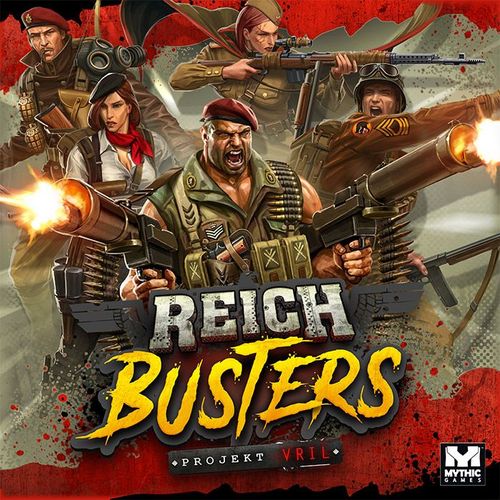
Reichbusters: Projekt Vril
Reichbusters: Projekt Vril Rulebook
Table of Contents
Table of Contents
Game Overview
The players are an elite squad of Allied Heroes. Working together, they must raid a Nazi castle and find the secret laboratories and bunkers hidden within. They will need to sneak past the guards, achieve all their mission objectives, and then at least one of them must escape in order to win. As this is a cooperative game, either all the players win, or all the players lose.
The players control the Allied Heroes. Their Nazi foes are controlled by the game itself.
Throughout the rules you will occasionally see boxes like this. These are not rules. Instead, they explain some of the thinking behind the development of the game, and how to get the most out of it.
Components
The Map
In Reichbusters, the board is called a map, and is built up of map tiles. Tiles are either rooms or corridors. A tile is made up of 1 or more areas.
In addition, a map may have overlays and room features to change the character of individual tiles. Each map will always have at least 1 start and exit location for the Heroes, plus 1 or more barracks entrances for the Nazi reinforcements to deploy from.
Map component icons: Tiles, Room, Area, Start (entrance), Exit (auscang), Entry (barracks).
Mission Tracker
This keeps track of the Heroes' progress through their mission. It is clearly divided into pre-alarm and post-alarm rounds.
Hero Dashboards
Each Hero has their own dashboard showing their basic stats, skills, weapons, and items.
- A: Hero card with stats
- B: Skill tokens slots
- C: Weapon tokens slots
- D: Item tokens slots
Cards
Reichbusters uses many types of cards: Hero stats, Hero actions, pre-alarm noise, post-alarm noise, wound, spawn, team, and RAID (which is made up of map, mission, and faction cards).
Dice
Reichbusters uses 4 types of dice: attack, defence, noise, and vril.
Tokens
Reichbusters uses a variety of tokens to track which skills Heroes have, where items can be found, where Nazis lurk, and much more.
Minis Overview
- Heroes: Sarge, Brick, Quentin, Claudine, Red Hawk
- 16x Nazi soldiers
- 4x Nazi officers
- 4x Nazi dogs
- 12x Zombies
- 4x Tracking bomber
- 1x Gisela Gruber
- 1x General Wolff
- 4x Experiment 601
- 4x Nazi Scientist
- 8x Experiment 6XX
- 1x Vrilpanzer
- 4x Sturmsoldat Gunner
- 4x Sturmsoldat Assault Trooper
Basic Concepts
Reichbusters uses a handful of core concepts which are useful to know from the start. If you remember these, then you'll find learning the rest of the rules a lot easier.
Keep the Noise Down!
Some Hero actions cause noise, and this may alert nearby Nazi patrols. Whenever this is the case the Hero will need to make a noise test.
Noise tests are resolved in the same way as other tests (described below).
Noise is never tested for Nazi actions.
For now, you should simply be aware that many actions can make noise, and that's bad. Rummaging through drawers and ripping up sofas to find things is not quiet, but smashing delicate glass equipment in some Nazi lab is even noisier. Guns are really loud, and don't even talk about grenades.
Every time you see a noise icon you need to make a noise test using the listed number of dice. More dice is likely to be louder.
Your mission success is largely based on how long you can stay undetected, so paying attention to your noise is vital. As soon as the alarm goes off, you'll have way more problems to deal with. However, you need to balance this with the fact that your mission may well be to find secret documents and sneak about. You're going to have to open those creaky castle doors, and rummage around to find stuff. And when you're rumbled by the guards, then you'll need to fight…
Tests
Most Hero actions other than movement require a test to determine the outcome. These use one or more types of the 4 types of Reichbusters dice: attack, defence, noise, and vril. Dice are only ever rolled by a player for their Hero. The Nazi AI does not use dice.
All tests work as follows:
- Determine the target number for success.
- Build your pool of dice and roll them all together.
- Trigger any special effects and play any action cards you want to modify the initial result. Continue doing this until you have played all the cards you want to, and have triggered all special results.
- Calculate your total score and compare it to the target number.
- Apply the results of your success or failure.
Typically, a player must equal or exceed a target number to succeed.
For example, Claudine attacks a Nazi with a defence of 4, so 4 is her target number. She needs to roll a total of 4 or more with her attack dice in order to wound them.
For example, Quentin is attacked by a Nazi with a strength of 6, so 6 is his target number. Quentin needs to roll a total of 6 or more with his defence dice to defeat the attack.
| Type of Test | Target Number | Notes |
|---|---|---|
| Attack | Defence of target miniature. | |
| Defence | Combined attack total of all attacking miniatures. | If the defence fails, draw a wound card. Apply the top effect. If the total of the attack minus the defence roll equals or exceeds the target number in the middle of the card then also apply the lower effect and keep the card. |
| Noise | 1 | If the target is reached, draw a card. Apply the top effect. If the total equals or exceeds the target number in the middle of the card then also apply the lower effect. |
| Wound | 1 | As above, plus keep the card if the lower effect is triggered. |
Special Results
Each of the different types of dice has one special result and it's worth explaining those rules now. These use variations of a standard icon (green, black, white, and red star badges for vril, noise, defence, and attack dice respectively) and are easily recognisable.
In addition, some cards or items can be used to add special results to a test. All special results work in the same way, regardless of where they come from. A special result has 3 key effects:
- Each special result counts as +2 towards your total.
- Each special result must be spent to trigger 1 effect.
- That dice cannot be re-rolled.
Each Hero has different effects available to them depending on their current skills, items, weapons, and so on. Each of these effects may be triggered 0-1 times per action.
In addition to any triggered effects that a Hero may have access to, all Heroes can use the boost effect.
Boost
A boost allows the player to roll an additional dice of the same type as the dice that triggered it. Add the result to your total. If this is another special, it must be spent as normal. Boost can be triggered as many times as you roll special results.
If a special result is not used to trigger another effect, then it automatically triggers a boost (whether you want it to or not).
You may freely choose which effects to trigger. If you re-roll any dice then any special results may also be used to trigger effects. However, remember that only boost may be used more than once in a single action, and that all special results must be spent to trigger something.
It's really important to note that special results rolled during a noise test will trigger a boost (unless you can spend the special elsewhere) even though this is bad for the Heroes. This means that you really want to avoid making any noise as even the slightest sound out of place can potentially alert nearby patrols – and that's really what the noise test represents. It's not as much how loud the noise is in a literal, measurable sense; more a reflection of how attentive any nearby Nazis happen to be at that moment.
Hero Dashboards
Each Hero has their own dashboard. This holds their weapon, skill, and item tokens. Weapons and skills are fixed at the start of a mission. Items may be picked up and dropped during the mission.
"Nearest" and "Adjacent"
Some cards or rules says that an effect applies to the "nearest" room, tile, or area. In every case, count the number of areas between the triggering area and the potential effect locations. When several locations are equally near, the players choose which to apply the effect to.
If several potential locations are adjacent to the triggering area, the players choose which to apply the effect to.
Cards, Discards and Shuffling
This is another rule which is reused throughout the game and is worth explaining now.
Reichbusters uses several decks of cards that are used as randomisers rather than reference (Hero action decks, wounds, noise).
Each of these decks of cards has its own discard pile. Whenever any such deck of cards is exhausted, follow these steps:
- Shuffle its discard pile to make a new draw deck.
- Take the top card of the new deck and remove it from the game.
- Continue play.
Setting Up To Play
- Decide on a mission to play. This will either be RAID, or the next incomplete mission in your campaign. a. For a RAID, draw 1 map card, 1 mission card, and 1 Nazi faction card. The combination of these cards builds the RAID mission. Set up the map as shown on that card. b. For a campaign scenario, use the mission briefing to set up the map and decks.
- Place the mission tracker beside the board.
- In all missions, players choose a team card. This gives them certain bonuses and initial items. The combination of team, mission, and Hero chosen will define the available items, skills, and heroics points.
- Once the team is in place, each player chooses a Hero. a. Each player takes a dashboard, their Hero's stat card, deck of cards, miniature, weapon tokens, and starting item tokens. b. Place each Hero miniature in one of the Hero starting areas on the map for that mission, and everything else in front of their player. c. Place the Hero stat card and any weapon, item tokens, and heroics points in the slots on the dashboard. d. Players take their Hero's 2 feat cards as the start of their initial hand of cards. They then shuffle the remainder of their Hero's deck and draw 2 cards to add to their feat cards. The remainder of these cards form the player's draw deck.
- Place the starting Nazi faction card for the mission beside the map, along with any required miniatures that are not already in play.
- Place the attack, defence, noise, and vril dice near the map, along with the spare tokens.
- The players then decide who will go first.
- Start the game with the first Hero's turn.
For example, the map on the next page is one of the many possible RAID setups.
When setting up the map, be careful to put the right types of items in each area. Items come in several broad families, and this gives you an idea whether a face-down item is medical, weaponry, or miscellaneous. While the exact item is randomly placed, we've balanced the appearance and position by type to give you a challenging mission. Getting weapons and medical muddled during set up can make things much harder than they need to be!
Winning the Game
The game will continue until the players win, they run out of time, or all are captured (see page 17) simultaneously.
Players win if they do two things:
- Complete all their mission objectives.
- At least one of the Heroes who completed the mission leaves the map by one of the exits before the end of Round 10.
In all other circumstances the Heroes lose.
Rounds & Turns
Reichbusters is played in a series of rounds. Each round is made up of 1 turn for each Hero, and 1 Nazi turn after each Hero turn. At the end of a round is a simple end phase to tidy things up.
Before the alarm is raised, players may choose the order in which they act. They can do this one Hero at a time; they do not need to decide the whole round order at the start.
After the alarm sounds, player order is allocated randomly at the start of each round by shuffling and dealing out the turn order tokens. The order is fixed for that round. The Nazis still take a turn after each Hero turn.
The difference between the players choosing their turn order before the alarm, and the random allocation after the alarm shows the change in control. Before the alarm the Nazis don't even know the Heroes are in the castle. This gives the Heroes the initiative. As soon as the alarm sounds, the mission becomes much more reactive, and it's a frantic race against time…
Hero Turn
Players have 2 basic actions they may take each turn. In addition, they may play as many action cards or feats as they want from their hand, and take one free action to donate an item to another Hero.
Basic Actions
The basic actions are Move 1 area, and Attack. A basic move is 0 noise. A basic attack uses the weapon's noise. A player may do each basic action once per turn.
Move
Unless otherwise specified, a moving Hero or Nazi will move 1 space on the map, into an adjacent area.
A Hero cannot move into and out of an area that contains a Nazi unit in the same action. However, a Hero can move out of one area containing a Nazi unit, and into another that also contains a Nazi. A Hero can also move into an area containing a Nazi in one action, and then out of that same area with a second action.
Attack
Attack actions can be either melee or ranged. The only difference is the distance at which the attack is made.
Melee attacks are when both attacker and target are in the same area. Heroes and Nazis are considered to be "in melee" if they are in the same area, even if no actual attack or defence tests have been made yet.
Ranged attacks are when the attacker and target are in different areas. If a Hero is in melee then they cannot make ranged attacks.
When a Hero attacks, follow these steps:
- If more than one weapon is available at the current range, then the Hero declares which is used in the attack.
- The Hero declares the target of the attack. In melee, this can be any Nazi in the same area. In ranged attacks, this is limited by targeting restrictions (Meat Shield and Bodyguard keywords).
- (Ranged attack only) Check the line of sight, range, and blocked areas. a. Line of sight: Heroes can see in the 4 cardinal directions (North, South, East, West) as far as they have an unblocked straight line. Walls and closed doors block line of sight. (Line of sight can also be blocked by a round corner.) b. Range: Range each weapon's range is listed on its token. c. Blocked areas: Heroes cannot attack through areas containing Nazi units.
- The Hero makes an attack test and applies the results.
Damage: If a Hero's attack is a success, the target Nazi suffers 1 wound. Most Nazis only have 1 wound, so this will kill them. Remove the miniature.
Nazis that have more than 1 wound will have 2 or more stat cards. Each corresponds to a wound state (OK or wounded). If the target Nazi is an individual, simply place the correct card on top of the other as a reminder. If the target Nazi is one of several of the same type, mark the miniature with a wound token and place both wounded and unwounded cards by the map as reference.
Either or both of these basic actions may be replaced with an action from the following list:
- Take 2 cards
- Ready a Weapon or Item
- Open/Unlock Door
- Use an Item
- Search
Search
If a Hero is in an area that contains 1 or more items and no Nazi miniatures, then they can search it. Choose 1 item to take.
- If you choose a face-up item, it is added to the Hero's dashboard automatically with no noise test.
- If you choose a face-down item, make a noise test at the value shown on the back of the token before you look at it. Once the test is complete, and regardless of the result, add the item to the Hero's dashboard.
Each Hero can carry up to 4 items at a time. If a Hero picks up a fifth item then they must choose 1 of their other items to drop. Dropped items are placed in the Hero's current area, face-up.
Face-up items represent stuff openly lying about, so it seems fair to allow our Heroes to pick them up with little fuss. Face-down items, on the other hand, represent stuff that's hidden in drawers or down the back of sofas. That's why rummaging about to find them may cause noise, and why you can't just pick them up when you're in the middle of fighting off the Nazis up close and personal.
Take 2 Cards
Take the top 2 cards of your own deck into your hand. There is no hand limit at the start of a mission.
Ready a Weapon or Item
This action removes 1 out of action token from 1 weapon or item on the Hero's dashboard.
If the out of action token is on a vril item, it can only be removed if the Hero discards a vril orb from their dashboard. Note that this orb is removed from the game, not dropped.
Open/Unlock Door
The Hero opens an adjacent unlocked door. Make the appropriate noise test. If the door is locked and the Hero does not have the key, then this action unlocks it causing the same noise as opening it would. If the door is locked and the Hero does have the key, then this action opens it with the normal noise for doing so. Once opened, doors cannot be closed.
Use an Item
Use 1 of the items on the Hero's dashboard. The item cannot be out of action. Make any required noise test. An Unreliable item will go out of action (mark it with a token) when it is used unless it has a special result spent on it during that action. Some particularly low ammo or unpredictable weapons or items can have multiple Unreliable keywords. In these cases, each keyword will trigger an out of action token unless a special result is spent on it.
Play Action Cards and Feats
Each Hero has their own, unique deck of action cards that define their particular style of play. The deck includes 2 feat cards, each of which has a single effect. The remaining 10 action cards in the deck each have 2 effects. When a card is used, the player must choose to use either the top or bottom effect. The top effect is always a free action or reaction. The bottom effect is always a modifier to another action (either a card or a basic action).
A player may play cards from his hand before, between, or after taking his basic actions. In addition, cards can be used to modify either basic actions or other cards.
Cards can be played for their modifiers after the dice have been rolled. More than one card can be played to modify a single test. You may wait to see the results of one card before deciding to play another. Only when a total is declared and the resulting effect applied is this process of playing cards and modifying the result considered final.
Deciding when and in what combinations you use your Hero's cards is the core of the game. Different Heroes have very different strategies for using their cards, so there's a lot to explore. Some, like Quentin or Claudine, are great in the early game, and often use their feats very early. Brick, on the other hand, will often accumulate a huge hand of cards before the alarm because he is rubbish at attacking quietly and is trying not to give the game away. However, once the alarm goes off he tends to have an epic turn or two of destruction, fuelled by all the extra cards he has, and this balances him out. In fact, this sort of card-burning heroic turn should happen to everyone a couple of times in each game. It's just knowing when to pop that combo for most effect.
Free Action
In addition to their basic actions and cards, a player may give 1 item to 1 other Hero in the same area for free.
This action causes 0 noise.
Heroics Points
Heroics points are one-use tokens that come in 3 types: attack, defence, and wild.
Attack and defence points can only be used on those tests. Wild heroics points can be used on either attack or defence tests.
Heroics points can be spent in two ways:
Before a test: spend 1 heroics point to automatically succeed. The total is considered to be equal to the target number.
After a test: spend 2 heroics points to ignore what was rolled and automatically succeed. The total is considered to be equal to the target number.
Heroics points never affect noise.
A Hero may gain an additional heroics point each time they clear a room. To clear a room, a Hero must kill all the Nazis (and this must be at least 2) in that room in a single turn without spending heroics points to do so.
Vril
All vril weapons and items are unpredictable. When they work as intended they are near-magical. However, they are also prone to draining without warning, surging for massive effect, or simply exploding.
Whenever vril equipment is used, roll the number of vril dice shown alongside the normal attack or defence dice. If a vril item doesn't normally require a test, roll the vril dice shown anyway.
Results are:
- Blank: The power drains from the item. Mark it with an out of action token.
- 1-3: If making an attack or defence test, add these to your total.
- Special: If making an attack or defence test, treat it as a normal special result. A vril special result can be used to trigger either vril specials or the specials for the type of test being made. If no test is being made (for example, with vril goggles) this result has no effect.
- Surge: The item or weapon triggers its surge effect and is then marked with an out of action token.
Setting Off the Alarm
The alarm can be triggered in one of two ways. Either the players reach the end of round 6 by taking their turns as normal and completing the end of round phase, or something triggers it early.
If the alarm is triggered early then finish the current action (not turn). Then move immediately to the end of round phase for that round.
Once the end of round phase is complete, the alarm triggers. Spawn any remaining Nazis.
After the alarm there are a few important differences:
- All Nazis are alert the whole time, so you no longer need the suspicious/alert tokens to track awareness levels.
- Player order is random.
- Ignore level 1 and 2 noise tests.
Unfortunately, the alarm will always go off eventually, regardless of how quiet the Heroes try to be. They can't get through an entire mission without leaving a trail of bodies, broken doors, and other clues to their presence along the route. All they can hope for is to get as far as possible and maybe even reach their objective before something incriminating is discovered, and a vigilant guard sounds the alarm. At least if they've already got to the objective they only have to fight their way back out again. If the alarm goes off before they even get that far then things may get a little desperate.
Once the alarm goes off, things get complicated real fast. This is an excellent reason to put the moment off as long as possible. All the Nazis being on the map is bad, and random player order is worse. However, it's not all a disaster – the blaring klaxons and the pounding of jackbooted feet on concrete does hide a lot of noise.
The pre-alarm and post-alarm games can be quite different, which is entirely intentional. Playing well needs an ability to both plan ahead, and deal with emerging contingencies, and the balance of which skill is more important shifts as the game progresses. It also varies with the Hero you're playing, and that of the others in your team. Luckily, the Heroes are all pretty heroic in their own ways, so even if they get into trouble, they also can get out of almost anything…
Nazi Turn
A Nazi turn only happens when there are Nazi miniatures on the map.
A Nazi turn has 3 phases:
- Raise the alarm! If 1 or more Nazi units are alert at the start of a pre-alarm Nazi turn, advance the mission tracker by one round.
- Action Stations! All Nazi miniatures on the map move. Do this in the order listed on the faction card.
- Kill the Intruders! All Nazi miniatures which can attack do so. Do this in the order listed on the faction card.
Raise the Alarm!
Nazi units can be in one of 3 levels of awareness: at ease, suspicious, or alert. All Nazis on a tile share the same level of awareness. Mission briefings list the initial level for each tile.
A tile will move up one level of awareness when:
- The Nazi first sees a Hero. This could be caused either by the Hero or the Nazi moving into line of sight of the other. Raise the level as soon as this happens.
- A Hero is in a Nazi's line of sight at the end of any Nazi turn. Raise the level at the end of the Nazi turn.
- A Hero attacks in their turn, and fails to kill all the Nazis in the target tile. Raise the level at the end of the Hero's turn.
Apply each case up to once per Hero or Nazi turn.
If a Nazi unit enters a new area with a different levels of awareness, the area is raised to the higher of the two levels.
For example, if a suspicious Nazi enters an area that already contains an alert Nazi, then the suspicious Nazi becomes alert. If an alert Nazi moved into an area containing a suspicious Nazi then the suspicious Nazi would become alert.
After the alarm is triggered you no longer need to worry about awareness levels. All Nazis are automatically alert.
Action Stations!
Nazi units move 1 area per turn. Unlike Heroes, Nazis open doors automatically. In the move phase, if a Nazi miniature needs to move through a closed door then they will open it instead of moving. This may result in breaking up groups of the same type as one opens the door and the others move through.
The above rule is the core rule. As you'd expect, various Nazi types have special rules that allow them to move faster, smash doors, and so on. These variations in behaviour are flagged with keywords.
Kill the Intruders
Nazis will attack the nearest Hero whenever they can. If two Heroes are equidistant, the Nazis will attack the Hero who most recently had a turn this round. If none of the potential target Heroes have had their turn this round, then the players choose who the Nazis attack.
If more than one Nazi miniature of the same type attacks the same Hero in the same way (melee or ranged), then combine all the attacks into a single defence test. Start with one attacker's value and add the support value of each additional attacker. This total becomes the target number for the Hero's defence test.
For example, 2 zombies are in the same area as Quentin. In the Nazi turn they make a combined melee attack against him. Zombies have an attack of 6, and a support value of 3, so Quentin has a target of 9 for his defence test. If there had been 4 zombies, Quentin would have needed 15.
End of Round
Once all players have had a turn, and the Nazis have had a turn for each player, there is an end of round phase:
- Any player with fewer than 5 cards draws 1 card from their own deck.
- Advance the mission tracker by 1 round.
Reference
BANG!
When a Hero uses a BANG! weapon before the alarm sounds, the mission tracker is immediately advanced 1 round. If this moves the mission tracker over the alarm threshold then stop moving the tracker and trigger the alarm.
Post-alarm, a BANG! causes a failed noise test that automatically triggers both the top and bottom effects of the drawn noise card.
BOOM!
When a Hero uses a BOOM! weapon before the alarm sounds, the mission tracker is immediately advanced 2 rounds. If this moves the mission tracker over the alarm threshold then stop moving the tracker and trigger the alarm.
Post-alarm, a BOOM! causes a failed noise test that automatically triggers both the top and bottom effects of the drawn noise card.
Captured Heroes
Heroes can be captured if they get isolated and overrun by Nazis. A Hero is considered captured if, at the start of their turn, all 3 of the following situations are true:
- There are no other Heroes in the area.
- The Hero has 3 or more wounds.
- There are 3 or more Nazis in the same area.
A captured Hero loses their turn. They also count as a Guard point for the Nazis while they are captured.
However, a Hero can be rescued by his teammates. If the 3 conditions mentioned above are no longer all true at the start of any of that Hero's subsequent turns, then they have escaped and may take their turn as normal.