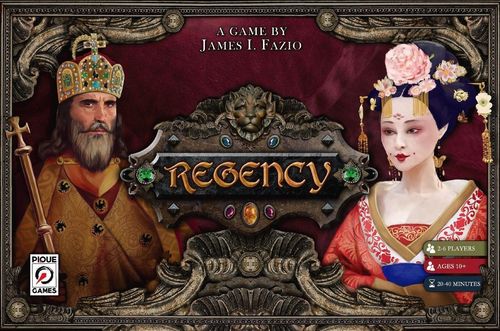
Regency
Regency Rulebook
Table of Contents
Table of Contents
Introduction
In Regency players compete across time as regents, seeking to amass the greatest civilization in history, by exerting influence over a diverse population of citizens. The first to assemble a complete domain, consisting of all six distinct castes of citizens, will reign supreme.
However, achieving this goal is no simple task. Players must contend with rival regents who will attempt to attract citizens away from the domain where they have taken up residency, whether by allure, by force, or by treachery.
Set against a historical and multi-cultural backdrop, Regency simulates the struggle of power and control that has marked the rise and fall of the world's greatest empires. Players use cards out of their hand to exert influence over citizens and to perform various actions and reactions. With the addition of each new caste of citizen (including nobles, religious, military, merchants, commoners, and brigands), new actions become available, resulting in an ever-escalating dynamic and competitive environment, right up to the crowning moment when one regent emerges supreme.
Components
- Populace Mat (Game Board)
- Regent Mats
- Citizen Cards (42)
- Event Cards (96)
Glossary of Terms
These terms appear throughout this rulebook, as well as on the event cards; players should become familiar with them.
- Action: an operation that can be performed by an active regent
- Active Regent: refers to an acting player, on their turn
- Attract: acquiring a citizen (swapping is not attracting)
- Caste: designates a citizen's role in a domain
- Citizen: represented by the citizen cards; there are two citizen types: simple and privileged
- Discard: placing an event card face-up into the discard pile, next to the event deck
- Domain: represented by the player's regent mat, this also includes all associated citizens
- Event: represented by the event cards, these include both actions and reactions
- Influence: refers to the game currency
- Populace: represented by the arrangement of six citizen cards displayed face-up on the game board
- Privileged Citizen: a citizen that can be assigned to a caste of a regent's choosing, from a selection of options
- Prowess: the ability to perform operations related to one of the six castes
- Reaction: an operation that a regent can perform, in response to an action, providing certain conditions are met.
Playing the Game
Besides the dynamic gameplay, the set-up and resolution are among the most gratifying features of Regency.
Game Set-Up
- Place the game board on the center of the table.
- Players select a regent mat and place it face-up in front of themselves; this indicates their domain.
- Shuffle the citizen cards and place them to the left of the game board; then, roll off the top six cards into the places indicated on the game board, forming two rows of three citizens, which constitute the populace.
- Shuffle the event cards and deal four to each regent; then place the remaining cards to the right of the game board, opposite the citizen deck.
Game Play
- Play begins with the regent whose prowess corresponds to the highest caste and then proceeds clockwise (to resolve ties, see page 5 - Regent Mats).
- An active regent may play any number of event cards from their hand that can legally be performed, following the text printed on the cards, and may discard any number of event cards for their influence value, which can be used to attract citizens from the populace.
- At the end of an active regent's turn, they may discard any number of event cards before drawing up to a hand limit of four.
- The regent seated to the left becomes the new active regent.
Game Resolution
- The first to assemble a complete domain consisting of all six citizen types is crowned the supreme regent.
Regent Mats
The regent mat represents the domain of a historical ruler. At the start of the game, players select a regent mat and place it face-up in front of themselves. Citizens will be positioned along the top and bottom of the regent mat, partially tucked away in their respective locations, arranged according to caste.
Play begins with the regent whose prowess corresponds to the highest caste. To resolve a tie, players may draw cards from the citizen deck; the player who drew the citizen of the highest caste goes first.
Regent Prowess
Each regent has a prowess that corresponds to one of the six castes (noble, religious, military, merchant, commoner, or brigand), indicated by the color of the description box and the symbol displayed next to the ruler's name. This allows the regent to use caste-specific event cards, regardless of whether they have a citizen of that caste in their domain. Note: players must still recruit citizens representing all six castes to achieve victory.
Regent Powers
Each regent has a regent power that matches their prowess. Once readied, the regent power can be activated by flipping over the regent mat. The regent powers are:
- (Noble) Inheritance - Action: draw up to six cards at the end of your turn.
- (Religious) Prayer - Action: select an event card from the discard pile and the top card from the event deck, shuffle them and randomly take one into your hand.
- (Military) Bulwark - Reaction: when a regent attempts to meddle with your hand or domain, cancel the effect.
- (Merchant) Treasury - Reaction: when you would pay influence, you may discard the top three cards of the event deck into the discard pile and use the influence displayed on those cards.
- (Commoner) Uprising - Reaction: at the start of any regent's turn, shuffle all citizens from the populace into the citizen deck, then reset the populace.
- (Brigand) Swindle - Action: swap a citizen in your domain with a citizen from another regent's domain.
Readying a Regent Power
Before a regent power can be activated it must first be made ready. To ready a regent power, an active regent must discard event cards from their hand, totaling four influence. The regent signifies the regent power has been readied by flipping their regent mat to the reverse side. Note: there is no limit to the number of times a regent power can be readied or activated in a given turn.
Citizens
Citizen cards represent the various citizens in Regency. The moment a citizen is assigned to a domain, the regent must also assign it a caste. A citizen can only be assigned to a caste that matches the color and symbol displayed on the border of the citizen card. There are two types of citizens, simple and privileged.
Simple Citizens
A simple citizen's caste is fixed - alas, such was history - and is determined by the color and symbol displayed along the border of the citizen card.
Privileged Citizens
Privileged citizens can be assigned to any caste displayed along the border of the citizen card. Regardless of how many options a privileged citizen may have, a citizen can only ever be assigned to a single caste.
Once a citizen is assigned a caste, it remains a member of that caste, unless an event occurs that allows it to be reassigned. When a privileged citizen is acquired from another regent's domain, that citizen may be assigned any caste indicated on the border of the citizen card, regardless of its previous assignment.
Populace
At the start of the game all 42 citizen cards should be shuffled and placed to the left of the populace mat. These cards form the citizen deck.
Six citizens should be flipped face-up off the top of the citizen deck, to fill the areas indicated on the populace mat, forming two rows of three citizen cards. These six citizen cards form the populace. Only the bottom three citizens can be recruited to a regent's domain by expending influence, while the top three reveal which citizens will soon become available.
The populace should always contain six citizens. As soon as a citizen is removed from the populace, all remaining citizens immediately shift clockwise (citizens rotate clockwise), terminating at the bottom left, starting with the first card in line to fill the space of the missing citizen, until the top leftmost space is empty. Then flip the top card off the citizen deck to fill the empty space.
Note: Until all vacant spaces on the populace mat are filled, no actions may be taken. Only reactions may be played, until the populace is refilled.
Attracting Citizens
A common way for regents to expand their domain is by attracting citizens from the populace. To attract a citizen in this way, an active regent must exert an amount of influence that meets or exceeds the value indicated on the populace mat.
- The amount of influence required to attract a citizen is 5, 6, or 7, depending on the citizen's location in the populace, ascending from left to right along the bottom row.
- Only citizens along the bottom row can be attracted using influence. Citizens on the top row may only be attracted by regents using events that target citizens in the populace.
- There is no limit to the number of citizens that can be attracted from the populace in a single turn.
Protecting Citizens
When a regent assigns a citizen a caste that is already filled by another citizen in their domain, the citizen cards should be stacked in an arrangement that leaves the caste colors and symbols visible to all players seated at the table. When the citizen cards are stacked in this way, the citizens closest to the regent mat are considered protected and cannot be targeted by rival regents. Only the outside citizen of each caste may be targeted by rival regents.
Event Cards
Event cards have two distinct purposes: 1) they determine the amount of influence a regent can exert, to attract citizens from the populace; and 2) they determine the actions and reactions that are available for regents to perform.
Influence
An active regent may exert influence by discarding any number of event cards from their hand, into the discard pile, to attract citizens from the populace into their domain.
Event cards can always be used for their influence, regardless of the caste requirements or conditions stated on the cards.
Actions
Event cards with the bronze sculpt of the lion in the upper left corner represent general actions that can be performed by any active regent. By discarding the event card into the discard pile an active regent may perform the action printed on the card.
Note: Event cards must either be used for their printed effects or for their influence, but cannot be used for both.
Caste-Specific Events
Some event cards have a caste color and symbol in place of the bronze sculpt of the lion. These events are caste-specific.
Caste-specific events can only be performed by a regent with a prowess that corresponds to that caste, or that possesses a citizen of that caste in their domain.
Reactions
Reactions are operations that a regent may perform, at any time, in response to a specific event, providing they meet all requirements indicated on the card. Any event can trigger a reaction, but only one reaction can be performed in response to each event card.
Once a reaction has been performed, other reactions cannot be played in response to that same event. However, a reaction can be played in response to the latest reaction, providing the condition stated on the card text is fully met. Note: reactions are triggered by events and cannot be played in response to a regent power.
Event Card Reference
The event deck consists of 7 unique general event cards (x6 of each) and 18 unique caste-specific event cards (x3 of each). Events marked with a star (shown here as [star]) should be removed from the game when playing with the duo or solo rules variant.
General
- Sovereign's Choice - Action: Discard any number of event cards from your hand; then draw that same number from the event deck.
- Appointment - Action: Exchange a simple citizen in your domain with a simple citizen from the populace.
- Receive Homage - Action: Draw two cards from the event deck; select one to keep and discard the other.
- Royal Summons - Action: Exchange the location of any two citizens in the populace.
- Festival - Action: Rearrange the citizens in your domain following all caste rules.
- [star] Dismiss - Action: Select a regent who must discard an event card.
- Favour: (no action - can be discarded for 3 influence)
Caste-Specific Events
The following are unique caste-specific events, including both actions and reactions. Each caste has 2 actions and 1 reaction, except military, which has 2 reactions and just a single action. Note: Actions are worth 1 influence; reactions are worth 2.
Noble
- Inspire - Action: Attract a simple citizen from the populace and add it to your domain.
- [star] Bestow Vassal - Action: Give a citizen in your domain to another regent, who must pay you 5 influence.*
- Refuse - Reaction: When a regent attracts a citizen from the populace, return that citizen to the populace.
Religious
- Convert - Action: Attract a military or brigand citizen from another regent's domain and add it to your own.
- [star] Tithe - Action: Each other regent must pass you one event card from their hand; keep one discard the rest.
- Penitence - Reaction: When a regent attempts to meddle with your hand or domain they must pay you 3 influence or abandon the action.
Military
- Conquer - Action: Attract a noble or commoner citizen from another regent's domain and add it to your own.
- [star] Garrison - Reaction: When a regent attempts to meddle with your hand, cancel the effect; draw a card from the event deck.
- Defend - Reaction: When a regent attempts to meddle with your domain, cancel the effect; draw a card from the event deck.
*or turn over their entire hand.
Merchant
- Procure - Action: Attract a citizen away from another regent's domain; pay 3 influence to that regent.
- [star] Barter - Action: Swap hands with another regent.
- Bargain - Reaction: When a regent attracts a citizen from the populace, add it to your domain instead; pay 3 influence to that regent.
Commoner
- Populate - Action: Draw a card off the citizen deck and add it to your domain.
- Harvest - Action: Draw two cards from the top of the event deck.
- [star] Revolt - Reaction: When a regent plays an event cancel the effect; then that regent draws a card from the event deck.
Brigand
- Abduct - Action: Attract a religious or merchant citizen from another regent's domain and add it to your own.
- [star] Plunder - Action: Look at all event cards in a regent's hand; then choose one to add to your own.
- Forgery - Reaction: When a regent plays an action, repeat the event as though you had just played it.*
*Note: Because Forgery replicates the event, not merely the effect of the card that it copies, once it has been played, it should be treated as an action that can trigger other reactions. However, the original action can no longer be reacted to, once Forgery has been played.
Duo/Solo-Player Variant
Regency can be enjoyed by 2-players or even 1-player by following the rules variants provided below.
In a 1 or 2 player game, players put their skills to the test against one of history's greatest regents: Catherine the Great!
Event Deck Modifications
Event cards marked with a star on the lower right edge should be removed from the game, leaving a 72 card event deck.
Catherine the Great is not dealt a hand of cards nor does she take any actions or reactions. Instead, on her turn, Catherine performs each of the steps listed below, twice, and thus her domain expands by two citizens each turn.
Play begins with Catherine the Great, then proceeds clockwise.
- Flip the top card off the event deck into the discard pile. Add the influence displayed on the discarded card to her base influence (4).
- Catherine spends 5, 6, or 7 influence (depending on the value of the discarded card) to attract a citizen from the populace, prioritizing any caste not already in her domain.
- If all available citizens are of a caste already in her domain, instead, draw the top card off the citizen deck and add it to her domain.
Caste Prioritization
Appointment of citizens to Catherine's domain is entirely prescripted and involves no decision making. Catherine prioritizes citizen selections according to caste: noble, religious, military, merchant, commoner, brigand. Catherine will prioritize privileged citizens above simple citizens, but will always choose any caste not already in her domain.
Frequently Asked Questions
Due to the dynamic game play, questions may arise concerning the timing or resolution of card effects. In general, reactions which alter or cancel the effect of an action are considered to resolve before the action is completed. Despite this, the event card representing the action remains discarded and any cost associated with playing the card remains spent.
Regents
Is there a limit to the number of regents in a game that possess the same prowess?
No. The only limitation is the number of physical regent mats (3 per prowess).
Who goes first when two or more regents are tied for the highest prowess?*
To resolve a tie, players draw cards from the citizen deck; the player who drew the citizen of the highest caste goes first.
*In a 1 or 2 player game, play always begins with Catherine the Great.