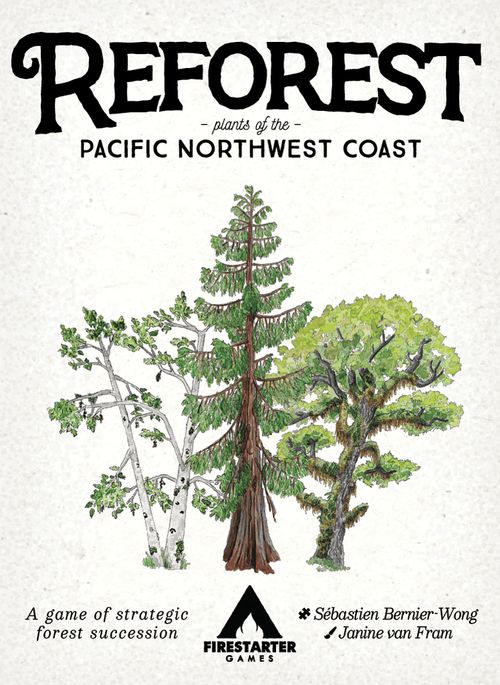
Reforest
Reforest Rulebook
Table of Contents
Table of Contents
Overview
Compete to grow the healthiest forest ecosystem by arranging and evolving a synergistic collection of plant cards.
Each plant has a point value, a unique ability, and a cost (in cards) to play them. Plants can grow in empty spaces or cover over others. You'll pay for them by discarding cards from your hand and/or your forest's energy supply.
The game is played in 3 rounds. After each, an animal visitor card is awarded to the player who best met their habitat preferences.
After the 3rd round, points are tallied from plants, visitors, and various bonuses.
Components
- 91 Plant cards
- 10 Visitor cards
- 1 Quick reference
- 1 Scoring card
- 5 Card event module (optional)
Setup: Plants
- Shuffle all plant cards together and keep the following amount depending on the number of players:
- 4 Players: 90 Cards
- 3 Players: 70 Cards
- 2 Players: 50 Cards
- Solitaire: 30 Cards
- Place these face down to form the plant deck. Leave space for a face-up discard pile.
- Put away the other unused plant cards.
- Deal 5 plants to each player. You may look at your own cards but keep them hidden from others.
- Draw 3 plant cards from the deck and lay them face up to create the nursery.
Setup: Visitors
- Shuffle all visitor cards together to form the face-down visitor deck.
- Lay out 3 visitor cards as round-end visitors. These will be awarded from left to right.
- Tuck the listed number of plant cards from the plant deck face down under both the 1st and 2nd round-end visitors:
- 4 Players: 12 tucked cards
- 3 Players: 10 tucked cards
- 2 Players: 8 tucked cards
- Solitaire: 6 tucked cards
Game Setup example: Round 1 and Round 2's round-end visitors each have tucked plants beneath them; Round 3's round-end visitor has no tucked plants. The table also holds the face-down visitor deck, the face-down plant deck, a face-up plant discard pile (empty at the start), and the 3-card face-up nursery.
Starting Player: The player who most recently took a walk in the woods plays first.
Card Overview
Each plant card (for example, Labrador Tea) shows:
- A. Plant Cost (cards icon): The number of cards that must be discarded to play this plant. You may discard any combination of plant cards from your hand or stored energy cards from your region. Costs may be reduced in various ways. See Paying for a Plant.
- B. Elevation (mountain icon): The elevation rows this plant can be played in.
- C. Shade Tolerance (sun / half-sun icon): Determines if a plant persists or turns into stored energy when grown over. See Covering Sun Plants / Covering Half-Sun Plants.
- D. Height (m): The approximate maximum growing height of this plant. Only plants of a greater height may grow over (cover) this card.
- E. Plant Value (wreath/points icon): The plant's point value.
- F. Plant Effect: A plant's unique ability. See Plant Effects.
- G. Understory Overview: Details about the plant. Traits, icons, and other features are found here. These remain visible and relevant even after the plant is covered.
Region Overview
A player's play area is called their region. It has 6 spaces distributed into 3 elevation rows (High / Middle / Low) where cards can be played.
Multiple cards can be stacked within a single space. This allows players to have more than 6 cards in their region.
You'll want to balance your stacks to get a good elevation bonus! See Elevation Bonus.
On Your Turn
On your turn, choose one of the following actions. You can either A. Gather plants to your hand or B. Play a plant to your forest. Play then proceeds to the player on your left.
If the plant deck is emptied on your turn, stop your current action immediately and resolve the end of a round. See Ending a Round.
A. Gather Plants
Draw up to 2 cards from any combination of the deck and/or the nursery. Replenish the nursery between player turns.
B. Play a Plant
Pay a plant's nutrient cost (cards icon) to add it to your region.
- The first plant you play must be played at low elevation.
- Future plants must be played adjacent to an existing plant or cover over one. Plants may only cover others if they are taller than them.
Adjacency
- A card/stack is not adjacent to itself.
- All cards or stacks in spaces that share a border are considered adjacent to each other.
- All cards within the same stack are also considered adjacent.
Example: in a region diagram with a marked space, all cards in the spaces bordering it are adjacent to it, including other cards stacked in that same space.
Paying for a Plant
The nutrient cost of a plant can be paid in any combination of these two ways:
-
Discarding X cards from your hand
-
and/or Discarding X adjacent stored energy (stored energy are face-down cards tucked under stacks in your region — see Stored Energy Cards)
-
Each discarded card is only worth 1 toward the cost to be paid, regardless of the discarded card's own nutrient cost.
-
Covering existing plants reduces the cost you'll pay. See Succession Discount.
-
Plants with a When Played effect have effects that adjust their cost as they are played.
Stacking Cards
Plants may be played directly on top of others if they are taller. This is called covering a plant and grants the succession discount. Plants of the same height cannot cover each other.
When covered, sun (shade-intolerant) plants turn into stored energy, while half-sun (shade-tolerant) plants persist. Covering either type of plant still grants the succession discount.
The term canopy refers to the topmost plants in stacks. The understory refers to all lower plants in stacks.
Succession Discount
Growing over a plant reduces the amount of nutrients needed to play the new plant.
- Subtract the cost of the topmost plant in the stack you are growing over from the cost of the new plant you are playing. Do not subtract the cost of other cards lower down in a stack.
Example: Salal is established in the canopy of your region. Since Salal has a cost of 2, the next plant that covers it will have its cost reduced by 2.
Covering Sun Plants
After growing over a sun plant, flip it over, turning it into stored energy. It can't survive in shade and instead joins the soil as nutrients.
Stored energy cards...
- ...do not count as plants.
- ...are each worth 1 point at the end of the game.
- ...can be discarded to pay for plants growing in adjacent spaces. See Paying for a Plant.
- ...can be looked at by their owner at any time.
Covering Half-Sun Plants
If growing over a half-sun plant, leave its understory overview (bottom section) visible.
- Covered half-sun plants lose their plant effects but are otherwise still considered in play. This means all information in their understory overview, including icons, traits, and plant value, are still relevant.
Stack Limit: There is no limit to the number of cards (plants or stored energy) that can exist in a single space of a region.
Hand Limit: After ending your turn, you must discard down to a hand of 7 plant cards.
Ending a Round
A round ends immediately when the plant deck is emptied. This may interrupt a player's turn/action. Resolve the following:
- Award round-end visitor(s): Players compare regions to see who best met the Multiplayer goal of the leftmost round-end visitor(s).
- The winner takes the visitor card. Visitors stay face up in front of you and do not count toward your hand limit.
- If tied, the visitor becomes an additional goal for the next round. Discard unawarded visitors after the 3rd round.
- Reset the deck: Shuffle the discard pile together with any remaining cards in the nursery and any plants tucked under the previous round's visitor. This becomes the new plant deck. Lay out 3 new nursery cards.
- Resume turn: If a player's turn or action was interrupted to end the round, they may now finish their turn/action.
Ending the Game
After the 3rd round-end visitor is resolved, the game continues until it would be the starting player's turn again. Scoring then commences by adding up the following:
- Plant Value: Score the point value on each face-up plant, including those in the understory.
- Scoring Effects: Score the point value from the visible yellow Scoring effects on plants in the canopy.
- Stored Energy: Score 1 point for each face-down energy card in your region.
- Visitor Value: Score the point value of all visitors you have earned or drawn.
- Elevation Bonus: Count the number of plant cards in the smallest stack of each elevation row. Score 2 points for each of those cards. Do not count stored energy. Empty spaces count as stacks of 0.
- Example: a row with a single stack of 1 card scores 2 points (1 card × 2). A row with stacks of 0 and 1 scores 0 points, since the smallest stack has 0 cards. A row with stacks of 3, 2, and 3 scores 4 points, since the smallest stack has 2 cards (2 × 2).
- Cards in Hand: Score 1 point for every 2 cards remaining in your hand.
Plant Effects
Plant effects are optional. If you choose to use an effect, you must resolve it entirely.
- When Played: Activates only once, when this plant is being played into your region.
- Passive: Always in effect until covered.
- Reaction: Activates any time its condition is met. Does not trigger itself when played.
- Before/After Gathering: Activates any time you take the Gather action.
- When Covered: Activates when this plant is in the canopy and is then covered by another.
- Scoring: Earns you bonus points if this plant is in the canopy at the end of the game.
Plants are included in their own effects. E.g., a plant with the berries icon counts itself when counting berries.
Playing a Plant (Order of Events)
- Choose a space or stack to play the plant onto.
- Calculate and pay the plant's cost.
- Place it onto the space or stack. It is now played (grown). Plants under it are now covered.
- If you covered a plant, turn it into stored energy if it is a sun plant, or leave it alive if it is a half-sun plant.
- Activate any relevant When Covered, Reaction, and/or When Played plant effects in any order. Plants do not trigger their own Reaction effects.
Solitaire Mode
Reforest can be played by a single player at one of two difficulty levels:
- Standard: Score higher than the total value of all 30 plants in your game to win.
- Hard: Add the value of any unearned round-end visitors (including those added in-game) to the Standard target score.
Rule Changes
- Gathering: After gathering, you must discard a card from the nursery or deck.
- Visitor Goals: Use the Solitaire goals of round-end visitors. Usually this means you must have a certain number of plants with a specific trait. Be sure to only use the correct round's goal amount. The layout is: Goal Criteria: Round 1 Goal / Round 2 Goal / Round 3 Goal.
- If a visitor is not earned at the end of its round, remove it from the game. Keep it to score Hard mode.
- Game End: When you empty the deck for the 3rd time, play 1 more turn before ending the game. Compare your score with your chosen challenge to see if you won! Ties are losses.
Glossary
- Adjacent: Cards/stacks in spaces that share a border are adjacent to each other. All cards within the same stack are adjacent to each other. A card/stack is not adjacent to itself.
- Canopy: The topmost plants of their respective stacks.
- Draw X Card(s): Take X cards from the deck and/or nursery. If a source is specified, draw from it instead.
- Draw a Visitor Card: Draw a card from the Visitor deck for its point value. You do not need to meet its goal requirements.
- Elevation: A row in a region: low, middle or high.
- Gather: Spend your turn to draw 2 cards.
- Look at: Inspect but do not draw. Does not trigger round end.
- Move: Move a card to a specified space. Does not count as growing a plant but can activate When Covered effects.
- Nursery: Three plant cards from the deck laid face up and available to be drawn. Replenished between turns.
- Region: A player's play area. It consists of 6 spaces distributed into 3 elevation rows.
- Space: A zone in a region where cards can be played. Can hold any number of stacked plants and/or energy.
- Stack: The collection of cards (plant and/or energy) placed atop each other within a single space.