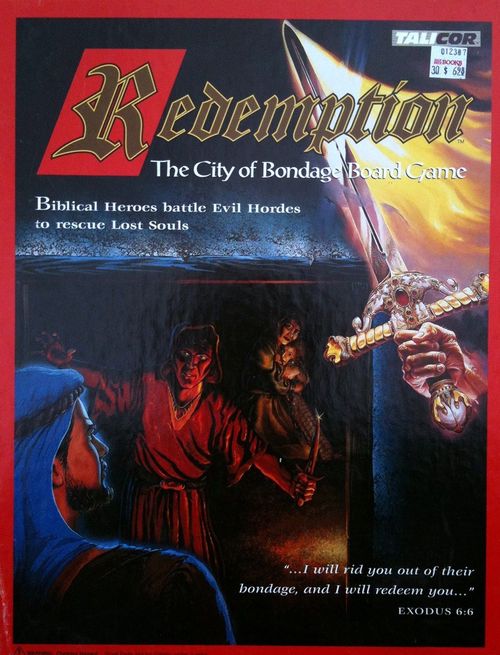
Redemption: City of Bondage
Redemption: City of Bondage Rulebook
Table of Contents
Table of Contents
Object
The Redemption® "City of Bondage" Board Game leads players on a dangerous crusade to rescue Lost Souls held captive in the City of Bondage. The first player to reach the Well of Living Water after gaining six victory points wins.
Game Components
12 Hero Tokens
The Hero token is used as a mover during play. There are two labels for each Hero. Peel off the Hero labels and place one label on each side of the token.
Gameboard
The gameboard displays a bird's-eye view of an ancient forgotten city. Many of the buildings are in ruin. The streets are dusty and are no more than paths that wind into dark alleyways. Located in the center is the city's Well of Living Water, a bright, open place, in dramatic contrast to its dark surroundings. The Well will provide embattled Heroes with a sanctuary to rest and recover.
The gameboard shows circled entrance gates into the city. These are the starting points for the game. All areas shown darker are the thresholds by which each building is entered. A player may only enter a building through the threshold.
100 Redemption Cards
The cards showcase some of the beautiful artwork from the Redemption® collectible card game. The printed card diagram labels the parts of a card: Card Icon and Color, Name of Card, Illustration, Special Instructions, Biblical Text and Biblical Reference.
1 Movement Die
Movement is directed by the roll of the die. The Movement Die is numbered 1 to 8.
6 Battle Dice
The Battle Dice are used to help determine battle outcomes between Heroes and Evil Forces by adding strength units to the Heroes during battle. They also determine the amount of damage the Evil Force does to the Hero during the battle. Each die has one blue Cross, one green Cross, one red Cross, one Dragon and two Blessing (Lamb) icons.
Hit Chips (20)
The round black Hit Chips are used as counters to show the number of hits a Hero has taken in battle.
Component Descriptions
In the board game, there are six types of cards.
Hero Cards (12)
Hero Cards correspond to the twelve Hero tokens and display the Hero and feature a cross(es) icon. Each Hero has his own unique strength represented by the color of each cross icon on the Hero Card. A Blue cross stands for one unit of strength in Faith. A Green Cross represents one unit of strength in Wisdom. A Red cross designates one unit of strength in Deed. A Hero with two crosses of the same color has two units of strength in that color. A Hero with two crosses of different colors has one unit of strength in two colors. Three Heroes only have one cross icon instead of two. These Heroes begin each of their quests by rolling 5 Battle Dice in battle instead of 4, as do the other Heroes (see Battle Dice below).
Enhancement Cards
Enhancement Cards feature a colored Bible icon and name the Enhancement. Enhancement Cards raise a Hero's strength in a color by one unit. Some Enhancements have the number two near the Bible icon, which means that Enhancement raises a Hero's strength by two units in that color. Other Enhancement Cards will give a Hero special strengths detailed on the Enhancement Cards. Once an Enhancement is obtained by a Hero, it strengthens the Hero for the remainder of the game unless the player is otherwise instructed to discard the Enhancement.
Blessing Cards
Blessing Cards feature a Lamb icon and explain how a Blessing is used. These cards are played during a player's turn and are usually discarded after being played. The player may decide when, during his turn, to play a Blessing Card; for example: a player may use the Battle Dice to fight a battle and if the outcome is not to the player's liking, he may play a Blessing Card (if he has one) that will yield a different outcome.
Lost Soul Cards
Lost Soul Cards show a Lost Soul and read "Lost Soul" on the card.
Evil Force Cards
Evil Force Cards have a colored Dragon icon and display the Evil Force. The color of the icon designates the Hero strength to which the Evil Force is vulnerable. The number near the Dragon icon is the power needed to cause the Evil Force to retreat. Strength in excess of the number near the Dragon icon would vanquish the Evil Force.
EXAMPLE: An Evil Force having a blue Dragon icon with the numeral 3 next to it is vulnerable to faith (blue). A Hero would need to achieve three units of strength in faith during the battle (by combining the Hero's strength on the Hero Card, any Enhancement Cards and any blue crosses rolled using the Battle Dice) to cause the Evil Force to retreat and be discarded. The Hero would need to achieve four units of strength in faith to vanquish the Evil Force and count it as one victory point for the Hero.
Trap Cards
Trap Cards have a skull icon and describe how the Trap works. A Trap is a situation that poses an obstacle to the Hero.
Starting the Game
- To start, each player rolls the Movement Die (numbered 1 through 8). The player with the highest number will take the first turn, is the first to select a Hero token with corresponding Hero Card (indicated by a cross icon in upper left corner), and the first to select an entrance gate (shown below) into the city. Play continues clockwise.
- After each player has a Hero token on his or her chosen gate, and the corresponding Hero Card on the table facing upward, the remaining Hero tokens are put back in the box since they will not be used this game. The remaining Hero Cards are shuffled back in the deck. These cards will be rescued Heroes later.
Circled areas show the entrance gates into the city. These are the starting points for the game.
Placement of Cards in City
The first player rolls the Movement Die. After the roll, this player consults the placement illustrations to determine how the cards are placed into the city. If the next player rolls the same number, the die is re-rolled for a different outcome and the illustrations are consulted again. Place the cards FACE DOWN unless otherwise instructed by the illustration descriptions. The cards are placed in the building by the player who rolled the die. All players will have one turn to place cards in the city.
Card Placement Illustrations
If you roll a:
- 1 = Place 1 card on each building in the two city sections on both sides of your entrance gate. (Example: if your entrance gate is shown in the illustration, you will place 1 card on each of the highlighted buildings.)
- 2 = Place 2 cards on each of the four buildings nearest to the Well of Living Water.
- 3 = Place 2 cards on each of the six buildings with a dome.
- 4 = Place 1 card on each of the nine buildings with a tile roof.
- 5 = Place 2 cards on each of the four buildings that are nearest to the four city gates.
- 6 = Place 1 card on each of the six buildings with stairs.
- 7 = Place 3 cards on each of the three buildings with awnings.
- 8 = Place 1 card face up on any four buildings, one in each section of the city. Sections break as follows (see the section diagram printed on page 4).
After each player has rolled the die and the cards are distributed according to the illustrations above, place one additional card face down on each building in the city. The remaining cards are set to one side of the board, face down, to form the draw deck. Every building now has at least one card face down.
Playing a Turn
Movement is the first step of a player's turn. A player may choose not to roll the Movement Die during a turn and hold the Hero's current position (to continue fighting in the current building). A player may not move his Hero on the same turn in which he has held position (such as to fight in a building or to recover at the Well of Living Water).
Movement
Roll the Movement Die. A Hero may move one step (block) for each number on the die. A Hero may not move diagonally and does not have to move the full distance rolled. Movement may be restricted by Hit Chips (small black chips). Hit Chips are explained in "Exploring a Building." For each Hit Chip over four on a Hero Card, the Hero loses one movement step. For example: a Hero with six Hit Chips has his movement reduced by two steps.
Moving into (exploring) a building is accomplished by landing on its threshold. If a Hero does not enter a building, the player's turn ends after movement and the next player takes his turn.
Exploring a Building
When entering a building, a player turns all cards in the building face up. The sequence below must be followed, but not all steps may be applicable.
- Blessing Card. If there is a Blessing Card in the building, take the Blessing Card first and place it face up near your Hero. You may choose to use the Blessing Card now or hold it for later use. Directions are printed on each Blessing Card. Discard the Blessing Card after use. If there are two or more Blessing Cards in the building, you gain all the cards in the room (any Trap Cards are discarded with no effect).
- Trap Card. When there is a Trap Card, it is sprung. Trap directions are printed on each Trap Card. When there are two or more Trap Cards in the building, have another player mix the Trap Cards, then select one at random. After the selected Trap is completed (and if the Hero is still in the building), the next Trap is completed until all the Traps are sprung (on the same turn).
A player may be forced to lose cards already gained during the course of the game, in which case, those cards cannot be used and no longer count toward victory. EXAMPLE: The Ignorance Trap Card forces a player to discard one Lost Soul Card.
- Evil Force Card. If there is an Evil Force Card in the building, your Hero must fight a battle. When there are two or more Evil Force cards in the building, have another player mix the Evil Force cards and you select one at random, to do battle. Place the Evil Force Card on top of the other cards. Place your Hero token on the Evil Force Card to show you are engaged in battle (see "Battle," below).
When there is an Evil Force Card in a building guarding an Enhancement, Lost Soul, or a Captive Hero Card, you must first defeat the Evil Force before you may gain possession of one of these cards. When there is a second Evil Force Card in the building, it must be defeated before a second card is gained. A player may only battle one Evil Force per turn.
- Surprise. When there are two or more Evil Force Cards in the building, the Hero is "surprised" and takes one hit. Place one Hit Chip on your Hero Card.
- Enhancement Card. An Enhancement Card (if you gain one) is placed face up near your Hero Card. You will need to review your Enhancement Cards before each battle to determine your base battle strength. These cards increase the Hero's battle strength in particular colors. Gained Enhancement Cards do not count toward final victory.
- Gaining Cards. If there are no Evil Force Cards in the building to battle, you may gain possession of one card (Enhancement, Lost Soul or Captive Hero) you have discovered. You may gain possession of only one card per turn. When there are a number of cards to gain, it will take a number of turns to gain them all. Be aware that another player may also enter the same building and gain cards (one per turn) while your Hero is in the building. When there are one or more Hero tokens in a building, all cards in the building remain face up until the last Hero moves out of the building.
When the last Hero leaves the building, all the cards (if any) remaining in the building are turned face down. If there are one or more Evil Force Cards still in the building, add another card, face down, to the building from the draw deck before exiting.
- Lost Soul Card. A rescued Lost Soul Card is placed face down near your Hero Card. Each rescued Lost Soul Card will count as one victory point.
- Hero Card. A rescued Hero Card is placed crosswise under your Hero Card. Each rescued Hero will give you one additional battle die in battle. Each rescued Hero Card will also count as one victory point.
Battle
- Determine the power of the Evil Force. Determine the power of the Evil Force Card you are battling (indicated by a color and number). The color of the Dragon is the color strength required by the Hero doing battle and the number near the Dragon icon is the power required to cause the Evil Force to retreat and be discarded.
- Determine your base battle strength. Add your Hero's strength to the strength of any Enhancements you hold in the color of the Evil Force.
EXAMPLE 1: You encounter an Evil Force with a red Dragon icon, power of five. Your Hero has two Cross icons, one red and one blue. Your Hero has one unit of strength in red (Deed). You also have an Enhancement Card with a red Bible icon worth one unit of red strength. Therefore, the base strength of your Hero against the red Evil Force is two units of strength against the Evil Force of five units.
EXAMPLE 2: If, instead, you were in battle with an Evil Force with a green Dragon icon, power of five, your base strength would be zero. (You're in trouble.)
- Determine the number of Battle Dice to roll. A Hero normally rolls four Battle Dice (some Hero cards state that the Hero may roll five dice in battle).
IMPORTANT: Your Hero will gain one Battle Die for each rescued Hero. Remember to place rescued Hero Cards crosswise under your Hero Card to help keep track of the additional battle dice you gain. A rescued Hero also counts as one victory point.
When your Hero has more than four Hit Chips (see #4 below, "Roll the Battle Dice") on his or her card, the number of dice you may roll is reduced by one for each hit over four. Note that additional rescued Heroes cancel out Hit Chips at a ratio of one to one with regard to Battle Dice. Rescued Heroes do not increase movement.
The most dice you can ever roll in battle is six.
- Roll the Battle Dice. For each Dragon icon rolled, place one Hit Chip on your Hero Card.
EXAMPLE: You roll two Dragon icons and your Hero receives two Hit Chips.
Dice which show Blessing icons may be re-rolled. However, sometimes there is no chance to win the battle, even with the re-roll. In this case, just concede the loss and do not re-roll, since more rolls may turn up other Dragon icons, forcing your Hero to receive more Hit Chips.
When you roll the proper color Cross icon, add the number of the correct color Cross icons rolled to your Hero's base battle strength number.
Battle Results
- When your total equals the power of the Evil Force Card, the Evil Force must retreat. Discard the Evil Force Card face up near the draw deck. If there are cards to gain, take one from the building. A retreating Evil Force does not add any victory points to your scoring.
- When your total is greater than the power of the Evil Force Card, the Evil Force is vanquished. Place the Evil Force Card face down next to your Hero Card. A vanquished Evil Force Card will count as one victory point. Note that Evil Force Cards that retreat do not count toward victory points. If there are cards to gain, take one card from the building.
- When your total is less than the power of the Evil Force Card, the Evil Force remains in the building. On your next turn, you can hold position in the building and battle again or roll the Movement Die and move away, following the instructions in "Exploring a Building," #6.
- A Battle Blessing happens when you roll four or more Blessing (Lamb) icons on a single roll. If you roll a Battle Blessing, you vanquish the Evil Force Card no matter what its power. Place the Evil Force Card face down near your Hero and count it as one victory point. If there are cards to gain, take one card from the building.
- A Hero may battle only one Evil Force during a player's turn. After the result of battle is determined, it is the next player's turn.
Recover
A Hero may, using the Movement Die, choose to move to the Well of Living Water in the center of the city to be able to recover. On the following turn after arriving at the Well, a player rolls the Movement Die and, instead of moving, removes the number of Hit Chips rolled from his Hero Card. After the result of recovery is determined, it is the next player's turn.
Winning the Game
The first player to gain six victory points and move to the Well of Living Water wins!
Victory points are scored as follows:
- Each rescued Lost Soul Card counts as one victory point.
- Each rescued Hero Card counts as one victory point.
- Each vanquished Evil Force Card counts as one victory point.
Overwhelmed
During some games, the Heroes may be overwhelmed by the forces of evil and be cast out of the city before they can achieve victory. This means that the game is lost. When this happens, your Heroes must regroup and start another game.
The Heroes are cast out of the city when the total number of Hit Chips on all Heroes at any given time reaches a certain number. Note that the Heroes may recover as many times as needed to avoid accumulating too many Hit Chips and being cast out of the city.
- When there is one Hero player, he or she may accumulate a total of six Hit Chips only.
- When there are two Hero players, they may accumulate a total of ten Hit Chips only.
- When there are three Hero players, they may accumulate a total of fourteen Hit Chips only.
- When there are four Hero players, they may accumulate a total of eighteen Hit Chips only.
Sample Turn
The player's Hero character is Paul, who has strength in Faith (blue) and Wisdom (green). During previous turns the player has rescued one Hero (Rebekah) and gained two Enhancement Cards, Stone Cut Without Hands (blue) and Breastplate of Righteousness (red). The player currently has two Hit Chips on his character.
- Hero: Paul — 1 Blue Cross, 1 Green Cross.
- Enhancements add to Hero's strength — 1 Blue, 1 Red. (The Breastplate of Righteousness card reads: "Hero is immune to Stone of Thebez Trap. Discard the Trap card.")
- Rescued Hero (Rebekah) — adds one to the number of Battle Dice rolled and counts as one victory point.
The player rolls the Movement Die and moves his Hero token to the threshold of a building having seven (7) cards in that building. The player turns all seven cards face up. There is a Blessing card (Pillar of a Cloud), a Trap card (Stone of Thebez), two Evil Force cards (Abaddon the Destroyer and Belshazaar), a Hero (Gideon), a Lost Soul and an Enhancement card (Live Coal).
Blessing Card. Acquired immediately. The player takes the Blessing card (Pillar of a Cloud) and places it with the other cards he has already gained.
Trap Card. Next, the player reads the Trap card (Stone of Thebez): "Roll 6 dice. Hero takes a hit for each Dragon icon rolled. Discard the Trap card." The player rolls six battle dice. One Dragon icon comes up. He adds one Hit Chip to his Hero (for a total of three) and discards the Trap card.
Surprise. Since there are two Evil Force cards in the building, Paul is surprised and receives a Hit Chip (total four).
- 4 Hit Chips: 2 from previous turn, 1 from Trap, 1 surprised by two Evil Force cards in same building.
Battle with Belshazaar. Another player mixes the two Evil Force cards and the current player draws one to battle. He draws Belshazaar (a blue Dragon icon with power of four). The player determines his base battle strength against Belshazaar by adding the blue Cross icon on the Paul card to the blue Bible icon on Stone Cut Without Hands. His base battle strength against Belshazaar is two. The player needs a total of four to cause Belshazaar to retreat and five to vanquish him. Since the player rescued the Hero, Rebekah, he can roll five battle dice (instead of four). The player decided not to use Pillar of a Cloud this battle but save it for another battle.
- The player rolls the battle dice with the result: two blessings (lambs), one blue Cross, and two red Crosses. The blue Cross adds one unit of strength against Belshazaar for a current total of three units of strength. The red provides no help.
- The player decides to re-roll the two blessings. He rolls another blue Cross and a Dragon. He adds a Hit Chip to Paul for the Dragon (total five).
- He has achieved four units of strength against Belshazaar, which is enough to cause him to retreat. Belshazaar is discarded to the discard pile and not scored as a victory point.
Gaining a card. The player may now gain one of the three cards in the room. The player takes the Gideon card, which counts as a victory point, and adds one more battle die to the number the player may roll. The player's turn is now over.