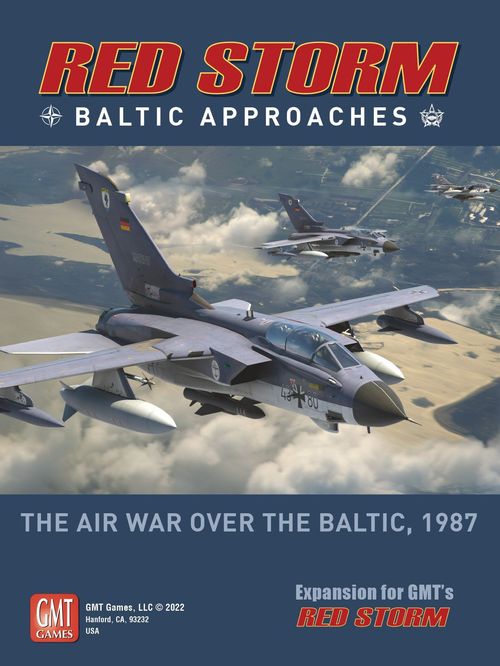
Red Storm: Baltic Approaches – The Air War Over the Baltic, 1987
Red Storm: Baltic Approaches – The Air War Over the Baltic, 1987 Rulebook
Table of Contents
Table of Contents
- 1.0 Introduction
- Component List
- 2.0 Game Equipment
- 6.0 Movement
- 8.0 Raid/Task Planning
- 10.0 Detection
- 14.0 Anti-Aircraft Artillery
- 15.0 SAMs and Radars
- 16.0 Air-to-Ground Ordnance
- 17.0 Air-to-Ground Attacks
- 19.0 Electronic Countermeasures
- 20.0 Fuel and Recovery
- 22.0 Weather
- 23.0 Night
- 24.0 Recon Missions
- 26.0 CSAR
- 27.0 Army Ground Units
- 29.0 The Front
- 30.0 Scenario Conditions
- 31.0 Scenario Setup
- 32.0 Victory
- 35.0 Naval Units
- 35.1 Naval Units
- 35.2 Task Forces
- 35.21 Task Force Contents
- 35.22 Dummy Task Force
- 35.3 Naval Unit Radar
- 35.4 Naval Unit Detection Attempts
- 35.5 Naval Unit AAA
- 35.51 Naval Unit Radar AAA
- 35.52 Naval Unit Organic AAA
- 35.53 Close Defense AAA
- 35.6 Naval Unit SAMs
- 35.7 Detection and Identification of Naval Units
1.0 Introduction
Baltic Approaches is an expansion for Red Storm that allows players to simulate air warfare over the western Baltic during the mid-1987 conflict depicted in Red Storm. In addition to close air support, deep strikes, and air defense missions, players can also simulate anti-ship strikes, support for amphibious assaults, airborne landings, and air assault operations—all of which would be critical in a maritime area of operations. Baltic Approaches also introduces ships to the game system, both as targets and as combatants.
1.2 Rules
The rules below add to the base Red Storm rules. In most cases, new paragraphs are added to existing rules. In other cases, new rule headings are added as well (indicated with an asterisk in the booklet). They are divided into standard and optional rules. Some rule sections repeat parts of Red Storm rules for clarity. Rules references use the same [X.X] notation from Red Storm. However, references to rules in Baltic Approaches are indicated with italics (e.g., [35.731]).
1.23 Learning Baltic Approaches
Players may wish to start by playing the introductory anti-ship scenario (BA1) and walking through the example of play.
1.3 Glossary of Game Terms
ASM. Air-to-Surface Missile (air-launched anti-ship missiles such as Kormoran, Sea Eagle, Harpoon, and similar weapons).
BALTAP. Baltic Approaches.
CG. Cruiser, Guided Missile.
CL. Cruiser, Light.
CVW. Carrier Air Wing.
DP. Damage Points for naval units.
DD/DDG. Destroyer / Guided Missile Destroyer.
Denmark. All Land and Sea hexes west/north of the Denmark border shown on the map. See [29.21].
DK. Denmark (Royal Danish Air Force, Royal Danish Navy).
Dummy Task Force. A fog of war term used to denote a Task Force that does not consist of real naval units. Dummy Task Forces are used to confuse the enemy player as to the location of real naval units.
East Germany. All Land hexes on/south of the German coast to the east of the inner German border.
EMCON. Emission Control.
ELINT. Electronic Intelligence.
Entry Point. A map hex marked with a flag and a letter or number in a white circle. Used for designating entry hexes for flights.
EW. Electronic Warfare.
FF/FFG. Frigate / Guided Missile Frigate.
FFL. Frigate, Light (Corvette).
FRG. Federal Republic of Germany (German Air Force / Luftwaffe, German Navy / Bundesmarine).
GDR. German Democratic Republic (Air Forces of the National People's Army / Luftstreitkräfte der Nationalen Volksarmee, People's Navy / Volksmarine).
GLCM. Ground-Launched Cruise Missile.
IDS. Interdiction strike.
Inner German Border. The land border between West and East Germany.
Island. A group of Land hexes on the map that is surrounded by Sea hexes and not connected to the mainland.
KIA. Killed in Action.
LST. Landing Ship Tank.
Manned Aircraft. A manned aircraft (not a cruise missile, ASM, or SSM).
MANPAD. Man-Portable Air Defense.
MB. Maritime Border.
ML. Minelayer.
MS. Minesweeper.
MV. Merchant Vessel.
NATO/WP Maritime Border (MB). The sea and air boundary between NATO and WP sea areas. Where it goes over a Land hex, it also marks the Front [29.11].
NDC. Naval Data Chart.
Naval Data Chart. Charts with game play information for naval units, similar to Air Data Charts.
Naval Units. Ships of various classes.
PCM. Missile Patrol Craft.
RAF. Royal Air Force.
RN. Royal Navy.
Ships. Short for "Naval Units". Used interchangeably in the rules.
Size. Small, Medium, or Large naval units.
SRAM. Short Range Air-to-Surface Attack Missile.
SSM. Surface-to-Surface Missile (ship or shore launched anti-ship missiles).
Sweden. All Land and Sea hexes inside the Swedish maritime border shown on the map. See [29.22].
Swedish Maritime Border (SMB). The sea and air boundary between Sweden and NATO/WP sea areas.
SE. Sweden (Royal Swedish Air Force, Royal Swedish Navy).
Target Class. A naval unit rating found on NDCs, used for attacks on naval units.
Task Force (TF). A group of one or more naval units.
TVD. Theater of Operations.
USMC. United States Marine Corps.
USN. United States Navy.
West Germany. All Land hexes on/south/west of the German coast to the west of the inner German border.
Component List
A complete game of Baltic Approaches contains:
- Two 22" x 34" maps
- One die-cut countersheet
- One Rules Booklet (this manual)
- One Scenario Booklet
- One Appendices Booklet
- One Player Aid Card (#6, 11" x 17")
- Three Aircraft and Naval Data Charts (11" x 17")
- Two 10-sided dice
- Naval Log Sheets
2.0 Game Equipment
2.2 Map
The Baltic Approaches game map portrays the northern end of the NATO/WP front, including portions of West Germany, Denmark, East Germany, and Sweden. Various land and maritime borders are shown, each with their own game function.
2.23 Baltic Approaches Terrain Features
A terrain key describes the features on the map. Land, Marsh, Urban, Airfield, Road, or Highway artwork indicates types of terrain. Sea artwork indicates Baltic Sea water areas. Some major bridges, canal locks, ports, forts, and ferries are depicted for target purposes only and have no other effect on play.
A hex with any portion of Land, Marsh or Urban artwork is a Land hex. A hex with only Sea artwork is a Sea hex.
In addition, hexes with any portion of Urban artwork are also Urban hexes, a hex with any portion of a Road or Highway is also a Road hex, a hex with an airfield is also an Airfield hex, and a hex with major or minor river artwork is also a River hex. Land hexes may have more than one status.
The terrain type extends to the hexsides so that flights on hexsides are "in" that terrain.
2.3 Playing Pieces
Counters come in five general types: air units, ground units, naval units, chits, and markers.
2.31 Air Units
Danish flights are light red, Swedish flights are royal blue, and Polish flights are white.
2.35 Naval Units
Naval units [35.0] are represented on the map by NATO or WP Task Forces (TF).
2.81 Data
Aircraft with "Surf" in the radar capabilities column and aircraft listed on the Surface Search Radar Table on the Baltic Approaches ADCs, have surface search radar capability. They may conduct radar detection and identification attempts [35.7] on naval units using the radar specifications listed. Data listed include: the aircraft, radar name, column used on the Naval Detection Table, radar range and range modifier, and the arcs where the surface search radar can search.
2.10 Naval Data Charts (NDC)
The Naval Data Charts list all the sensor and combat information for naval units. Each type of naval unit in the game has an entry on the NATO or WP NDC.
The NDC data include: the name and class of the ship, the countries that operate it, damage point limit, size, target class, and EW rating. Also listed are EWR radar search specifications, with range shown in an [X/Y/Z] format with X indicating the radar search range against flights at Low or above, Y indicating the range against flights at Deck in Land hexes, and Z indicating the range against flights at Deck in Sea hexes.
SAM data, if any, are also shown in the same format as land based SAMs. Under the AAA column the ship's AAA capabilities are listed. The Capabilities column lists any special abilities (including SSMs) the ship possesses.
NDC also have notes and two additional tables on them related to naval unit combat: Surface-to-Surface Missile Table and Naval Unit Sub-Target Damage Table.
2.11 Naval Unit Logs
Naval Unit Log Sheets are used by the NATO and WP players to track the status of individual naval units [35.0] that make up the Task Forces on the game map.
2.12 Player Aid Card 6
Baltic Approaches includes an additional Player Aid Card (PAC). The PAC includes several new tables and text boxes specific to naval units and anti-ship weapons (example: Naval AAA Table). These naval tables and boxes are outlined in blue. Tables and text boxes that update or add to those from the base Red Storm game are outlined in red (example: the SAM Data Table (Addition) box). Finally, tables and text boxes that are intended for use only for Baltic Approaches are outlined in green (examples: the Baltic Approaches Random Events Table and the Weather Table).
6.0 Movement
6.4 Stacking
Flights may freely stack with friendly Cruise Missile [17.7] and Air-to-Surface Missile [17.8] flights.
8.0 Raid/Task Planning
8.2 Tasks
Baltic Approaches adds two new tasks: Naval Strike and Maritime Patrol.
| Task | Behavior |
|---|---|
| Naval Strike | Air-to-Surface: Naval Units. Air-to-Air: Defend. Other: Abort flight if all air-to-surface ordnance jettisoned. |
| Maritime Patrol | Air-to-Surface: None. Air-to-Air: Defend. Other: Abort flight if any aircraft is Damaged. |
Design Note: Naval Strike missions differ from pre-planned bombing missions in that the flights have much greater flexibility to maneuver as they approach the target. Maritime Patrol sees aircraft with surface search radars assisting naval strikes locate enemy ships.
8.31 Flight Path
Naval Strike raids only plan the following four waypoints: Ingress, Release Point, Rejoin Point, and Egress.
8.34 Other Taskings
Flights tasked with Maritime Patrol do not have to follow a flight path and may move freely, without restriction.
8.345 Naval Strike Tasking
Naval Strike flights are treated as Bombing flights with the following exceptions:
a) Naval Strike flights may, once they reach the Release Point of the flight path, move freely, without restriction until all their air-to-surface ordnance is used or jettisoned. At that point, they must move to the Rejoin Point in five or fewer turns.
b) Each Naval Strike flight that exceeds this five-turn limit must deduct an additional fuel point each turn in the Fuel Phase until the turn the Rejoin Point is reached.
Example: A MiG-27M flight uses all its ordnance during an attack on Turn 8, it would need to reach the Rejoin Point by the end of Turn 13 to avoid the fuel point penalty.
For the purposes of bomb points [16.12], a flight tasked with Naval Strike is treated like one in a Deep Strike raid (if it has two bomb point ratings, it uses the lower one).
Transcriber note: the paragraph above is printed without a heading, in the right column directly after 8.345; it is placed here in reading order.
8.346 SEAD Task and Naval Units
In addition to ground-based SAM, EWR, and AAA, SEAD flights may also attack naval units.
10.0 Detection
10.12 Naval Detection Levels
Scenarios may assign a Naval Detection Level for the WP and NATO, lettered from A (best) to F (worst). The Naval Detection Level column may be shifted by random events. It is not affected by Early Warning Jamming [19.35]. The Naval Detection Level is used for Detection [10.2] attempts on enemy Task Forces [35.72].
Design Note: Compared to the central front area in Red Storm, the northern flank for NATO and the WP features fewer search radars, thin intelligence networks, and a large nautical area with highly variable weather effects.
10.25 Early Warning Radars
The maximum range that an EWR radar may attempt to detect an enemy flight at Deck altitude in a Sea hex is eight hexes.
10.3 Track Phase
At the start of the Track Phase, all detected ASM flights at Deck altitude become undetected and are flipped over to their undetected sides.
10.4 Visual Identification
In Day conditions, flights are visually identified if they are within one hex and within line of sight of an enemy TF with at least one non-sinking naval unit.
In Night conditions, flights are visually identified if they are at Deck or Low altitude, line of sight, and within one hex of an enemy TF with at least one non-sinking naval unit.
14.0 Anti-Aircraft Artillery
14.75 Inherent AAA/IR SAM Zones
In BA scenarios where one or both sides are indicated as having such zones, attacks only occur against flights at Low or Deck altitude in specified Land hexes on the enemy side of the Front, NATO/WP Maritime Border, or Sweden Maritime Border in effect for that scenario. The zones do not extend into Sea hexes.
14.76 Automatic Small Arms AAA at Deck
This rule applies in all Land hexes of West Germany, East Germany, and Sweden. In Denmark, this rule only applies in Land hexes of Jutland and Zealand. It is NA on all other Danish islands [29.21].
14.77 Captured AAA Concentrations
NATO Light AAA concentrations that are not located at an airfield (e.g., 1850 and 3238 on the Baltic Approaches map) that are on the WP side of the Front or a Maritime Border due to the date of the scenario are WP Light AAA for all purposes.
15.0 SAMs and Radars
15.25 Terrain Masking
If the flight enters a Sea hex at Deck altitude at a range greater than eight hexes, the acquisition marker is removed before any SAM attack can be made. Note that diving to Deck altitude in a Sea hex at greater than eight hex range does not remove the Acquisition marker before a SAM attack. The flight must move into a Sea hex while already at Deck altitude at a range greater than eight hexes to do so.
16.0 Air-to-Ground Ordnance
16.11 Ordnance Types
- AS-4: WP long-range cruise missile [17.76]
- Kormoran: NATO Air-to-Surface Missile [17.8]
- Sea Eagle: NATO Air-to-Surface Missile [17.8]
- Harpoon: NATO Air-to-Surface Missile [17.8]
- RB-04E: Swedish Air-to-Surface Missile [17.8]
16.15 Mixed Loadouts
Flights tasked with Naval Strike may have mixed loadouts. Flights carrying AS-4, AS-6, or ASMs may not have mixed loadouts.
16.23 Ordnance Speed Limits
Flights laden with Cruise Missiles [17.7] or ASMs [17.8] may not select a speed greater than five.
17.0 Air-to-Ground Attacks
17.63 Rocket Pods
Rocket Pods attack naval units at full (x1) strength. Flights may only attack naval units with Rocket Pods using Level Bombing profile at Deck altitude.
17.71 AS-6 Kingfish
The AS-6 (KSR-5M) may also attack naval units. It follows all rules for Air-to-Surface Missiles [17.8] with the following exceptions: it may make two turns (each a maximum of 60°) between the launch hex and target hex, it conducts a Dive Bombing profile Bomb Run from Medium altitude and can be engaged in air-to-air combat. It uses [35.81f] procedures for naval unit target selection.
17.76 AS-4 Kitchen
The AS-4 (Kh-22) is a WP long-range cruise missile. When attacking land targets, it follows all rules for the AS-6 Kingfish [17.71] with the following exception: it moves at a speed of 13. When attacking naval units, it follows all rules for Air-to-Surface Missiles with the following exceptions: it conducts a Dive Bombing profile Bomb Run from Medium altitude and can be engaged in air-to-air combat. It uses [35.81f] procedures for naval unit target selection.
17.8 Air-to-Surface Missiles
Air-to-Surface Missiles (ASMs) are used to attack naval units [35.0]. With the exception of the AS-4 and AS-6, ASMs may not attack non-naval unit targets.
17.81 ASM Types
ASMs come in six types: Kormoran, Sea Eagle, Harpoon, RB-04E, AS-4, and AS-6. A flight may only carry one type of ASM.
17.82 ASM Launches and Movement
All ASMs have a minimum range of 2 hexes and a maximum range that varies by ASM type. ASMs must be launched from the altitude in the Alt column on the ASM Table or one level above that level.
ASMs may only be launched at a Task Force that has been successfully identified [35.73] and is in the forward arc of the launching flight. When launched, an ASM must have a designated Task Force as its target (targets are kept secret from the other player). All ASMs launched from the same flight in the same turn must share the same target Task Force.
ASM launches are Blind Bombing profile attacks. However, there is no IP for an ASM Bomb Run. Instead the carrying flight may launch ASMs after expending any MP to enter a hex or turn. The launching flight must be at the altitude listed on the ASM Table for that ASM or one level higher. ASM flights with an Alt listing of Deck on the ASM Table may not be launched in or enter Urban, Rough, or Mountain hexes.
When launched, place the ASM counter in the launching flight's hex on its undetected side at the same heading as the launching flight. The ASM flight's altitude is the one specified on the ASM Table regardless of the launching flight's altitude.
Example: The launching flight is at Low altitude, but the ASM's "Alt" listing on the ASM table is "Deck". Place the ASM flight at Deck altitude with the same heading as the launching flight.
Each turn thereafter, it moves like a flight at the speed and altitude indicated on the ASM Table. Each ASM flight may make one turn (a maximum of 60°) between the launch hex and the target hex. All ASMs have Night and Terrain Following Radar (TFR) capability.
An ASM flight may include one to four missiles. When the flight is created, players must note the number and type of ASM and the target TF's number and hex. Flights launching more than four ASMs may create two or more ASM flights at the same time. In all cases, create the fewest number of flights of ASM required.
Example: A flight launches six ASMs, it creates two ASM flights (one with four ASMs, one with two) not six individual ones or two flights of three.
17.83 ASM Target Tracking
Once launched, place a Poor Data Link marker on the ASM flight if any of the following occur:
a) the launching flight does not have the target TF in its forward hemisphere;
b) the launching flight becomes Disordered or Aborts;
c) or the launching flight is marked with a BVR Avoid, SAM Avoid, or Maneuver marker.
ASM flights with a Poor Data Link marker apply a negative modifier on all attacks by ASMs in that flight.
17.84 ASM Attacks
Upon reaching a hex adjacent to its target TF, and after any AAA/SAM fire, the ASM flight initiates a Level Profile or Dive bomb run [17.2] (see ADC entries for the type of ASM). In an exception to [17.3], no LOS is required. The instant this occurs, the attacking player rolls on the ASM Target Table to determine each individual ASM's target naval unit. This information is revealed to the other player. All naval units in the TF, including sinking [35.82] ones, are eligible targets.
Once an ASM flight enters the target TF hex, and after all AAA and SAM fire (including possible Close Defense AAA), resolve each ASM's attack individually. ASMs use the ASM/EOGB/LGB column on the Air-to-Surface Attack Table. Apply the ASM attack modifiers on the Air-to-Surface Attack Table. If a 1 or better result occurs, apply the ASM's Damage Modifier to the roll on the Naval Unit Damage Table. After resolving all ASM attacks, eliminate the ASM flight.
17.85 ASMs in Combat
ASM flights cannot be engaged by aircraft in air-to-air combat [11.0] (Exception: AS-4 [17.76], AS-6 [17.71]).
ASM flights can be acquired and attacked by SAMs and AAA. The SAM Defense Table modifier for no line of sight to the SAM does not apply. Any SAM Avoidance result is considered a Roll SAM Damage result instead. ASM flights do not take Morale Checks [13.1] and may not be voluntarily Aborted.
Small size ASMs (see ASM Table) receive an additional DRM on the Naval AAA Damage Table. They are also considered GLCM Cruise Missiles for the purposes of ground-based Barrage AAA attacks. ASMs may be Damaged, Crippled, and Shot Down normally (Exception: any Damaged or Crippled result is treated as a Shot Down result).
Some naval units are equipped with Close Defense AAA [35.53] specially designed for engaging ASMs.
19.0 Electronic Countermeasures
19.33 Off-Map Standoff Jamming
For scenarios on the Baltic Approaches maps, Standoff Jamming markers for off-map Standoff Jamming flights may be placed on the north/west edge of the map/playing area (NATO) or the east/south edge (WP). However, off-map Standoff Jamming markers may never enter a hex five or fewer hexes from the Front or a Maritime Border.
19.35 Early Warning Jamming
Early Warning Jamming does not affect Naval Detection Levels [10.12].
19.6 Naval Units
Naval unit EWR/SAM/Radar AAA are affected by standoff jamming / spot jamming as if they were EWR/SAM/Radar AAA units on land. In addition, players may place Spot Jamming markers on enemy TFs with their radars on. Even though a TF represents multiple naval units, all radars in a TF are affected by standoff jamming / spot jamming.
Design Note: While it may seem odd that one jammer could have so much effect on multiple ships, keep in mind that a "jammer" in game terms often represents a suite of multiple jammers on a single aircraft capable of affecting many radars at the same time.
20.0 Fuel and Recovery
20.3 Baltic Approaches Recovery
At the end of a scenario, all aircraft on a side must be recovered. Those that do not recover safely count as destroyed for Victory Point [32.1] purposes.
Aircraft in a flight that lands at a friendly open airfield during a scenario automatically recover safely.
Aircraft in a flight that ends a scenario in, or exits the map from, a hex on the friendly side of the Front, NATO/WP Maritime Border, or Sweden Maritime Border automatically recover safely and do not need to roll for Recovery unless:
a) The flight's Fuel Point allowance has been exceeded.
b) The aircraft is Damaged or Crippled.
If condition a) applies, roll to check for Recovery for all aircraft in the flight. If only condition b) applies, roll only for Damaged or Crippled aircraft in the flight. This roll takes place in the Fuel Phase of the turn the flight exits during a scenario or in the Recovery Phase if it ends the scenario on the map.
Roll two dice for each aircraft (not flight). If the roll is 2 or greater, the aircraft recovers safely, otherwise the aircraft is lost. See the Recovery Table on Player Aid Card 6 for modifiers.
For CSAR purposes, the fate of the crew of an aircraft that fails to recover depends on where it ended the scenario:
a) If the aircraft's flight ended the scenario in, or exited the map from, a Land hex on the friendly side of the Front, NATO/WP Maritime Border, or Sweden Maritime Border the crew is automatically rescued.
b) If the aircraft's flight ended the scenario in, or exited the map from, a Sea hex on the friendly side of the NATO/WP Maritime Border or Sweden Maritime Border roll a die. On a 4 or higher, the crew is rescued. On a 3 or less the crew is KIA.
c) If the aircraft's flight ended the scenario in, or exited the map from, a hex on the enemy side of the Front, NATO/WP Maritime Border, or Sweden Maritime Border the crew is automatically captured.
22.0 Weather
22.11 Line of Sight vs Naval Units
LOS [22.1] to a Naval Unit is blocked if the flight is at Deck altitude, the flight is in a Sea hex, and the range is greater than eight hexes.
Design Note: In Red Storm the "baseline" altitude for determining line of sight was ~2,000 feet—a realistic minimum altitude for flights to operate over the rough terrain of central Germany. At sea and in decent weather, a well-trained crew or missile can safely fly much lower (under 300 feet) for extended periods. As a result, a rule is needed to account for the limited radar horizon between a ship or SAM radar antenna at approximately 60 feet above sea level and an aircraft or missile at 250 feet or less.
22.9 Random Break/Rain Placement (Optional)
Instead of the method for placing Break and Rain markers in [22.43], players may use this random method instead. Each scenario will specify a "Break/Rain Hex". For each Break or Rain marker to be placed, roll 1d6 to determine the direction from this hex (see diagram) and then roll 1d10 to determine the distance from this hex in that direction.
Place the Break/Rain marker in that hex. If this hex is off the map, that Break/Rain marker is not placed.
22.21 Rolling for Baltic Approaches Weather
In the Weather Phase [31.1], roll one die (if required by the scenario) to determine the column to use on the Weather Table (Good, Moderate, or Poor). Once the column is determined, roll another die to determine the weather conditions for the scenario. The outcome will determine if there is Haze, Mist, Rain, Clouds, and/or if Rough Sea Conditions are in effect.
22.5 Mist
If Mist conditions are in effect, all rules for Mist apply in Sea hexes as well as Land hexes, including "ground" (in this case water) collisions [23.22].
22.7 Rough Sea Conditions
Rough Sea conditions indicate that wave action and other surface weather factors are bad enough that aircraft, weapon, and naval unit operations are degraded. Rough Sea conditions only affect flights and naval units in Sea hexes [2.23]. Rough Sea conditions result in negative modifiers to detection by and of naval units [35.4, 35.72], air-to-ground attacks [35.81e], ground collisions [23.22], CSAR [26.0], identification of naval units [35.73], and naval unit AAA and SAM attacks [35.5, 35.6].
Design Note: "Rough Sea" condition equates to approximately Sea State 5+, with waves of 2.5 meters or more in height.
22.8 Rain
The scenario may indicate if any areas of rain are in effect. Rain markers must be placed in hexes containing cloud layers. A Rain marker projects an area of Mist [22.5] in the hex containing the marker and two hexes in each direction. Place Rain markers as if they were cloud breaks [22.43].
23.0 Night
23.22 Ground Collisions
Aircraft rolling for potential ground collisions ("water collisions" in this case) are subject to an additional –1 DRM in a hex where Rough Sea conditions are in effect.
24.0 Recon Missions
24.4 Recon of Naval Units
For the purposes of Recon missions [24.0], naval units are treated as ground raid targets with the following exceptions:
a) During a Naval Strike Raid, any enemy Task Force attacked by raid aircraft, Cruise Missiles [17.7], ASMs [17.8], or SSMs [35.9] is treated as a raid target for the purposes of requiring BDA.
b) Synthetic Aperture Radars [24.2] may not be used for recon runs on naval units.
26.0 CSAR
26.12 Automatic Rescue/Capture at Sea
If the Crew marker lands in a Sea hex on the friendly side of the NATO/WP Maritime Border [29.11] or Sweden Maritime Border [29.12] and is in/adjacent to a hex occupied by a friendly naval unit, it is automatically rescued.
If the Crew marker lands in a Sea hex on the enemy side of the NATO/WP or Sweden Maritime Border and is in/adjacent to a hex occupied by an enemy naval unit, it is automatically captured.
26.21 Simple CSAR Rules at Sea
If the crew is not automatically rescued or captured, is in a Sea hex, and simple CSAR rules are in effect, roll one die. Modify by –2 if the crew is within three hexes of an enemy naval unit, –2 if Rough Sea conditions are in effect, +2 if on the friendly side of the NATO/WP or Sweden Maritime Border, +2 if within three hexes of a friendly naval unit with helicopter capability (see NDCs), +2 if within eight hexes of a non-disordered, non-aborted friendly Maritime Patrol flight, and +2 if within one hex of a friendly Land hex.
For NATO crews, if the modified roll is 7 or greater, the crew member has been rescued by NATO maritime CSAR units. Otherwise the crew member is KIA.
For WP crews, if the modified roll is 8 or greater, the crew member has been rescued by WP CSAR units. Otherwise the crew member is KIA.
26.3 Detailed CSAR Rules
For scenarios on the Baltic Approaches map, detailed CSAR rules are used to rescue crew in Land hexes on the enemy side of the Front and crew in Sea hexes on both the friendly and enemy sides of a Maritime Border.
In the Admin Phase that a Crew marker lands in a Land hex on the enemy side of the Front, the player may roll to trigger a CSAR mission. On a roll of 6 or more the mission is triggered. Modify the roll by +3 if night conditions [23.0] are in effect. If a mission fails to trigger, the crew is automatically captured, and the marker is removed from play. A triggered mission may be refused by a player for any reason.
In the Admin Phase that a Crew marker lands in a Sea hex, the player may roll to trigger a CSAR mission. Roll one die. On a roll of 6 or more the mission is triggered. Modify the roll by +3 if night conditions are in effect, +1 if on the friendly side of a Maritime Border, –1 if on the enemy side of a Maritime Border, and –1 if Rough Sea conditions are in effect. If a mission fails to trigger the crew is automatically captured. A triggered mission may be refused by a player for any reason.
26.4 CSAR Missions
For scenarios on the Baltic Approaches map, use OOB Table E2 (NATO) and K2 (WP).
26.412 CSAR Missions at Sea
CSAR missions for a Crew marker in a Sea hex are resolved as a normal CSAR mission, with the following exceptions:
a) The CSAR mission unit is set up in any hex three or more hexes north/west (NATO) or south/east (WP) of the NATO/WP Maritime Border or Sweden Maritime Border.
b) Helicopters in the mission automatically recover safely if they land in any Land hex on the friendly side of the NATO/WP Maritime Border or Sweden Maritime Border.
c) Helicopters may "land" in the Sea hex for the purpose of Helicopter Pickup [26.43].
27.0 Army Ground Units
27.1 Army Ground Unit Types
There are two new types of Army Ground Units: Infantry and Towed Artillery. Note that Towed Artillery have "ART" on the counter like artillery units from Red Storm but are distinguished from regular artillery by the towed howitzer images.
27.2 Army Ground Units as Targets
Infantry units are Target Profile C. Towed Artillery units are Target Profile D.
29.0 The Front
29.1 Maritime Borders
29.11 NATO/WP Maritime Border
The NATO/WP Maritime Border (MB) is a continuous line of hexes running roughly from the north edge of the map to the German coast. It represents an approximation of the reach of NATO and WP air and surface radar, surveillance, submarine, and CSAR capabilities. A unit's location relative to the MB is used for various game functions. The NATO side includes all hexes on and west/northwest of the MB and the WP side includes all hexes east/southeast of the MB.
A portion of the MB changes on 25 May, representing movement of the ground front in northern West Germany and WP amphibious/airborne operations in Denmark. The line on the map marked "25 May+" denotes the new MB used in scenarios on/after that date.
Where the MB enters a Land hex, it also serves to denote the Front [29.0] for all purposes.
29.12 Sweden Maritime Border
The Sweden Maritime Border (SMB) is a continuous line of hexes running roughly "around" the portion of southern Sweden shown on the map. It represents the extent of Swedish territorial waters and airspace. The Swedish side includes all hexes on and "inside" the SMB.
A portion of the SMB changes on 4 June, representing the invasion of southern Sweden by WP forces. The line on the map marked "Sweden June 4+" denotes the new SMB used in scenarios on/after that date.
Where the SMB enters a Land hex, it also serves to denote the Front [29.0] for all purposes.
29.2 National Areas
In addition to West and East Germany, portions of Denmark and Sweden are also displayed on the game map and come into play in various scenarios.
29.21 Denmark
Denmark includes all Land and Sea hexes north/west/northwest of the Denmark border shown on the map. NATO and WP units may freely enter any hex of Denmark that is in play in a scenario.
Denmark is divided into separate land areas for some purposes, the land areas are Jutland (connected to West Germany) and Funen, Zealand, Møn, Falster, Langeland, and Lolland islands. Island names are in black text (example: "MON" in 4927).
Small Danish islands that are not connected to these six named islands (examples: 2026, 3222, 3728) are not considered part of any island. This is important in particular for determining where Inherent AAA/IR SAM Zones [14.75] and Automatic Small Arms AAA at Deck [14.76] attacks occur.
29.22 Sweden
Sweden includes all Land and Sea hexes within the Sweden Maritime Border (SMB) shown on the map. All hexes on and "inside" of this line are in Sweden.
Sweden begins the game as a neutral country. It remains neutral until attacked by the WP on 30 May. Scenarios will specify the status of Sweden and Swedish units.
From 15-29 May, NATO and WP flights may not voluntarily enter any hex of Sweden unless specified in SSR. Any NATO or WP flight that involuntarily enters Sweden (i.e., a Scatter or SAM avoidance result), must move out of Sweden as quickly as possible. In addition, while in Sweden the flight may not initiate combat of any kind. Cruise Missile [17.7] and ASM [17.8] flights may not enter Sweden.
From 30 May on, WP flights may enter Sweden without restriction. NATO flights remain prohibited from entry as above.
30.0 Scenario Conditions
Naval Detection Level. In addition to the normal Detection Level, some scenarios will also specify a Naval Detection Level [10.12] for the NATO and WP sides.
Break/Rain Hex. The hex to use if players are using the alternate Random Break/Rain Placement rule [22.9].
31.0 Scenario Setup
31.2 Ground Planning Phase
The first player determines the map locations and, if required, content of Task Forces and Dummy Task Forces. Naval unit log sheets are filled out. The second player then does the same.
31.25 Naval Unit Setup
Naval units set up in TFs in Sea hexes. Unless otherwise specified in the scenario, all TFs start undetected.
31.4 Ground Deployment Phase
All Task Forces [35.21] and Dummy Task Forces [35.22] are placed on the map.
31.6 SEAD Phase
AAA and SAM units more than twenty hexes from the Front, on islands in Denmark, or anywhere in Sweden may not be targets for pre-game SEAD attacks.
31.9 Radar Phase
Task Forces may switch on radar.
32.0 Victory
32.1 Victory Points
| VP | Objective |
|---|---|
| 1 | Enemy ASM/SSM Shot Down before attacking its target. |
| 3 | No successful BDA of enemy Naval Strike Raid target Task Force. |
32.13 Naval Units
The only VPs awarded for damaging, crippling, or sinking naval units are the VPs specified in Scenario Victory Conditions. No additional VP are awarded for damaging SAMs or EWRs on naval units.
35.0 Naval Units
Naval units in Baltic Approaches are a combination of "targets" for aircraft and AAA/SAM/EWR platforms. Task Force (TF) counters represent naval units on the map, even if they only represent one naval unit. Each scenario will specify the content of each TF in the scenario.
35.1 Naval Units
There are many different types of naval units (also referred to as "ships") in the game, divided into the following classes: Guided Missile Cruiser (CG), Light Cruiser (CL), Guided Missile Destroyer (DDG), Destroyer (DD), Guided Missile Frigate (FFG), Frigate (FF), Corvette (FFL), Missile Patrol Craft (PCM), Mine Layer (ML), Minesweeper (MS), Landing Ship Tank (LST), and Merchant Vessel (MV). Naval Units grouped together in a hex are represented by Task Force (TF) counters.
Naval units also have a general "size" listed on the NDC (small, medium, or large).
Some naval units have EWR [10.25] detection capability. Many naval units have organic AAA [35.52], and may also have Radar AAA [35.51] and/or Close Defense AAA [35.53]. Some naval units also have SAM [35.6] capability. Anti-air capabilities vary by class of ship. Some also have helicopter capability ("Helo") listed on the NDC.
35.2 Task Forces
Task Force (TF) counters are used to represent all naval units on the map, even if they only represent one naval unit. No more than one TF is allowed in a hex, including Dummy TF (no "stacking").
35.21 Task Force Contents
The contents of each TF are determined by the scenario but may never contain more than five naval units. During a scenario, the contents of a TF may not change.
A player keeps track of the contents of his TFs on his side's Naval Log Sheets, the details of which are kept secret from the other player except for information required to be disclosed due to detection or identification [35.7] of a Task Force.
35.22 Dummy Task Force
A scenario may allocate each player a number of Dummy TFs. The number provided for a side is the maximum number that side may have in play at any time. Dummy TFs use generic TF counters. Dummy TFs contain no ships and only exist to confuse the other player.
Identified [35.73] Dummy TFs are immediately removed from the map. Dummy TF may also be voluntarily removed at any time. Unlike flight dummies [4.12], they may not be regenerated. Once removed they may not be placed again during a scenario.
Design Note: This is a bit different than air dummies that are removed when detected. The idea here is that TF dummies represent a mix of non-military shipping, electronic decoys, or EW "games" being played by enemy forces. Sorting through all that requires the additional effort represented by the naval unit identification process.
35.3 Naval Unit Radar
A Task Force with at least one naval unit that has undamaged EWR, SAM, Radar AAA, or Close Defense AAA capability has radar.
Important: When the TF radar is "on" any naval units in the TF with the appropriate undamaged radar capability may conduct EWR radar search detection, make Radar AAA and Close Defense AAA attacks, and acquire/attack enemy flights with its SAMs. When the TF radar is "off" naval units in the TF may not do any of those things.
When the TF radar is "on", mark the TF with a Radar On marker. The TF radar may be switched "on" at the following times:
a) In the Movement Phase if a TF fires its Radar AAA [35.51], fires its Close Defense AAA [35.53], or attempts an LOAL SAM attack [15.51]. In all cases, switch the radar on prior to the attacks.
b) In the SAM Acquisition Phase if a TF attempts quick acquisition [15.22].
c) In the Admin Phase.
The TF radar may be switched "off" at the following times:
a) In the Movement Phase when an ARM [17.5] is launched by a detected flight and the TF is in the launching flight's forward hemisphere [35.83].
b) In the Admin Phase.
Design Note: In reality a TF of just a few ships would have dozens of radars of various types (navigation, air/surface search, SAMs, AAA, etc.). However, in practice a TF would generally operate with all of them off (Emission Control, or "EMCON") or all of them on. Treating each TF as having one radar streamlines play.
35.4 Naval Unit Detection Attempts
Naval units may make visual detection attempts [10.21] against enemy flights within four hexes and line of sight [22.1]. Make only one naval unit visual detection attempt per enemy flight in each Detection Phase regardless of the number of friendly naval units eligible to visually detect. This naval unit visual detection attempt is in addition to a visual detection attempt made by friendly flights. At night, naval unit visual detection attempts are limited to a range of one hex.
Naval units with their radar on may conduct EWR detection attempts [10.25] on the C column with appropriate modifiers for any enemy flights at Low altitude or above within their maximum range listed on the NDC (the first number listed in the radar range brackets). For flights at Deck altitude in a Land hex, the maximum range is ½ normal range (the second number listed). For flights at Deck altitude in a Sea hex, the maximum range is eight hexes (or the third number listed in the range brackets, whichever is lower).
Make only one naval EWR detection attempt per enemy flight in each Detection Phase regardless of the number of friendly naval EWR radars in range. The player controlling the naval units may decide which naval EWR radar to use for the detection attempt. This naval unit EWR attempt is in addition to a land based EWR attempt to detect the flight.
Example: TF1 has three ships, each with a different EWR. There are two undetected enemy flights in range of at least one of the EWRs in the TF. The player controlling TF1 may use one of the EWR radars in range (player choice) in TF1 to make detection attempts on the two undetected enemy flights.
35.5 Naval Unit AAA
Most naval units have some AAA capability, operating as either a Radar AAA, Organic AAA concentrations, or Close Defense AAA.
35.51 Naval Unit Radar AAA
Some naval units have, in game terms, Radar AAA. All Radar AAA are treated as Fire Can units. They are listed as Medium (M) or Heavy (H) on the NDC. They operate as normal Radar AAA with the following exceptions:
a) The TF radar must be on for Radar AAA to attack. The radar may be turned on to make the attack [35.3].
b) They may attack targets at Deck altitude.
c) They have a maximum range of one hex.
d) Naval Radar AAA Fired markers are provided for tracking the status of Naval Radar AAAs during a turn. They are removed in the Admin Phase [3.2].
35.52 Naval Unit Organic AAA
Some naval units have organic AAA concentrations [14.2] of different densities. These AAA concentrations project a barrage zone only in the hex of the naval unit. They operate like normal organic AAA with the following exceptions:
a) Once activated they may become inactive in the Admin Phase [3.2]. If multiple naval units Task Force have organic AAA concentrations, all the AAA concentrations must activate or inactivate together.
b) When there is more than one naval unit in a Task Force the organic AAA concentration effects are combined by density. As a result, there may be up to three naval unit AAA concentrations in one hex: one Light, one Medium, and one Heavy. If there is more than one Light, Medium, or Heavy organic AAA concentration in a TF, that concentration gets a favorable DRM on the Naval AAA Damage Table (maximum of +3).
Example: A CG (Heavy AAA) and a DD (Light AAA) are in a Task Force. The Task Force has both Light and Heavy AAA concentrations, both projecting AAA barrages in the Task Force's hex. If there was another DD with Light AAA in the TF, there would be a +1 DRM on AAA Damage Table rolls for the TF's Light AAA.
35.53 Close Defense AAA
Some naval units are specified on the NDC as having Close Defense AAA capability vs ASMs. Close Defense capability is a special type of Mobile AAA with a range of zero and a depletion number shown in {x} on the NDC.
Naval units with Close Defense AAA may make a Close Defense AAA attack on ASMs attacking that naval unit. They may not make Close Defense AAA attacks on ASMs targeting other naval units in the TF. Close Defense AAA attacks occur after all other SAM/AAA fire against the moving ASM flight and just before resolving any ASM attacks for the ASM flight. If more than one ASM in a flight is attacking the same naval unit, the Close Defense AAA fires at the ASMs individually.
Unlike ground-based Radar or Mobile AAA, a Close Defense AAA may attack an unlimited number of times in a turn as long as it does not deplete its ammo or get damaged.
Close Defense AAA may only attack ASMs and may not attack manned aircraft (their effects vs manned aircraft are built into the other AAA ratings for the naval unit).
To make a Close Defense AAA attack, the TF radar must be on. The radar may be turned on to make the attack [35.3]. Each Close Defense AAA attack is resolved using the Close Defense columns of the Naval AAA and Naval AAA Damage tables.
ASMs at Deck altitude are attacked like flights at Deck. ASMs attacking from Low or above are attacked at Low.
If the attack results in any D, C, or K result on the Naval AAA Damage Table, the ASM is destroyed before it attacks the naval unit. Other ASMs in the flight attacking other naval units are not affected. If the Close Defense AAA attack does not score a D, C, or K result there is no effect and the ASM attacks normally.
After all Close Defense AAA attacks are made against ASMs in a given flight, roll one die to see if any of the Close Defense AAAs that fired deplete. Apply a –1 DRM for each attack in that Movement Phase beyond one. A final roll equal to or less than the naval unit's Close Defense depletion number means the Close Defense AAA is depleted and may not attack again during the scenario.
Close Defense AAA Example: A flight of four Harpoon ASMs moves into a hex adjacent to its target TF's hex. There is no AAA or SAM fire. The NATO player announces the ASM flight is starting its Level profile Bombing Run. There is one Kynda class CG and two Kashin class DDGs in the TF. Rolling for each Harpoon on the ASM Target Table, the WP player determines that three of the Harpoons will attack the Kynda and one will attack one of the DDGs. For its next MP, the flight of Harpoons enters the TF's hex.
Non-Close Defense AAA fire shoots down the Harpoon attacking the DDG, leaving the three attacking the Kynda. The Kynda has Close Defense capability with a depletion number of {4} and will be able to fire it at each of the three Harpoons attacking it. The WP player fires at the first Harpoon at Deck altitude, rolling a 9. Consulting the Naval AAA Table under the Close Defense column, the player sees this is a "miss". The player fires at the second one, rolling a 13 (a possible hit). Rolling on the Naval AAA Damage Table on the Close Defense Column, the player rolls a 11. After adding the –1 modifier for speed 4, the +1 for bomb run, and the –2 for Small ASM, the player sees that a final 9 is "No Effect". The player now fires at the third Harpoon, rolling a 16 (a possible hit). This time a final roll of 12 on the AAA Damage Table is a "K" result, which destroys the Harpoon. The WP player now rolls to see if the Kynda's Close Defense AAA depletes. One die is rolled (an 8). Three attacks were made, so with the –2 DRM a final roll of 6 does not deplete the Kynda's Close Defense AAA. Two Harpoons attacking the Kynda were not shot down, so they now resolve their attacks on the Kynda CG.
35.6 Naval Unit SAMs
Many naval units have surface-to-air missile capability, either for area defense or self-defense purposes. The capabilities of SAMs on naval units are listed on the NDC.
SAMs on naval units operate like normal SAMs [15.0], using the SAM data provided on the NDC, with the following differences:
a) SAM Warning [15.12], Dummy SAM [15.14], and Dummy Radar [15.15] rules are not used for naval unit SAMs.
b) A TF with its radar off may not acquire or attack enemy flights with SAMs (Exception: when making a LOAL attack [35.3]).
c) Naval unit SAMs use any acquisition marker not otherwise in play. Players should note each naval unit's acquisition marker (or markers) during set up.
d) A naval unit's SAMs may be damaged if the SAM sub-target for that naval unit is hit [35.82].
35.7 Detection and Identification of Naval Units
35.71 Naval Unit Detection States
Naval units are always in one of three detection states: undetected, detected, or identified.
Undetected naval units are represented by generic Task Force counters (with a "?"). Generic Task Force counters are also used by Dummy Task Forces [35.22]. Detected naval units are represented by non-generic Task Force counters (one with a number on it). An identified naval unit is represented by a non-generic Task Force marker with an Identified marker on it.
Improvements in the detection state of a Task Force (i.e., going undetected to detected or detected to identified) are permanent. A TF's detection state never goes "in reverse".
35.72 Detection of Naval Units
Naval units may be Detected [10.1] using regular Detection [10.2] (using the Naval Detection Level [10.12]), visual detection [10.21], or radar search detection [10.22]. Only one visual and one radar detection attempt may be made in a Detection Phase on a TF regardless of how many flights are eligible to conduct a radar or visual detection attempt.
Players may make a visual detection roll for each enemy TF within six hexes and line of sight [22.11] (three hexes at Night [23.0]) of a non-Disordered friendly flight.
Players may make a radar search detection attempt for each enemy TF within range and in an allowed search arc (see ADCs) of a non-Disordered, friendly flight that has surface search radar capability (see ADCs). The search range for flights at Low or above is the range of the search radar. The maximum radar search range for flights at Deck altitude is eight hexes, regardless of the flight's radar range.
When a detection attempt on an undetected TF succeeds (via any method) flip it to the non-generic (numbered) side, even if a dummy. The owning player must provide the number of naval units in the TF. In the case of a dummy TF any number can be chosen. No other information is provided.
Example: A NATO Task Force consists of one DDG, two FF, and two FFL naval units is detected by a WP Su-24M flight using its radar. The detecting WP player would only be told the NATO TF has "five naval units". At the same time, the WP detects a NATO dummy TF. The NATO player decides to say it also has five naval units.
35.73 Identification of Naval Units
A detected TF may subsequently be "identified" as the result of a subsequent successful visual search [35.731], which results in Visual Identification, or radar search [35.732], which results in Radar Identification. In addition, a TF that is Radar Identified [35.732] may subsequently be Visually Identified [35.731]. Once a TF is Radar or Visual Identified, the enemy player must be provided the required level of information on request.
35.731 Visual Identification
A TF may be visually identified one of two ways:
a) In the Detection Phase, players may make a visual identification attempt for each detected or radar identified enemy TF within three hexes and line of sight [22.11] (one hex at Night [23.0]) of a non-Disordered friendly flight. Other than these shorter max ranges, the attempt is made like a normal visual detection attempt, with all the same modifiers. The visual identification attempt may be made in the same Detection Phase a TF is detected. Only one visual identification attempt may be made on a TF in a Detection Phase regardless of the number of flights eligible to do so. If successful, mark the Task Force with a Visual Identified marker. If a dummy TF, it is immediately removed.
b) During the Movement Phase, a TF marked Radar Identified is automatically Visual Identified (no roll needed) if a manned aircraft flight initiates a visual profile Bomb Run on the TF [35.81d].
When visual identification occurs, the owning player must provide the detailed contents of the Task Force to the enemy player, including the number of and specific classes of ships present. They must also notify the enemy player if any of the individual ships are Damaged or Crippled [35.82].
35.732 Radar Identification
In the Detection Phase, players may make a radar identification attempt for each detected enemy TF within eight hexes and an allowed search arc (see ADCs) of a non-Disordered, friendly flight that has surface search radar capability (see ADCs). Other than the max range of eight hexes, the attempt is made like a normal radar detection attempt, with all the same modifiers. The radar identification attempt may be made in the same Detection Phase a TF is detected. Only one radar identification attempt may be made on a TF in a Detection Phase regardless of the number of flights eligible to do so. If successful, mark the Task Force with a Radar Identified marker. If a dummy TF, it is immediately removed.
If a radar identification attempt succeeds, the owning player must only provide the number and size (small, medium, or large, as listed on the NDC) of the naval units in the Task Force. Starting with the Detection Phase of the turn following a TF being radar identified, players may continue to make visual identification attempts in an effort to get additional details on the contents of the TF. These attempts are resolved like normal visual identification attempts.
Example: Continuing the example above, in a subsequent turn the WP player succeeds in visually identifying the NATO TF by another Su-24M flight. The NATO player must now provide the exact contents of the TF to the WP player, including the type and class of each ship present (i.e., "one Lütjens DDG, two Koln FFs, and two Thetis FFLs"). The NATO player would also have to indicate which, if any, of the ships are Damaged or Crippled.
If the Su-24M flight instead used radar to identify the NATO TF, the NATO player would only have to tell the WP player that there are three "Medium" naval units (the DDG and FFs), and two "Small" ones (the FFLs) in the TF. However, after this initial radar identification the Su-24M flight may continue to make visual identification attempts in subsequent turns in order to gain more detailed information.
Design Note: Identification of naval units means a player's forces have accumulated additional detailed information, either through a refined radar picture, electronic signature detection, and/or use of the "Mark 1 eyeball" sufficient to confirm the specific type/class of naval unit, and its precise location. In game terms, this extra effort is represented by a second successful "detection" attempt.
35.8 Naval Units as Targets
Naval units are treated as ground units, with some exceptions.
35.81 Attacks on Naval Units
All naval units are Target Profile C. Naval units are attacked [17.1] by flights as ground targets with the following exceptions:
a) Naval units in a Sea hex may only be attacked by flights if they are part of an identified Task Force [35.73] (Exception: ARM Attack [35.83]). Naval units in a Land hex (in port) may be attacked as if they were Army Ground Units (they are considered visually identified [35.731] at the start of the scenario).
b) Naval units may only be attacked using the following Visual Attack Profiles [17.3]: Dive Bombing, Level Bombing, LGB Level, LGB Toss, EOGM, EOGB, and Strafe.
c) Naval units may only be attacked using the following ordnance types [16.11]: Regular Bombs, Rockets [17.63], Guns, LGB, EOGM, EOGB, ARM (all types) [35.83], Cruise Missiles [17.7], ASM [17.8], and SSM [35.9].
d) When a flight of manned aircraft declares the start of a visual profile Bomb Run, the target TF is automatically visual identified [35.731b] and the defending player must provide the attacking player the detailed contents of the Task Force. The attacking player then specifies which aircraft are attacking which individual naval units in the TF. However, only one attack profile [17.3] may be used by the flight, and all PGM shots from an individual aircraft must attack the same naval unit.
e) Attacks on naval units use the Air-to-Surface Attack Table and Naval Unit Damage Table, on PAC 6.
f) When an ASM flight [17.84] declares the start of its Bomb Run, the defending player rolls on the ASM/SSM Target Table to determine target naval unit of each ASM. The results are revealed to the other player.
g) Roll immediately for damage to naval units. Both players may see the Naval Unit Damage Table result.
h) For the purpose of taking damage, all ships have sub-targets as specified on the NDC. However, unlike a ground target, players may not choose which sub-target will be attacked. Instead, the sub-target of the naval unit attacked is only determined if the attack achieves a Slight, Heavy, or Critical result. The owning player rolls to determine which sub-target is hit [35.82] and records the specific sub-target damaged on the Naval Log Sheet. This information about Sub-Target damage is not disclosed to the enemy player until the Bomb Damage Assessment Phase [18.1, 24.0] (Exception: any "Hull" sub-target damage result is revealed immediately).
Example: A flight of Su-20 aircraft starts a dive bombing attack on an enemy Task Force that was previously radar identified. The TF is now automatically visually identified, so at the start of the Bomb Run the attacking player is provided with the detailed contents of the TF (two minesweepers and a frigate). The attacking player assigns all aircraft in the flight to attack the frigate, resulting in a "3" result on the Air-to-Surface Attack Table. Both players then consult the Naval Unit Damage Table. The attacking player rolls on the 3 Column and rolls an 11, which produces an "H" result and 6 DP, which cripples the frigate. The attacking player is made aware of both results. The defending player then rolls for Sub-Target damage with the result being the SAM Launcher on the frigate is damaged. This information is not revealed to the other player. Had the sub-target result been "Hull" this would have added one additional DP to the frigate and been revealed to the other player.
35.82 Naval Unit Damage
Naval unit damage is tracked to determine its status at scenario end and, prior to that, how its combat systems are affected by any damage it takes.
Each naval unit has a Damage Point (DP) limit listed on the NDC. A naval unit that has taken any number of DPs up to half (round down) its DP limit is "damaged". A naval unit that has taken more than half (round down) of but less than its DP limit is "crippled". A naval unit that has taken equal to or greater DPs than its DP limit is "sinking". Ignore any additional DP taken by a sinking naval unit.
Damaged and crippled naval units may continue to use their radar, SSM, SAMs, or AAA normally unless any of those specific systems are damaged as a result of sub-target damage.
A sinking naval unit may no longer use its radar or any of its SSM/SAM/AAA (the crew is focused on damage control). A sinking naval unit is still in the TF for all other purposes (i.e., it may be the subject of additional attacks). At scenario end, all "sinking" naval units are "sunk" for VP purposes.
Example: A naval unit has a DP limit of 7. If it has taken 1-3 DP it is damaged, if it has taken 4-6 DP it is crippled, if it has taken 7+ DP it is sinking.
Design Note: "Sinking" is used here as shorthand for "out of action" or "dead in the water and on fire". For larger ships, it does not mean the ship literally sinks immediately as this often takes quite a while. Instead, it means that the ship has taken so much damage it is not likely to return to port or be repaired in the timeframe covered in the game.
Each Damage Table [35.81e] result adds DPs to a naval unit: Slight Damage (3), Heavy Damage (6), and Critical Damage (10). The amount of Damage Points taken by a naval unit is known to both players at all times.
In addition to DPs based on the base Damage Table result, each result (each S/H/T, not each DP) may potentially damage a specific sub-target on the naval unit. Whenever an attack results in an S/H/T damage result, the player owning the damaged naval unit rolls on the Naval Unit Sub-Target Table to determine which sub-target is hit, and notes this on the naval unit's log sheet. Except for a "Hull" result (which adds to the DP total), damage to naval unit sub-targets is kept secret from the attacking player until the Bomb Damage Assessment Phase.
Each class of ship has a Target Class (in the "Tgt" column on the NDC) indicating the row used on the Naval Unit Sub-Target Table.
Damage to sub-targets has the following effects:
- Hull. Add one additional Damage Point.
- EWR. The naval unit may not perform EWR detection attempts [10.25].
- SAM. One of the naval unit's SAMs is damaged. That SAM may not acquire or attack enemy flights. Other SAMs (if any) continue to operate normally.
- AAA. One of the naval unit's AAA types is damaged and may not attack enemy flights. Other AAA (if any) continue to operate normally.
- SSM. The naval unit may not launch SSMs.
Additional hits to the same sub-target are possible. For Hull hits, add another DP. For SAM Launch, SAM Fire Control, and AAA, randomly select from among the naval unit's SAMs and AAA each time to determine which one is damaged (extra damage results on a damaged SAM/AAA have no additional effect). For EWR and SSM hits, there is no additional effect.
35.83 Naval Units and ARM Attacks
Anti-Radiation Missiles (ARMs) may be used to attack a detected TF with its radar on (the TF does not have to be identified). Preemptive ARM launches vs TFs are not allowed.
ARM Attacks [17.5] targeting TFs are resolved as if the TF were a SAM unit with its radar on with the following exceptions:
a) If a TF attacked by an ARM has, at the moment the ARM is launched, more than one naval unit with an undamaged Radar AAA, Close Defense AAA, EWR or SAM sub-target, the owning player randomly selects the individual naval unit (from among those with undamaged radars) that is attacked by the ARM. Sinking naval units are not eligible ARM targets. This information is kept secret from the attacking player.
b) If a TF targeted by an ARM shuts down its radar (voluntarily or otherwise) the ARM automatically misses, regardless of the type of ARM. No attack roll is made.
c) ARM attacks never inflict Damage Points on the target naval unit. Instead, whenever an ARM attack results in a damage result of any kind (S, H, or T), the player owning the naval unit randomly selects from among undamaged Radar AAA, Close Defense, SAM, or EWR sub-targets of the target naval unit. The selected sub-target is damaged. This information is kept secret from the attacking player.
d) In the Admin Phase, a TF may automatically remove a Radar Shutdown marker (unlike a SAM, no roll is needed).
Example: A detected WP flight launches an ARM, announcing it is a normal launch, the flight launching flight, and the number of ARM shots (one in this case). The NATO player has two TFs (TF1 and TF2) in the WP flight's forward hemisphere. Since the launching flight is detected, the NATO player may voluntarily shutdown both TFs radars. The NATO player chooses to shutdown one of the TF radars (TF1). TF1's radar is turned off and a Radar Shutdown marker is placed on it. The WP player announces that the ARM shot is targeting TF2. TF2 radar is still on, so it must take an ARM Morale Check. It does so, failing on a roll of 2. TF2's radar is turned off and has a Radar Shutdown marker placed on it. The WP ARM automatically misses (no attack roll is made). In the Admin Phase, the NATO player removes the Radar Shutdown markers and turns both TF's radars back on (no rolls are needed).
Example: A NATO ARM attack on a WP TF results in an "H" result. Instead of inflicting damage points, the WP player first randomly selects among the three naval units (a DDG and two FFL) in the TF to see which one was attacked by the ARM. One of the FFLs is selected. It has Radar AAA, EWR and SAM Fire Control sub-targets. The WP player randomly selects between the three, selecting the SAM Fire Control sub-target. While no damage points are applied to the FFL, its SAM Fire Control sub-target is damaged, which means it can no longer acquire or attack enemy flights with its SAMs. Both the target naval unit and the sub-target hit are kept secret from the NATO player.
35.84 Naval Unit Electronic Warfare
Some naval units have an electronic warfare (EW) rating listed on the NDC. This represents a combination of jamming, deception, and/or decoy equipment on the ship.
When an ASM/SSM attacks a naval unit, use the Naval EW Attack Table to compare the EW rating of the ASM/SSM to the EW rating of the naval unit. The result will be an additional DRM used on the Air-to-Surface Attack Table.
35.9 Surface-to-Surface Missiles
Many naval units are armed with surface-to-surface missiles (SSM), primarily used for attacking other naval units. Both sides also have shore batteries that could fire SSMs.
35.93 SSM Attacks and Combat
Once launched, SSMs are treated as ASMs for movement [17.82], attacks [17.84] and combat [17.85] with the following exceptions:
a) ASM Target Tracking [17.83] does not apply. However, some SSMs require a data relay (see [35.94]).
b) RB-08, P-15U, P-15M, 3M44, and P-120 SSMs may be engaged by aircraft in air-to-air combat as if they were Cruise Missiles [17.75]). Aircraft engaging them receive a +10 DRM on any Morale Checks [13.0].
Design Note: These older SSMs were generally larger, and flew much higher, than the newer "sea skimming" ASMs. This made them vulnerable to interception by aircraft.
35.94 SSM Data Relay
Some SSMs require a data relay flight (designated at the time of the SSM launch and revealed to the other player) under certain conditions. If required, a data relay flight must meet the following conditions throughout the movement of the SSM flight:
- The target TF must be in its data relay range (see ADC).
- The relay flight must be at Low or higher altitude.
- The relay flight must not be Disordered or Aborted.
- The relay flight must not be marked with a BVR Avoid, SAM Avoid, or Maneuver marker.
If any of those conditions are not met during the movement of the SSM, remove the SSM counter (it goes "stupid" and crashes).
35.91 SSM Types
SSMs are a surface-launched type of ASM and come in ten types: Harpoon, Exocet, Penguin, RB-08, RBS-15, P-15U, P-15M, 3M44, P-120, and 3M80. A naval unit carries the SSM specified on the NDC.
35.92 SSM Launches
Each SSM type has a minimum and maximum range listed on its NDC entry.
SSMs may only be launched against a TF that has been successfully identified [35.73]. When launched, an SSM must have a designated Task Force as its target (targets are kept secret from the other player) and must meet any targeting conditions specified in the scenario. All SSMs launched from the same naval unit in the same turn must share the same target TF.
SSM launches take place at the end of the Movement Phase after all movement is complete. If both sides have SSMs, roll a die to see which side does its launches first (Even = NATO, Odd = WP). The launching player announces which TF is launching the SSMs. When launched, place an ASM counter (NATO) or SSM counter (WP) in the launching TF's hex on its undetected side at the altitude specified on the SSM Table. Any initial facing is allowed.
SSMs fly at the altitude and speed specified on the SSM Table. Each SSM flight may make one turn (a maximum of 60°) between the launch hex and the target hex.