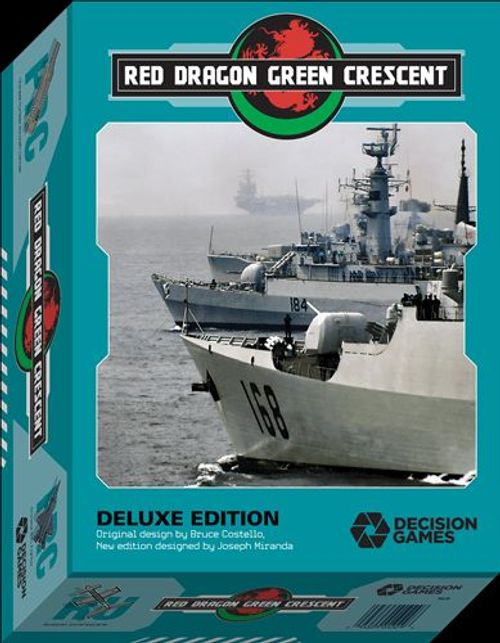
Red Dragon / Green Crescent
Red Dragon / Green Crescent Rulebook
Table of Contents
Table of Contents
- 1.0 Introduction
- 2.0 Components
- 3.0 Set-Up, Control & Intervention
- 4.0 How to Win
- 5.0 Sequence of Play
- 6.0 Random Events
- 7.0 Stacking, Mobility Restrictions & Bases
- 8.0 Operations (Ops)
- 9.0 Movement
- 10.0 Combat
- 11.0 Abstracted Wars
- 12.0 Hyperwar Combat (Optional)
- 13.0 Red Dragon Rising Scenario
- 14.0 Green Crescent Scenarios (General)
- 15.0 Green Crescent Scenarios
- 16.0 Red Dragon Green Crescent Combined Game
- 17.0 Tournament Rules (Optional)
- 18.0 Optional Counters
- 19.0 Scenario Variants
- Errata (January 2025)
1.0 Introduction
Note: These rules use the following color system: Red for important notes such as exceptions or errata, Blue for examples of play, Green for designer notes. Check for e-rules updates to this game at www.decisiongames.com
1.1 Background
Red Dragon Green Crescent (RDGC) Deluxe is a strategic-level conflict simulation of hypothetical future conflicts in and around East Asia, the Indian Ocean, and the Middle East. The time frame is the not-too-distant future, roughly between 2024 and 2035. The game system is based on the proven CSR Award Winning design, Red Dragon Rising (from S&T Magazine #250) and its sequel, Red Dragon Green Crescent (from Modern War #1), as well as variants which were published along the way. RDGC Deluxe is adaptable for two players, multi-player, and solitaire play.
This edition of RDGC Deluxe accounts for developments in the strategic situation since the original games were published. The People's Republic of China (PRC) has in recent years established bases (or at least basing rights) throughout the Indian Ocean. Russia is engaged in a war in Ukraine. The 2021 Taliban victory in Afghanistan shifted the perception of the power of the United States and its Coalition partners.
All around, the powers are bringing online advanced weapons systems and new tactics. This is modeled with two general time frames for the scenarios, one set in the 2020s and the other in the 2030s.
A critical consideration is the change in the global balance of power. China relies extensively on open seas to import petroleum and other strategic materials. But the rise of the Shanghai Cooperation Organization (China, Russia, and several Central Asian States) and the Russian-led Eurasian Union has created a new power bloc which has the potential to dominate the Eurasian landmass. In the current game, the PRC has expanded its bases in the Indian Ocean region and has more forces deployed there than in the original versions of this game.
At the same time, the United States, and its allies, including the North Atlantic Treaty Organization (NATO), deploy considerable naval power. Thus, much of the game pits Chinese, and potentially Russian air and naval power, in situations where they can gain local superiority against the Coalition which is operating at long ranges from their home bases, though with numerous forward bases.
The combat factors assigned to the units represent their inherent combat power as well as their usual support. For example, an aircraft carrier would include escorting destroyers, while the larger ground units include close air support not otherwise modeled in the game.
There are numerous question marks raised by the game. Would Pakistan stand idly by if India allied with the US, given the existential threat they perceive of a US-Indian victory in a general war with China? And if Iran were to ever make a move to create dominance in the Persian Gulf, what better time than while its primary adversary, the United States, is embroiled in a full-on war with China? There are also conflicts on the Arabian Peninsula and the wider Middle East. Finally, there is the war in Ukraine, commencing in February 2022 and with implications which are still to be seen.
The main emphasis in the game is on naval and aerial operations. Ground forces are included only insofar as they impact on the fight for naval bases and certain strategic targets, such as Taiwan and the Persian Gulf littoral.
The game has only limited use of weapons of mass destruction. Too much use would have military and political implications beyond the scope of this game.
And finally, the collective totality of the combined East Asia/India/Middle East regions makes for potent new gaming situations. We have tried our best to bring all of this to you, and we think you will find this situation quite challenging to game, whichever side you take. Besides the main scenarios, there are numerous variants and options, adding new dimensions. Players are encouraged to develop their own scenarios for RDGC Deluxe using their own data and exploring possibilities for contingencies.
1.2 Game Scales
Ship units mostly represent mission-oriented groupings of units such as SAG's (surface air groups), SUBRON (submarine squadrons), and individual capital ships (like aircraft carriers). Amphibious units represent task forces built around landing ships and their escorts. There are also some specialized naval types.
Most of the ground units in RDGC Deluxe represent brigades or similar groupings of forces ("Brigade Combat Teams", or "BCT" for the US). There are some larger divisions and corps.
Aircraft units are mostly represented by mixed-type combat wing formations, though only one aircraft type is shown on each counter. Long range bombers (strategic) have their own mono-type units that can't combine operations with short range (tactical) air wings in the game.
Designer's Note: There are such things as aerial refueling for tactical aircraft, but within the context of the game, the range represents the local area of operations.
1.3 Operations
The central game system is based around discrete Operations (Ops), usually involving movement and combat for individual units or stacks of units.
1.4 No Fog of War
In this game, given the vast array of intelligence and technological assets both sides would have available, there is no fog of war. Both players are always free to examine all the units on the map, stacked and not stacked, friendly, enemy, and neutral.
Exceptions: the enemy Reinforcement Pool and the optional Hyperwar markers, which once drawn, are placed face down by the owning player, and out of sight of the opponent, until used.
Important: There are no "zones of control" as in many other wargames.
1.5 Tips if You Already Know Red Dragon Rising & Red Dragon Green Crescent
There are many changes from the previous games, some obvious and some subtle. You should read the current rules in their entirety and note new rules and changes. Note the Sequence of Play in Section 5.0 and the sections on Random Events, Operations (Ops), Movement, and Combat in Sections 6.0 through 10.0. Furthermore, review all Ops, Random Events, and Variants for changes from the earlier editions. The Stealth and NLOS rules are now combined into a single Stealth rule (10.7). Section 12.0 is an optional rule called Hyperwar Combat, which adds some new dimensions to play.
Important: See Sections 13.0-16.0 for Scenario specific rules.
1.6 Optional Rules & Player Agreement on Use
There are several optional rules, Ops, and units included in RDGC Deluxe. In games with two or more players, all players must agree to the use of any specific optional rules, or they cannot be used.
1.7 Player Side Terminology
RDGC Deluxe is a two-player game. The two player sides are:
- Eurasian: People's Republic of China (China/PRC), Russia, and their allies.
- Coalition: United States of America (US) and its allies.
Other powers are also involved, and some scenarios will include those powers while others will not. Nonetheless, the two superpowers in the game remain the United States of America (US) and the People's Republic of China (China/PRC).
- Friendly units are all counters controlled by the player.
- Enemy units are all counters controlled by the opposing player.
- Neutral units are all counters controlled by neither player.
- Allied refers to units and nations that are active Belligerents controlled by one or the other player (Example: Iran joins the Eurasian side. Therefore, Iran is controlled by and allied with the other Eurasian countries).
Important: When the term Eurasian is used, it refers to all Eurasian-controlled units (China (PRC) and its active allies). When the term Coalition is used, it refers to all Coalition-controlled units (US and its active allies). Otherwise, rules may refer to specific nations. For example, PRC would refer to all China forces but not to other Eurasian allies.
2.0 Components
This game includes: two rules booklets; two 22x34-inch mounted game boards; 528 5/8-inch die-cut counters (3 sheets); 5 player aid cards (PACs); 2 note pads; 3 six-sided dice; storage bags.
2.1 Game Map
The game map consists of two sections, the Indian Ocean Map area (Map A--west map section) and the Pacific Ocean Map area (Map B--east map section).
- The game map is drawn to emphasize the strategically critical Sea Zones and Land Areas on and near the Asian land mass.
- The game has scenarios that can either be played separately on one map section or the other, or the map sections may be played as one for the Red Dragon Green Crescent Combined Game.
- Every unit in play on the game map can be in only one Sea Zone, Land Area, or Off-Map Display at any one time.
- The game map has a Terrain Key showing the stacking limit for certain areas (7.0).
- Areas marked Unplayable are off limits to units of both sides.
2.1.1 Zones, Areas
- Sea Zones (or Zones): Generally, only naval and air units can enter Zones. Ground units can enter via Sea moves or Amphibious (Amph) transport.
- Land Areas (or Areas): Generally, only ground and air units can enter Areas. Naval units can conduct coastal operations via the Astride rule (9.5).
- Coastal Base Enclaves: These are treated as Land Areas with limited stacking (Examples: Djibouti, Bandar Abbas, Gwadar).
- Large Islands: These are treated as Land Areas with unlimited stacking. (Examples: Sri Lanka, Taiwan, Sakhalin). Such areas have outlines which follow their coastlines.
- Small Islands: These are treated as Land Areas but with stacking limits (Examples: Diego Garcia, Spratly Islands, see 7.0). Such areas are delineated by circles. While they may have sea colors within them, the land is considered for game purposes to fill the entire circle.
- Certain Small Islands have a solid line circle around them (Examples: Spratly Islands, Okinawa, Singapore). These are at the junctions of various Sea Zones and thus block naval movement across them unless using Skip Moves (9.3).
- Other Small Islands have a dotted line circle around them. These do not block naval movement. (Examples: Diego Garcia, Marianas).
- Singapore is a Land Area adjacent to West Malaysia, though otherwise treated as a Small Island. It blocks naval movement directly across it (9.3).
2.1.2 Map B Geographic Peculiarities
- Mainland China is defined as the North, Central, and South China areas. It does not include the island of Taiwan which is not considered part of China for game purposes, even if it comes under Eurasian control.
- Hainan Island (in the South China Sea) is considered part of the South China Land Area.
- Okinawa is not part of Japan (for game purposes). It starts Coalition-controlled.
- Guam and Saipan are considered one island Land Area (the Marianas Islands).
- The four Japanese home islands (Kyushu, Honshu, Shikoku, Hokkaido) are separated by water. Ground units must use naval or air transport to move between them.
- Sakhalin Island is part of Russia. Units can move to and from it via air and sea transport and re-basing Ops.
2.1.3 Map A Geographic Peculiarities
- The following enclaves are Eurasian bases in the Standard scenarios: Djibouti (Horn of Africa), Gwadar (Pakistan), and Chittagong (Bangladesh). These are separate areas from the surrounding countries.
- Iran includes both Iran proper and Bandar Abbas. Bandar Abbas is a separate base area within Iran proper, but still counts as Iranian territory. Units can move from Bandar Abbas to Iran Proper and vice versa (if otherwise qualified to do so).
2.1.4 Playable Areas
- Units of a particular nation can always be placed in or enter areas of their own country (Example: Taiwanese units in Taiwan).
- Units of allies of a particular nation can also be placed in or enter areas of allied countries unless otherwise stated (Example: US units in Taiwan).
- Areas that have an Invadable icon are those in which enemy units can make landings via ground movement (Op G-1), or airborne/airmobile/amphibious assault (Ops G-6, G-7, J-2). Otherwise, enemy units cannot enter them. The area can be invaded from any adjacent Sea Zone or Land Area, regardless of where the symbol is placed.
Examples:
-
PRC units could invade Taiwan across the Taiwan Strait, not just the East China Sea (where the symbol is located).
-
An Indian Marine brigade could not enter the Sind area of Pakistan; it could invade Gwadar.
-
If Indonesia were a Coalition ally, Coalition units could set up and move into all five of its large islands, but Eurasian units could only invade Sumatra, Borneo, East Indonesia, and Celebes.
-
Once a player has gained control of an Invadable area, they can move units in via Airlift (Ops G-4, G-5) and Sea Transport (Op G-8).
-
Naval and air units can always attack into enemy areas (unless otherwise prohibited).
-
All naval, air and At Sea ground units can enter all Sea Zones (unless marked as Unplayable).
-
Units can never enter areas or zones marked Unplayable.
-
Units cannot enter or attack into areas of Neutral countries unless declaring an Intervention (3.3).
-
See Section 7.0 for numerous special cases.
2.1.5 Coalition & Eurasian Off-Map Base Displays
- US & Allies Off-Map Bases Display (Map B): Is considered a combined ground area and sea zone that directly borders the Sea Zones along the entire east edge of Map B.
- Coalition NATO Off-Map Bases Display (Map A): Is considered a combined ground area and sea zone that directly borders the Gulf of Aden Sea Zone along the west edge of Map A. It is also connected to the Africa Transit Display.
- Coalition NATO Africa Transit Display (Map A): Is considered a combined ground area and sea zone that directly borders the Horn of Africa Sea Zone along the west edge of Map A. It is also connected to the NATO Off-Map Bases Display.
- Eurasian Off-Map Bases Display (Map B): Is considered a ground area that directly borders the west edge of Map B; and in some scenarios, the north edge of Map A. This display is considered as a base area with unlimited stacking. All types of friendly units can occupy them. It is used for units which are in play but not on the actual map. This includes Hypersonic Weapons (10.11).
- Eurasian Indian Ocean Base Control Index (PAC #1): Place the Eurasian Indian Ocean Bases marker on this index to record the number of such bases that are Eurasian controlled.
- Eurasian Victory Point (VP) Index (PAC #1): Place the VP Index marker on this index to record the number of current Eurasian Player victory points accrued.
- Ops Cycle Log (Pad #1): Can make copies to use during games to keep track of Ops and Random Events played, along with game play notes.
- Ops/Turn Record Track (PAC #1): Place the Turn marker on this index to keep track of the Ops/Turns completed.
- Random Events Table (Pad #2): Used to roll for the possibility of Random Events. A reference copy is also printed on the back of PAC #3.
- Korean War Resolution Table (See 11.1.3): A player who initiates the Korean War Resolution operation (Op I-3) uses this table to resolve a Korean War.
- Indo-Pakistani War Table (see 11.2.4): A player initiating Op I-4 (Resolve Indo-Pakistani War) uses this table to resolve the war.
Important: Friendly Off-Map Bases Displays cannot be entered or attacked by enemy forces.
2.1.6 Other Displays & Charts
- Coalition & Eurasian Eliminated/Withdrawn Units Displays (Map A): Coalition and Eurasian players place friendly units which have been eliminated in combat in their respective Eliminated Units Display and units which have been removed from the map for reasons other than combat (such as Random Events) in their Withdrawn Units Display.
- Markers Displays (Maps A & B): The Coalition and Eurasian players can use either of the two displays to hold various game markers.
- Indo-Pakistani War Display (Map A): Players can place controlled Indian and Pakistani air units in the display to provide die roll modifiers to the Indo-Pakistani War Table (11.2.4).
- Korean War Display (Map B): This Display serves as a holding box for forces in North and South Korea (11.1.8).
- Area of Operations Chart (PAC #5): Shows which areas in which various forces may operate.
2.2 Counters
The cardboard counters in the game represent:
- Combat Units (or Units): Various groupings of land, sea, aerial combat forces.
- Markers: Representing various informational and administrative mnemonics.
2.3 Combat Units
All combat units of all types display at least seven (and sometimes more) types of printed information. Those data points are always arranged using the same pattern on all the units. (Counter diagrams show: Nationality; Unit Size and Unit Type Symbol for ground units; Ship Type and Naval Category Symbol for naval units; Aircraft Type for air units; Anti-Ground, Anti-Air, Anti-Sub and Anti-Surface Factors; and Stealth and Long-Range indicators.)
2.3.1 Nationality, Background Colors & Abbreviations
Each unit's nationality, and therefore the side to which it potentially belongs during play, is shown by its background color and a two or three letter abbreviation.
- Many nations start the game as Neutrals but may enter the war as play progresses.
- Scenarios will provide instructions as to which player controls which Nationalities, and which Nationalities will be Neutrals.
Nationality Abbreviations:
- ASEAN: Association of Southeast Asian Nations
- AUS: Australia
- BGL: Bangladesh
- IDS: Indonesia
- IND: India
- IRN: Iran
- ISR: Israel
- JPN: Japan
- MLY: Malaysia
- MYN: Myanmar
- NATO: North Atlantic Treaty Organization
- NK: North Korea
- PKN: Pakistan
- PHL: Philippines
- PMC: Private Military Contractors
- PRC: People's Republic of China
- PSF: Peninsula Shield Forces (Gulf Arab States)
- RU: Russia
- SK: South Korea
- SNG: Singapore
- SRL: Sri Lanka
- THL: Thailand
- TWN: Taiwan
- US: United States
- VN: Vietnam
- VNSA: Violent Non-State Actor Forces
- YE: Yemen
Important: A major change with this game edition is that the British, French, and Italian units are combined into a single NATO force. Another is that the various Persian Gulf units are combined into the Peninsula Shield Force (PSF). These changes model a variety of command control and logistical factors.
2.3.2 Counter Data-Point Abbreviations
- 6GF: Sixth Generation Fighter
- ASM: Anti-Shipping Missiles
- EKRA: Wing-In Ekranoplane
- HAL AMCA: Hindustan Aeronautics Limited--Advanced Medium Combat Aircraft
- HS: Hypersonic
- LR: Long Range (a bomber-type of aircraft; requires a distinct Op to activate).
- OPT (on backs): Optional units, use with Variants rule or player scenarios.
- SAM: Surface to Air Missiles
- SSM: Surface to Surface Missiles
- Stealth: A type of aircraft, ship, or ground unit with special capabilities.
- Static: A stationary unit, cannot move.
- 2020 (on backs): Unit is used only in the 2020s scenario.
- 2030 (on backs): Unit is used only in the 2030s scenario.
Naval Unit Category icons: Surface Ship; Amphibious (Amph) Surface Ship; Submarine.
2.3.3 Naval Unit Ship-Type Abbreviations & Notes
Ship units, in addition to their identifying illustrations, are also printed with letter-abbreviations of their types. Those abbreviations are as follows:
- ACF: Air Cushion Vehicle Flotilla
- BBG: Battleship with guided missiles
- CBG: Carrier Battle Group
- CG/CGN: Guided Missile Cruiser (conventional or nuclear powered).
- CGBD: Guided Missile Cruiser with anti-ballistic missile defense systems
- CGX: Guided Missile Cruiser armed with rail guns, lasers, and other advanced weapons
- CV: Carrier
- CVD: Light Carrier equipped with drone air and underwater craft.
- CVG: Hybrid Carrier Cruiser
- CVL: Light Aircraft Carrier
- CVN: Nuclear-powered Aircraft Carrier
- CVX: Future Aircraft Carrier
- DDX: Future Destroyer
- FAC: Fast Attack Craft (static)
- LCS: Littoral Combat Ship (amphibious type)
- LS: Landing Ships (various amphibious types: LHD, LSD, LST)
- MW: Mine Warfare
- SAG: Surface Action Group
- SS: Diesel-powered Submarine
- SSGN: Nuclear-powered Cruise-Missile Submarine
- SSN: Nuclear-powered Submarine
- SSND: Nuclear-powered Submarine (armed with undersea drone swarms)
- SSX: Future Stealthy Submarine
- XSB: Expeditionary Sea Base (amphibious type)
- XSG: Expeditionary Sea Group (amphibious type)
2.3.4 Aircraft-Type Abbreviations & Information
Aircraft units, in addition to their identifying icons, also carry alpha-numeric abbreviations of their predominant types, such as B-2, F-35, Su-27, etc. Short Range (SR) and Long Range (LR) aircraft have different Ops.
2.3.5 Ground Unit Types
The ground unit types in the game are identified by NATO-style symbols.
Important: Ground units are broken into two broad categories: Heavy and Light. This characterization is important in terms of the transportability, by sea and/or air, of each ground unit.
Designer's Note: The ground forces in the game represent those which could be used for power projection in a largely aero-naval campaign. For example, the vast number of formations in the Chinese People's Liberation Army are not portrayed insofar as they are factored into the prohibition on Coalition units invading mainland China. Static corps units represent home defense armies for playable areas. Mobile corps units are actually divisional sized groupings of brigades.
Heavy Ground Units (Armor, Mechanized, Combined Arms, Mechanized Marines, Surface to Air Missiles (SAM)):
- Can move to sea only when transported by an Amphibious class naval unit (Ops G-9, J-2).
- Have limitations on Airlift (Op G-4).
Light Ground Units (Marines, Infantry, Air Assault (or Airmobile), Airborne Infantry, High Tech/Rapid Deployment, Special Forces (Airborne), Special Forces (Non-Airborne), Surface to Surface Missiles (SSM), Anti-Shipping Missiles (ASM)).
Important: Light brigade sized units can use At Sea movement without an Amph (see reverse of counter), and use Airlift (Op G-4).
Special Capability Units:
Important: Airborne, Air Assault, and Special Ops (Special Forces) Units may conduct certain Airborne Moves (Ops G-6, G-7).
Ground Unit Abbreviations (for informational purposes):
- BTMC: Borneo Territorial Military Command
- CTMC: Celebes Territorial Military Command
- CJTFA: Combined Joint Task Force Airborne
- CRRF: Collective Rapid Reaction Force
- FLW: Future Land Warfare
- IRGC: Iranian Revolutionary Guard Corps
- MLR: Marine Littoral Regiments
- PMC: Private Military Contractor
- SC: Strike Corps
- STMC: Sumatra Territorial Military Command
- Stryker: Stryker Brigade Combat Team
- VDV: Vozdushno-Desantnye Voyska (Air Assault Troops)
- VNSA: Violent Non-State Actors (assorted warlords, insurgents, cartels, et alia)
2.3.6 Ground Unit Sizes
There are four sizes of ground units in the game. These sizes are used with the rules for transport and stacking, listed as follows:
- III: Regimental Combat Team (brigade size)
- X: Brigade
- XX: Division
- XXX: Corps
Important: Mobile corps are divisional-sized groupings of brigades, such as the PRC airborne.
2.3.7 Naval Units, Submarines & Surface Ships
There are two broad categories of Naval Units in the game: Submarines and Surface Ships.
- If a rule refers to Naval Units, it applies to both Submarines and Surface ships.
- If a rule refers to Submarines it applies only to SS, SSN, SSX and SSGN units.
- If a rule refers to Surface Ships it refers to all non-Submarine types.
Carrier Units: Aircraft Carrier naval units are a subset of Surface Ships.
- These include CBG, CVL, CVN, CVX, CVD.
- Carrier units are additionally identified by having either the word Carrier on their reverse side, or a reduced step.
- CVN and CVX Carriers are the only naval units with a second step.
- See Op N-6 (Launch a Ranged Carrier Air Strike) for particular capabilities.
Amphibious (Amph) Units: Amphibious naval units are a subset of Surface Ships. These include LS, LCS and XSG.
2.3.8 Combat Factors
Each unit in the game is printed with four combat factors.
- Anti-Ground (upper left, red text in white box)
- Anti-Air (upper right, black text)
- Anti-Submarine (lower left, black text in white box)
- Anti-Surface Naval (lower right, black text)
Important: The red Anti-Ground factor and white boxes around the Anti-Ground and Anti-Submarine factors are visual cues. They have no other impact on combat.
Important: The units' various combat factors are hit numbers. A player conducts combat fire by rolling one die and if the result is less than or equal to the firing unit's combat factor, one enemy unit takes a hit (10.2).
Important: If any of a given unit's combat factors is zero (0), that unit cannot fire at that kind of target.
Examples:
- A submarine with an anti-surface naval combat factor of 3 fires on an enemy surface ship unit. A die roll of 1, 2, or 3 would inflict one hit, while a 4 or higher would have no effect.
- A submarine with an anti-aircraft combat factor of zero may never fire at enemy aircraft units. That doesn't mean the opposite is true. For example, a submarine with an anti-aircraft combat factor of zero could certainly be fired upon by enemy aircraft that had an anti-submarine combat factor of 1 or more.
Important: See 10.0 for unit special combat abilities.
2.3.9 Step Strength
A step is the overall ability of a given unit to absorb combat losses (a hit in game terms) prior to being eliminated from play. In this game most of the combat units are one-step units.
- One-step units: Units with their combat factors printed on just one side of their counter require only one hit to be permanently eliminated from play.
- Two-step units: When a two-step unit suffers a hit in combat, it is flipped over so its reduced side faces up. If a reduced unit takes another hit in combat, it's immediately eliminated, placed in the dead pile, and out of play.
Important: Certain reduced (damaged) two-step units may be refit/repaired back to full two-step strength during a game (see Ops L-3, L-4). One-step units cannot be refitted/repaired but can in some cases be replaced if eliminated (Ops L-5, L-6, L-7).
2.3.10 Carrier-Based Aircraft
All the aircraft units in the game are land-based. The aircraft aboard aircraft carriers are built into those ships' combat factors. Generally, carriers function as other naval units but they can also conduct the Op N-6 (Launch a Ranged Carrier Air Strike). Note that carriers are surface naval units, not air units.
2.3.11 Stealth Units
Various units in the game are identified as stealthy (STL).
2.3.12 Static Units
Certain ground and naval units are Static. Once placed on the map, they can never move nor be transported (except if eliminated to go into the dead pile).
Examples: Singaporean, Malaysian, Philippine, Yemeni, and most Taiwanese ground units. The Iranian FAC naval unit. (See 7.9 for restrictions).
Important: All other units are considered Mobile and thus can use various Movement Ops.
2.3.13 Hypersonic Weapons
Players have Hypersonic Weapons available. The number of Hypersonic Weapon counters they receive are variable and depends on the scenario. Players may launch a Hypersonic Weapon Strike using Op A-6 (10.11).
2.4 Markers
In addition to the combat units described above, the counter-mix also includes memory aid markers. Those markers are as follows:
- Turn (front & back): Records the current turn of play on the Ops/Turn Record Track.
- Victory Point (VP) (front & back): Records VP on the Victory Point index.
- Eurasian Indian Ocean Bases: Indicates on the Eurasian Indian Ocean Base Control Index the number of bases currently controlled by the Eurasian player.
- Bases: These markers are for mnemonic purposes. There is one set for the Eurasian player and another set for the Coalition player.
- Control (front & back): Indicate control of areas (where not otherwise obvious).
- National Status (front & back): Indicate if a nation is Neutral or a Belligerent.
- Naval Minefields (front & back): Function as quasi-units.
- Nuclear Strike: Used with optional rule 18.19; players can also use them to create their own optional rules.
- Hyperwar Markers: Hyperwar markers are used with the optional rule Hyperwar Combat (12.0). Markers are picked by implementing Op X-1.
- Random Events & Variants: Used as mnemonics for various Random Events or with Variant scenarios. Players may use as they best see fit.
2.5 Random Events
Random Events introduce variable and unexpected military, political and economic situations into the game. Each Random Event has the following information (see 6.0):
- Game Code:
- RD: Red Dragon Rising scenarios.
- GC: Green Crescent scenarios.
- RDGC: Red Dragon Rising and Green Crescent scenarios.
- Event #
- Title
- (Duplication #): If there is more than one chance of the same Event occurring.
- Explanation
- Disposition: Remove, Remains, Available, or Reset
Sample Random Event: Event GC.13: Petrodollar Crisis. Eurasian side gains 1 VP per Gulf Arab State controlled by Eurasian units. Remove.
2.6 Do or Die
Die Roll Modifiers (DRM): A DRM is a number or numbers added to or subtracted from a rolled die result (Example: a +1 DRM would convert a result of 3 to a 4. A -1 DRM would convert a 3 to a 2).
- In all cases, a die roll of 1 remains a 1, regardless of any modifiers.
- A die roll of greater than 6 is treated as a 6.
- Unless otherwise stated, all die roll modifiers are cumulative. (See the Combat rules and various Random Events.)
2.7 Reinforcement Pools
Each player will need one large-mouth opaque container, such as a coffee mug or ammo can for units forming their Reinforcement Pool. The units in that container constitute that side's Reinforcement Pool (see Scenarios).
- When directed by an Op or other Random Event, the player draws at random the designated number of units from their pool. Place them per the scenario set-up instructions.
- A reinforcement unit cannot perform any other action as part of being placed (deployed) on the map. Thereafter, it can perform actions normally.
- In the event that the player draws a unit from a nation which is a Neutral power, place that unit aside and pick a substitute.
2.8 Rules Precedence
Special rules in Scenarios, Random Events, Variants, and Optional rules may supersede the standard rules.
3.0 Set-Up, Control & Intervention
3.1 Set-Up Order
Players select a scenario (13.0, 14.0, 15.0, 16.0) and any Variants. In general, the Coalition side sets up first and the Eurasian side sets up second. Each scenario specifies the particular set-up of the various game pieces. Exceptions may be noted in scenarios.
3.2 Control
Control of a Zone or Area means your forces have a presence in a Zone or Area.
3.2.1 Land Areas
An area can be in one of several different states of Control. Control of the various Land Areas on the map has bearing on determining the winner of the game (4.0), as well as determining which side's forces can make use of the base facilities (if any) located within them (7.6).
3.2.2 Control States
Each Land Area on the map is always in one of the following control states:
- Controlled by the Coalition side
- Controlled by the Eurasian side
- Contested
- Uncontrolled
3.2.3 Control State Determination
- A player controls a Land Area if their side has ground units (any type) in it and there are no enemy units in it.
- An area is contested if both sides simultaneously have one or more ground units there.
- An area is uncontrolled if neither side has friendly ground units in it.
- See Home Countries (below) for special cases.
3.2.4 Boots on the Ground
The control status of a given Land Area may switch back and forth between the two sides as units enter and exit it (via movement, combat, whatever), any number of times during play.
3.2.5 Sea Zones
The Sea Zones on the map are generally never controlled by either player, regardless of the presence of units. It's possible for units of both sides to be located in the same Sea Zone(s) at the same time, and to move through each other.
3.2.6 Persian Gulf
The Persian Gulf is a special case. If one side has naval units in the Persian Gulf and the other has no naval units in it, then the side with naval units controls the Persian Gulf (per above). Control of the Persian Gulf affects certain Random Events and victory conditions.
3.2.7 Neutrality
Neutral units do not contest or control an area or zone. Also, if a country is a Neutral, its Land Areas are not controlled by either side. Sea Zones adjacent to a Neutral Land Area are still in play.
Example: US naval units are in the Persian Gulf as well as Neutral Iranians. The Persian Gulf is Coalition-controlled.
3.2.8 Home Countries
The following areas are always controlled by the player controlling that country. No garrison is needed nor can the enemy control these areas:
- Russia (mainland but not Sakhalin)
- China (Northern, Central, Southern)
- Japan (Kyushu, Shikoku, Honshu, Hokkaido)
- Java (but not other Indonesian islands)
- Vietnam
- Thailand
- Myanmar
- Bangladesh (but not Chittagong)
- India (Kolkata, Mumbai, Karwar, Madras)
- Pakistan (Sind, Baluchistan, but not Gwadar)
- Iran Proper (but not Bandar Abbas)
3.2.9 Unplayable Areas
Areas marked Unplayable are never controlled by either player. Units can never enter or attack into them.
3.2.10 Off-Map Displays
The US and NATO Displays are always Coalition controlled. There is no need to garrison them.
3.3 Neutrals & Belligerency
The territory and units of Neutral nations are not in play until some Op or Random Event ends their neutrality; at which point they become Belligerents (Ops I-1, I-5).
3.3.1 Interventions
Intervention is a term for bringing a Neutral country into belligerency via military invasion (per below). An Intervention is conducted by declaring any action that would result in friendly units entering or attacking into a Land Area of a Neutral. Once this occurs, that country then becomes a Belligerent, allied with the player opposing the intervening side.
- An Intervention may cause an immediate and one time change in the VP index. These changes are listed in the scenarios.
- The intervention can be the result of a movement (any type) or attack by any type of unit (naval, air, ground).
Example: Indonesia starts a scenario as a Neutral. PRC units conduct an amphibious invasion of Borneo so Indonesia becomes a Coalition ally.
Generally, both sides can Intervene (invade) against any Neutral. Following are exceptions:
- Eurasians: Cannot invade North Korea or Iran. These nations can be brought in as allies (see Random Events and Ops). Further, the Eurasians cannot intervene into areas which are otherwise prohibited to them (Example: the Japanese Home Islands).
- Coalition: Cannot invade Japan, South Korea, The Philippines, Singapore, Malaysia, Thailand. These nations can be brought in as allies (see Random Events and Ops). Further, the Coalition cannot intervene into areas which are otherwise prohibited to them (Example: Iran proper).
Example: Coalition forces cannot invade Iran Proper; they could invade Bandar Abbas thereby making Iran a Eurasian ally.
Forces can enter areas of nations that begin a scenario as enemy allied, which become an enemy ally during play, and which are on the friendly side.
Example: Iran starts as a Eurasian ally, so a Coalition attack on Bandar Abbas would not count as an Intervention--Iran is already in the game.
Important: See also Joint Operations Op J-5 (Hybrid Operation) and Op J-6 (Shock and Awe).
Designer's Note: This edition of the game lifts some of the original's restrictions on invasions (Interventions) owing to vast changes in the global political-military situation.
3.3.2 New Belligerents
If a Neutral becomes a Belligerent, all its Land Areas, bases and armed forces immediately and permanently join the friendly side.
- Once a Belligerent, countries revert to Neutrality only via certain Random Events.
- Countries that either start the game allied with one side and which are subsequently out of the game due to a Random Event may not be brought back into the game later.
- Scenarios will designate which nations are Neutrals and which are Belligerents at the start of play.
3.3.3 Random Events & Belligerency
Certain Random Events will make Neutrals an ally of one player or the other (6.0).
- In this case, the player now controlling that new Belligerent sets up its forces.
- Ground and air units must be set up in its Land Areas.
- Naval units must be set up in adjoining sea areas, or Astride that nation's coasts.
- Additionally, any bases in that country can be used by all allies of the controlling side.
3.3.4 Random Events & Return to Neutrality
Certain Random Events will convert a Belligerent back to Neutrality (6.0).
- In this case, the player last controlling that nation immediately picks up all land and air units of that nation outside of its home territories and places them back in their home areas.
- Redeploy all of that nation's naval units Astride their Land Areas or adjacent Sea Zones. Units already in home territories and adjoining Sea Zones remain in place.
- Once redeployed, these units cannot engage in Ops again.
- Additionally, any bases in that country can no longer be used by either side.
Important: See rule 7.0 for special cases.
3.3.5 Redeploying of Belligerent Land & Air Units Due to Neutrality
The player controlling the following nations picks up and place their ground and air units from a new Neutral's Land Areas as follows:
- US, NATO, Australian (Map B): US Off-Map Bases Display, Singapore, Okinawa, Marianas (if Coalition-controlled).
- US, NATO, Australian (Map A): NATO Off-Map Bases Display, Diego Garcia (if Coalition-controlled).
- Japanese: Japanese home islands.
- PRC: North, Central, South China.
- Russia: Russia (mainland).
- India: Any India areas.
Important: All other nations' ground and air units in newly Neutral areas are eliminated.
Designer's Note: The above powers can redeploy forces owing to their overall sea and airlift capabilities.
3.3.6 Redeploying Naval Units due to Neutrality
Belligerent naval units Astride a new Neutral's coast are placed in the adjacent Sea Zone. Otherwise, naval units (and units transported by them) are not affected.
3.3.7 Neutral Unit Operations
Neither player can conduct Ops with Neutral units. If Neutral units are in a zone or area, they are ignored for all purposes. Belligerent forces cannot attack Neutral units unless conducting an Intervention (3.3.1).
Example: Bangladesh is a Neutral. Eurasian and Coalition units could freely enter and move through the Bay of Bengal unaffected by the Bangladeshi naval unit. Further, if a Eurasian force attacked a Coalition force in the Bay of Bengal, the Bangladeshi naval unit would not participate, nor would it be affected by any outcomes of the combat.
3.3.8 Multiple Belligerencies
A country may go into or out of Belligerency multiple times in a game per the Random Events and scenario variants.
Designer's Note: Shifting from/to Belligerency and Neutrality represents a wide range of political and military actions not otherwise modeled in the game, such as diplomatic initiatives, economic downturns, and internal revolutions.
3.3.9 Pro-Eurasian & Pro-Coalition Neutral Nations
See Ops I-1 and I-5 for lists of Neutral nations and how players can bring them into belligerency.
4.0 How to Win
Conditions for winning the various game scenarios are explained in each separate scenario.
4.1 Victory Point Index
The Victory Point (VP) Index is located on a PAC.
- Record the current VP by using the VP marker.
- VP are listed by the scenario. A +# means the Eurasian side gains the VP; add the number to the VP index. A -# means the Coalition side gains the VP; subtract the number from the VP index.
Example: A -2 means shift the VP Index two spaces in favor of the Coalition.
4.2 VP for Controlling or Contesting Areas
These VP are gained and lost immediately, based on control of areas.
- These VP are indicated in the scenarios by +/- numbers.
- Gain and loss of VP can happen any number of times in a scenario.
- VP do not accumulate but are retained until lost (They can be regained).
- Contesting control does not change VP.
Example: If Eurasian forces gain control of Taiwan, they would immediately score the VP for the island. If the Coalition were then to regain control of Taiwan, then the points would be lost. If there were both Eurasian and Coalition ground units on Taiwan, there would be no change in VP.
4.3 VP Received One Time
Certain VP are received only once but are permanently retained. These include VP for Random Events, winning the Korean and Indo-Pakistani Wars, and employing certain Ops.
- VP for eliminated units are for units removed from the map; simply reducing a full-strength two-step unit to its reduced side does not count for VP.
- These VP are indicated by +/- numbers.
- If a condition specifies "for two eliminated units" then the VP are scored when the second unit is eliminated.
4.4 Random Event VP
If a Remains Random Event generates a VP gain or loss, this is applied only upon the event initially going into effect, not on later turns.
4.5 VP Max & Minimum
- If VP go higher than +19, then the game ends and the Eurasian side wins a global level victory.
- If VP go lower than -19, then the game ends and the Coalition side wins a global level victory.
5.0 Sequence of Play
5.1 In General
RDGC Deluxe is played in a sequence of phases, the outline for which is given below. Each time Phase VI is completed, one turn (or Op Cycle) has passed. Play then reverts to Phase I, and the sequence begins again.
Repeat the sequence until one of the following occurs (whichever comes first):
- One player wins an automatic Sudden Death victory per 4.5 or the scenario rules.
- A Random Event forces an end to the scenario.
- The number of Ops designated by the scenario has been completed.
Important: The default game length is 30 turns (30 Eurasian Ops Completed) if not otherwise stated. An Ops/Turn Record Track as well as an Ops Cycle Log are provided for Ops/Turns tracking purposes.
5.2 Sequence of Play
Game Turn/Op Cycle
- Phase I: Eurasian (First player) Random Event Pre-Check (6.0).
- Phase II: Eurasian (First player) Random Event Resolution (if called for by the Phase I die roll (6.0)).
- Phase III: Eurasian (First player) Op(s).*
- Phase IV: Coalition (Second player) Random Event Pre-Check.
- Phase V: Coalition (Second player) Random Event Resolution (if called for by die roll).
- Phase VI: Coalition (Second player) Op(s).*
End of Turn/Op Cycle
*Important:
- When playing the Red Dragon Green Crescent Combined Game (5.4), a player can usually conduct one Op on each map section per turn, for a total of two Ops (one Op on each map section)
- In some situations, a player may be able to conduct two Ops in a row on one map because of a Random Event or Hyperwar marker providing for double Ops. In a combined map game, the second Op of a double Op may be conducted on the player's map of choice, either on the same map along with the standard Op or on the other map.
5.3 Completing an Op is Final
Once a step or a sub-routine with a given step has been completed by a player, no portion of it may be taken back or in any way redone (unless his opponent graciously gives permission to do so). During the campaign game, Random Events can allow a player to conduct a second Op; do so as soon as the first Op is completed.
5.4 Red Dragon Green Crescent Combined Game Op Sequence
During the Red Dragon Green Crescent Combined Game, each player may perform one Op on each map section sequentially (unless modified by Random Event or certain Ops). After both of a player's Ops have been completed on one or both maps, the other player makes their Random Event Pre-Check.
6.0 Random Events
All Random Events are located on PACs #2-3.
Important: Players should read through the Random Events prior to playing as they will have considerable impact on play. In certain cases, having the right forces in the right place can radically alter the Random Event outcomes.
6.1 Random Events (General)
There are three categories of Random Events:
- RD: Used only in the Red Dragon Rising game and the Red Dragon Green Crescent Combined Game.
- GC: Used only in the Green Crescent game and the Red Dragon Green Crescent Combined Game.
- RDGC: Used in both the Red Dragon Rising and Green Crescent games, and the Red Dragon Green Crescent Combined Game.
Event markers are provided as mnemonics for several events. These should be placed on the map so both players can easily view them.
6.2 Random Event Pre-Checks
Each time a new Phase I is begun (5.2), the Eurasian player rolls for a Random Event with three dice, checks the results on the Random Events Table (2.1.6), and then executes the instructions for the Random Event in Phase II.
- After executing the instructions, dispose of the event as noted per its disposition instructions (6.3).
- Play then proceeds to Phase III (8.0).
Each time a new Phase IV is begun (5.2), the Coalition player rolls for a Random Event with three dice, checks the results on the Random Events Table (2.1.6), and then executes the instructions for the Random Event in Phase V.
- After executing the instructions, dispose of the event as noted per its disposition instructions (6.3).
- Play then proceeds to Phase VI (8.0).
A No Random Event result can be rolled on the Random Events Table, in which case no Random Event occurs from that pre-check.
When playing a one-map scenario, ignore any Random Event which would affect only the other map or units not involved in that scenario. Treat the result as a No Random Event.
Important: Certain Random Events are applied to either side regardless of the player who rolled for it. For example, even if the Coalition rolls the GC.14 Random Event: Chinese Resource Crisis, the Chinese are still affected by the Random Event.
6.3 Random Event Disposition
After the instructions on the Random Event have been implemented, implement the following per the Disposition instruction:
- Remove: Remove the Random Event from play. If rolled for again, treat the result as No Random Event.
- Remains: Keep note of the Random Event. Its effect applies for all remaining game turns. If rolled again, treat the result as a No Random Event.
- Available: The Random Event can be rolled for again.
- Reset: The Random Event RDGC.16 Random Event: Global Political/Morale Crisis results in a Reset, where all other Random Events with a Remove status can now be rolled for again.
Important: Event RDGC.16 is a special case and is the only Random Event situation where all Random Events with a Remove status are Reset.
6.4 Repeats
Most Random Events only have one chance of occurring. Other Random Events have multiple chances of their effects occurring.
6.5 Other Possible Events/Non-Events (Optional)
Players should feel free to create their own Random Events to add to any of the scenarios, or in designing their own new scenarios.
7.0 Stacking, Mobility Restrictions & Bases
A Force is defined as one group of units which are conducting an Operation (Op) together.
- At the start of the Op, designate which units will compose the force.
- In general, all such units must start in the same area or zone, and then move, attack or conduct some other designated action together.
7.1 Stacking in General
Stacking is the term used to describe the stacking (placing) of more than one friendly unit in the same Sea Zone or Land Area at the same time.
- In general, a player can stack an unlimited number of units in a Zone or Area (but see 7.2).
- Friendly and enemy stacks can be in the same area.
- Enemy units do not count against friendly stacking limits.
- Stacking together does not force combat.
7.2 Special Stacking
Certain small islands and coastal enclaves have a stacking limit printed next to them.
| Number on map | Friendly units allowed at one time |
|---|---|
| 3 (Example: Okinawa) | 3 ground units, 3 aircraft units, & 3 naval units (total of 9 units). |
| 1 (Example: Maldives) | 1 ground, 1 air, & 1 naval unit (total of 3). |
| None, Large islands (Example: Sakhalin) | Unlimited. |
- Mobile divisions and corps count as three units for stacking.
- Static ground units do not count for stacking. There can be multiple static units in the same area (Example: three Taiwanese static corps in Taiwan).
- If stacking limits are ever violated, the player controlling the over-stacked units immediately eliminates any excess to restore the limit.
7.3 Invading Restricted-Stacking Areas
The number of ground units which a player can use to launch an invasion (amphibious, airborne, air assault) of an island is limited to the ground stacking limit (Ops J-2, G-6, G-7).
Examples: One PRC corps or three PRC brigades could invade Okinawa. Three amphibious brigades could invade Okinawa or Ras Karma (Op J-2). Similarly, a maximum of one ground brigade could invade the Spratly Islands or the Seychelles.
- If a force is conducting an invasion of an island, you can do so with ground units up to the stacking limit. If the invasion force clears the defenders, then land the invading units on the island up to the stacking limits.
- There are no restrictions on the number of naval units that can support such invasions with their combat factors from adjacent Sea Zones (Op J-2), as there are no stacking limits in any Sea Zone.
- The number of air units which can support an invasion is limited to the normal air unit stacking limit--this is a function of the number of air units which can be launched from a base per Op A-3.
Important: Remember, air units that launch an attack must return to their start base, per Op A-3. They could only move to a captured base on an ensuing Op A-1
7.4 Unit Types & Stacking
In general, units belonging to all three major categories of units (ground, aircraft, and naval units) may potentially stack together in every Land Area and Sea Zone on the map. Limitations depend on the type of bases in the specific area. Friendly and enemy units can stack in the same area or zone. Enemy units do not affect the stacking limit for friendly units.
Example: Each player could have three land brigades in Bandar Abbas.
7.5 Interoperability
Interoperability is defined as units of two or more different contingents (nations) conducting the same Op together.
- All units on each side can be in the same area, regardless of interoperability. If attacked, they defend together.
Example: A Eurasian controlled PRC and Iranian unit are in the same area. The Eurasian player could not initiate a combined move and attack Op with them. However, if a Coalition force attacked them, PRC and Iranian units would both fire back.
- The Coalition side and all its allied contingent units can freely interoperate and activate together during the same Op.
- Eurasian side allies cannot interoperate. Exceptions are as noted elsewhere (7.9).
- Units which can interoperate can also transport each other per Amphibious Assault (Op J-2).
The units of the following nations can never interoperate with each other:
- India and Pakistan
- Iran and PSF (Gulf Arab States)
- Vietnam and China
Certain Nationality forces have limitations where they can move (7.9).
7.6 Bases
Certain Land Areas on the map are indicated as containing aero-naval basing facilities (or bases). When a player controls an area containing a base (per 3.2) they can use it for various game actions (such as basing air units).
- This includes bases which started under the player's control at the start of the scenario, and bases which are captured (by controlling the area).
- Captured (or recaptured) bases immediately become operational for game purposes.
- Bases are indestructible in game terms. Their control may change hands any number of times.
Important: Remember, to control certain bases a player must have a ground unit in the area. This can be any type of ground unit. Note that certain base areas start with a garrison-type unit. If the garrison is eliminated, it could be replaced with any type of friendly ground unit to maintain control. Other bases, such as those in mainland Russia, mainland China, the Japanese Home Islands, Vietnam, Java, India, Pakistan, and Iran proper, require no friendly ground unit for control.
7.7 Base Operations
Aircraft units may only operate from Land Areas containing friendly bases.
- US LR bombers operate from either the Coalition or NATO Off-Map Displays or Diego Garcia. They may conduct missions only on the map where they are currently based (8.2).
- PRC, Indian, Iranian, and Russian LR units may conduct missions only on the map where they are currently based (8.2).
- The Coalition player may airlift light ground units or re-base air units from friendly-controlled base area to base area, including to the other map (Op G-4).
- Damaged CVN units may only be repaired in (Astride) a friendly controlled Land Area with a base or in an Off-Map Display (Op L-3).
- A base in a contested area (3.2) is considered to still be under the control of (and therefore usable by) the player who controlled that area prior to the entry of the contesting enemy units.
- Air units may never be re-based into contested areas. (Use the Base markers as a mnemonic.)
- A player does not have to garrison bases in friendly areas which enemy ground units cannot enter (2.2.4 & 3.2.8). They are always friendly-controlled.
- The Coalition always controls the Coalition Off-Map Base Displays (2.1.5).
7.8 Restrictions on Mobility
7.8.1 Neutrality & Belligerency
See the scenarios for countries which start as Belligerents or as Neutrals (3.3). Interventions (3.3.1), Variants (19.0), and Random Events (6.0) can change Neutrality and Belligerency.
7.8.2 Land Areas (In General)
Units can enter all Land Areas which:
- Were originally friendly to their side.
- Were Neutrals but became friendly to their side.
- Are on the enemy side but have an Invadable icon (2.1).
Coalition ground units cannot enter or attack into Northern China, Central China or Southern China, or Russia (they are not Invadable). But Coalition naval units can move Astride and attack into these areas (within normal Ops restrictions). Also, Coalition air units can attack into mainland China and Russia.
Important: Units can never enter or attack areas marked Unplayable.
Designer's Note: The reason for restrictions on entering certain areas is owing to defensive forces not otherwise shown in the game. There are also various logistical and political reasons for these restrictions.
7.8.3 Sea Zones (in General)
Units can enter all Sea Zones except those marked Unplayable. See also any restrictions noted below.
7.8.4 Kyushu Strait
The Kyushu Strait is a chokepoint for all naval unit movement between the Sea of Japan and the North Pacific Ocean.
Naval units cannot move directly from the Sea of Japan into the North Pacific Ocean, or vice versa, unless Japan is a Belligerent (friendly or enemy). This rule does not affect Air Movement.
7.8.5 Spratly Islands
The Spratly Islands usually start scenarios as uncontrolled (unless a scenario or variant states otherwise). Both sides' forces can enter the Spratly Islands from the start of the game (without a Neutrality violation).
Designer's Note: The control of the Spratly Islands is today a matter of international dispute.
7.8.6 Philippines Straits
Naval units cannot move directly from the Sulu Sea Zone (adjacent to the Luzon and Leyte Land Areas) to the North or Central Philippine Sea Zones and vice versa unless the Philippines are a Belligerent (friendly or enemy). This rule does not affect Air Movement.
7.8.7 Strait of Malacca
Either side may move naval units from one map to the other via the Malacca Strait if Singapore is either friendly controlled, contested, or Neutral. They cannot move via the Strait if Singapore is enemy controlled. The Strait is printed across both maps but is one Sea Zone for all purposes.
7.8.8 Myanmar & the Andaman Sea
Myanmar is printed across both maps, but Myanmar is one Land Area, and the Andaman Sea south of Myanmar is one Sea Zone for all purposes.
7.9 National Restrictions
Area of Operations: Generally, units can operate in playable areas on the map. The term operate includes basing, movement, combat, and other Ops (within the general rules restrictions). Certain restrictions apply to some areas and nationalities as detailed below.
Important: See the Area of Operations Chart for details.
Special (Exceptional) Cases:
7.9.1 China (PRC)
- Chinese units can generally operate anywhere on both maps, with specific restrictions noted in the rules.
- Chinese and Russian units can combine in Ops with each other.
- Chinese units cannot otherwise interoperate with non-Russian units.
- Optional rules allow for additional areas of operations.
7.9.2 Russia
Russian units can operate on both maps, with the following restrictions:
- Aircraft units can base only in Russia (mainland and Sakhalin), the PRC, Ras Karma (if Yemen is a Eurasian ally), and Bandar Abbas (if Iran is a Eurasian ally).
- Russian naval units may only base in Russia (mainland and Sakhalin), Ras Karma (if Yemen is a Eurasian ally) and Bandar Abbas (if Iran is a Eurasian ally).
- Russian and PRC units can combine in Ops with each other.
- Russian and Iranian units can combine in Ops with each other.
- Russian units cannot otherwise interoperate with non-PRC, non-Russian units.
- Optional rules allow for additional areas of operations.
Designer's Note: This is a change to the prior iteration of the system owing to great cooperation between the PRC, Iranian, and Russian militaries.
7.9.3 North & South Korea
North and South Korean units cannot move or attack until the Korean War commences (11.1) or per the special case of the Korean Crisis Escalation event.
- Coalition units can never enter North Korea (other than as given below).
- Eurasian units can never enter South Korea (other than as given below).
- North Korean units cannot interoperate with other Eurasian units.
a) Operation of Korean Forces
Once the Korean War commences (Op I-2), Korean units can operate as follows:
- North Korean naval units can enter the Yellow Sea or Sea of Japan and conduct attacks from those Sea Zones.
- North Korean air units must base in North Korea. They can attack anywhere in range but must return to North Korea.
- South Korean naval units can move and attack anywhere on Map B. However, no more than one South Korean naval unit may end an Op outside of the Sea of Japan and Yellow Sea.
- South Korean air units must base in South Korea. They can attack anywhere in range but must return to South Korea.
- The South Korean Marine brigade may use At Sea (G-8), Amph (G-9, J-2) or Airlift (G-4) Ops. The brigade may move only to Okinawa or Taiwan and conduct operations in these areas.
- North and South Korean units may conduct Ops separately from the resolution of the 'big war' on the Korean peninsula (see section 11.1). Note that if the units are eliminated during such Ops, they cannot be counted for Korean War Resolution (11.1.3).
b) Non-Korean Forces in Korea
Prior to the start of a Korean War (11.1, Op I-2):
- PRC units may be moved to North Korea.
- PRC units in North Korea can attack Coalition naval units in the Yellow Sea and Sea of Japan but cannot attack into the South Korea Land Area.
- No other units can enter North Korea.
- US units may be moved to South Korea. US units in South Korea can attack Eurasian naval units in the Yellow Sea and Sea of Japan but cannot attack into the North Korea Land Area.
- No other units can enter South Korea.
Important: Once the Korean War has started, PRC and US units in Korea cannot conduct attacks (they can perform other Ops). This restriction is lifted when the Korean War ends (Op I-3).
Designer's Note: During the Korean War, both the PRC and US are too busy fighting on the peninsula.
Important: Neither side can use Ops to attack targets in North or South Korea prior to the outbreak of the Korean War or attack Korean units at sea.
7.9.4 Taiwan
- Taiwanese corps units are static.
- The Taiwanese Marines may move At Sea (Op G-8) or via Amph Ops (G-9, J-2) to Okinawa or the Spratly Islands.
- Taiwanese air and naval units may only operate in the Taiwan Strait and/or the East China Sea Zones and attack enemy units in Okinawa.
7.9.5 Japan
- Japanese units can move and attack anywhere on Map B.
- In scenarios where a Japanese unit starts on Map A, if that unit moves to Map B, it cannot return to Map A.
7.9.6 Philippines
- Philippine naval units can only operate in the six Sea Zones bordering their islands.
- Philippine corps units are static.
- The Philippine Marines brigade may move (via Amph, At Sea or Airlift Ops) from one Philippine island to another Philippine island, and conduct invasions on the islands (but not elsewhere).
- Philippine air units can only base in the Philippines.
7.9.7 Indonesia
- Indonesia usually starts Neutral.
- When Indonesia becomes a Belligerent, all units can enter Sumatra, East Indonesia, Borneo, and Celebes.
- Only Indonesian and friendly allied units can enter into Java.
- Enemy units cannot attack or enter Java.
- Indonesian mobile ground units may be transported (via Amph, At Sea, or Airlift Ops (G-9, J-2, G-8, G-4)) among all Indonesian territories (Java, Sumatra, Borneo, East Indonesia, Celebes).
- Indonesian naval units may operate in any of the eight Sea Zones adjacent to the Indonesian Land Areas.
- East Indonesia, the island chain east of Java (adjacent to the Banda Sea), is part of Indonesia and is treated as one playable separate Land Area. It has no starting units.
- East Malaysia (on Borneo) is part of Malaysia (see below).
Designer's Note: Java is too densely populated and too well defended to be invaded and occupied by enemy forces during a scenario.
7.9.8 Vietnam
- Vietnamese units may enter Sea Zones adjacent to Vietnam.
- The Marine unit may move to and from the Spratly Islands.
- If Vietnam is allied to a player, friendly allied air and naval units may use the Vietnamese base, but their ground units cannot enter Vietnam (the latter for political reasons).
7.9.9 Brunei
The country of Brunei (on the island of Borneo) is noted on the map but is treated as part of East Malaysia for all game purposes.
7.9.10 Singaporean & Malaysia
- The Singaporean corps is static.
- Singaporean naval units may operate in Singapore and/or any of the Sea Zones bordering Singapore or Malaysia.
- Singaporean air units may base in Singapore and fly missions per Air Ops.
- Malaysia consists of two areas: West Malaysia (the Peninsula) and East Malaysia (on Borneo).
- Malaysian corps units are static.
- Malaysian naval units may operate in Malaysia and/or any of the Sea Zones bordering Malaysia or Singapore.
- Malaysian air units may base in Malaysia or Singapore and fly missions per Air Ops.
- Singaporean and Malaysian units can interoperate.
Important: Any attack on Malaysia automatically brings Singapore into the war against that attacker, and vice versa.
7.9.11 Myanmar, Thailand & Bangladesh
- Units of these countries can base only within their respective Land Area and only operate there or in adjacent Sea Zones (to include islands within those zones).
- Myanmar ground units may move into the Andaman Islands and the Nicobar Islands (but nowhere else).
- Thai ground units may move into Malaysia and Singapore if those countries are friendly (but nowhere else).
- The Bangladesh naval unit can only be placed in the Bay of Bengal (and not move out of it).
- The Chittagong area is separate from Bangladesh. It starts as a PRC base.
7.9.12 Sri Lanka
- Sri Lanka may start as a base for one side or the other, depending on the scenario.
- If both India and Sri Lanka are Neutrals and one side invades Sri Lanka (see the Intervention rule, 3.3), India becomes an ally of the side opposing the invaders.
Designer's Note: Sri Lankan forces are represented by a static unit, mainly because of having to deal with an ongoing insurgency limiting their offensive abilities.
7.9.13 India
- Indian units can operate freely on Map A.
- On Map B, Indian units may move no further north than the South China Sea, Sulu Sea, and South Philippine Sea.
- Indian units cannot enter the Philippines.
- Only Indian units can enter the four Indian Land Areas (Kolkata, Mumbai, Karwar, Madras).
- Indian and Pakistani units can never interoperate.
7.9.14 Pakistan
- Pakistani naval, air and ground units are limited to operating on the Map A.
- Pakistani air units may only base in Pakistan.
- Only Pakistani units can enter the two Pakistani Land Areas (Sind, Baluchistan).
- US and NATO air and naval units can base in Baluchistan if Pakistan is a Coalition ally. US and NATO ground units cannot otherwise enter Sind or Baluchistan.
- The part of India northwest of Bangladesh is an extension of the Kolkata area. It does not have a seacoast.
- Pakistani and Indian units can never interoperate.
Important: India and Pakistan can simultaneously be Coalition allies only if Pakistan already is an ally, and any Indian islands are invaded by the Eurasian side. Indian and Pakistani units cannot be activated by the same Op.
7.9.15 Iran
- Iranian units can only enter Iran (proper and Bandar Abbas), the Persian Gulf, Gulf of Oman, Western Arabian Sea, Gulf of Aden, and Saudi Arabia, Kuwait, Oman, UAE and Ras Karma.
- The static FAC naval unit can be set up only Astride Bandar Abbas or Iran proper. It can move only to the Persian Gulf or from the Persian Gulf back to Bandar Abbas or Iran.
- All units allied to Iran can enter and base in Bandar Abbas. If enemy forces control Bandar Abbas, they can use it as a base.
Example: If Iran is allied with the PRC, PRC naval units could base in Bandar Abbas but not Iran proper.
- Russian and PRC units can enter and base in Iran proper per Optional rules.
- Iranian units can interoperate with Russian units.
7.9.16 Yemen
- Yemen is a separate contingent from the PSF.
- Yemeni units must base at Ras Karma (not on the Arabian Peninsula).
- Mainland Yemen is out of play.
- The Ras Karma Island group, which is part of Yemen, is playable.
7.9.17 Peninsula Shield Force
- The Peninsula Shield Force (PSF)--The Gulf Arab States--represent the forces of Saudi Arabia, Kuwait, UAE and Oman.
- The PSF is initially Neutral unless a scenario specifies otherwise.
- If starting as a Neutral, the PSF automatically enters the game if any of its units are attacked by either side (see also Op I-5). Under these conditions, it enters as an ally of the side which did not attack.
- PSF Naval units can base only in Saudi Arabia, Kuwait, UAE and Oman. They can only move into Sea Zones in or operate Astride the Persian Gulf, Gulf of Oman, Western Arabian Sea, and Gulf of Aden (and into which they could otherwise operate).
- The four PSF static ground units are set up in the countries named on the counter. The combined arms brigade can move via ground movement from one of the four Gulf Arab States to another adjacent Gulf Arab State only (in one Op).
- PSF air units can re-base only in the Gulf Arab States.
- PSF units can also enter and attack into Bandar Abbas (if Iran is a Belligerent) and Ras Karma (if Yemen is a Belligerent) but not base in these areas.
- US and NATO units may base in the Gulf Arab States even while Neutral, but cannot launch any attack from there until the PSF becomes a Belligerent.
- US and NATO units can be attacked while based in the Gulf Arab States, and this brings the PSF into the war as a Coalition ally.
Important: For game purposes, Qatar and Bahrain are considered part of Saudi Arabia and are not treated as separate areas on the map or in game play.
7.9.18 Chittagong, Gwadar & Djibouti
Chittagong, Gwadar and Djibouti are enclaves which start as PRC bases. They are always in play.
- Pakistani units can move from Baluchistan to Gwadar and vice versa.
- Attacks on targets in Chittagong or Gwadar brings Bangladesh or Pakistan (respectively) into belligerency on the opposing side (if those countries are Neutral).
- Units cannot move from Djibouti into the Horn of Africa (which is unplayable).
7.9.19 US, NATO, Australia
- Generally speaking, US, NATO, and Australian forces can operate in any playable and invadable area on both maps. There are exceptions. (See 7.8.2, 7.9.1, 7.9.2, 7.9.3, 7.9.13, 7.9.14)
8.0 Operations (Ops)
(All Operations are located on PACs #4-5.)
Important: Players should read through all the Ops carefully. They are the actions for fighting and winning a successful campaign.
8.1 Basic Operational Activation
An Operation (Op) is the term used to describe the basic increments of movement and/or combat, as well as various other actions, by which the players conduct game play.
- All possible Ops in the game are listed on Operations PACs #4-5 and are grouped by functional categories.
- Both sides can conduct all Ops unless otherwise marked with the Eurasian Only or Coalition Only symbols.
- Ops can be conducted multiple times unless otherwise stated.
- In general, only one type of unit (air, naval, ground) can conduct an operation together. Joint Operations allow two or three types to operate together.
- Operations generally involve one force--that is, one group of units in one area moving, fighting, or taking some other action together.
8.2 Theaters & Operations
In general, a given Op can only be played for one map at any given time: either Map A or Map B. Exception are:
- Moving naval units from one map to another.
- Re-basing air units (Op A-1).
- Conducting air Ops within range if otherwise permitted.
- Airlift between maps (Ops G-4, G-5)
- Airborne and Air Assault (G-6, G-7 under certain circumstances)
- Bring reinforcements in on either or both maps simultaneously (Ops L-1, L-2).
- Long Range airstrikes (Ops A-4, A-5).
- The Eurasian player may use Op G-10 to move ground units to Myanmar if allied (limits as per scenario).
- See also Op X-1 and Variant RDGC.V5: One Belt, One Road.
8.3 Optional Operations
Some Ops include the term Optional. These may not be used unless all players agree before the game begins to utilize that rule.
8.4 Conducting Operations
- Each time a player conducts an Op they must announce it to their opponent.
- Neither player can conduct operations listed as being available only to the other player, and some Ops are listed as possible only by some specific nationalities.
- Unless otherwise noted, all Coalition units may freely interoperate (i.e., activate together and perform the same Op at the same time (7.5)).
- Indian and Pakistani units may never interoperate, even if both are allied with the US (7.9.13 and 7.9.14).
- Unless otherwise noted in specific scenario variants or Ops, Eurasian allies may not interoperate with other nationalities (but PRC and Russian, and Russian and Iranian can (7.5, 7.9.1, 7.9.2, 7.9.15)).
- Certain Ops can be performed only once per game. These are noted on the Ops. Otherwise, a player can select and perform the same Op any number of times in a game, except where the Op specifies otherwise.
9.0 Movement
9.1 General Rule
Players move mobile units across the map. Movement takes place between contiguous Land Areas and/or Sea Zones within the parameters of the Ops detailed in section 8.0 and PACs #4-5. There are two general types of units for movement purposes:
- Mobile: These units can move.
- Static: These units must remain in the area or zone in which they are initially placed by scenario.
Static status is noted on the counter by a Static symbol (2.3.12). All other units are mobile and thus can move.
9.2 Adjacency & Diagonal Sea Zone Moves
In general, units cannot skip over Land Areas or Sea Zones. Exceptions are given in individual Ops and see 9.3.
- Areas/Zones are adjacent if they share a common edge (Example: Taiwan Strait and South China Sea).
- Diagonal moves (moves from one Sea Zone to another that shares only a corner point) are conducted in the same manner as if the two zones were connected along a linear border.
9.3 Islands & Skip Moves
Naval units cannot move directly across small islands with solid circles around them if those islands are enemy controlled. These are Okinawa, Spratly Islands, and Singapore. However, naval units can make Skip Moves through these small islands provided friendly ground units control or contest control of those areas. Naval units in one movement Op can move directly from any one of the Sea Zones bordering on those island groups to any other of those bordering Sea Zones (as one movement). Otherwise, enemy ground unit control, or an uncontrolled status (neither side has ground units), will block such a direct move.
Example: A naval move from the Yellow Sea to the Central Pacific Ocean would be blocked by enemy control of Okinawa. If Okinawa were friendly controlled or contested, a naval force could make a Skip Move via Okinawa. On the other hand, a naval move from the Yellow Sea to the North Pacific Ocean would never be blocked.
- Small islands with dotted line circles around them do not block naval movement from Sea Zone to Sea Zone. Example: Naval movement in the Mariana Sea would not be blocked by the Marianas Islands.
- Coastal Enclaves do not block naval movement (see Djibouti, Bandar Abbas, Gwadar, and Chittagong; Singapore is not included for this purpose). Example: Friendly units can move from the Gulf of Oman to the Persian Gulf even if enemy forces control Bandar Abbas.
- Islands count as one Land Area for movement purposes.
9.4 Land-Based Aircraft
The aircraft units in the game are all land-based. There are two general types of aircraft units in the game:
- Tactical: or Short Range (SR).
- Strategic: or Long Range (LR).
Long Range status is noted on the counter as "LR" (2.3.12). All other aircraft units are Short Range.
Both types of aircraft can operate only from Land Areas containing base facilities. The operations that SR and LR can conduct are listed under the Ops.
9.4.1 LR Air
- Coalition LR missions can be flown from the US and NATO Off-Map Displays of the same map.
- Russian LR missions can be flown from the Eurasian Off-Map Display onto either map.
- In general, LR air units can fly through any type of areas or zones, regardless of enemy or Neutral units, without stopping.
9.4.2 SR Air
- SR aircraft can be based in Off-Map Displays but the only mission they can fly while there is to re-base into the map (per Op A-1).
- In general, SR air units can fly through any type of areas or zones, regardless of enemy without stopping.
- They cannot fly via Neutral Land Areas.
- They are restricted to the number of areas listed per Op A-2, A-3 and A-4.
Examples:
- A US SR air unit based on Okinawa could use Ops A-2 or A-3 to enter the adjacent Sea Zones or Taiwan.
- An Indian SR air unit based in the Madras area could attack enemy units in the Maldives Island Chain or Sri Lanka.
Designer's Note: Carrier-based aircraft are built into the strength of aircraft carrier units and do not use these Ops. They attack via the various Naval Ops. See also Op N-6.
9.5 Naval Units Astride Land Areas
Naval units (Surface Ships and Submarines) can move Astride Land Areas. When in such positions, they are operating along their coasts (for naval bombardment, amphibious landings, etc.) and/or operating around ports. To indicate a naval unit is Astride a Land Area, the player places the unit so that it overlaps the Sea Zone and the Land Area, across the outline of the coast.
- The advantage of moving naval units Astride a Land Area comes with activations of Op N-4 and J-2. Note, however, the enemy air and naval units will gain an attack bonus against them (see rule 10.6). Also note that naval units Astride a Land Area are subject to emergency re-basing in case of certain combat and/or Random Events.
- A naval unit which is Astride a Land Area can use its anti-ground combat factor to attack enemy units. Such naval units can also be attacked by ground units which have the appropriate combat factors (anti-submarine or anti-surface naval). See the Combat rules (10.0).
- Static naval units can only move from the Sea Zone in which they are placed to Astride an adjacent Land Area or vice versa.
- Small islands and enclaves (solid or dotted circles) are considered Land Areas for game purposes. Naval units cannot move onto them, except to move Astride.
- Naval units can move Astride small islands and enclaves. The number of Astride naval units is subject to the island's stacking limit (7.2).
Important: Naval units Astride Land Areas are still considered to be in the adjacent Sea Zone.
Designer's Note: Being Astride represents close support with gunfire, missiles and raiding parties not otherwise depicted in the game or taking advantage of port facilities.
9.6 Emergency Re-basing of Air Units Procedures
A player conducts emergency re-basing immediately when that area where friendly aircraft are present becomes controlled by enemy ground units and there are no friendly ground units to contest them. Re-base per the Re-basing Op (Op A-1). Emergency re-basing does not use an Op as it necessarily occurs during the enemy Ops phase.
Important: Emergency Re-basings are never subject to interceptions.
9.7 Ground Unit Movement
Mobile ground units can move from one Land Area to an adjacent Land Area (per Op G-1). Such areas must be playable. They can also use At Sea, Amph, and Airlift Ops (G-8, G-9, J-2, G-4 and G-5).
Example: A ground unit could move from Kuwait to Saudi Arabia in one move; it could move to UAE in a second move.
9.8 Light Ground Units at Sea
Brigade and regimental-sized light ground units may go to an At Sea status (and potentially remain there any length of time), by flipping over to show their reverse "At Sea" side. This indicates the unit has boarded transport ships not otherwise represented by counters in the game. They must start in a Land Area with a base, regardless of control. Corps and division sized light units, and heavy units, require amphibious units to move into Sea Zones.
- A side may have a maximum of three units on their At Sea status at any one time per game map (for a possible total of six).
- The following countries may have any number of units per map At Sea at any one time (within the three per map limit): US, NATO, Japan, PRC, Russia, India.
- All other countries can have only one unit At Sea at any one time.
- Flipping over eligible units to their At Sea side is part of moving out to sea during a naval movement Op.
- This is not a separate Op, and this may be accompanied by naval unit movement.
- While At Sea, light ground units are considered to be normal naval units with combat factors of all zeroes. Thus, they can be attacked by enemy forces and sunk.
- When an At Sea unit reaches a port (coastal base, regardless of control) the owning player may (but is not required to) flip that unit over to its combat side. The unit must then be placed in the Land Area with the port.
- At Sea ground units are protected targets if other naval units are in the same zone (10.5).
9.9 Heavy Ground Units at Sea
Mobile heavy ground units may only go to sea in amphibious transport ships (Amph) of their own side.
- Amph units can transport from 1-3 heavy brigades/regiments (any combination of types), depending on its transport capacity.
Important: The brigade/regiment transport capacity of an Amph unit is shown on its reverse side (Example: Transport 1 or Transport 3).
- To show that a heavy unit is being transported by an Amph unit, place the ground unit beneath the Amph unit's counter.
- Embarking a unit aboard an Amph unit is not a separate Op, but rather a part of moving out to sea during a normal naval Op.
- While At Sea, heavy ground units are an inseparable part of the Amph unit transporting them. If their Amph unit comes under attack, no separate attacks are made against the transported ground units. They share the fate of that Amph unit. If the Amph is sunk, the transported units are eliminated.
- Transported ground units cannot use their combat factors until they land.
- Corps and division sized units count as three brigades for this transport rule.
- Amph units can also transport light units (any combination of light and heavy units, with brigades/regiments, divisions and corps counted per above).
Example: An Amph unit can transport one light and two heavy brigades, or one division, or one mobile corps.
- Units may remain embarked aboard Amph units for any length of time.
- Whenever an Amph unit transporting ground units moves Astride a Land Area, the ground unit(s) it is transporting may be unloaded as part of that same movement Op. Place them in the Land Area.
9.10 Amphs & Combat
Amph units are protected targets (10.5). When an Amph unit debarks ground units as an amphibious invasion (to an enemy controlled or contested Land Area), that Amph unit is subject to return fire from the enemy units on land during that one Op if those ground units have any anti-surface naval combat factors (see 10.6 and 10.10).
9.11 PRC Air Cushion Vehicle Flotilla
The PRC Air Cushion Vehicle Flotilla (ACF) is treated as a special amphibious transport unit.
- It may only be placed Astride the PRC mainland, the Taiwan Straits, or Astride Taiwan as part of an amphibious invasion or move.
- The ACF may transport any three PRC brigades or one corps to Taiwan (and vice versa).
- The ACF is special in that it may load, transit the straits, and invade Taiwan all in one Op (Op J-4).
9.12 Special Ops Units
These units represent forces special operators conducting low profile operations. They are treated as standard ground units with stealth capability.
- Special operations units are light units.
- Units can use airlift, airborne, and air assault movement.
Other less conventional missions are represented separately via the special operations Hyperwar markers.
Designer's Note: Special Ops units represent large-scale special operations forces operating in a relatively open mode, such as the US Ranger Regiment or the various Chinese special forces groupings. This rule also accounts for special forces working in conjunction with friendly guerrilla forces.
9.13 PRC Logistical Limits on Map A
Due to logistics considerations, the Eurasian player is limited in the number of PRC units that can be on Map A (Indian Ocean Map) at any one time (any type or combination of units, naval, air, ground). The Eurasian player can have a maximum of four PRC units on Map A per controlled base on Map A (this includes ground units occupying such bases).
- There must be at least one Eurasian ground unit in those bases to count for control.
- This limit is determined at the start of each Eurasian Op. If there are excess units on the map at that point, the player must restore the limit by the end of the Op or eliminate excess units (owing to a lack of logistical support).
- The Eurasian player can start with 0-12 units on Map A (any types).
- A PRC corps counts as three units.
- Use the Eurasian Indian Ocean Bases marker on the Eurasian Indian Ocean Base Control Index as a mnemonic to track the number of bases controlled.
- This limit does not apply to, nor is it affected by, non-PRC units on Map A (Example: Russian naval units that force their way into the Indian Ocean do not count against the limit).
Example: Eurasian ground units control three bases on the Indian Ocean at the start of an Op. The Eurasian player could maintain up to 12 PRC units on Map A (any combinations of naval, air or ground). If during the ensuing Coalition Op, Coalition forces capture one of these three bases, during the following Eurasian Op the player would have to either (a) Capture or recapture a third base, or (b) Eliminate four PRC units on Map A.
Designer's Note: This rule is a major change to the prior edition of the game, modeling enhanced Chinese basing capacity.
9.14 PRC & Myanmar
- PRC units may enter Myanmar (if a Eurasian ally).
- Ground units enter via the Southern China border (Op G-10).
- Air units can re-base into Myanmar (Op A-1).
- Naval units can move Astride per naval movement (Op N-2).
- There can be a max of four PRC units in or Astride Myanmar at any one time (and see 9.13).
- PRC units on Map B can enter Myanmar by regular movement via the Andaman Sea.
9.15 PRC, Russia & Iran
- PRC and Russian units can enter Iran from Central Asia only via Optional and Variant rules and Ops.
- PRC and Russian units can enter Iran via the Indian Ocean.
9.16 The Suez Canal
The Coalition player may move naval units, transported ground units and At Sea ground units in the NATO Off-Map Bases Display to the Gulf of Aden per Naval Movement Ops. Air units can re-base per Op.
If the Suez Canal is blocked (which can happen by Random Event):
- Place the Suez Canal Blocked marker.
- Coalition NATO naval, Amph transported, and At Sea units must instead transit the Cape of Good Hope around southern Africa to enter the map. Use one Op to enter the Africa Transit Display and a second Op to enter the map.
- Air units can still re-base from the NATO Display to Map A, and LR air units can still fly in and out on bombing mission Ops.
- Light ground units can still use airlift and airborne movement per Ops.
Designer's Note: In general, bases are not as important for naval units in this game as they would be in games covering an earlier era of warfare. That's because the ships represented by counters in the game are fueled and provisioned to be able to remain at sea during pretty much the entire portion of the war covered here. This also accounts for at-sea replenishment and such.
10.0 Combat
10.1 Combat in General
Combat occurs when one player uses his units to initiate an attack against enemy units; those units then fire back.
In general, combat is voluntary, and only occurs between opposing units in the same Sea Zone or Land Area.
- The side initiating a combat Op is the attacker. The other side is the defender.
- The attacking player does not have to use all units in a zone or area to attack. Units withheld from an attack are not affected by enemy fires.
- The defender cannot withhold units from a combat. All defenders are potentially affected by enemy fires.
- The defender fires back with all defending units and all units in the zone or area can be affected.
- Both mobile and static units can attack and be attacked.
- Neutral units cannot participate in combat unless the attacker is conducting an Intervention or Invasion. Otherwise, Neutral units are ignored in combat resolution.
Example: PRC naval units attack US naval units in the Bay of Bengal. There are also Neutral Indian units in the Bay of Bengal. Those Indian units would not be attacked nor fire back.
Combat is only mandatory when conducting:
- A First-Ashore Amphibious Invasion (an invasion of an enemy-controlled Land Area with ground units in an area where there are no other friendly ground units present at the start of the Op), or
- A move of airborne/air-assault/airlifted ground units into the following areas containing enemy ground units: Taiwan, any of the Gulf Arab States, Chittagong, Gwadar, Bandar Abbas, Djibouti, and all small islands (such as Okinawa and Diego Garcia).
Example: Eurasian and Coalition units occupy Taiwan. The Eurasian player uses an airborne Op to move a PRC unit into Taiwan. The airborne unit must attack and the PRC unit already on the island may (but does not have to) participate in the combat.
At other times, a player conducting the Op moving units into an enemy-occupied Sea Zone or Land Area is not required to attack. Further, units starting an Op are not required to attack enemy units in the same zone or area. Opposing units can co-exist indefinitely within the same Land Areas and/or Sea Zones until one side or the other initiates an attack.
- When ground units move into a Land Area occupied only by opposing aircraft and or naval units (the latter when located Astride a coast), no combat can occur. Those enemy air units would be forced to make an emergency re-basing in such a case (Op A-1).
- In all cases, if a player moves units into an area and launches an attack, any other friendly units in the area may participate in the attack, subject to interoperability (7.5).
- Combat may occur across zone/area boundary lines only when air units launch airstrikes against other areas or zones. Otherwise, all combat is within a zone or area.
10.2 Combat Procedure
Combat units participate in combat (or battle) by firing at opposing enemy units. A player conducts fire by rolling one die and if the result is less than or equal to the combat factor of the firing unit, one enemy unit takes a hit.
- The player conducting the fires states the firing unit and which enemy unit will be attacked. Use the appropriate firing unit combat factor.
- In each combat, a friendly unit may fire at any one opposing unit (and only one!).
- Conversely, each firing unit may be fired at by one or more enemy units in that same area or zone.
- Note the special case described below in 10.5 (Protected Targets).
- All fire during a battle is taking place simultaneously within and between both sides. Thus, there is no advantage to rolling your combat resolution die before the other player. Exception: See 10.8 (Stealth First Fire).
All combat dice are rolled and their results noted before any actual unit reductions or eliminations take effect. See 2.4 for further information on Combat Unit types.
- For formality's sake, the player who conducted the Op should be allowed to fire first.
- Within the strictures of the Protected Targets rule (10.5) it's permitted to assign more than one of your units to attack the same enemy unit, but all targets must be designated before rolling any dice.
- If your first or one of your early firing die rolls succeeded in eliminating the multi-targeted enemy unit, you are not then allowed to reassign your extra-assigned units. They have wasted their time as far as that target is concerned.
Important: There are never any multi-round battles. Each involved unit on both sides is allowed to fire once, and that battle is then over until some new Op initiates another combat in that zone or area.
Designer's Note: There is no computation of combat odds as in many other wargames.
10.3 Combat Factors
- Anti-Ground: Used when firing against enemy ground units.
- Anti-Air: Used when firing against enemy air units.
- Anti-Submarine: Used when firing against enemy submarine units.
- Anti-Surface Naval: Used when firing against enemy surface naval units.
Example: A submarine unit (Japanese Submarine Unit shown) has an anti-air factor of zero, so it cannot fire at enemy air units even if attacked by them. It has an anti-submarine factor of 4 so it would hit an enemy submarine on a die roll of 1-4 (assuming no DRMs). It has an anti-surface naval factor of 3 so it would hit an enemy SAG on a die roll of 1-3 (again, assuming no DRMs).
10.4 One & Two Step Units
- Units that have one step (2.3) are eliminated if they take one hit (by a successful combat die roll).
- Two-step units (2.3) are reduced one step each time they take a hit. Register the first hit by flipping it over so its reduced side shows upward (the side with the lower combat factors). Damaged units remain damaged until repaired under the provisions of Ops L-3, L-4, or until eliminated by a subsequent hit.
10.5 Protected Targets
All carrier-type units (CVN/CVX/CV/CVL/CVD), Amph naval units (along with any ground units that they may be transporting) and At Sea light ground units are protected targets when being fired at by enemy units.
A protected target may be specifically attacked only if every other non-protected-category surface ship in the same zone or area is also being attacked by at least one other enemy unit.
Important: ASM units (10.10) and Hypersonic Weapons (10.11) can directly attack protected target units.
10.6 Naval Units Astride Land Areas
Ground units can attack enemy naval units which are Astride (on the coast of) the same Land Areas.
- Units with an Anti-Submarine factor can attack Submarines.
- Units with Anti-Surface Naval factors can attack Surface units.
- This also applies to Amph units conducting amphibious assaults (landing transported units).
- Whenever friendly air or naval units attack enemy naval units Astride a Land Area, a -1 combat DRM is applied (see 10.12). This modifier is cumulative with all other applicable positive and/or negative modifiers. A roll of 6 is always a miss (there are no automatic kills).
Examples:
- A US F-16 is attacking a PRC SAG Astride Taiwan. The normal anti-surface naval combat factor of the F-16 requires a die roll of 1-4. Because the target is Astride a Land Area, the hit range becomes 1-5.
- A Taiwanese static unit with an anti-surface naval factor of 2 attacks a PRC SAG which is Astride Taiwan. The hit range is 1-2. Because the target is Astride a Land Area, the hit range becomes 1-3.
Important: Naval units Astride to Land Areas are still considered to be in the adjacent Sea Zone.
10.7 Stealth Units
Stealth (STL) units are those which can penetrate enemy defenses with minimal detection or can fire standoff weapons. To summarize their special abilities:
- STL units conduct First Fire: They conduct First Fire in combat (10.8).
- STL units have an Enhanced Defense: Whenever a Stealthy unit is fired at by enemy units of any kind, the enemy adds one (+1) to the die roll (Exception: A roll of 1 will always be a hit, regardless of other modifications (2.6)).
Examples:
- A unit with an anti-air factor of 4 fires at a Stealthy air unit. The die roll is 4 which becomes a 5 and thus no hit.
- A unit with an anti-air factor of 1 fires at a Stealthy air unit. The die roll remains a 1 which becomes a hit.
Designer's Note: This is a change from previous iterations of the system. Stealth units in this game combine the functions of the Stealth and NLOS units from the prior games in this series. While in some cases these units are not stealthy per se, they are treated the same for gaming purposes as they are equipped with over the horizon weaponry.
10.8 Stealth First Fire
- Units classified as stealthy conduct a first fire against enemy units.
- Each stealthy unit fires before other (non-stealthy) units conduct their normal simultaneous fire (10.2).
- If both sides have stealthy units, then all Stealthy units fire simultaneously, followed next by all other regular (and surviving) units.
- Stealthy or non-stealthy units can be targeted.
- Non-stealthy units destroyed by stealthy unit fire cannot fire back in the stealthy round and are simply eliminated. If only reduced by stealthy fire, then non-stealthy units fire in their own round with their reduced combat factors.
Designer's Note: Stealth represents over the horizon weapons (UAVs, cruise missiles) upgraded electronics, and for ships, tumblehome hull designs with integrated weapons. Stealthy also represents anti-air 'missile buses', carrying large numbers of long-range anti-air missiles which see targets by stealthy forward roving aerial 'spotters' or SOF on the ground. US Amph with stealthy capability represents capabilities of this ship together with escorting DDX. The Japanese Land Warrior unit represents a high-tech expeditionary force, so it has stealth capability.
10.9 Supported & Unsupported Attacks
- A Supported attack is one where more than one class of unit is involved (air, naval, and ground).
- An Unsupported attack is one where only one class of unit is involved (air, naval, or ground).
- This makes a difference in certain Ops (see PACs #4-5).
10.10 Missile Units
10.10.1 SSMs (Surface to Surface Missiles)
SSMs represent internally guided and self-correcting surface to surface ballistic missiles. They fire barrages of highly accurate tracking missiles at any land, air, or surface naval target on the same map, regardless of range. Like SAMs, SSMs may fire at enemy air units conducting combat operations against their area (they are assumed to include SAM batteries).
Important: Submarines may not be attacked by SSMs (SSMs have no anti-submarine capability).
10.10.2 SAMs (Surface to Air Missiles)
SAMs are air defense units, including anti-aircraft missiles and radars plus their command-control. SAM units are treated as a standard ground unit, except that the presence of a SAM prevents any enemy airborne Op in its area.
10.10.3 ASMs (Anti-Ship Missiles)
ASMs may fire their anti-naval combat strength against enemy surface naval units or amphibious units conducting an amphibious assault (Op J-2), or at enemy naval units in an adjacent Sea Zone (Op N-6), or at other types of attacks (Op N-4, N-5) on that Land Area. Enemy units defending against ASM cannot declare Protected Target status.
Important: ASMs do not negate the Protected Target eligibility of any carrier unit.
- ASM combat against amphibious units is resolved after the assault is declared but before the ground units land. Any combat result against the Amph naval unit is also applied to the ground unit(s) being transported.
- If the Amph unit is hit, then eliminate all one-step units, and reduce all two-step units (the latter then disembark and conduct an attack).
10.11 Hypersonic Weapons
Players have Hypersonic Weapons available. At the start of the scenario, each player rolls one die. The number of Hypersonic Weapon counters they receive are (depending on the scenario):
- Eurasian (PRC): Number = die roll (for a number from 1-6).
- Eurasian (Russian): Number = die roll divided by two, (round up any fraction for a number from 1-3).
- Coalition (US): Number = die roll divided by two, (round up any fraction for a number from 1-3).
These units are held in the friendly Off-Map Bases Display.
- When a player launches a Hypersonic Missile Strike (Op A-6), place the counter on any zone or area on either map containing enemy units and follow the instructions in the Op.
- Hypersonic Weapons not received in the initial setup are permanently out of play.
10.12 Summary of Combat DRMs
DRMs (cumulative):
- -1: For air and naval units to hit against naval units Astride Land Areas (6 is always a miss).
- +1: For all units to hit against Stealth type units (1 is always a hit).
10.13 General Comment on Combat
Within the parameters of this rule, a unit can always engage enemy units if the former has a combat factor that would allow it.
Example: a ground unit could use its anti-air factor against an enemy air unit flying a mission into the area.
Similarly, a ground unit which has an anti-surface naval factor could conduct combat against an enemy SAG which is Astride the area and engaged in combat. They cannot fire on naval units in an adjacent sea zone otherwise.
- Naval units Astride a Land Area can use their anti-ground factors in combat against enemy ground units, and anti-air against enemy air units in that area.
- See also Op N-6 (Launch a Ranged Carrier Air Strike).
11.0 Abstracted Wars
Any major new ground war in Korea would be fought on a scale incongruent with the rest of the activity in the game and so is presented somewhat abstractly. A major war between India and Pakistan is also abstracted.
11.1 War in Korea
The War in Korea rules are for the Red Dragon Rising (13.0) and the Red Dragon Green Crescent Combined Game (16.0).
11.1.1 Initial Korean Situation
At the start of each game there's no war going on in Korea. Until such time as there is war in Korea, no North or South Korean units may be moved or used in any kind of attack by either player.
Prior to an outbreak of war:
- US (but not other Coalition) units can move into and/or out of, and/or remain in, South Korea (but not North Korea).
- PRC (but not other Eurasian) units can move into and/or out of, and/or remain in, North Korea (but not South Korea).
- No attacks by either side may take place within the Koreas, nor can Korean units be attacked.
Exception: The South Korean marine brigade can move out of, and/or remain in, and/or return to, South Korea (but not North Korea). See 7.9.3 for other restrictions.
Designer's Note: In effect, North Korea starts the game as a pro-PRC Neutral, and South Korea starts as a pro-US Neutral.
11.1.2 Starting a Korean War
War starts on the Korean peninsula when/if the Eurasian player announces Op I-2 (Start War in Korea).
- Once Op I-2 has been initiated, it remains in effect until such time as the Korean War is resolved per 11.1.3.
- The Eurasian player is never compelled to choose Op I-2, nor is the Coalition player ever allowed to start a war in Korea.
- Initiating Op I-2 is an Op by itself.
- Starting the war does not allow the Eurasian player to also begin resolving the conflict as part of that same Op declaration. That must wait for a later Op to be played.
11.1.3 Resolving a Korean War
Once the Eurasian player has declared Op I-2, either player may initiate Op I-3 (Resolve Korean War) to resolve the Korean War.
- Op I-3 must be initiated during the appropriate play sequence (Phase III for the Eurasian player, Phase VI for the Coalition player).
- Players then refer to the table below and follow the instructions given there.
- Neither player is required to initiate Op I-3 simply because Op I-2 was earlier initiated. The Korean War may continue indefinitely.
KOREAN WAR RESOLUTION TABLE
| Die Roll | Ground War Combat Outcome |
|---|---|
| ≤0 | Coalition Win: Eliminate all Eurasian units in N. Korea. |
| 1 | Stalemate: Eliminate 2 Eurasian ground units in N. Korea. |
| 2 | Stalemate: Eliminate 1 Eurasian ground unit in N. Korea. |
| 3 | Stalemate: Eliminate 1 Eurasian ground unit in N. Korea & 1 Coalition ground or air unit in S. Korea. |
| 4 | Stalemate: Eliminate 1 Eurasian ground unit in N. Korea & 1 Coalition ground in S. Korea. |
| 5 | Stalemate: Eliminate 1 Coalition ground unit in S. Korea. |
| 6 | Stalemate: Eliminate 2 Coalition ground units in S. Korea. |
| ≥7 | Eurasian Win: Eliminate all Coalition units in S. Korea. |
11.1.4 Die Roll Modifiers
Prior to rolling a Korean War Resolution die:
- The Eurasian player adds up all the PRC and North Korean anti-ground combat factors for units in North Korea (including ground, air, and Astride naval units) plus all the anti-ground combat factors available from PRC air units in Northern China.
- The Coalition player adds up all the US and South Korean anti-ground combat factors available in South Korea (again, ground, air, and Astride naval units) plus all the anti-ground combat factors from all US and Japanese air units on Honshu and Kyushu, plus the anti-ground combat factors of any Coalition CVN in the Yellow Sea and/or Sea of Japan.
Once this is done, apply the following DRMs:
- One -1 (minus one) DRM is accrued for every five Coalition factors counted in the process described above. Any remaining units that do not total five do not count (Example: if the Coalition player had 13 factors, he receives a -2 (minus two) DRM).
- One +1 (plus one) DRM is accrued for every five Eurasian-side factors counted in the process described above. Any remaining units that do not total five do not count (Example: if the Eurasian player had 16 factors, he receives a +3 (plus three) DRM).
- The two DRM amounts are then combined to create one final net DRM (In this example the final net DRM would be +1).
The player who initiated the Korean War Resolution operation (Op I-3) must then roll a die and apply that final net DRM.
- The die roll result with DRM applied is then checked on the Korean War Resolution Table and applied by both players.
- Any mandated eliminations are implemented.
- Each player decides which of his own units to eliminate.
- If the result of the die roll is a Stalemate and all of one side's units are not eliminated, the war continues. Op I-3 may be initiated again, attempting to resolve the Korean War.
11.1.5 Korean War Final Resolution
If Op I-3 (by either player) results in one side losing all its ground units in Korea (even via a Stalemate result), the Korean War is over, permanently. The side that lost all its ground units has lost the Korean War.
- If the Eurasian player wins: +4 VP.
- If the Eurasian player loses: -4 VP.
Important: See 13.9.9 and 16.9 for variations in VPs for winning the Korean War.
- The winning side remains unable to redeploy any of its ground units out of Korea for the rest of the game (this is the penalty for over-committing to the Korean peninsula).
- The winning side's aircraft and naval units are thereafter able to move into the conquered/liberated portion of Korea and make use of the base facility there normally.
- Once the Korean War has been resolved, neither side may introduce new ground units into the peninsula.
- Air and/or naval attacks may still be made into the peninsula from outside of it. Any such operations would be conducted using normal combat rules, not those of Op I-3.
11.1.6 Involvement of Korean Forces
See rule 7.9.3.
11.1.7 Korean Crisis Escalation Random Event
If the Korean Crisis Escalation Random Event (RD.12) is rolled and the Korean War has not been initiated by Op I-2, then North and South Korean units can move and attack per 7.9.3.
- Note that this does not initiate a Korean War.
- If a Korean War is in progress, see the instructions on the event.
11.1.8 Korean War Display
This Display serves as a holding box for forces in North and South Korea, which may be numerous. Units placed in the display are, respectively, in either North or South Korea. The Korean War marker should be placed in the display once war in Korea commences with Op I-2.
11.2 The Indo-Pakistani War
The Indo-Pakistani War rules are used for Green Crescent scenarios 15.1, 15.2, 15.5 and the Red Dragon Green Crescent Combined Game (16.0).
11.2.1 Initial Subcontinental Situation
At the start of each game there is no war between India and Pakistan (unless otherwise noted in the scenario).
11.2.2 Starting an Indo-Pakistani War
An Indo-Pakistani War starts when the Eurasian player successfully conducts Op I-1 and successfully rolls for Pakistan to become an ally.
- India must already be a Coalition ally before the war can commence.
- Initiating Op I-1 is an Op by itself. Starting the war does not allow the Eurasian player to attempt to resolve the conflict as part of that same Op.
- Only the Eurasian player can initiate an Indo-Pakistani War.
- See Variant GC.V5: Indo-Pakistani War for a different possible situation.
- Once an Indo-Pakistani War commences, it is resolved using the following rules.
11.2.3 Resolving an Indo-Pakistani War
- Once Pakistan is in the war, either player is free to choose during the Sequence of Play Phase III (for the Eurasian player) or Phase VI (for the Coalition player) to employ Op I-4 (Resolve Indo-Pakistani War).
- With that done, the players refer to the Indo-Pakistani War Resolution Table below.
- Players are not required to initiate Op I-4 (Resolve Indo-Pakistani War) simply because Op I-1 was earlier initiated.
11.2.4 Indo-Pakistani War Table
The player employing Op I-4 (Resolve Indo-Pakistani War) rolls one die and consults the following table, applying any applicable DRMs shown below the table.
INDO-PAKISTANI WAR TABLE
| Die Roll | Ground War Combat Outcome |
|---|---|
| ≤1 | India Wins: Remove all Pakistani units from the game. Pakistan is an unplayable area for the remainder of the game. |
| 2 | The War Continues: Pakistan loses one air unit. |
| 3-5 | The War Continues: Both sides lose one air unit. |
| 6 | The War Continues: India loses one air unit. |
| ≥7 | Pakistan Wins: Remove all Indian units from the game. India is an unplayable area for the remainder of the game. |
The player taking any loss selects the unit to be eliminated.
11.2.5 Die Roll Modifiers
- -1: Per each two additional aircraft India has placed in the Indo-Pakistani War Display (do not count any aircraft initially set up there).
- +1: If India doesn't have at least two air units in the Indo-Pakistani War Display (do count aircraft initially set up there).
- +1: Per each two additional aircraft Pakistan has placed in the Indo-Pakistani War Display (do not count any aircraft initially set up there).
- +1: If PRC and Pakistan are allied.
11.2.6 Indo-Pakistani War Display
Players can place controlled Indian and Pakistani air units in the display to provide DRMs to the Indo-Pakistani War Table.
- The display is considered to be on the border of Pakistan (Sind Area) and India (Mumbai Area).
- Players deploy Indian and Pakistani air units to the display as part of initial scenario setup or via Op A-1 (Re-base Aircraft). Other units cannot enter the display.
- Combat between Indian and Pakistani units on the display can occur only via the Indo-Pakistani War Table.
- Units in the Display cannot attack units on the map and vice versa.
- Indian and Pakistani forces can otherwise fight each other on the map if both countries are opposing belligerents without using the Indo-Pakistani War Table. (Indian and Pakistani ground forces fighting a war on their mutual border are not shown in the game.)
12.0 Hyperwar Combat (Optional)
12.1 Picking Hyperwar Markers
Each player is provided with a set of Hyperwar markers. These markers represent various strategic level assets and operations.
- During initial deployment, the players place all their US, PRC, Russian, Indian, Pakistani, and Iranian Hyperwar markers into six separate opaque containers (separate from their own Reinforcement Pools).
- Picking a Hyperwar marker requires an Op but playing a marker does not.
- A player may pick one Hyperwar marker from any container containing such markers belonging to a county allied to his own side (as Op X-1).
- Hyperwar markers might also be picked as part of a scenario variant.
- PRC Hyperwar markers can only be used to support PRC units.
- Russian Hyperwar markers can only be used to support Russian units.
- US Hyperwar markers can support US units or any ally, except Pakistan or India (which have their own Hyperwar markers).
- The marker may be played immediately or held in your hand to be played during an Op, depending on the explanations (see below). Once played, remove the marker from the game.
- You do not have to show Hyperwar markers that you picked to the other player (nor should you) until you play them.
- You may always examine any markers that you have in your own hand.
Important: Hyperwar is not the same as Hypersonic Weapons (see 10.11), the latter being a modified form of air unit.
12.2 Types of Hyperwar Markers
C4I Satellite (command-control-communications-computers-intel): You may play this as an Op to play two further Ops in a row. However, you may not pick a Hyperwar marker as one of these Ops.
ASAT/BMD (anti-satellite weaponry/ballistic missile defense)
ASAT Capability: When the enemy plays a C4I Satellite marker, play an ASAT/BMD marker, and roll one die:
- On a 3-6: Negate the effects of the enemy C4I Satellite. The enemy may not substitute another Op for it.
BMD Capability: This can be used in three ways:
(a) When the enemy player makes an Op G-11 (Theater Missile Strike), play this marker, and roll one die for each attacking missile unit (attacking one area or zone):
- On a 3-6: That attack is negated before executing any combat for it (the attacking unit is not affected).
(b) When the enemy player makes an Op G-12 (Taiwanese Mass Missile Strike, Coalition only) or Op G-13 (North Korean Mass Missile Strike, Eurasian only), play this marker, and roll one die:
- On a 5-6: That attack is negated before executing any combat for it.
(c) When the enemy player makes an Op A-6 (Hypersonic Missile Strike), play this marker, and roll one die for each incoming missile unit (in one area or zone):
- On a 6: eliminate a Hypersonic Missile before executing any combat for it.
In General:
- The enemy may not substitute another Op for the attack.
- Playing an ASAT does not constitute an Op on the part of the friendly player.
- No more than one ASAT/BMD may be played per enemy Op.
Cyberwar: A player may, when initiating an attack, play a maximum of one Cyberwar marker.
- Treat all attacking units as Stealthy (they have first fire, regardless of other considerations). For Stealth units there is no additional effect.
- The defender may play a Cyberwar marker to negate the effects of an enemy (attacking) Cyberwar marker. Otherwise, the defender cannot play Cyberwar to gain first fire.
Example: The attacker has one Stealth and one non-Stealth unit. The defender has one Stealth and two non-Stealth units. The attacker plays a Cyberwar marker. Both attacking units gain first fire, and the defending Stealth unit fires back in the same round (per 10.8). Then after all those fires have been resolved, any surviving defending non-Stealth units can fire back.
Spec Ops: You may play this as an Op to launch a special operations attack.
- Declare any one Land Area and examine all enemy units there.
- Pick one target unit and roll one die: On a 1-2: That unit is eliminated (due to sabotage, friendly insurgents, sedition, etc.), even if the target is a stealthy unit.
Important: Hyperwar AI is an optional counter provided for players to develop their own variants (see 18.20).
SCENARIO RULES, VARIANTS & OPTIONAL RULES
13.0 Red Dragon Rising Scenario
The following rules pertain to Red Dragon Rising, the classic scenario from S&T #250, which is played on Map B (the Pacific Ocean Map) only. Updated rules and additional variants from subsequent updates are included. There are two player sides: Eurasian and Coalition.
13.1 Set-Up & Control
13.1.1 Choose Scenario Time Frame
First, choose the scenario time frame (2020s or 2030s) and separate all available units for that period by looking on the backs of combat counters (2020 or 2030). After separating the units available to use, set the rest aside. They will not be involved in the game.
Important: Units with no date printed on the back are available for all timeframes, while those with "2020" are only available in 2020s scenarios, and those with "2030" only in 2030s scenario.
- Set up in the order directed below unless specified otherwise by a variant scenario.
- The set-up lists units by general type (SSN, etc).
- When any one type of unit contains individual units within it that have differing factors, randomly pick the proper number from among them.
- Ground and air units must be set up in land areas or embarked on Amph units (there are no At Sea starts for ground units unless otherwise stated.
- Naval units are set up in sea zones: a) adjacent to or Astride the coast of named nations; or b) in sea zones as stated by setup instructions.
- Neutral naval units are set up in sea zones adjacent to or Astride their home countries.
- Amph refers to any type of friendly Amphibious class units.
13.1.2 Set-Up & Unit Reinforcement Codes
- Units marked 2020 are used only in the 2020s scenario.
- Units marked 2030 are used only in the 2030s scenario.
- Units marked "Opt" are used in two circumstances: with certain scenario variants (see the Variants) or by mutual player agreement. This can be done to explore various alternative orders of battle.
13.1.3 Control
- At the start of play, the Eurasian player controls PRC China (Northern, Central and Southern China).
- The Coalition player controls Japan (which includes Honshu, Kyushu, Shikoku), Okinawa, Taiwan, the Marianas, and the Coalition's Off-Map Bases Display.
13.1.4 VP Marker
Set the VP marker to zero (0)
13.2 Coalition Set-Up
Coalition Powers: United States, Japan, Australia, and Taiwan.
United States Forces
- Any Sea Zone or Zones (2020s): 1x CVN, 1x SAG, 2x SSN, 1x SSGN.
- Any Sea Zone or Zones (2030s): 1x CVX, 1x SAG, 2x SSN, 1x SSGN.
- Okinawa (both decades): 1x Garrison division.
- Marianas (both decades): 1x Garrison brigade.
- Marianas, Honshu, Kyushu, Okinawa and/or the Coalition Off-Map Bases Display (2020s): 2x CVN, 2x SAG, 1x SSN, 1x SSGN, 1x Amph, 1x Air unit (any type), 1x Marine brigade, 1x Infantry brigade.
- Marianas, Honshu, Kyushu, Okinawa and/or the Coalition Off-Map Bases Display (2030s): 2x CVN, 1x SAG, 1x DDX, 1x SSN, 1x SSGN, 1x Amph, 1x Air unit (any type), 1x Marine brigade, 1x Infantry brigade.
- South Korea (both decades): 1x Mechanized brigade.
- Coalition Off-Map Bases Display (both decades): 2x US B-52/ B-2 (any combination).
- Sea Zone or Land Area anywhere (both decades): 1x US SAG.
Australian Forces
- Coalition Off-Map Bases Display (both decades): 1x Amph, 1x Combined Arms brigade.
- Marianas, Honshu, Kyushu, Okinawa and/or the US Off-Map Bases Display (both decades): all other Australian units.
Japanese Forces
- Honshu and/or Kyushu (both decades): all Japanese units.
13.3 Coalition Reinforcement Pool
Place all US and NATO units not initially set up on the map into the Coalition Reinforcement Pool. For details on their entry into play see Op. L-2 (Reinforcements, Coalition). Place Reinforcements per the Random Event explanation.
13.4 Neutral Set-Up
Coalition Player
The Coalition player sets up units in their home countries: South Korea, Taiwan, Thailand, Malaysia, Singapore, Indonesia, Vietnam, Philippines.
- West Malaysia: The West Malaysian Corps.
- East Malaysia: The East Malaysian Corps.
- Luzon and/or Mindanao: Philippine units.
- Sumatra: The Indonesian STMC static corps.
- Borneo: The Indonesian BTMC static corps.
- Celebes: The Indonesian CTMC static corps.
- Java and/or in the Java or Timor Seas: All other Indonesian units.
Eurasian Player
The Eurasian player sets up units in their home countries:
- In or Astride North Korea (both decades): all North Koreans.
- Russians are set up as follows: Russian Mainland (2020s): 1x Marine brigade, 1x Airborne brigade, 1x SSM/SAM; 1x Tu22, 1x Tu142, 1x Il38, 1x Su24, 1x Su27, 1x MiG 31. Sakhalin Island (both decades): 1x Garrison division.
- Russia (2030s): same as 2020s plus 1x Su57.
- Astride Russian coast (2020s): 1x CGN, 1x SAG, 1x SSN, 1x SS.
- Astride Russian coast (2030s): same as 2020s plus 1x CVL, 1x SSX.
Neutral Nations Additional Set-Up
- For each Neutral nation place their name marker on the map showing initial status.
- Scenario Variants and Events may bring Neutrals into belligerency during setup or the course of a game.
13.5 Eurasian Set-Up
Eurasian Powers: PRC.
PRC Forces
- Any sea zone (both decades): 2x SSN.
- Central China (both decades): 1x Marine corps, 1x Airborne corps.
- Northern, Central and/or Southern China (both decades): All other air and ground units (except the PRC static garrisons). Naval units can be placed Astride PRC coasts or in adjacent sea zones.
- The Eurasian player may choose to start one or both At Sea PRC SSN units in any sea zones on the map, including those zones already containing US naval units.
Important: The three PRC static garrison brigades are not used in the Red Dragon Rising scenario. They are only used when Map A is in play.
13.6 Eurasian Reinforcement Pool
Place all Russian units not initially set up on the map into the Eurasian Reinforcement Pool. This includes Hypersonic Weapons. For details on their entry into play see Op. L-1 (Reinforcements, Eurasian). Place Reinforcements per the Op explanation.
13.7 Myanmar
During initial setup, the Eurasian rolls one die:
-
1-3: Myanmar is a Eurasian ally.
-
4-5: Myanmar is a Neutral.
-
6: Myanmar is a Coalition ally.
-
If Myanmar is a Neutral: Neither side may use it as a base, nor use its units. It may be attacked per the rules at which point it becomes an ally of the other side.
-
If Myanmar is either side's ally: That player sets up and controls its units and can use it as a base. Both sides' units can enter its territory.
Designer's Note: This is a major change from the original Red Dragon Rising, reflecting recent breakdowns in Chinese-Myanmar relations.
13.8 Optional Counters & Variants
Optional counters and scenario variants are shown in 18.0-19.0. Players can implement any number of counters and variants by mutual agreement. Scenarios can change with set up. Alternatively, players can each pick one or more variants at random. Optional counter and variant choices should be made prior to beginning a game.
13.9 Victory Conditions
13.9.1 Eurasian Defeat
If the Eurasian player has completed 30 Ops (equaling 30 turns/cycles) without achieving any type of victory, the game ends immediately, and the Coalition player is declared the winner (without needing to complete 30 Ops.
- Turns are tracked by the completion of Ops. Players openly keep track of each Op completed.
- In situations whereby the Eurasian player is awarded a second Op (see Random Events), the second Op does not count toward the 30 Ops total.
13.9.2 Eurasian Sudden Death Victory
Play stops and the Eurasian player is declared the winner the instant any one of the following situations occurs:
- There are no Coalition CVN/CVX anywhere on the map. (CVN/CVX in the US & Allied Off-Map Bases Display are not counted as being on the map).
- Eurasian ground units are simultaneously the only ground units on both Taiwan and Singapore.
- Eurasian ground units are simultaneously the only ground units on all of Okinawa, the Marianas, and the Spratly Islands.
13.9.3 Eurasian Victory on Points
If the Eurasians do not attain a Sudden Death victory, they can still win through the accrual of victory points (VP).
- VP are only gained and lost by the Eurasian player.
- The Eurasian side is reckoned to have won the game on points if, at the end of any Eurasian Op, the Eurasians have 12 or more VP.
- Players should keep track of the number of VP the Eurasian player has (a VP Index is provided on PAC #1), adding or subtracting them as each new development occurs.
- The Eurasian player starts the game with zero VP, and it is possible for the tally to drop into negative numbers.
13.9.4 Eurasian VP Awards & Losses
- VP are added or subtracted immediately as they occur.
- VP for geographical objectives are given in terms of numbers added or subtracted from the Eurasian VP total. The numbers are the points the Eurasians gain when they get control of the objective or the points they lose if the Coalition regains control.
- VP for eliminated units cannot be regained.
Eurasian Key Objective VP:
- +/-4 VP: Win/lose the ground war in Korea.
- +/-6 VP: Gain control of Taiwan.
- +/-4 VP: Gain control of the Spratly Islands.
- +/-2 VP: Gain control of Okinawa, Marianas and Singapore (each).
Other VP:
- +/-1 VP: Gain control (per 3.2) of a Coalition or initially-Neutral land area other than Key Objectives above. That's one VP for each such controlled area.
- -/+ 1VP: Gain control (per 3.2) of Sakhalin island (Russia).
- +2 VP: Each Coalition CVN/CVX/CVL eliminated.
- -2 VP: Each Eurasian CVN/CVX/CVL eliminated.
- +/-# VP: Various Ops (see 6.0) and Random Events (see 8.0).
13.9.5 Coalition Victory
Play stops immediately and the Coalition player is declared the winner the instant that either of the following are in effect:
- There are no PRC units anywhere on the map outside of mainland China, or
- It is Turn 10 or later and the VP Index is below zero.
As mentioned above, the Coalition player will win the game if the Eurasian player has failed to do so by the time the Eurasian player completes his 30th Op.
13.9.6 Conceding Defeat
Either player may concede defeat at any time.
13.9.7 Draws
Certain Random Events may end the game.
13.9.8 Standard Victory Condition Modifications (Optional)
If both players agree, these optional (and variable) Eurasian victory conditions may be used in the game instead of the Sudden Death or VP victory conditions. These victory conditions are not considered superior, but they add interesting variations to the game. Players should use either set of conditions as desired, if agreed to by both players:
- The Eurasian player is reckoned to have won the game on points if, at the end of any Coalition (rather than Eurasian) Op, the Eurasian player has accrued at least 12 or more VP.
- If GC.15 Random Event: Expanding Middle East War occurs, the game ends as a Draw.
13.9.9 Variable Victory Conditions (Optional)
This rule places the Eurasian player more in the role of a military commander subject to the objectives of political authorities.
- Prior to the start of each game, the Eurasian player secretly rolls one die, recording the result on a piece of paper, and consults the following table for his key objectives.
- The Eurasian player gains the listed VP for controlling the listed land areas, rather than those listed in 13.9.4.
- When the game is concluded, the Eurasian player must reveal the die roll to the Coalition player.
VARIABLE EURASIAN KEY OBJECTIVE TABLE
| Die Roll | Objective | Taiwan | Korea | Spratlys | Marianas |
|---|---|---|---|---|---|
| 1 | Defeat US fleet | +4 VP | +2 VP | +1 VP | +4 VP |
| 2 | Spratly Islands Oil | +4 VP | +2 VP | +6 VP | +2 VP |
| 3 | Taiwan | +6 VP | +2 VP | +4 VP | +2 VP |
| 4 | Taiwan Imperative | +8 VP | +2 VP | +2 VP | +2 VP |
Strategic Intelligence: Once per game the Coalition player may attempt to learn the Eurasian strategy. In place of taking an Op during his turn, the Coalition player may declare his attempt and roll one die. Eurasian Strategy is revealed with:
- 1st-2nd Ops Cycle: die roll of 1
- 3rd-5th Ops Cycle: die roll of 1-2
- 6th Op Cycle-end of game: die roll of 1-3
14.0 Green Crescent Scenarios (General)
The following rules pertain to scenarios for Green Crescent, which are played only on Map A (the Indian Ocean Map). Specific rules in the Green Crescent scenarios may supersede these general rules, otherwise these general rules apply.
- There are two player sides: Eurasian and Coalition.
- Green Crescent includes several mini scenarios that each last a limited number of turns.
- There is also a campaign scenario and a combined Red Dragon Green Crescent game.
14.1 Set-Up & Reinforcement Codes
- Follow the same general procedure per 13.1, but use Map A.
- Remove the Coalition units listed for the Red Dragon Rising scenario set up (but not the reinforcements). Those Red Dragon Rising units are only used in the combined campaign game (16.0). Set-up is per 14.2 below.
- Gulf Arab States: These are Kuwait, Saudi Arabia, UAE, and Oman units. Their forces are represented by the Peninsula Shield Force (PSF).
- Set the VP marker to zero (0).
14.2 Coalition Set-Up
Coalition Powers: US, NATO, PSF, India.
US Forces
- Diego Garcia and/or any Sea Zones (2020s): 1x CVN, 1x SAG, 1x SSN,
- Diego Garcia and/or any Sea Zones (2030s): 1x CVX, 1x SAG, 1x SSN.
- Any one Gulf Arab State (both decades): 1x SR air unit (any type).
- Diego Garcia or the Coalition NATO Africa Transit Display (both decades): 1x Amph, 1x B-52 or 1x B-2, 1x Marine or Infantry brigade.
NATO Forces
- Diego Garcia and/or any zone adjacent to Oman or Yemen (both decades): 1x SAG,
- Diego Garcia (both decades): 1x Garrison brigade.
- Oman (both decades): 1x Marine brigade.
Designer's Note: Unlike the original RDGC game, NATO reinforcements units do not automatically arrive. This is owing to the security situation in Europe due to the Ukraine War and its potential aftermath.
Peninsula Shield Forces
- Kuwait, Saudi Arabia, UAE, Oman (both decades): Static units with the name of country.
- Any one Gulf Arab State (both decades): 1x Combined Arms brigade.
- Any Gulf Arab States or the Persian Gulf (both decades): All air units. No more than one air unit can be set up per country.
- Gulf Arab States or the Persian Gulf (both decades): All naval units. No more than one naval unit can each be set up Astride per country.
India
India is Neutral in Scenarios 15.5. & 16.0.
- Arabian Sea or Astride Mumbai (2020s): 1x CVL.
- Bay of Bengal or Astride Kolkata (2020s): 1x CVL.
- Arabian Sea or Astride Mumbai or Bay of Bengal or Astride Kolkata (2020s): 1x SSN.
Important: India has only one SSN to deploy for 2020s scenarios. It can be deployed in one of the four above noted positions at the player's discretion.
- Arabian Sea or Astride Mumbai (2030s): 1x CVL, 1x SSN.
- Bay of Bengal or Astride Kolkata (2030s): 1x CVL, 1x SSN.
- Any combination in the Arabian Sea and/or Bay of Bengal: All remaining naval units.
- Seychelles, Maldives, Andaman Islands: named Garrison brigades.
- India (both decades): All remaining units.
- If Sri Lanka starts allied with India: Up to 3x Indian ground/air units can be set up there. Also, 1x SAG can be set up in the Coromandel Coast.
- Indo-Pakistani War Display: Some, none, or all air units.
14.3 Coalition Reinforcement Pool
Place all US and NATO units not initially set up on the map into the Coalition Reinforcement Pool.
- For details on their entry into play see Op L-2 (Reinforcements, Coalition).
- Place Reinforcements per the Random Event explanation.
- Other nations' reinforcements are not used.
14.4 Neutral Set-Up
Coalition Player
The Coalition player sets up in their home countries:
Pakistan
- In Pakistan (both decades): All units.
- Naval units must be set up astride the Sindh area.
- Indo-Pakistani War Display: Some, none, or all air units.
Designer's Note: Gwadar is not considered part of Pakistan for the scenarios; it is controlled by the PRC.
Bangladesh
- Set up the naval unit in the Bay of Bengal.
Sri Lanka (see below)
- Sri Lanka: Garrison (static).
Yemen (see below)
- Ras Karma: Garrison (static), air unit.
Eurasian Player
The Eurasian player sets up in their home countries:
Iran
- Iran (both decades): All units.
- Iranian naval units must be Astride Iran or Bandar Abbas.
- The Bandar Abbas static unit must be set up in Bandar Abbas.
Neutral Nations Additional Set-Up
- For each Neutral nation place their national status marker showing the Neutral side.
- Scenario Variants and Events may bring Neutrals into belligerency during setup or the course of a game.
14.5 Eurasian Set-Up
Eurasian Powers: PRC.
PRC Forces
- At the start of play, the PRC controls Djibouti (Horn of Africa), Gwadar (adjacent to Pakistan) and Chittagong (adjacent to Bangladesh). Place one Garrison brigade in each (with the name of the base).
- Select up to eight naval units and land units capable of being At Sea (in total). Place them Astride or adjacent to Djibouti, Gwadar and/or Chittagong, or in any one single Map A sea zone. Additional units may be brought in by Op A-1 and/or Op G-1.
- Set the Eurasian Indian Ocean Bases marker to the "3" space. See rule (9.13).
- If Sri Lanka starts as a Eurasian ally (see 14.7): Up to two China ground/air units can be set up there. Also, one SAG can be set up in the Coromandel Coast. Set the Eurasian Indian Ocean Bases Index to "4".
Russian Forces Forward Deployment
If Yemen is friendly to the Eurasians (see below), and Russian units are in the scenario: the Eurasian player may set up one Russian naval and one air unit there.
14.6 Eurasian Reinforcement Pool
Place all PRC units not initially set up on the map into the Eurasian Reinforcement Pool.
- For details on their entry into play see Op. L-1 (Reinforcements, Eurasian).
- Place Reinforcements per the Random Event explanation.
- If Russia enters play: Add all Russian reinforcements to the pool.
14.7 Yemen & Sri Lanka
Yemen
During initial set-up, the Eurasian player rolls one die:
- 1-3: Yemen is a Eurasian ally. Ras Karma is a Eurasian base.
- 4-5: Civil War continues. Neither side may place units in or Astride Yemen. Neither side may enter or attack into Ras Karma. Do not use Yemeni units.
- 6: Yemen is a Coalition ally. Ras Karma is a Coalition base.
Sri Lanka
During initial set-up, the Coalition player rolls one die:
-
1-2: Sri Lanka is a Eurasian ally.
-
3-4: Sri Lanka is a Neutral.
-
5-6: Sri Lanka is a Coalition ally.
-
If Yemen or Sri Lanka is a Neutral: Neither side may use it as a base, nor use its units. Sri Lanka may be invaded per the rules at which point it becomes an ally of the other side.
-
If Yemen or Sri Lanka is a side's ally: That player sets up and controls its units and can use it as a base. Both sides' units can enter its territory.
14.8 Optional Counters & Variants
Optional counters and scenario variants are shown in 18.0-19.0. Players can implement any number of counters and variants by mutual agreement. Alternatively, players can each pick one or more variants at random. Optional counter and variant choices should be made prior to beginning a game.
15.0 Green Crescent Scenarios
15.1 Scenario 1: Indo-Pakistani War
- The scenario lasts 10 turns.
- There are no Random Events.
- Use only Indian and Pakistani units.
- Set up country units per 14.0.
- Indo-Pakistani War has started.
Sides
- The Coalition side sets up and controls India.
- The Eurasian side sets up and controls Pakistan.
- Each player rolls one die. The player with the highest number is the first player (re-roll a tie).
Victory
- Play continues for 10 turns or until one player wins per the Indo-Pakistani War Table (see 11.2.4).
- If neither player wins per the Indo-Pakistani War Table, the Eurasian player wins if he has gained 4 or more VP at any point in the game, at which point the game ends immediately.
- The Coalition side wins at the end of Turn 10 if the Eurasian side has not met its victory conditions.
Indo-Pakistani Scenario VP:
- +/-1 VP: Gain control of Laccadive Islands, Maldives, Addu Atoll (each).
- +1 VP: Per eliminated Indian carrier.
- +1 VP: Each 2x eliminated Indian SAGs.
- -1 VP: Each 2x eliminated Pakistani air units.
15.2 Scenario 2: Sino-Pakistani Alliance
- The scenario lasts 10 turns.
- There are no Random Events.
- Use only Indian, Pakistani, and PRC units.
- Set up country units per 14.0.
- Indo-Pakistani War has started.
Sides
- The Coalition side sets up and controls India.
- The Eurasian side sets up and controls Pakistan and the PRC.
- Each player rolls one die. The player with the highest number is first player (re-roll a tie).
Important: There is a favorable DRM for Pakistan being allied with the PRC when using the Indo-Pakistani War Table (see 11.2.4).
Set up is the same as Scenario 15.1 except:
- India may set up some, none, or all SSNs in any sea zone.
- India may not re-base any air units from the Indo-Pakistani War Display.
- Chittagong, Gwadar, and Djibouti are Eurasian bases.
Victory
- Play continues for 10 turns or until one player wins per the Indo-Pakistani War Table (11.2.4).
- If neither player wins per the Indo-Pakistani War Table, the Eurasian player wins if he has gained 4 or more VP at any point in the game, at which point the game ends immediately.
- The Coalition side wins at the end of Turn 10 if the Eurasian side has not met its victory conditions.
Sino-Pakistani Scenario VP:
- +/-1 VP: Gain control of Laccadive Islands, Maldives, Addu Atoll (each).
- +1 VP: Each eliminated Indian carrier.
- +1 VP: Each 2x eliminated Indian SAGs.
- -1 VP: Each 2x eliminated Pakistani air units.
15.3 Scenario 3: Persian Gulf Crisis
- This game lasts 15 turns.
- There are no Random Events.
- Use PRC, Iranian, Yemeni, US, NATO, and Gulf Arab State (PSF) forces.
- Set up these countries' units per 14.0.
- Chittagong, Gwadar, and Djibouti are Eurasian bases.
- Place the Level 2 side of the Persian Gulf Mined marker in the Persian Gulf.
Sides
- The Coalition side sets up and controls US, NATO, and PSF units.
- The Eurasian side sets up and controls PRC, Iranian, and Yemeni units.
- Each player rolls one die. The player with the highest number is the first player (re-roll a tie).
Victory
- Play continues for up to 15 turns.
- The Eurasian player wins if he has gained 12 or more VP at any point in the game, at which point the game ends immediately.
- The Coalition player wins at the end of Turn 15 if the Eurasian side has not met its victory conditions.
Persian Gulf Crisis Scenario VP:
- +/-2 VP: Per Eurasian control of Kuwait, Saudi Arabia, Oman, UAE (each).
- +1 VP: Per turn the Persian Gulf has a Persian Gulf Mined marker.
- +2 VP: Each Coalition carrier eliminated.
- +2 VP: Each 2x Coalition SAGs eliminated.
- -2 VP: If all Iranian combat units are eliminated (not including the minefields).
- -1 VP: Per Coalition LR air unit attack on an Iranian unit in Iran, regardless of result; these VP are not received if the LR bomber is eliminated in the combat.
- -/+2 VP: Coalition side controls Bandar Abbas.
15.4 Scenario 4: Oil War Redux
- This game lasts 20 turns.
- Use Random Events. (Treat results involving forces not used in this scenario as "No Random Event").
- Use only PRC, Iranian, Yemeni, US, NATO, and Gulf Arab State (PSF) units.
- Set up country units per 14.0.
- Chittagong, Gwadar, and Djibouti are Eurasian bases.
- Place the Level 2 side of the Persian Gulf Mined marker in the Persian Gulf.
Sides
- The Coalition side sets up and controls US and NATO units. Both are Belligerents.
- The Eurasian side sets up and controls PRC, Iranian, and Yemeni. All are Belligerents.
- Roll one die: 1-3: The Coalition side controls the PSF units; 4-6: The Eurasian side controls the PSF units.
- Each player rolls one die. The player with the highest number is the first player (re-roll a tie).
Victory
- Play continues for 20 turns or until one player gains a Sudden Death victory.
Oil War Redux Scenario Sudden Death:
- If the Coalition side controls the PSF, Eurasian side needs +10 or more VP to win.
- If the Eurasian side controls the PSF, Coalition side needs -10 or less VP to win.
- If at the end of Turn 20 neither side has won, the result is a mutual defeat as the global petroleum economy collapses.
Oil War Redux Scenario VP:
- +/-2 VP: Per Eurasian control of Kuwait, Saudi Arabia, UAE and Oman, each (if PSF is controlled by the Coalition side)
- -/+2 VP: Per Coalition control of Kuwait, Saudi Arabia, UAE, and Oman, each (if PSF is controlled by the Eurasian side).
- +/-2 VP: If Eurasian naval units occupy the Persian Gulf (and there are no Coalition naval units in it).
- -/+2 VP: Coalition control of Bandar Abbas.
- +/-1 VP: Eurasian control of Diego Garcia.
- -/+1 VP: Coalition control of Djibouti, Gwadar, and Chittagong (each).
- +1 VP: Per turn the Persian Gulf has a Persian Gulf Mined marker.
- +1 VP: Each Coalition carrier eliminated.
- +1 VP: Each 2x Coalition SAGs eliminated.
- -1 VP: Per Coalition LR bomber attack on an Iranian unit in Iran, regardless of result; these VP are not received if the LR bomber is eliminated in the combat.
15.5 Scenario 5: Green Crescent Campaign
- This scenario lasts 30 turns, or until one side gains a Sudden Death victory, or a Draw occurs.
- Set up all units per 14.0,
- Use Random Events.
Sides
- The Coalition side sets up first, including both Coalition and Neutral nations.
- The Eurasian side then sets up PRC and Iranian units.
- The Eurasian player moves first.
Special Rules
- NATO Forces: NATO Reinforcement units are placed per Op. L-2.
- PSF: The Gulf Arab states enter the war if Iran is brought in by Random Event, or if any units in their territory (including Coalition units based there) are attacked.
- Bangladesh: Bangladesh may enter by Op I-5. Set up the naval unit in the Bay of Bengal.
- Thailand: Thailand may enter by Op I-5. Set up in Thailand.
- PRC: PRC units set up per 14.5.
- Sri Lanka: Roll one die: 1-2: Sri Lanka is a Eurasian ally. 3-4: Sri Lanka is a Neutral; either player may invade it. 5-6: Sri Lanka is a Coalition ally.
- Coalition Bases: Coalition forces can use any friendly controlled base on Map A (including captured bases). If Pakistan is Coalition controlled, Sindh can be used by US and NATO units as a base.
- Eurasian Bases: PRC units can base in Chittagong, Gwadar and Djibouti. Russians can base in Iran if allied to the Eurasians.
- Coalition Interoperability: All Coalition units can Interoperate (7.5). Exception: Pakistani and Indian units cannot interoperate.
Victory
- The Eurasian objective is either outright control of the Indian Ocean, or to cause such havoc among Coalition forces that it can win the war elsewhere.
- The Coalition objective is to prevent these conditions.
- Play continues for 30 turns or until one player wins per Sudden Death or VP.
Sudden Death
- A side automatically and immediately wins a Sudden Death victory if all enemy naval and air units have been eliminated.
- Neutrals are not counted here.
Victory Points
- If no victory occurs per the above, then victory is based on points.
- At the end of any turn (after the completion of the final US Op) make a VP check. If the Eurasian side has 15 or more VP, the Eurasian player wins.
Green Crescent Campaign VP:
- +5 VP: Pakistan wins an Indo-Pakistani War.
- +1 VP: Any Eurasian naval unit(s) are in the Persian Gulf zone (check at the end of a turn).
- +1 VP: Per turn the Persian Gulf is mined (check at the end of a turn).
- +/-2 VP: Eurasian control of Diego Garcia.
- +/-2 VP: Eurasian naval unit(s) occupy the Persian Gulf (and there are no Coalition naval unit(s) in it).
- +/-1 VP: Eurasian side controls the Nicobar Islands, Andaman Islands, Addu Atoll (each).
- +1 VP: Suez Canal is blocked by Middle East War or Sabotage events (one each).
- +2 VP: Each Coalition carrier eliminated.
- -1 VP: Each Coalition naval unit exited via the Malacca Straits to reinforce the Eastern Asian theater.
- -2 VP: Each Eurasian carrier eliminated.
- -2 VP: If at any time there are no Iranian units on the map (one time only; Iran must be a Belligerent for these VP).
- -3 VP: If at any time there are no PRC units on Map A (one time only).
- -/+2 VP: Coalition control of Djibouti, Gwadar, Chittagong (each).
- -/+2 VP: Coalition control of Bandar Abbas (If Iran is a Eurasian ally).
Draws
The Random Event RDGC.17: World War Next Check may end the game in a Draw.
PRC Op Imperative
If the Eurasian player has completed 30 Ops (equaling 30 turns/cycles) without achieving any type of victory, the game ends immediately, and the Coalition player is declared the winner (without needing to complete 30 Ops).
- Turns are tracked by the completion of Ops. Players openly keep track of each Op completed.
- In situations whereby the Eurasian player is awarded a second Op (see Random Events), the second Op does not count toward the 30 Ops total.
16.0 Red Dragon Green Crescent Combined Game
This scenario covers a war involving both the Indian Ocean and Pacific powers. Use both maps and all units. There are two player sides: Eurasian and Coalition.
16.1 Set-Up & Reinforcement Codes
- Follow the same general procedure per 13.1 and 14.1.
- Use all game units.
- Game length is an unlimited number of turns, until one player wins a Sudden Death victory or secures 15 VPs (+15 VP for the Eurasians or -15 VPs for the Coalition). (See 16.9.)
16.2 Coalition Set-Up (Both Maps)
Set up the Red Dragon Rising units per 13.0. Set up the Green Crescent units per 14.0.
16.3 Neutral Set-Up (Both Maps)
Set up the Red Dragon Rising units per 13.0. Set up the Green Crescent units per 14.0.
16.4 Eurasian Set-Up (Both Maps)
Set up the Red Dragon Rising units per 13.0. Set up the Green Crescent units per 14.0.
16.5 Optional Counters & Variants
Optional counters and scenario variants are shown in 18.0-19.0. Players can implement any number of counters and variants by mutual agreement. Alternatively, players can each pick one or more variants at random. Optional counter and variant choices should be made prior to beginning a game.
16.6 Coalition Reinforcement Pool
Place all Coalition units not initially set up on the map into the Coalition Reinforcement Pool.
- For details on their entry into play see Op. L-2 (Reinforcements, Coalition).
- Place Reinforcements per the event explanation.
16.7 Eurasian Reinforcement Pool
Place all Eurasian units not initially set up on the map into the Eurasian Reinforcement Pool.
- For details on their entry into play see Op. L-1 (Reinforcements, Eurasian).
- Place Reinforcements per the event explanation.
16.8 Neutral Nations Additional Set-Up
- For each Neutral nation place their national status marker showing the Neutral side.
- Scenario Variants and Events may bring Neutrals into belligerency during setup or the course of a game.
16.9 Combined Game Victory
The objective is to gain complete dominance of the Indian and Pacific Ocean areas and their littorals.
Sudden Death (Both Sides)
A side automatically and immediately wins a Sudden Death victory if all enemy naval and air units have been eliminated. Neutrals are not counted here.
Eurasian Sudden Death
A Eurasian Sudden Death victory occurs when the following occurs (checked at the end of each turn):
- Eurasian side ground units control (per 3.2) five or more of the following: Taiwan, Spratly Islands, Marianas, Singapore, Sri Lanka, Diego Garcia, and Djibouti.
- Further, if Eurasian naval units occupy the Persian Gulf and there are no Coalition naval units in that same zone, this counts as one of the five areas for purposes of a Eurasian Sudden Death victory.
Coalition Sudden Death
A Coalition Sudden Death victory occurs when all the following occurs:
- Coalition side ground units control (per 3.2) all of the following: Taiwan, Marianas, Singapore, Diego Garcia.
- Coalition side ground units control (per 3.2) at least three of the following: Spratly Islands, Chittagong, Sri Lanka, Gwadar, Djibouti.
- Coalition naval units occupy the Persian Gulf and there are no Eurasian naval units in that same zone.
Designer's Note: The Coalition victory condition reflects the current (2024) US "tilt" towards the Pacific, with a much more aggressive foreign policy. The idea here is that both sides are competing for domination, not just to defend their spheres of influence.
Victory Points
Otherwise, victory is based on points. At the end of each turn (after the completion of the final Op) make a check.
- If the Eurasian side has 15 or more VP: the Eurasian player wins.
- If the Eurasian side has -15 or fewer VP: the Coalition player wins.
Combined Game Scenario VP
- +5 VP: Eurasian side wins the Korean War.
- +4 VP: Pakistan wins the Indo-Pakistani War.
- +/-6 VP: Eurasian control of Taiwan (per 3.2).
- +/-4 VP: Eurasian control of Luzon or Singapore (each) (per 3.2).
- +/-2 VP: Eurasian control of Borneo or the Spratly Islands (each) (per 3.2).
- +/-2 VP: Per Eurasian control of Kuwait, Saudi Arabia, UAE and Oman, each (if PSF is a Coalition ally).
- +/-2 VP: Eurasian naval units occupy the Persian Gulf zone at the end of any turn (and there are no Coalition naval units in it).
- +1 VP: Per turn the Persian Gulf is mined--check at the end of each turn (see Op N-9).
- +1 VP: Suez Canal is blocked by Middle East War or Sabotage events.
- +/-1 VP: Per Eurasian control of the Okinawa (per 3.2), Nicobar Islands, Andaman Islands, or Addu Atoll (each).
- +2 VP: Each Coalition carrier eliminated.
- -3 VP: If at any time there are no PRC naval units on Map B. These VP are lost only once per game.
- -2 VP: If at any time there are no Iranian units on the map. These VP are lost only once per game. (Iran must be a Belligerent for this to happen).
- -/+3 VP: Coalition side controls Bandar Abbas.
- -/+1 VP: Coalition side controls Djibouti, Gwadar, Chittagong, Sakhalin (each).
- -/+2 VP: Per Coalition control of Kuwait, Saudi Arabia, UAE and Oman, each (if PSF is a Coalition Ally).
- -2 VP: Per Eurasian carrier eliminated.
- +/-# VP: Various Ops (see 6.0) and Random Events (see 8.0).
Draws
Random Events may end the game in a Draw.
17.0 Tournament Rules (Optional)
These rules establish a special way to gauge victories over a number of combined campaign games, and weigh any "wins" by the way and means in which they occurred.
Players must agree to an odd number of games (such as five). Then, fight the games, record the results, and award an overall victory to the player (or players, in multi-player games) in terms of Tournament Victory Points (TVP) on the following scale:
- 3 TVP: Per game won by the 15th turn.
- 2 TVP: Per game won by the 30th turn.
- 1 TVP: If you won but used a nuclear Op at some point in the game to do so (Ops X-5, X-6).
- -2 TVP: If you were the first to use a nuclear Op but still lost.
- 0 TVP: Draws.
At the end of the set number of games, add all TVP points together and divide by the number of game plays. Tournament Victory Levels (TVL) are awarded as follows:
| TVL | Result |
|---|---|
| 2.2 ≤ TVL | Decisive Victory |
| 1.5 ≤ TVL < 2.2 | Moderate Victory |
| 0.7 ≤ TVL < 1.5 | Nominal Victory |
| 0.2 ≤ TVL < 0.7 | Draw |
| 0 ≤ TVL < 0.2 | Moderate Defeat |
| TVL < 0 | Decisive Defeat |
18.0 Optional Counters
Players who want to explore the many possibilities that surround any future war in the Far East and Indian Ocean can use the following optional units and rules (see 13.8, 14.8, & 16.5).
- All players should agree to any Optional counters and rules employed.
- Players can deploy any number of Optional counters by mutual agreement.
- Optional counter selections should be made prior to beginning a game.
- The deployment instructions are guidelines and players are free to use these units to create their own scenarios.
- Unless otherwise specified, these units are restricted by their national movement limits (see 7.0).
18.1 ASEAN
ASEAN Special Forces Brigade (Both decades): A joint task force from the Association of Southeast Asian Nations. Add the brigade to the Coalition Reinforcement Pool. If picked, place it on a Coalition-controlled or contested base in either Malaysia, Singapore, Indonesia, the Philippines, or Thailand. The country must be a Belligerent. If no base is available when picked, the unit is removed from play. It can interoperate with the forces of all these countries.
The ASEAN special forces can base in and move into the land areas of any of these countries (and can use airborne/air assault Ops) and be At Sea or be amphibiously transported in sea zones adjacent to them. It can also move into the Spratly Islands and the Nicobar Islands. The unit is removed from play also if all these countries become Neutral.
18.2 Australia
AUKUS: Australia-United Kingdom-United States Forces (2030s): These units include an additional SSN and the Future Land Warfare (FLW) High-Tech Brigade. The SSN is from contracts with the United States and United Kingdom. The FLW brigade is equipped with advanced technologies provided via the AUKUS Pact. Remove from the game the Australian SS naval unit and the Combined Arms brigade and replace them with the additional SSN and the High-Tech brigade. See the AUKUS variant for other details.
18.3 India
HAL AMCA Air Unit & Airmobile Brigade Strike Corps (2030s): The Indians expand their aircraft industry and Strike Corps (SC). Add these two units to the starting Indian set-up.
18.4 Iran
Combined Arms Corps (Both decades): This corps can be initially set up in Iran (Proper or Bandar Abbas). It can move only via land movement, from Iran directly to Kuwait (or back), or Iran to Bandar Abbas (or back). It functions as a standard ground unit. The Corps can also be attacked by all types of Coalition units.
Note: This corps can only get as far as Kuwait for logistical reasons (and is able to cross the small portion of Iraq separating Iran and Kuwait).
CVD: Drone Equipped Aircraft Carrier (2030s): A light carrier equipped with various drone aerial and undersea craft. The Eurasian player adds this unit to the Iranian start force, set up in the Persian Gulf. It functions as an aircraft carrier. If the CVD is eliminated, it does not count as a lost carrier for VP.
IRGC: Iranian Revolutionary Guard Corps Marine Brigade (Both decades): Iran expands mobilization of amphibious forces. The brigade can be initially set up in Iran, including Bandar Abbas. It can move within Iranian restrictions. It can conduct At Sea moves in the Persian Gulf and Gulf of Oman (only).
Enhanced SSM/SAM (2030s): A base for advanced artificial intelligence missiles and drone swarms. It can be initially set up in Iran (Proper or Bandar Abbas). It is a static unit. It can conduct the Theater Missile Strike Op in addition to other ops.
18.5 Israel
F-35-I Strike (Both decades, Map A only): A one-time Israeli airstrike with long range F-35s. Add the F-35-I unit to the Coalition Reinforcement Pool. When picked, place it to one side. The Coalition can use the F-35-I once per game to attack any one zone or area on Map A. It cannot be Intercepted (Op A-7). The unit can attack two different targets in that zone or area, or one target twice (make two die rolls). Regardless of the outcome of the combat, the F-35-I is removed from the game permanently. Further, it can attack only Iranian and Pakistani units. And even further, after the combat has been completed, the Eurasian sides gains 1 VP (for political ramifications).
18.6 Japan
CVL Hyuga (2030s): Japan deploys a third aircraft carrier with an expanded air group. The Coalition adds this unit to their Reinforcement Pool when Japan becomes a Belligerent. It follows the same general rules as other Japanese naval units.
CGBD: Ballistic Missile Defense Cruisers (2030s): Large destroyers with ABM and laser systems for shooting down incoming missiles. The Coalition player can place this unit as part of the initial set up or in the Reinforcement Pool. Remove from the game one SAG from initial set up (that SAG is out of the game).
The CGBD functions as a SAG, and if the zone in which it is located, or any area to which it is adjacent, is attacked by Hypersonic Weapon units (Op A-6), the CGBD can attack one (selected by the Coalition player) before it fires. Use the CGBD anti-air factor. A hit on a Hypersonic Weapon eliminates it before it conducts its own fires.
Also, if a SSM or ASM strike is made against a CGBD's zone (Op G-11) or an area to which it is adjacent then reduce that SSM or ASM's combat factor by one (to a minimum of 1). If there is more than one CGBD in the zone, there is no additional effect.
Enhanced Expeditionary Capabilities (Both decades): Add the Japanese LS (Amph) naval unit to the Reinforcement Pool when Japan becomes a Belligerent.
F-3 Sixth Generation Fighter (Both decades): Place this unit in the Coalition Reinforcement Pool. Remove one Japanese F-15 from the game (initial setup or reinforcement).
Hypersonic Weapons (2030s, Map B only): Japan deploys cruise missiles, drone underwater vehicles and orbital reentry craft. These units can be used if Japan is a Coalition ally. The number set up is one die roll divided by two, rounding up any fraction (for a number from 1-3). Add the resulting Japanese Hypersonic Weapon units to the Coalition Reinforcement Pool. The others are permanently out of play.
18.7 NATO
Amph Naval Unit & Combined Arms Division (Both decades, GC or Combined scenarios, Map A only): The Coalition adds these two units to the Coalition Reinforcement Pool when NATO is a Coalition ally. When picked, deploy in the Coalition NATO Off Map Display. (Optionally, place only one of the two units in the pool and place the other one aside. When one unit is picked, place the other also in the display.) The complete elimination of the combined arms division gives the Eurasian player 1 VP (due to political ramifications).
Canadian Indo-Pacific Deployment (Both decades): (1) Initially deploy 1x NATO SAG (from the standard Reinforcement Pool) in either the US or NATO US Off-Map Bases Display, the Marianas or Diego Garcia. (2) Add 1x CP140 (optional unit) to the Coalition Reinforcement Pool.
18.8 Pakistan
SSN: Expanded Nuclear Submarine Program (2030s): Add the Pakistani SSN to the start force.
18.9 People's Republic of China
AMDV: Airborne Missile Delivery Vehicle (2030s): A large aircraft armed with long range missiles. The Eurasian player can place this air unit as part of initial set up or in the Reinforcement Pool. It can make an LR airstrike (Op A-5) by itself or in conjunction with other friendly LR air units.
CVD: Drone Equipped Aircraft Carrier (Both decades): A light carrier equipped with various drone air and undersea craft. The Eurasian player adds this unit to the Reinforcement Pool in the 2020s, and as a start unit in the 2030s. It functions as an aircraft carrier. If the CVD is eliminated, it does not count as a lost carrier for VP.
CGX: Advanced Tech Cruisers (2030s): The Eurasian player can place these as part of initial set up or in the Reinforcement Pool. For each CGX used, remove from the game one PRC SAG from the initial set up force or Reinforcement Pool, respectively.
Enhanced Expeditionary Capabilities (Both decades): PRC starts with an additional LS (Amph) naval unit and Marine brigade. Both start together on any one Chinese base on either map.
Z-10 Advanced Helicopters (2030s): The PRC deploys naval versions of the Z-10 helicopter gunship. Add the Z-10 to the PRC initial setup. It is an air unit.
18.10 PMC: Private Military Contractors
(Both decades) There are two of these units, one Coalition-controlled, the other Eurasian-controlled. During initial set up, place these units aside. With the respective Op L-1 or Op L-2, each player can recruit a PMC. Place the PMC on any player controlled or contested land area with a Base or in an Off-Map Bases Display (Do not place them in the Reinforcement Pool).
PMC function as combined arms brigades for the controlling side. They are interoperable with all forces on the same side, regardless of other considerations. If eliminated, place them aside. They can be recruited in a future Op per this rule.
18.11 Russia
CRRF Air Assault Brigade & SU-30 (Both decades): A Russian and Russian allied Central Asian Collective Rapid Reaction Force which moves into the Middle East. If Russia starts as a Eurasian ally, or becomes a Eurasian ally, add the two CRRF units to the Eurasian Reinforcement Pool. Deploy in Iran (including Bandar Abbas).
These units operate as Russian forces. The Air Assault brigade can move via air assault movement (Op G-6 (Airborne Move)) from/to Iran to/from any Gulf Arab State adjacent to the Persian Gulf or Gulf of Oman (but nowhere else for logistical reasons). The CRRF units can attack per normal Ops. The Su-30 can base in Iran and conduct short range air operations from there. These units cannot enter or re-base into other areas, including Russia. See also Variant GC.V11: Iran Has Nukes.
Ekra: Wing-In Ekranoplane (Both decades): Large aircraft that use ground effect to fly low over the water. The Russians have been experimenting with these aircraft as troop transports. The EKRA unit is always placed in the Reinforcement Pool. When picked, place the it astride Russia on Map B or in the Sea of Japan. The Ekranoplane is treated as a naval Amph unit (Exception: the enemy fires on it using anti-air combat factors, including for defense against the Ekranoplane conducting an amphibious invasion).
The unit may enter only Russia, sea zones adjacent to Russia and China, and astride land areas adjacent to those sea zones (which must be otherwise playable). It may never enter the mainland of China, Japan Home Islands (Okinawa is OK), or North and South Korea.
SSND: Expanded Nuclear Submarine Program (2030s): Russia deploys submarines armed with undersea drone swarms. Add this unit to the Eurasian initial set up or Reinforcement Pool.
Su-75 Light Tactical Aircraft (2030s): Russia deploys advanced technology fighters armed with drone swarms. The Eurasian player can place this air unit as part of initial set up or in the Reinforcement Pool.
VDV Mechanized Airborne Division (Both decades): Russia commits strategic airborne forces to the theater of operations. Add the Airborne division to the Eurasian Reinforcement Pool when Russia becomes an ally. If picked, the unit can deploy in Russia or per the optional Russian CRRF force.
Sotnik Force Deployment (Added to the 2030s Reinforcement Pool): Russian forces equipped with the next generation Sotnik (Centurion) soldier system, including enhanced networking, advanced weaponry, armor, and drones. The marine unit also represents expanded Russian naval infantry forces (one regiment from a new naval infantry division).
18.12 Taiwan
Increased Naval Defenses (ASM) (2030s): Additional anti-shipping missiles and hardened coastal defenses. Set up on Taiwan. It is a static, two-step anti-shipping missile unit.
18.13 United States
BBG: Battleship (Guided Missile) (Both decades): The US Navy maintains Iowa class or similar battleships with the big guns removed and replaced with guided missile launchers and/or railguns. The Coalition player places the BBG in the Reinforcement Pool. Remove from the game one US CVN or CVX from the Reinforcement Pool (for the BBG).
The BBG functions as a SAG. It is a two-step unit and can be repaired per Op L-3. If the BBG is eliminated, the Eurasians gain one VP.
CGBD: Ballistic Missile Defense Cruisers (2030s): Aegis class cruisers with ABM and laser systems for shooting down incoming missiles. The Coalition player can place these units as part of initial set up or in the Reinforcement Pool. Remove from the game one SAG from initial set up or the Reinforcement Pool per CGBD, respectively.
The CGBD functions as a SAG plus if the zone in which it is located or any area to which it is adjacent is attacked by Hypersonic Weapon units (Op A-6), the CGBD can attack one (selected by the Coalition player) before it fires. Use the CGBD anti-air factor. A hit on a Hypersonic Weapon eliminates it before it conducts its own fires.
Also, if a SSM or ASM strike is made against a CGBD's zone (Op G-11) or an area to which it is adjacent then reduce that SSM or ASM's combat factor by one (to a minimum of 1). If there is more than one CGBD in the zone, there is no additional effect.
CGX: Advanced Tech Cruiser (2030s): A cruiser equipped with rail guns and lasers. The Coalition player can place this as part of initial set up, or in the Reinforcement Pool. Remove from the game one US SAG from the initial set up force or Reinforcement Pool, respectively.
CVD: Drone Equipped Aircraft Carrier (2030s): A light carrier equipped with various drone air and undersea craft. The Coalition player adds this unit to the Reinforcement Pool in 2030s scenarios. It functions as an aircraft carrier. If the CVD is eliminated, it does not count as a lost carrier for VP.
CJTFA: Combined Joint Task Force Airborne (Both decades, Map A only): The NATO based US 173rd Airborne Brigade (plus assigned NATO units) has a secondary mission as the quick reaction force for CENTCOM (the US Middle East joint command). If playing with Map A, during initial setup place this unit in the Coalition NATO Off Map Display.
XSB: Expeditionary Sea Base (Both decades): An amphibious warfare group which supports forward logistical and special operations. It operates as an amphibious surface unit. Deploy the XSB during initial setup and swap out any one US start amphibious or SAG unit back into the Coalition Reinforcement Pool.
Additionally, when taking the Reinforcement Op, the Coalition may place one US naval unit picked from the Reinforcement Pool in the same zone as the XSB, or one picked special operations unit as a transported unit on the XSB, rather than the standard deployments allowed. (This is indicated by "spec(ial) reinf(orcement)" on the back of the counter.)
FDB: Forward Deployed Mechanized Brigade (Both decades): US Heavy forces or their equipment pre-positioned into the theater. During initial setup, the Coalition player can place the FDB Mechanized brigade on Diego Garcia, Okinawa, the Marianas Islands, or the NATO or US Off-Map Bases Display.
ASM: Land Based Anti-Ship Missiles (2030s): The US deploys land based anti-shipping missiles. Add the ASM to the Reinforcement Pool.
CVL: Lightning Carriers (2030s): The US deploys light aircraft carriers (modified amphibious warfare ships carrying F-35B Lightning II aircraft). Add one CVL unit to the US start force and a second one to the Reinforcement Pool. If this option is selected, the Coalition must remove from the game either one US CVN or amphibious class unit from the start or Reinforcement Pool (and receive two CVL). CVL can transport one heavy or light brigade. Eliminated CVL count as lost carriers for VP.
Note: CVL are one-step units.
MLR: Marine Littoral Regiments (2020s: 1x, 2030s 2x): US Marines reorganize into lighter and more technology intensive units including integrated air and air defense assets. MLR can be placed as part of initial setup or as reinforcements. If this option is selected, the Coalition must remove from the game one standard US marine brigade from the start set up or Reinforcement Pool, respectively (per MLR). MLR have no At Sea movement ability. MLR have a special air assault capability (Op G-6). They can use any US Amph class unit as a base for starting or completing an air assault operation. They cannot otherwise conduct air assault (as their aircraft are based on the amphibious ships).
6GF: Sixth Generation Fighter (2030s): Long range stealth fighter aircraft with advanced networking and UAV systems. Add the 6GF to the Coalition Reinforcement Pool. It can make an LR airstrike (Op A-5) by itself or in conjunction with other friendly LR air units. Further, it is considered an LR air unit for all game purposes.
18.14 More Mine Warfare
(Both decades) This variant assumes more emphasis on naval mine operations, including minefield clearing and anti-submarine warfare. Add the Mine Warfare (MW) units to each side's respective set-up or Reinforcement Pools per player agreement.
When a MW unit is part of a force conducting Op N-10, Clear Minefield, add 1 to the die roll; a roll greater than 6 is treated as a 6 (and also succeeds). If there is more than one MW unit in a force, only one unit applies the DRM.
18.15 More Special Forces
(Both decades, 2-map only) This variant assumes a greater mission for special forces: another US Theater Special Operations Command, a NATO Joint Special Forces Command, Russian Spetsnaz, PRC expansion of SF, Japanese Intervention Force, Pakistani Inter-Services Intelligence, Iranian Al Qods, the Indian Armed Forces Special Operations Division, and a Gulf Arab States Joint Force.
Add these units to each side's respective Reinforcement Pool when their nation becomes a player-controlled force or ally.
The PSF unit can be used only in 2030s scenarios, 2-map only.
18.16 VNSA: Violent Non-State Actor Forces
(Both decades) Assorted insurgents, warlords, cartels, pirates, etc. Each VNSA force includes three units: two Guerrilla (non-airborne special forces) brigade and a Fast Attack Craft (FAC) naval unit. Each side has VNSA units available for use--red for the Eurasian side and teal for the Coalition side.
The units can be placed as part of initial set up or as reinforcements. The ground units can deploy on any playable land areas (but not on small islands). The naval unit can deploy on any sea zone adjacent to a coastal land area (not including small islands). The areas must belong to a Belligerent nation.
Both types are static units. The guerrilla units have no airborne or air assault capabilities. They are not interoperable with any friendly contingent. If a VNSA unit is eliminated, immediately return it to the friendly Reinforcement Pool. Once placed, the guerrilla units cannot move. The naval units can move only to astride their sea zone, or back.
18.17 Critical Resources
(Both decades, 2-map only) Represents the discovery of massive reserves of petroleum (on or off-shore), rare earth minerals, or terminals for transcontinental commerce. Prior to initial set-up of units, roll one die and place the marker in:
| Die roll | Area |
|---|---|
| 1 | Djibouti |
| 2 | Gwadar |
| 3 | Andaman Islands |
| 4 | Spratly Islands |
| 5 | Palawan |
| 6 | Celebes |
The marker is not a unit. It cannot be moved or attacked. It adds plus two (+2) to the VP value of the area in which it is placed.
18.18 HVT: High Value Target
(Both decades) A weapons of mass destruction facility or similar. Players can use the HVT to develop their own scenarios. Treat it as a static, one-step ground unit. The HVT marker can be eliminated by anti-ground combat if it takes a hit. It has no combat factors.
18.19 Nuclear Strike Markers
(Both decades) Whenever a player launches a nuclear strike against an area containing a base (Ops X-5, X-6), roll an additional die.
- 1-3: Place a Nuclear Strike marker;
- 4-6: No effect (this is in addition to the die roll for the Strike itself).
If a Nuclear Strike marker is in an area, then its base cannot be used by either player for the remainder of the game for PRC Indian Ocean Base Determination, At Sea Ops, Repair Ops, Refit Ops, and Reinforcement deployment. Otherwise treat the area normally (including stacking). Once a nuclear strike has been placed in an area, no further checks are made for marker placement. Players can also use Nuclear Strike markers to develop their own scenarios.
18.20 Optional Hyperwar Markers
Players can use these optional Coalition and Eurasian Hyperwar markers to create their own variants and for future contingencies. Otherwise, do not employ them.
19.0 Scenario Variants
Players can also use the following Variants to explore the many possibilities that surround any future war in the Far East and Indian Ocean (see 13.8, 14.8, & 16.5).
- All players should agree to any Variants employed.
- Players can implement any number of Variants by mutual agreement.
- Alternatively, players can each pick one or more Variants at random.
- Variant choices should be made prior to beginning a game.
- Players may choose from three sets of variants. Variants exist for the Red Dragon Rising scenario, Green Crescent scenarios, and the Combined Game scenario.
19.1 Red Dragon Rising Variants
Variant RD.V1: US Tilt to the Pacific. The Coalition player rolls one die at the start of the game and picks at random that number of units from the Coalition Reinforcement Pool, then places them in the Coalition Off-Map Bases Display (for Map B).
Variant RD.V2: US Asia Drawdown. Remove the US initial set-up forces from Okinawa and place them into the US Reinforcement Pool (except for the garrison division). Also remove the US mech brigade from Korea and place it into the US Reinforcement Pool. Deploy one Japanese brigade and one Japanese air unit on Okinawa. The US on-map set-up is limited to placing 1x CVN, 2x SAGs, 2x SSNs and 1x SSGN at sea in any sea zone, plus one infantry or marine unit on Guam.
Variant RD.V3: US Pre-emptive Move. US intelligence gave sufficient warnings so that US forces could reinforce prior to the start of war. The Eurasian player sets up first, followed by the Coalition player. The Coalition player may place all US and Japanese naval forces on Map B at sea within two sea zones of Japan. All US naval units in the Off-Map Bases Display can be Set up in any sea zones; any air units can be Set up in any Coalition bases. The Coalition player conducts the first Op (skipping the Eurasian Op phase the first turn). Afterwards, play in the normal sequence.
Variant RD.V4: US Increased Emphasis on Submarine Warfare. The Coalition player adds 2x SSN or SSX to the US start force. Select the units from the Reinforcement Pool. Deduct 1x SAG from US start force.
Variant RD.V5: The Philippines Open Bases to US. The Philippines start as a Coalition ally. The US can deploy up to 3x naval and/or air units (from set-up force) in Luzon (naval astride or in the Sulu Sea).
Variant RD.V6: Korean Conflict Resolved. Peace finally comes to the Peninsula. Do not set up the forces of either Korea, and do not use any Op involving Korea. Place the US mech brigade in Korea in the Reinforcement Pool. Korea does not count for victory points.
Variant RD.V7: Spratly Islands Scramble. After initial set-up, but before play begins, the Eurasian player rolls one die. Results are:
- 1-4: PRC may set up 1x ground brigade, 1x air unit, and 1x naval unit in the Spratly islands.
- 5-6: US may set up 1x ground brigade, 1x air unit, and 1x naval unit in the Spratly Islands.
These units are selected from units already on the map, excluding Off-Map Displays.
Variant RD.V8: Broader PRC-Russia Alliance. The Eurasian player starts the game with Russia as an active ally. In addition, the Eurasian player may set up to 6x starting PRC and Russian (any combination) naval units of any type in any sea zones on Map B during initial deployment. The Eurasian player sets up second and moves first.
Variant RD.V9: PRC-North Korean Alliance. The Eurasian player starts the game with North Korea as an active ally. The Korean War begins automatically on Turn 1 (per Op I-2, but without the need to play it).
Variant RD.V10: Taiwan Microchips. If at any time Eurasian units control or contest Taiwan, then for the remainder of the scenario the Coalition deducts 1 from all reinforcement die rolls (this modifies the die roll, not the number of units received). This is cumulative with all other reinforcement die roll modifiers.
Variant RD.V11: Pre-Game Hyperwar Prep. Both the Eurasian and the Coalition player randomly and secretly draw 2x Hyperwar markers prior to the start of the game.
Variant RD.V12: Russian Arctic Ocean Route. The Russians dispatch naval reinforcements via the Arctic Ocean. When making a Reinforcement Op L-1, instead of picking units at random, the Eurasian player instead selects 1x (and only 1x) Russian SAG/SSN/SS/Amph unit from the already eliminated units (if there are any) and deploys it in the Sea of Japan.
Variant RD.V13: Russians Reinforce Pacific Forces. Eurasians may initially set up the following Russian units (from Scenario reinforcements): (a) Astride the Russian mainland coast or in Sea of Japan: 2x naval units; and (b) Russian mainland: 1x ground brigade, 1x air unit.
Variant RD.V14: PRC Base in the Solomons. The Eurasian player may initially set up one Chinese SAG or SS in Timor, Banda, Celebes, or the South Philippine Sea (from start forces). If playing with the Chinese Enhanced Expeditionary Capabilities option, then that Amph unit plus 1x Marine unit may be deployed in the same Sea Zone with the SAG or SSN.
19.2 Green Crescent Campaign Variants
Variant GC.V1: US Masses Forces in the Indian Ocean. US intelligence provides sufficient warning so that the Coalition can reinforce prior to the start of war. During set up, transfer the units from the NATO Off-Map Bases Display to any one Indian Ocean sea zone (the Marine unit on its At Sea side). Also, select 1x US or NATO Amph type unit, and then roll one die and divide by two (rounding any fractions up). Randomly draw that number of units from the Coalition Reinforcement Pool, and place all these units in the NATO Off-Map Bases Display.
Variant GC.V2: Coalition Alert. Intelligence gets sufficient warning so that US and NATO forces can reinforce prior to the start of war:
(a) The Eurasian player sets up first, followed by the Coalition.
(b) Place 1x US or NATO CVN or CVX, 1x SAG, and 1x Marine brigade (At Sea) in the NATO Off-Map Bases Display during set up. Select them from reinforcement units. These units are free to move into the Indian Ocean via the Suez Canal. The Coalition conducts the first Op (the Eurasian Op is skipped for the first turn).
Variant GC.V3: Saudi-Iranian Treaty. PSF (Gulf Arab States) starts as Neutral. When conducting Op I-5, the Coalition player must roll a 1 or 2 to bring the PSF into the war as a Coalition ally (regardless of whether Iran is a belligerent or not). Coalition forces can now attack Neutral PSF units if Iran is an enemy belligerent--this brings the PSF into the war as a Eurasian belligerent. Also, Iranian units can base in the Gulf Arab States if both are belligerents on the same side.
Variant GC.V4: India begins the Game as US Ally. India starts as a Coalition ally.
Variant GC.V5: Indo-Pakistani War. This scenario opens with India and Pakistan at war with each other. India is a Eurasian ally. Pakistan is a Coalition ally. Otherwise, Set up normally.
Variant GC.V6: PRC Advance Guard to Indian Ocean. At set up, the PRC may place an additional 1-4x land and/or air units into PRC bases in the Indian Ocean.
Variant GC.V7: Eurasian Base in Yemen. Yemen begins the game as a Eurasian ally. PRC air and naval units which set up on Map A may set up in Yemen. Eurasian units may use the Yemen base.
Variant GC.V8: Iran at War. Iran starts as a Eurasian ally. The Persian Gulf Mined marker is placed with the "Level 2" side face up. The Gulf Arab States are automatically at war against Iran, as well.
Variant GC.V9: Russian Blue Water Operation. The Eurasian player deploys up to 3x Russian units (only naval and/or transported Marine ground units) in any sea zone on Map A, including the Persian Gulf but excluding the Strait of Malacca. If Ras Karma (Oman) or Bandar Abbas (Iran) start the scenario as Eurasian allies, they can be set up in those areas. These units can be selected from those initially set up in Russia or which would otherwise start in the Reinforcement Pool. These units do not move until the PRC uses Op-I-1 to bring Russia in as an ally, or if Russia starts as a Eurasian ally, or if the Coalition attacks Russian forces.
Variant GC.V10: Eurasian Union Collective Rapid Reaction Force (CRRF). If Russia and Iran are both Eurasian allies, then add the Optional Russian CRRF air assault brigade and Su-30 air unit to the Eurasian Reinforcement Pool. If Russia and/or Iran start Neutral but later becomes Eurasian allies, then add these two units to the pool at the point they become allies. If picked as reinforcements and Iran is a Eurasian ally, deploy both units in Bandar Abbas (Iran). They may be deployed only if Bandar Abbas is Eurasian controlled or contested. If Iran is not a Eurasian ally when they are picked, or Bandar Abbas is Coalition controlled, remove them from play temporarily (and do not pick substitutes). If Iran later becomes a Eurasian ally, return these units to the pool. See also the Russian Optional units rule (18.11).
Variant GC.V11: Iran Has Nukes. At any point in the scenario, the PRC player may use Op X-5 (Middle East Nuclear Strike) to conduct limited Iranian nuclear strikes. If at the end of the scenario the Coalition has eliminated all Iranian units from the map, then deduct 3 VP from the Eurasian total (in addition to any VPs generated from OP X-5). Also, the Coalition sets up 1x additional LR air unit from Reinforcements on either Diego Garcia or the NATO Off-Map Bases Display.
Variant GC.V12: Petro-Dollar Crisis. If Eurasian ground units at any point in the game control one or more of Kuwait, Saudi Arabia, Oman, and/or UAE, then for the remainder of the scenario the Coalition deducts 1 from all reinforcement die rolls (a max of 1). This is cumulative with all other reinforcement die roll modifiers (and if the modified die roll is zero or lower, none are received for this Op).
Variant GC.V13: Indian Ocean Scramble. After initial set up, but before play begins, the Coalition player rolls one die:
- 1-3: No Indian ground units initially set up in the Seychelles and Maldives (the garrison brigades are permanently out of play).
- 4-5: Indian garrison brigades set up per Scenario in the Seychelles and Maldives.
- 6: Same as 4-5 plus set up 1x Indian air in and 1x SAG unit astride either the Seychelles or Maldives. These are selected from units already on the map, excluding Off-Map Displays.
19.3 Combined Game Variants
Variant RDGC.V1: NATO Expands East. At the start of the game, the Coalition player selects any 3x NATO units from the Reinforcement Pool. Place naval units astride or in sea area adjacent to Coalition bases on Map A. Place air and ground units on Coalition bases on Map A or the Coalition NATO Off-Map Bases Display. Ground units also may begin embarked on Amph units.
Variant RDGC.V2: AUKUS (Australia, United Kingdom, United States Pact). 2030 Scenarios only. The Coalition player deploys the standard game Australian naval units per the original scenario or on any sea zones on Map B. Remove the Australian SS unit and replace it with the optional Australian SSN. Remove the Combined Arms brigade and replace it with the optional Australian High-Tech brigade. Remove the NATO SAG deployed on Map A and place it in the Reinforcement Pool.
Note: The removal of the SAG is owing to political factors as NATO countries object to loss of nuclear submarine contracts.
Variant RDGC.V3: US Sanctions on China & Russia. Roll one die at the start of the game:
- 1-4: Sanctions Succeed, Eurasians affected.
- 5-6: Blowback, Coalition affected.
The affected side deducts 1 from all reinforcement die rolls for the remainder of the game (this modifies the die roll, not the number of units received). This is cumulative with all other reinforcement die roll modifiers.
Variant RDGC.V4: China-India Border War in Himalayas. India starts as a Coalition ally. The Coalition player must permanently remove 2x Indian air units and 1x brigade from the initial set up forces. The Eurasian player must permanently remove 1x PRC air unit and 2x brigades from initial set up forces.
Variant RDGC.V5: One Belt, One Road. Iran and Russia start as Eurasian allies (and are Belligerents). The Eurasian player can, as an Op:
(a) Re-base 1x PRC or 1x Russian (if allied) air unit from the PRC mainland or Russia to Iran (or vice versa); or
(b) Move 1x PRC or 1x Russian (if allied) ground unit from the PRC mainland or Russia to Iran (or vice versa). The moving unit cannot initiate combat in this move.
Variant RDGC.V6: War in Europe. Remove all Russian and NATO reinforcements from the scenario (initial set up units remain in play). No Russian or NATO replacements for the game (Refits are allowed). Remove the optional US CJTFA brigade from the scenario. Permanently remove 1x US SSN, 1x SAG, from the Coalition Reinforcement Pool.
Variant RDGC.V7: Fog of War. Each player places only 6x of their side's Hyperwar Strike markers in their respective pool; the remaining markers are not used. Do not examine the removed markers, nor the ones in the pools until picked (in this way, players will not be sure of their own or enemy Hyperwar capabilities).
Variant RDGC.V8: Orbital War. Satellite surveillance collapses owing to any number of reasons. At the start of the game, either player rolls one die. The die roll result is the game turn when this variant's effects occur. Players can organize all friendly units in an area or zone into one or more stacks. The composition of stacks can be changed only as part of a movement Op involving that force; the units can then join other stacks at the end of the move or move off on their own. Different stacks can combine for an attack or defense. Players cannot examine enemy stacks unless:
(a) There is a friendly unit in the same area or zone (which can occur at the end of any Op); or
(b) The player launches an attack or other Op into the area or zone.
In these cases, players can examine all enemy units in an area or zone. Naval units Astride an area count as a separate stack and can be examined if enemy units are in either the area or zone. Transported units can be examined if their transport is revealed. Minefields and markers are never part of a stack and can always be examined.
Errata (January 2025)
The following is the Red Dragon Green Crescent Deluxe Errata sheet (edited January 3, 2025), transcribed as printed. It has not been applied to the rules text above. The two map images referred to below are not reproduced.
Map
Map A: There should be a line separating the Persian Gulf sea zone from the Gulf of Oman sea zone. See the red line in the image below.
Map B: There should be a Base symbol on the Central China land area. This base should be where the red circle is in the image below.
Clarifications
Q&A
Question 1: May aircraft units stack with naval units that are astride land? When the naval units are attacked, the aircraft units would then defend with the naval units per 10.1. I believe the answer is no (friendly aircraft units may not be placed on astride naval units), but the question came up in the last game.
ANSWER: No.
Question 2: Scenario 15.1 - We played it twice and do not see how Pakistan can win (other than hoping for good die Rolls and bad Indian die rolls), particularly when India has the first move. In one game, the Indians attacked the Pakistan astride naval units and destroyed most of them. In the second game, the Indians pulled back to protect their carrier/SAG units, and Pakistan did not have the strength to occupy an island. In both games, when Pakistan moves aircraft units into the Indo-Pakistan war box, the Indians have time to follow suit before Op I-4.
ANSWER: India does have a military edge today, so this reflects the situation.
Question 3: When aircraft attack a land area with ground and aircraft units, do all defending ground and aircraft units defend per 10.1?
ANSWER: Yes.
Question 4: It seems when the last ground unit leaves an area/island, neither side has control per 3.2.3, even if naval units remain by the islands?
ANSWER: Correct.
Question 5: In Scenario 15.4, it seems like a suicide run for the US Long Range aircraft to attack a target in Iran as all the ground, aircraft, and astride naval units with Anti-Air factors can each roll for defense.
ANSWER: This is correct. Note that US long range aircraft are Stealth, so they get first fire. Bear in mind, elimination of a unit does not mean it is wiped out, it is rendered out of action for the remainder of the campaign.
Question 6: In Scenario 15.4, when does a side score VP? At the beginning of the turn and then any time a VP event occurs? Does the +1 VP for a Persian mined marker count if it exists at the beginning of the turn but not at the end of the turn?
ANSWER: Generally, for when the VP condition occurs. Mined is checked at the end of the turn.
Question 7: In Scenario 15.4, When the Eurasian side wins the die roll to control PSF units, the PSF units are considered Eurasian?
ANSWER: Correct.
Question 8: In Scenario 15.4, if the Eurasian forces control the PSF forces, how can the Coalition forces win?
ANSWER: By landing ground forces and taking control of Persian Gulf areas.