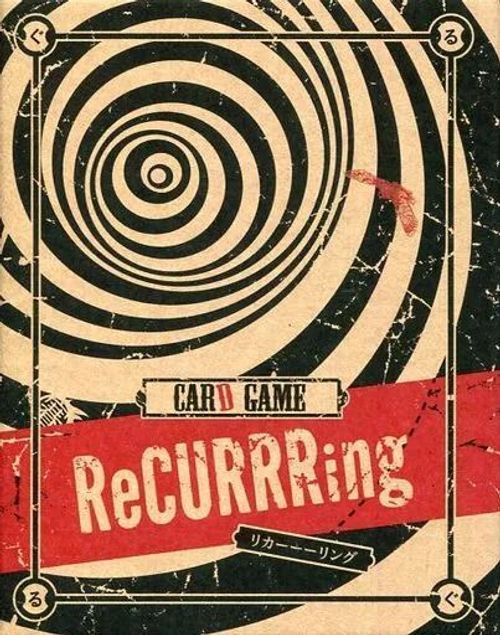
ReCURRRing
ReCURRRing Rulebook
Table of Contents
Table of Contents
Components
All cards are numbered.
- Number cards: 1 to 9. The number of cards of each value equals the value (one "1", two "2", and so on up to nine "9"). Total number cards = 45.
- R cards = 12.
- Total cards = 57.
Player Count Setup
Use only the cards listed for your player count. Return the rest to the box. "Not these!" means those cards are not used in that game.
- 3 players: 39 cards total. Use all number cards 1 to 7 plus 11 R cards. Not used: number cards 8 and 9, and 1 R card.
- 4 players: 48 cards total. Use all number cards 1 to 8 plus 12 R cards. Not used: number card 9.
- 5 players: 55 cards total. Use all number cards 1 to 9 plus 10 R cards. Not used: 2 R cards.
Preparation
- Return unused cards to the box according to player count.
- Shuffle the cards you need. Shuffle again. Once more. Okay!
- Deal the cards one at a time to each player, face down, until all cards are dealt.
- When a card is dealt, check the number.
- The player with the "1" card places it in the middle of the table.
- The first round of the game begins with the player who holds the "1" card.
Flow of the Game
- Take cards from the middle of the table and replace them with higher cards. An entire set on the table is exchanged at once.
- This is repeated by each player in clockwise order, as they are able and willing.
- If you can't or don't want to exchange, you may pass.
- If everyone else passes, your card on the table will score.
- When someone empties their hand, the game is over. The player with the highest score wins.
Start of the Round
A round continues until someone scores. Rounds repeat until the game is over.
- The game starts with the player who plays the "1" card. After that, the first player of each round is the player who scored the last round.
- There are no cards on the table at the beginning of a round. The starting player sets out one favorite card from their hand to start the next round. This card becomes the table card for the round.
- The cards on the table are shared. Placing them in the middle of the table makes them easy to play.
- Play continues clockwise from the starting player.
- You cannot pass on the first turn of a round. No forgiveness.
- You also cannot play two or more cards on the first turn of a round.
What Can You Do on Your Turn?
In this game, the smaller the number, the stronger the card. For example, 1 is stronger than 9.
R is the weakest card. R is not a wildcard.
On your turn, take a card (or cards) from your hand to exchange with those on the table, or pass.
Change: Use Your Cards in an Exchange
When using multiple cards, use only cards of the same value. Cards can be played in two ways:
- Method A: Play a stronger card with the same number of cards as are on the table.
- Method B: Play a set of cards 1 more than the number on the table. In method B, you can play regardless of the strength of the card. It can be stronger, weaker, or the same strength.
You cannot play two more cards than what is on the table.
In either case, the cards that were on the table come into your hand. It's an exchange, remember? The card(s) you played become the new table cards.
Example (1 card 3 on the table):
- Method A, same number of cards: a single 1 or 2 (stronger than 3) can be exchanged for the 3 on the table.
- Method B, one more card: two equal cards can be played in place of the single 3. Two 2s are OK ("Anything plus one is OK!"). Two R cards together are OK ("Anything together is OK!"). Two 3s are OK ("Yep, this too!").
- Not allowed: two 4s and 6s, since they are different values ("Hey! These are different! No good."). Four cards of one value, such as four 5s, are NG because that is more than 1 more than what is on the table ("Oops! That's more than 1 more than what's on the table").
Pass
When you cannot or don't want to play a card, you may pass.
- Once you pass, you cannot join until the next round.
- If you pass, put your hand on the table to show you are out of the round. It's polite.
- Don't worry, you can come back in for the following round.
End of the Round
If all other players pass, the round is over.
- At this time, place the cards from the middle of the table to your side face up. (This helps everyone see which cards and how many are out of the game.)
- Don't add them to your hand by mistake!
- The next round begins with the player who just scored.
End of the Game
If it begins, it must also end.
- It is the final round if someone plays their last cards.
- The cards gained in this exchange are placed face down in front of the player. (There is no opportunity to use them as a hand.)
- This makes it easy to see who went out first as the round continues.
- The game is over after this round.
Scoring
- Number cards are worth 1 point each. The number on the card does not matter.
- R cards are worth 0 points.
- However, the player who emptied their hand first gets to count each R card as 1 point.
- Cards in hand and cards placed face down have no score.
- The player with the most points wins.
Make a note of your scores. Play a total of 3 games.