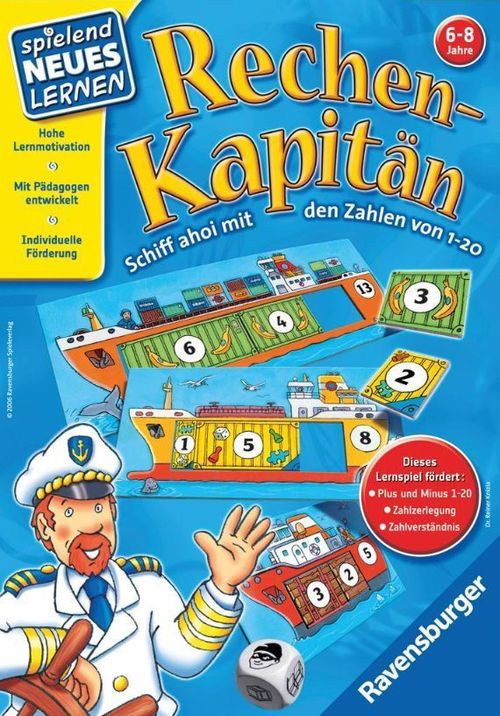
Rechen-Kapitän
Rechen-Kapitän Rulebook
Table of Contents
Table of Contents
Components
- 12 Ships
- 6 Warehouses
- 75 Cargo crates
- 1 Wooden die
Before the First Game
Carefully punch the ships, the warehouses and the cargo crates out of the punch-out sheets.
The ships differ in length and have cargo holds of different sizes. For example, ship number 15 can carry fifteen single cargo crates or three five-cargo crates; ship number 7 has room for seven single cargo crates, or for one four-cargo crate and one three-cargo crate.
Three different goods are brought to the warehouses of other countries by the ships: bananas, puzzles and coffee beans. The number on a cargo crate shows its size.
Each warehouse contains three shelves: one shelf for bananas (green), one shelf for coffee beans (yellow) and one shelf for puzzles (red). The coloured frame shows which cargo crates belong on which shelf.
Introductory games
- Have your child arrange the cargo crates by size and lay them side by side. The connection between number and length becomes clearly visible this way.
- Ask your child to load the ships. Perhaps only with single crates? Or with the largest possible crates? In this way the child discovers through play how many single crates fit into ship number 5, or that ship number 10 has room for one eight-crate and one two-crate.
- Give your child various cargo crates and ask them to find the matching ship. This makes clear that adding up the cargo crates corresponds to the size of the ship. By placing the cargo crates into the chosen ship, the child can check for themselves whether they calculated correctly.
Game Idea 1
Arithmetic practice for 2 to 4 children from age 6.
Goal of the game: Load ships together and transport as many as possible into your own harbour.
Preparation
Place three ships of your choice in the middle of the table. The remaining ships form a stack next to them. Spread the cargo crates face down around these ships. Turn over as many cargo crates as there are players. If, for example, four children are playing, turn over four cargo crates before the game starts.
Note: The cargo crates are of different sizes. Even when they lie face down, you can estimate roughly how large the crates are from their length.
The wooden die and the warehouses are not needed for this game. Put both back into the box.
How to play
The youngest player begins. Play then continues clockwise.
1. Turning over a cargo crate
Turn over a cargo crate! Now several cargo crates lie face up on the table. Choose one of them that you want to load into a ship.
Observe the following:
- Each ship may only be loaded with one type of goods. If, for example, a puzzle crate is already in a ship, that ship must be filled completely with puzzles. Coffee beans and bananas cannot be transported with this ship.
- Every fully loaded ship must contain at least two cargo crates. If no cargo crate fits into a ship because the required type of goods or size is not available, you unfortunately cannot load anything. The next player takes their turn.
2. Loading the ship
Load the cargo crate into one of the ships lying ready.
- Does it fit? Great! Now the next player takes their turn. Attention! If you are the one who loads the last cargo crate into a ship, you may take that ship into your harbour. Pull it from the middle of the table to yourself. Then place a new ship from the stack into the middle of the table. There must always be three ships ready for loading.
- Does it not fit because it is too large? Too bad! Put it back into the middle of the table. Now the next player takes their turn.
End of the game
The game ends as soon as all ships have been fully loaded and transported into the harbours. Whoever then has the fleet with the most ships wins the game!
Game Idea 2
Arithmetic practice for 2 to 4 children from age 7.
Goal of the game: Load your own ships as quickly as possible.
Preparation
Each player receives three ships of their choice. Place them in front of you.
Spread the cargo crates in the middle of the table. Lay them face down. Turn over as many cargo crates as there are players. If, for example, four children are playing, turn over four cargo crates before the game starts. Place the wooden die ready.
The warehouses are not needed for this game. Put them back into the box.
How to play
The youngest player begins. Play then continues clockwise.
1. Turning over a cargo crate
Turn over a cargo crate! Now several cargo crates lie face up on the table.
2. Rolling the die and carrying out an action
Roll the die! The die symbol shows you which action to carry out:
-
Single crate (one cargo crate symbol): Choose one face-up cargo crate and load it into one of your ships.
- Does it fit? Great! Now the next player takes their turn.
- Does it not fit because it is too large? Too bad! Put it back into the middle of the table. Now the next player takes their turn.
-
Two crates (stacked cargo crates symbol): You are strong and can carry even two cargo crates. Choose two and load them into your ships. You may load both crates into one ship, or you may also distribute the crates among the ships.
- Do they fit? Great! Now the next player takes their turn.
- Do they not fit because they are too large? Too bad! Put them back into the middle of the table. Now the next player takes their turn.
- Is only one cargo crate still able to fit into one of your ships? Load that one and put the other one back face up into the middle of the table.
-
Thief symbol: You are tired and exhausted. So as not to have to go so far, you sneakily take one cargo crate from another player's ship. Load it into your own ship. If no cargo crate fits into your ship because the required type of goods or size is not available, you unfortunately cannot load anything. Put this cargo crate face up into the middle of the table. The next player takes their turn.
-
Spilled cargo symbol: You were not paying attention while loading. Your cargo is stacked so crookedly that it slides into the water. Choose one of your ships and put the entire cargo back face up into the middle of the table. Now the next player takes their turn.
Observe the following when loading:
- Every fully loaded ship must contain at least two cargo crates.
- Each ship may only be loaded with one type of goods.
End of the game
The game ends as soon as one player has fully loaded their three ships. That player wins the game.
Game Idea 3
Arithmetic practice for 2 to 4 children from age 8.
Please note! In this game:
- Each player has only one ship left.
- Each ship can transport different types of goods. Bananas, coffee beans and puzzles can therefore be loaded together into one ship.
- Every fully loaded ship must contain at least two cargo crates.
Goal of the game: Load your own ship several times in order to fill the shelves of the warehouse.
Preparation
Each player receives one warehouse and the ship that matches it. Make sure that warehouse and ship have the same number. Place both in front of you.
Return the remaining ships and warehouses to the box.
Spread the cargo crates in the middle of the table. Lay them face up. Place the wooden die ready.
How to play
The youngest player begins. Play then continues clockwise.
1. Rolling the die and carrying out an action
Roll the die! The die symbol shows you which action to carry out. Look at page 6 to see what the symbols mean.
If your ship is not yet fully loaded after loading the cargo crate, your turn ends and the next player takes their turn.
If your ship is fully loaded, the captain sets sail immediately. He brings the goods to other countries. Here the crates are stored in warehouses. So continue in the same turn with step 2, "Filling the warehouse."
2. Filling the warehouse
Take the cargo crates out of the ship and load them onto the shelves of the warehouse. Make sure they are placed on the correct shelf:
- banana crates belong on the green shelf,
- coffee beans on the yellow shelf, and
- puzzles are stored on the red shelf.
If your cargo crates do not fit onto the corresponding shelf, you must put the relevant cargo crates back face up into the middle of the table so that your shelves do not overflow. Now your turn is over and the next player takes their turn.
As long as the shelves of the warehouse are not yet full, your captain sails back so that you can load the ship again. The next time you are due, make sure you only load cargo crates for which there is still space in the warehouse. Repeat loading (step 1, "Rolling the die and carrying out an action") and unloading (step 2, "Filling the warehouse") as often as necessary until the shelves of your warehouse are completely full.
Note: If you load cleverly, you need exactly four ship loads to fill the shelves of the warehouse. If a fifth trip becomes necessary, you may make it with a half-full ship as well. On the last trip you only need to load the cargo crates that are still missing in the warehouse.
End of the game
The game ends as soon as all shelves of one warehouse are full. The player who was first to fill the shelves of their warehouse wins the game.
Expert variant
Game Idea 3 can also be played with face-down cargo crates. At the start, turn over as many cargo crates as there are players. If, for example, four children are playing, turn over four cargo crates at the beginning of the game. Now one further cargo crate must be turned over before every turn.