Realm
Realm Rulebook
Table of Contents
Table of Contents
Equipment
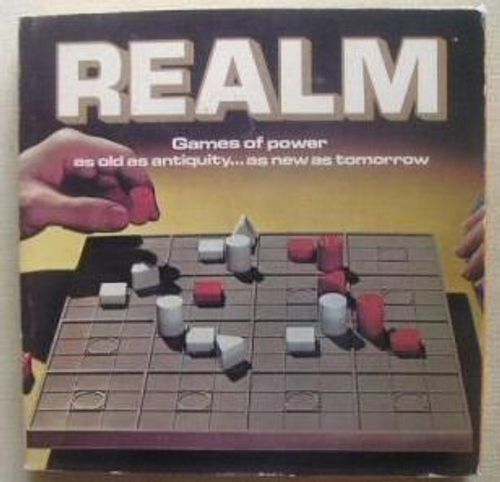
The Realm board consists of 144 spaces divided into 16 "Realms," each with 9 spaces (like a tic-tac-toe grid). The Center space of each Realm is marked with a circle. Its remaining 8 squares are called Border spaces.
Each player commands three different types of pieces:
- 4 Powers (circular)
- 9 Enforcers (triangular)
- 14 Bases (square).
Different quantities of these pieces are used in each version. In all games, the player to move first is decided by a convenient method, such as flipping a coin or allowing the loser of the previous game to choose.
Realm – Featured Game
Each player controls 3 Powers, 8 Enforcers, and 12 Bases. The object of the game is to control more Realms than the opponent when the game ends.
Beginning with an empty board, the first player places one of his Bases (square) on the Center of any Realm. His opponent then places a Base on the Center of a vacant Realm of his choice. Players continue alternately placing Bases in vacant Realms until each has placed three Bases. A player cannot place a Base on any Center that lies in the same row or column of Realms as a Base that he has previously placed. The setting up of the board continues next with each player alternately placing Powers (circular), one at a time, on any Border Space of a Realm where a friendly Base was previously placed. Only one Power can be placed in each such Realm.
A player is said to control a Realm if he has a Base on its Center space. Thus each player will begin the game controlling three Realms, and each will have one of his Powers located within it.
How Pieces Move
- BASES are immobile. Once placed on a Center a Base cannot move during the game.
- POWERS move any number of spaces in a straight horizontal or vertical line as long as they move into a new Realm. A Power must end its movement when the next space is blocked by any piece. A Power may move through, but may not end its move, on a vacant Center.
- ENFORCERS move in the same manner as Powers except that they may only move in the direction in which they are pointing when moving. Prior to moving an Enforcer a player may turn its point a quarter-turn (90 degrees). An Enforcer can (usually) move in one of three directions on a given turn, but never directly opposite from the direction in which it begins pointing. After an Enforcer ends its movement it remains pointed in the same direction as it moved. Immobile Enforcers cannot move (see below).
Special Events
After each piece completes its movement, a Special Event may occur as follows:
-
A Power creates a Base. When a Power ends its movement in a Realm with a vacant Center, and there are no enemy Powers within the Realm, a friendly Base is created and is immediately placed on the Realm's Center.
-
A Power creates an Enforcer. When a Power ends its movement in a friendly-controlled Realm (a friendly Base exists therein), and no mobile Enforcer of either side exists within that Realm, a friendly Enforcer is created. This piece is immediately placed in any vacant space within the Realm and is positioned in any desired direction.
- An Enforcer cannot be created if there are no vacant Border spaces in this Realm.
-
An Enforcer immobilizes an enemy Enforcer. When an Enforcer stops in a Realm where one or more mobile enemy Enforcers exist, one such enemy Enforcer is immobilized by standing it on end, so that it points upwards. If there is more than one enemy Enforcer, the attacker chooses which to immobilize. The moving Enforcer is also immobilized in the same way unless there are more friendly Powers within this Realm than enemy Powers.
-
An Enforcer captures an enemy Base. When an Enforcer stops in a Realm containing (1) an enemy Base, (2) no mobile enemy Enforcers, and (3) more friendly Powers than enemy Powers, the enemy Base is captured. The captured Base is removed from the board and retained by the capturing player for the duration of the game. If only one more friendly Power exists within the Realm than enemy Powers, the Enforcer is now immobilized. However, if at least two more friendly Powers exist than enemy Powers, the Enforcer remains mobile.
Play
In accordance with the rules of movement, a player may move one or more of his pieces on the same turn, after selecting one of three play options: Dispersal, Concentration or Rearrangement.
- Dispersal: A player may move any number of his mobile pieces from within one Realm to one or more other Realms.
- Concentration: A player may move two or more pieces that end their move in a common Realm, provided the pieces began the turn outside this realm. Note: In both Dispersal and Concentration, after each individual piece moves, any Special Event so triggered is enacted before the next piece moves.
- Rearrangement: A player may pick up all of the pieces he has within one Realm and replace them on different spaces within the same Realm, changing the orientation of any mobile Enforcer as desired. All immobile Enforcers remain immobile. A player may not rearrange any of his opponent's pieces within this Realm. A player may not rearrange in the same Realm three moves in a row.
Ending the Game – Winning
The game ends as soon as one player has created all of his Bases or neither player, by agreement, can create another Base. The player controlling more Realms at that time wins the game.
- If a tie exists, it is broken by determining which player has a greater combined total of mobile Enforcers and uncreated Enforcers. The game is a draw if both players have an equal total of these.
Strategy
By Bill Mikulas
Realm begins with each player placing three Bases. Within the limitations of the rules there are 16 distinct ways a player can place his Bases. Generally, you do not want your bases too far apart from each other, and you need to control at least one of the 4 central Realms.
The Powers are positioned in an attempt to limit the opponent's options and while giving yourself greater choices.
Once you begin play, it will quickly become apparent that the order in which you move your pieces on a given turn will influence the order and outcome of Special Events. For example, it is usually wise to move Powers into a Realm to gain the advantage before moving an Enforcer into this Realm to capture your opponent's Base or immobilize his Enforcer. However, by moving in a Power after the Enforcer captures an enemy Base, it is possible to create a friendly Base in this Realm on the same turn.
At the beginning of the game there is usually a rush to claim the empty Realms. Often at the end of this phase, each player will control, or have the likelihood to control, 8 Realms. If you can get 9 Realms to your opponent's 7, you will have a clear advantage. Hence, securing 9 Realms is the major goal of your initial placement and opening moves. The following are good initial moves.
Concentration: Bring 2 Powers into a new Realm, claiming that Realm.
Dispersal: Send 2 Powers into 2 empty Realms, claiming them. After your second turn, you will control 6 Realms.
In the middle phase of the game try to create multiple simultaneous threats, block and immobilize the opponent's pieces, get ahead in the number of mobile and uncreated Enforcers, and occasionally be willing to give up a Realm to gain a stronger position.
In the end phase, go all out to create all your bases or to assure, if no more bases can be placed, that you control more Realms.
Variations
Many variations of Realm are possible for the creative-minded. Even a small variation can change playing strategy quite a bit. Here are some popular variations:
- Start with 11 Bases for a shorter-playing game or 13 Bases for a longer playing game. You may find that the Enforcers are much more valuable in the "13" game.
- You may vary the number of Enforcers or Powers you play with and thus alter their significance. Try a game with 4 or 6 Enforcers.
- You may eliminate the restrictions about initial placement of Bases on the board, so that you may place a Base on the Center of any vacant Realm.
- You may restrict the movement of Powers and Enforcers with the following rule: A Power or Enforcer must end its movement when it enters a Realm controlled by an enemy Base, stopping on any space within that Realm along its line of movement.
- You may make it harder to create a Base by deciding that a Power can only create a Base when it stops in a Realm with a vacant Center and there are no other Powers, friendly or enemy, within the Realm.
- You may make it easier to capture a Base and replace it with one of your own by deciding that as soon as you capture an enemy Base you put one of your Bases in its place. This results in a much faster game.
- Use your ingenuity to develop any other variations as desired!
Classic Realm
Fast and simple, players of all ages will enjoy this one.
Each player commands a force of eight Enforcers. Think of them as "frogs" jumping from lily pad to lily pad. The object is to dislodge the opponent's frogs from the Centers of the Realms (the lily pads), and forcing them onto the Border spaces (the water).
Play
Players alternate moving one piece on a turn. A piece may only move if it occupies a Center (lily pad). Movement is from Center to adjacent Center (either horizontally or vertically adjacent). Intervening Border spaces (water) are jumped over. When a piece lands on a Center occupied by a friendly piece, it must continue to move to another adjacent center but may change direction. A piece must end its movement when it either lands in a vacant Center or one occupied by an opponent's piece – in which case the opponent's piece is dislodged and falls into the "water." Place it on any Border space of this Realm. The moving piece replaces it at the Center and now ends its turn.
To "rescue" a piece, a player must first occupy the Center of this Realm with another piece. When this piece moves out of the Realm, any one of his pieces "in the water" is replaced in the Center (this is a bonus move, in addition to the piece moving out of the Realm). The rescued piece can move again on a future turn. If 9 pieces are already in a Realm, no movement into it is possible; only the piece at its Center may move out of this Realm.
Winning
The game is won by the player who succeeds in "dunking" all 8 of his opponent's pieces (forcing them onto Border spaces).
Variations
-
After players have played a few games with the standard setup, they may vary the opening play in Classic Realm. Beginning with an empty board, each player in turn places one piece on any empty Center until all sixteen Centers are occupied. The player who placed the final (16th) piece makes the first move in the game. Play continues normally.
-
With experience, it will be found that the player who plays first has a considerable advantage. To compensate, DOUBLE-MOVES are allowed at certain turns. In a DOUBLE-MOVE turn, a player may move two different pieces or one piece twice. The second player is allowed to make the first DOUBLE-MOVE on his third turn, but may save it until any later turn. Once the second player has taken his DOUBLE-MOVE turn, the first player must take two regular turns and then may take a DOUBLE-MOVE turn at any time thereafter, and so on alternating between players. This variation can be played with the standard setup or with the setup of Variation 1.
Medieval Realm
A slightly more competitive game than Classic Realm.
Each player commands a force consisting of two Dukes (Powers) and six Men (Enforcers). The object of the game is to move all eight of one's playing pieces off the opposite side of the board (facing the opponent) before the opponent can do likewise.
Play
Players alternate in moving one piece on a turn. Pieces may move only from a Center to a horizontally or vertically adjacent Center. Dukes can move in all four directions but Men are limited to moving only forward or sideways. As in Classic Realm, if a piece lands on a friendly-occupied Realm, it continues moving to another adjacent Realm, changing direction, if desired, until it lands on a vacant or enemy-occupied Center. In the latter case the enemy piece is dislodged to any empty border space in the Realm and the moving piece is placed in the Center. A piece is not permitted to move into a Realm occupied by an enemy Duke, for Dukes can never be dislodged. Only pieces in the Centers may move. When a piece leaves a Center, one of the opposing player's pieces (if there are any) in the border spaces of the Realm is immediately replaced in the Realm's vacated Center (This rule is the opposite of the rule in Classic Realm).
No piece may enter or jump over a Realm that is completely filled. The piece in that Center, however, may be moved out of the Realm. Sometimes a player finds he cannot move any piece because all of his pieces remaining on the board are dislodged. If this occurs, the opposing player continues to move until a move returns one of the player's pieces to a Center.
Winning
The first player to move all eight of his pieces off the board is the winner. A piece is moved off the board from the Center of a Realm on the opposite side of the board, either as a separate move or, if the Center of the Realm is occupied by a friendly piece, as part of a continuing move. In the case where each player moves a Duke on three consecutive turns the game is a draw.
Oriental Realm
This is an intriguing game of "surrounding."
Each player commands a force of one Emperor (Power) and seven Mandarins (Enforcers). The object of the game is to completely surround at least one of your opponent's pieces.
Play
On his turn a player is permitted to move any or all of his mobile pieces located within any Realm. He moves each such piece one at a time. A piece may be moved any number of spaces horizontally or vertically, or until it is blocked from moving further by any other piece. A Mandarin may not move if "pinned." It is pinned if two enemy pieces are adjacent to it on opposite horizontal or vertical spaces (even if either or both of those pieces are also "pinned").
The Emperor may not be pinned and, in addition, it may free a friendly Mandarin from being pinned. A Mandarin that would otherwise be pinned may move if, at the start of the move, it is adjacent (horizontally or vertically) to the Emperor.
Winning
The game is won by the player who completely surrounds his opponent's Mandarin or Emperor on its four horizontal and vertical spaces, regardless of whether the attacking pieces are in the same or an adjacent Realm. (Usually four pieces are needed in order to surround, but along the board's sides, either two or three are sufficient.)
Sometimes a game is won by surrounding a connected group of enemy pieces. The encirclement is complete if such a group is surrounded on all adjacent horizontal and vertical spaces.
A draw exists if no piece can move (all are mutually blocked and pinned).
Warning Option: Players may agree before the game that an opponent will always be warned when a piece of his can be completely surrounded on his next turn.
Variation: Beginning with an empty board, each player alternates in placing one piece on the board. Only one piece may be placed per Realm, but may be placed on any of the Realm's nine spaces. Play begins when all Realms are so occupied.
Modern Realm
This is a great game of "infiltration."
Each player starts with a force consisting of seven Agents (Enforcers) and one Counter-Agent (Power). During play these pieces will be exchanged for Headquarters ("HQ") Pieces (Bases). The object of the game is to establish one's eight HQs, one each, in the Centers of his opponent's eight starting Realms.
Play
The turn to play alternates unless one player cannot move any of his pieces in which case his opponent continues moving until the blocked player has a piece available that can move.
At his turn a player chooses any Realm in which he has at least one piece and moves out all of his moveable pieces that are located within that one Realm.
Agents and Counter-Agents move in straight horizontal and vertical lines, ending movement as desired or when blocked from moving. No piece may pass over another piece nor may any piece enter a Realm containing the enemy Counter-Agent. If a piece enters a Realm occupied by an enemy Agent or HQ in its Center, it must end its move in a space of that Realm along its line of movement.
HQ's once placed on the board never move.
Direction changes: Whenever a piece enters a Realm occupied by a friendly piece in its Center, it may continue to move and may change its direction of movement one time within that Realm moving off at a right angle. It can continue entering Realms and changing direction, if desired, as long as each Realm is occupied by a friendly piece in its Center.
Mobility: Counter-Agents are always mobile in all situations. An Agent in a Realm is mobile if either a friendly piece controls the Center, or if the Center is vacant, or if at least as many friendly pieces exist in the Realm as opposing pieces at the start of the player's turn. Agents are immobile if located on a border space of a Realm in which the opponent has more pieces and controls the Center.
Realm Capture: A player's objective is to capture the eight Realms on the opponent's side of the board (called "Target Realms"). A capture occurs as follows:
- Any piece moved into a Target Realm whose Center is vacant immediately captures that Realm.
- An Agent moved into a Target Realm whose Center is enemy-occupied captures the Realm only if the total of friendly pieces (including the moving piece) exceeds the total of enemy pieces in the Realm.
- A Counter-Agent moved into a Target Realm always captures it regardless of the number of enemy pieces within.
The piece moved into the Realm to effect the capture is removed from the game and a friendly HQ is placed on the Center. If the Center was occupied by an enemy piece, that piece is dislodged to any vacant border space within the Realm that the moving player chooses. (Note that it is possible over several turns to move many pieces into one Realm and then move them all out on a succeeding turn capturing several enemy Realms on that single turn).
Winning
The first player to occupy all eight of the Realm Centers on his opponent's side of the board wins the game.