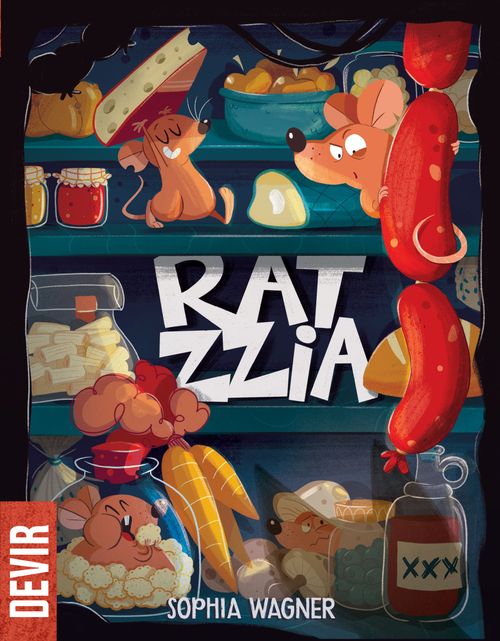
Ratzzia
Ratzzia Rulebook
Table of Contents
Table of Contents
Game Overview
Try to help your mice accumulate a large amount of food before the others can find a better haul. Make sure you get your food into your hiding place and store it for the winter so the other rodents won't be able to steal from you!
Goal of the Game
The winner is the first player to fill their little sack with food tokens worth a total value of 25 or more.
Game Components
- Food tokens: 45 sausage tokens, 7 cracker tokens, 7 cheese tokens
- 35 dice in five different colors, 7 for each player
- 5 little sacks, one for each player
- 2 candy dice
- 1 game board
- 7 cardboard game board pieces
Setting Up the Game
- Place the board in the middle of the table and the food tokens to one side. If there are 2 or 3 players, place the punched out game board pieces in their places, according to the numbers in their reverse side (as indicated on the inside of the game box lid). These pieces hide certain squares and leave only those needed for the number of people playing.
- Place the Candy dice on the candy jar: one die if there are 2 to 3 players or two dice if there are 4 to 5 players.
- Each player takes seven Mouse dice of their color and one small sack. If there are only 2 players, each of them takes only six dice of their color and a sack. Also, place three additional dice (belonging to one of the colors that are not being used) to the left side of the board (see the rules for 2 players below).
- The first player is the one who last got a snack from the refrigerator. He gets three sausage tokens and places them in front of him. Going clockwise, each player gets one more sausage than the player just before them.
Food Tokens
The food tokens are shaped like sausages, crackers, and cheese, and each type has a value assigned to it:
- Sausage — Worth 1
- Cracker — Worth 5
- Cheese — Worth 10
At any time, players may exchange different food tokens of equal value if they wish (a cracker is worth five sausages, and a cheese is worth ten sausages).
The beige squares on the board show where you can place dice and the number of sausages you can receive when you get your rewards. The food tokens you get can be adjusted as needed. For example, if you get a three sausage reward, you can take a cracker token from the general reserve and return two of your sausage tokens to make proper change.
How to Play
The game is played in turns going clockwise around the table. On their turn, each player rolls their dice (mice) and places them in columns on the board, trying to reach the rewards on the top shelf of the pantry.
During their turn, the player:
- Rolls the Mouse dice they have: Right after rolling, they may reroll as many dice as they want, but only once per turn.
- The player then places their Mouse dice on the squares of the board that match their results. They can place as many dice from their roll as they choose, in whatever columns they want to, as long as they place at least one die.
- The dice they place on the board remain there until the column they are in is full, which means that they might have fewer dice to roll on their next turn.
In order to place a Mouse die, the following requirements must be met:
- The columns are always filled from bottom to top (except the cat row, which fills from left to right).
- Each die must be placed in the next empty square in its column, next to the last die that was placed.
- Players are not allowed to leave gaps when placing dice in the columns. If gaps are created later in the game (because a player has removed dice from a given column, for example) the gaps are ignored.
- The value of the die to be placed must match the number shown in the illustration on that square.
- If a square has no number, it can be filled with a die showing any result, unless there is a link mark between two squares — see below.
- If there is a link mark between two squares, both of them must be occupied by dice that have the same number showing. Note that you don't have to place both dice at the same time, but the second die has to match the first one when it is placed!
Rewards
Once the player has decided that they will not place any more dice on the board, they must follow these steps:
- Check the columns from left to right to see if any columns have been completed. A column is complete if there is a die in its top square (regardless of whether there are empty spaces in the column).
- If a column is complete, then all players take back all of the dice they have in that column. As they collect them, they receive the reward shown in the squares their dice were on.
- The player who is playing their turn when the column is completed also gets the additional reward indicated above it on the top shelf (see Top Shelf Rewards).
All rewards are placed in front of the player who has earned them. For the moment, they remain in sight, and until they are safely stored in their little sack, they can still be swiped by a Greedy Gobbler (see Top Shelf Rewards)!
Now it's the next player's turn.
Example: The yellow player placed a die with a 3 showing in the fifth column to complete it. So, at the end of their turn, all of the dice that are on squares in that column are returned to their owners. This means that the green player receives 2 sausages as a reward for the squares they had dice on and the orange player gets 1 sausage for the same reason. Finally, the yellow player gets 1 sausage as a reward for having filled the top square plus 2 more sausages from the jar above for completing the column.
Have You Run Out of Options?
If, during their turn, a player does not have as many dice to roll as they want or if they are simply not convinced about any of the columns where they previously placed dice, instead of rolling and placing dice, that player may choose to remove all of their dice from any one column (but not from the cat row). This may create gaps. If a player has no dice to roll on their turn, they have no choice but to make use of this option.
The Cat
The cat is the guardian of the pantry. Any unexpected noise could attract her attention, and she will come running to see what is happening! If this happens, all of the mice must rush to hide as fast as they can. But, this is something that a clever mouse could take advantage of!
The cat row works differently from the columns: During their turn, a player may call the cat's attention by placing dice in the grey squares (the dice can show the same or different values). As soon as all of the grey squares are filled (there may be one or two depending on the number of players in the game), any player that rolls any results in their dice that match the die in the rightmost grey square (before or after re-rolling their dice) must immediately place those dice in the red squares of the cat row, before they choose what to do with the rest of their dice.
As soon as the cat row is completed, the cat comes out to hunt the mice! All players must immediately remove all of their dice from the board without receiving any reward at all.
If the cat arrives before the active player is able to re-roll their dice (right after their initial roll), they can roll any dice they got back because of the cat.
Example: The yellow player rolled two 1's, a 3, a 5 and a 6. They must immediately place the 5 die in the cat row and continue their turn with the dice that they have left. If that die filled the cat row, all of the Mouse dice on the board would be removed, and the yellow player would be able to re-roll those (along with any other dice they had to remove because of the cat).
End of the Game
The game ends as soon as any player has managed to place food tokens that add up to a value of 25 or more inside their little sack. It is the players' duty to do all they can to be the first to get their food and run away with it!
Playing Hint: You can only put food in your little sack by using the "Safeguard Your Food" reward at the top of the 7th column — see Top Shelf Rewards.
2 Player Game Rules
To maintain the tension in games of Ratzzia with just two players, use the following changes to the rules:
The three extra dice set by the side of the board during set up are called support dice.
After rolling their dice but before placing them on the board, a player has the option to roll all of the available support dice. If they do, they must place at least one of their dice and all of the support dice they rolled, if possible:
- Support dice must be placed according to the usual rules, but they can never be rerolled.
- The player must find a way to place the support dice and they are given priority over the player's own dice (even if this means leaving the Greedy Gobbler column ready to be completed by the other player!).
- If it is not possible to place all of the support dice and one of the player's own dice on the board, and only in this case alone, the player may return the support dice that have not already been placed back in the reserve.
If a column is completed (with the player's own die or a support die), the rewards are collected as usual, but no one receives any rewards for squares filled by support dice. After that, the support dice are returned to the reserve so that they can be used again.
If the board is cleared because the cat row was completed, any support dice are returned to the reserve. If the player who completed the cat row has not yet had a chance to roll the support dice this turn, they may do so at this time.
Top Shelf Rewards
The player who completes a column receives the reward shown on the top shelf above that column, in addition to any rewards they earned for their dice:
Anxious Annie: This mouse is in a rush to get as much food as she can, as fast as she can… and who can blame her for that? Take the die from the top square of the Anxious Annie column (which has just been completed) and immediately place it in the bottom square (the lowest one) in any of the other columns. The die does not have to match the number required by the square it is moved to. If that square is already occupied by a die, push it up (along with any other dice in that column) to the square above it. The dice that are pushed up will fill in any existing gaps in the column. If moving the dice up results in the completion of the column, the active player gets the top shelf reward for the column as usual.
Candy Jar: They are pretty, sweet, and are perfect for giving the mice in a column the strength to move up with more energy! Take one Candy die from the candy jar if possible. If there are none, take one Candy die from a player who is holding one but who has not yet used it (if there are two players with Candy dice in their hands, choose which one you will take it from), or from the board if they have been placed in a column. You can use the Candy die as a "wildcard" on any of your future turns: Place it with the face that shows your color up and as though it was showing any value you want. When the column the Candy die is in has been completed and the rewards given, return the Candy die to the candy jar.
Get Sausages: Those crazy humans keep their sausages in these convenient containers. What better way to make off with a bunch in a single heist? Take the number of sausages indicated on the jar and place them in front of you. Remember: Until you put them in your little sack, they are not safe and they can be stolen from you!
Safeguard Your Food: You have to be careful and make certain that the food you worked so hard to obtain is safe from the hands and mouths of hungry outsiders! This reward lets you move unprotected food you have collected into your little sack, but only exactly the amount shown on the highest matching pair of dice in this column added together. If you do not have enough unprotected food to match this value, you cannot put any into your little sack. If you have more food than what is required, the excess food must remain in front of you, still unprotected. The food that you have in your sack is safe and cannot be taken from you.
Example: The fives are the highest pair (doubles) in the column. Since they add up to 10, you can put food worth 10 points safely into your sack.
- Case 1: You only have 8 sausages to put away, so you can't perform this action and you cannot put anything in your sack.
- Case 2: You have 13 sausages to put away. You put 10 into your sack and the other 3 remain in front of you, unprotected.
Greedy Gobbler: This unscrupulous mouse steals food from others in order to get ahead. There's one in every family… Chose one player and take half of the food (rounded up for odd numbers) they have unprotected in front of them.
Accountant: Some mice believe it is essential that the food that we collect is properly distributed among all the mice families. At the same time, all players must hand over half the unprotected food (rounded up for odd numbers) they have to the player next to them. The player who completed the column decides whether they pass to the right or the left.