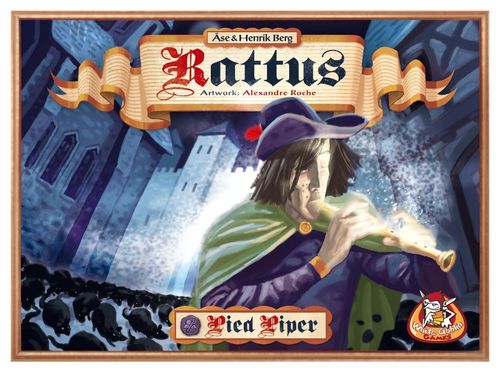
Rattus: Pied Piper
Rattus: Pied Piper Rulebook
Table of Contents
Table of Contents
Components
- 12 character cards (2 new cards for each of the 6 classes: Peasantry, Bourgeoisie, Church, Chivalry, Magic and Royalty)
- 2 Bishop pieces
- 3 Rampart pieces
- 3 Nun pieces
- 10 Potion tokens
Setup and Play
This expansion contains 2 additional new character cards for each of the 6 classes of the game. Including the 6 characters of the base game, there are now 3 different cards for each class, making 18 cards. However, only 6 cards are used in a game. After choosing 6 character cards, the setup of the game is identical to the one described in the base game. Some of the new cards require additional components (Bishop – 2 Bishop pieces, Emperor – 3 Rampart pieces, Nun – 3 Nun pieces, Magician – 10 Potion tokens). If you choose to play with these cards, the corresponding components must be placed near the game board.
Note: In a game with fewer than 4 players, it is advisable to choose at least one Chivalry card, to be certain that no region of the board is safe from the epidemic.
Before starting, the 6 character cards for the game must be chosen. This can be done in several ways:
- Draw 6 cards at random from the 18 character cards.
- Use one of the card lists offered at the end of this rulebook.
- Agree among the players on the 6 cards to use.
- Shuffle the cards of the 6 classes separately, then draw one card from each class.
The game is played as in the base game, using the 6 chosen character cards. If several cards of the same class are in play, the players remove one population cube from the game for each corresponding card in their possession whenever that class's symbol appears on a rat token.
Example: If the Crusader and the Knight are in play, and two different players each hold one of these cards, they each lose 1 population cube for each Chivalry symbol. If one player holds both of these cards, he loses 2 cubes for each Chivalry symbol.
The New Character Cards
Note: Only the active player (the player whose turn it is) may use the abilities of the character cards in his possession. He may use a card's ability only once per turn, and always before action 3 (with the exception of the Soldier, Crusader and Serf cards).
Crusader (Chivalry)
A player holding this card may move the Plague piece 2 regions during action 3, before the effects of the plague are evaluated. In addition, he may reveal simultaneously all the rat tokens in the infected region, and decide the order in which they will affect that region.
Soldier (Chivalry)
A player holding this card may move the Plague piece 2 regions during action 3, before the effects of the plague are evaluated. In addition, when he places new rats during action 3 (spreading the epidemic), he may place one extra rat.
Combinations of cards: If a player holds several Chivalry cards, he may never move the Plague piece more than 2 regions.
Messenger (Bourgeoisie)
A player holding this card may, at any time during his turn, swap the positions of 2 cubes on the board. He may swap one of his own cubes with the cube of an opponent, or 2 cubes belonging to two other players.
Note: The exchange of cubes made by the Messenger is not affected by the Rampart pieces in play.
Burgomaster (Bourgeoisie)
A player holding this card may, instead of adding new cubes in the usual way (1 cube per rat) during action 2, add one population cube to each region in which he has more cubes than any other player.
Combinations of cards: If a player also holds the Peasant card, the extra cube may be placed in a region in which he has more cubes than any other player. If the player holds and can use the Queen card, the two extra cubes may be placed in one or two regions in which he has more cubes than the other players.
Note: He may choose not to use the Burgomaster's ability, and place the cubes in the usual way.
Emperor (Royalty)
A player holding this card may, at any time during his turn, place (or move) the 3 Rampart pieces. A Rampart must be placed between two neighbouring regions (on a border or on the arrow linking the two regions). Nothing may cross a Rampart: neither rats, nor population cubes, nor the Plague piece, for as long as the Rampart is in place.
Note: The Nun and Bishop pieces (see below) are not blocked by Ramparts, since they are placed freely on the board and are not moved from one region to another.
Queen (Royalty)
If the cubes of the colour of the player holding this card connect a greater number of regions than those of any other player, he may place 2 extra cubes whenever he adds cubes to a region (action 2: placing new population cubes on the board).
Example: There are red cubes in Anglia, Gallia and Hispania, blue cubes in Russia and Tartaria, yellow cubes in Hispania, Italia and Polonia, and green cubes in Germania and Turcia. The red player has therefore connected 3 regions, the blue and yellow players 2 regions each, while the green player has connected no regions. So if the red player holds the Queen card, he may add 2 extra cubes whenever he has to place new cubes on the board. None of the other players could use the Queen's ability in this situation.
Translator's note: As printed in the source, the example lists three yellow regions (Hispania, Italia, Polonia) but states that the yellow player connected 2 regions. The source text is reproduced as printed; the booklet does not explain the count.
Pied Piper (Magic)
A player holding the Pied Piper card (the flute player) may, at any time during his turn, move one of the cubes of his colour from one region to a neighbouring region. In doing so, he must move with that cube as many rat tokens as possible from the region of origin to the new region. Ramparts prevent such a move. If the destination region contains a Bishop piece, no rat may be brought into it.
Note: The rule states that the number of rats per region is limited to 3. So if the player moves one of his cubes to a neighbouring region already containing 2 rats, he may bring only one additional rat into that region. The player may use Pied Piper to move one of his cubes into a neighbouring region even if no rat can follow it (if the region of origin contained no rat, or if the destination region already contains 3 rats or a Bishop piece).
Magician (Magic)
A player holding this card may, at any time during his turn, place a Potion token next to one of his cubes anywhere on the board. Several Potions may be placed next to the same cube, but only one per turn.
The Potion protects the cube: if that cube were to be removed from the game during action 3, the owner of the cube may choose instead to remove the Potion that protected it.
Note: For the Serf's special ability, removing a Potion from the game is not equivalent to removing a population cube from the game.
Serf (Peasantry)
During action 3, on his turn, a player holding this card may place a cube of his colour in the infected region for each rat token that has removed from the game at least 1 population cube of another player. The new cube is placed immediately in that region, and may then be affected by the resolution of the other rat tokens.
Baker (Peasantry)
On each of his turns, the player may place a cube from his supply on this Baker card. When the card is taken by another player, that player immediately places all the cubes placed on this card in a single region of his choice.
Nun (Church)
A player holding this card may, at any time during his turn, place (or move) the 3 Nun pieces. A Nun piece may be placed in any region, and several Nun pieces may be placed in the same region. Each Nun piece reduces the population of its region by 1 when it is determined whether a rat token affects the region or not.
Example: Scandia contains 3 cubes and 2 Nun pieces. The Plague will affect the population only if a rat token revealed shows a limit value of 1.
Bishop (Church)
A player holding this card may, at any time during his turn, place (or move) one of the two Bishop pieces. A Bishop piece may be placed in any region, and both pieces may be placed in the same region. Bishop pieces protect a region against rats: no rat may move into or be added to a region in which one or two Bishop pieces are present.
End of the Game
As in the base game, when the game ends one last turn is played counter-clockwise. All players, except the one who has just taken the last normal turn, may use the abilities of their character cards one last time. At the end of this last turn, and before the Plague ravages the 12 regions, if the Baker card is in play, the player to the left of the player holding the Baker places the cubes on that card in a region of his choice.
During this final turn, the abilities of the cards are the same, except for:
- Queen: If the condition of the Queen card is met, the player may place 2 of his cubes in a region of his choice.
- Crusader: The player may move the Plague piece one or two regions, reveal all the rat tokens present in this new region, and apply their effects immediately in the order of his choice.
- Soldier: The player may add a rat token to a region neighbouring the region occupied by the Plague piece. If the supply of rat tokens is exhausted (as often happens at the end of a game), draw a token from the rat tokens already removed from the game.
- Burgomaster: The player may add a cube to a region in which he has more cubes than any other player.
- Serf: The player may move the Plague piece one region and use the Serf's abilities in this new region (reveal the rats).
Combinations of cards: If a player holds more than one card whose effects depend on the Plague symbol (Crusader, Chivalry, Serf), he must apply the effects of these cards in the same region.
Suggested Card Selections
- Golden Age: Peasant, Baker, Serf, Queen, Burgomaster, Soldier. These cards will regularly allow players to add extra cubes. The board will therefore be a little more populated than usual.
- Rat Control: Pied Piper, Magician, Bishop, Nun, Monk, Emperor. These cards will act on the movement, placement and effects of the rat tokens.
- Europe at War: Knight, Crusader, Soldier, Messenger, Merchant, Pied Piper. These cards will allow players to attack each other in various ways.
Errata to the Base Game Rules
The following correction to the Rattus base rules is printed in the expansion booklet.
On page 7 of the base rules, replace: "And this always before action 3 (Exception: the King)" with: "And this always before action 3 (Exception: the Knight)".