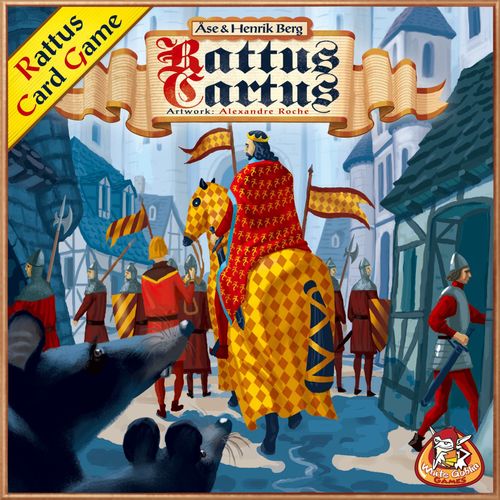
Rattus Cartus
Rattus Cartus Rulebook
Table of Contents
Table of Contents
Components
- 84 population cards, 14 of each of the six classes (Peasantry, Bourgeoisie, Church, Chivalry, Magic and Royalty) showing different numbers of nuns (24 x 4, 12 x 3, 12 x 2, 12 x 1 and 24 x 0)
- 60 building cards, 5 of each of the 12 different buildings (2 different buildings per class)
- 51 special cards, 12x Sword, 12x Flute, 12x Pass and 15x Gold
- 1 starting player card
- 15 joker cards
- 1 influence score board
- 50 rat tokens, with value 1, 3 or 5
- 40 wooden discs (8 in each of the player colours)
- 20 victory point tokens
Set Up
-
Place the influence score board somewhere on the table.
-
Each player chooses a colour and places a disc of this colour on the starting space of each of the six influence tracks on the scoring board. He keeps the two remaining discs in front of himself.
-
Each player receives rat tokens with a total value of 10. Place the remaining rat tokens as a face-up supply on the table. The players keep their rat tokens face down throughout the game, but are free to inspect the values of their own rat tokens at any time. During the game players may convert 3 (or 5) value 1 rats for a value 3 (or 5) rat at any time.
Note: Each time a player receives one rat he takes a value 1 rat. The same rule applies to discarding rats.
-
Shuffle the population cards. Draw 5 cards without looking at them and place them face down in a row on the table. This row determines the number of Nuns that will help the players at the end of the game, hereafter called the «Nun-row».
-
Deal 5 population cards to each player. Place the remaining population cards in a face-down deck with space for a discard pile next to it. This deck is the Population card deck. Whenever the Population card deck is depleted, the discard pile is shuffled into a new Population card deck.
-
Place the Joker cards and any special cards required by building cards in play in separate, face-up decks.
-
Choose 30 building cards to be used in the game (see Choosing building cards). Shuffle these cards and place this deck face-down on the table. This deck is the Building card deck.
-
Take a number of cards (see following table) of the Building card deck and place these unseen in a face down deck. This deck is the Replacement deck.
Number of players: 2
Choosing building cards: In each game, only 30 building cards will be used, 5 from each of the 6 classes. Before each game, you have to decide which building cards to use in the game. This can either be decided upon collectively by the players, or you can do it by some random method, either by selecting one random building per class and including 5 copies of this building, or by shuffling together all the building cards for each class separately and drawing 5 random cards from each class.
Note: When playing Rattus Cartus for the first time, we recommend playing with the following set of building cards: 5x Farm (Peasantry), 5x Marketplace (Bourgeoisie), 5x Monastery (Church), 5x Castle (Chivalry), 5x Palace (Royalty), 5x Fortune-teller's Tent (Magic).
Game Sequence
This game is played in 8 (with 4-5 players), 9 (with 3 players) or 10 (with 2 players) rounds, each round consisting of five phases:
- A. Draw new building cards
- B. Supplies
- C. Enter buildings and play population cards
- D. Resolve buildings
- E. End of the round
A. Draw new building cards
Draw new building cards from the building card deck.
In a four or five player game, draw three building cards from the Building card deck, and place them in a row. In a two or three player game, only two building cards are drawn.
If all the drawn building cards show the same Building, replace the last drawn card with the top card from the Replacement deck (put the replaced card at the bottom of this deck). If the new card is the same too, repeat this process until a different card is drawn.
Example: In phase A in a four-player game, three building cards are drawn. In phase B, each player may choose to draw two cards and look at one card in the Nun-row (Fortune-teller's Tent), draw four cards (Monastery), or discard two rats (Monastery).
B. Supplies
Each player chooses and performs the supply action of one of the building cards drawn. Each building card displays a supply action consisting of different combinations of the following symbols:
- Draw the given number of cards
- Discard one rat
- Look at one of the cards in the «Nun-row»
Note: If all players agree, they can choose and perform their supply actions in this phase simultaneously, otherwise this phase is played in turn order, starting with the current starting player.
C. Enter buildings and play population cards
Each player, starting with the starting player and proceeding clockwise around the table, enters one of the available buildings by placing one of his discs on the first available space on the building card. Then he announces how many cards he'll use in this building (this can be zero) and places that number of cards face-down in front of him.
Note: A player may enter a building even if another player has previously entered the same building. Note: A player can choose the same or a different building as he did in phase B.
Example: The red player is the starting player in this round, followed by (in clockwise order around the table) yellow, green and blue. The red player decides to enter the first Monastery, places his red disc on the «1» space on the building card and plays four of his hand cards face down in front of himself. Next the yellow player chooses to place his yellow disc on the «1» space of the Fortune-teller's Tent, and play three cards face down in front of himself. Then the green player places his green disc on the «1» space of the second Monastery, but chooses not to play any cards at all. Finally, the blue player places his blue disc on the «2» space of the second Monastery, and plays one card face down.
Important: In a two player game each round only one player can perform a premium action even if both players enter different buildings. The player who played the most population cards and jokers (regardless of which building he entered) may perform the premium action of the building he entered, while the other player may only perform the standard action of the building he entered. In the event of a tie, the first player to enter a building wins the tie.
Final round: In the final round of the game, no actions can be performed in the buildings. The player who would normally perform the premium action will get an additional influence point in that class. The other players get nothing.
Note: The final round can easily be recognized because the building card deck is depleted.
D. Resolve buildings
The buildings are resolved one by one, starting with the first building in the row.
Resolving a building consists of three steps:
a. Resolve cards
When resolving a building, all players who entered the building reveal the cards they've played. Each player resolves the cards he has played:
- For each population card (regardless of class) and joker played, the player scores one influence point in the class of the building (moves his scoring marker one step up on the influence track for that class).
- For each population card played that did not match the class of the building, he must take one rat from the supply and place it face down in front of him.
- For each special card (Sword or Flute) played, follow the rules concerning that special card (see Overview of the special cards).
Each building is resolved in the order in which the players entered the building. The player on the «1» space goes first, followed by the player on the «2» space, etc.
Note: If a player moves his scoring marker to a space already containing one or more scoring markers belonging to the other players, he places his scoring marker on top of these scoring marker(s).
b. Perform actions
Each player who entered the building is allowed to perform the special action of the building. Most of the buildings have two similar actions printed on them:
- The premium action (top): may only be performed by the player who played the most population cards (regardless of class) and jokers combined in this building. If two of more players played the same number of cards, the tied player who entered the building first may perform the premium action.
- The standard action (bottom): may be performed by every other player in this building.
Note: Even if a player is in a building and did not play any population cards or jokers, he may still perform the standard action of the building. He may even be able to perform the premium action, if he was the only player in the building, or he was the first player to enter the building and none of the other players in the building played any population cards or jokers.
Note: In some cases, the order in which the players perform the action of a building may be important. If this is the case, the player performing the premium action starts, followed by the other players according to the order in which they entered the building.
c. Discard cards
All played cards are discarded: population cards go to the discard pile, jokers and special cards return to their corresponding decks. Player keep cards they gained by the effect of special cards or the result of an action in this building.
Example: Continuing with the previous example, the first building to be resolved is the Fortune-teller's Tent. The yellow player was the only player who entered this building. Now he reveals the three cards he played. Two of the cards were Witch cards, and the third card was a Monk.
Since one of the cards did not match the class of the building (Magic), he has to take one rat from the supply.
Finally, he gets to perform the premium action of the card, that is, he gets to look at two of the cards in the Nun row.
Following this, the first Monastery is resolved. The red player was the only player who entered this building. He reveals the four cards he played. These cards were one Monk card, one King card and two Witch cards.
Thereafter, he scores 3 points in the Magic class (advances his scoring marker 3 steps on the Magic scoring track).
Thereafter, he gets to perform the premium action of the building, that is, discard two rats.
Finally, the second Monastery is resolved. This building was entered by the green and the blue player. So they both reveal their played cards. The green player didn't play any cards, so he neither scores any points nor takes any rats.
The blue player played one card, which turned out to be a «Sword» special card, so he doesn't score any points or take any rats either. But since the blue player played a Sword card, the green player has to give him half his remaining hand cards.
Then, he advances his scoring marker 4 steps on the Church track.
Finally, the green player performs the premium action of the building and the blue player performs the standard action, since they were tied for the number of population cards and jokers played, and the green player entered the building first. So the green player gets to discard two of his rats, and the blue player discards one rat.
E. End of the round
After resolving all buildings, the discs on the buildings are returned to their owners. Discard the building cards used in this round. The starting player gives the Starting player card to the player on his left. That player will be the starting player in the next round.
End of the Game
After the final round, the game ends.
Now, all players calculate their scores. Victory points are awarded as follows:
- For each class, the player with the most influence points scores 10 victory points, the player with the second most influence points scores 5 victory points, and the player with the third most influence points scores 2 victory points. A player with no influence points in a class can never score victory points for that class.
- The player with the highest number of population and joker cards in his hand scores 2 points. In case of a tie, all tied players score 1 point.
- For each kind of special card (except «Gold») the player with the most cards of that kind in his hand scores 2 points. In case of a tie, all tied players score 1 point.
- If the Treasury building was used during the game, the player with the most «Gold» special cards scores 6 points. The player with the second most «Gold» special cards scores 3 points. In the case of a tie for the most «Gold» special cards, the 9 victory points are divided among the tied players (rounded down). No victory points are awarded for second place. In the case of a tie for the second most «Gold» special cards 3 victory points are divided among the tied players (rounded down).
- Any victory points tokens collected during the game score their printed value.
Note: If two or more players have the same number of influence points the order of the stacked discs decide: Lower discs beat higher discs in the same stack. Note: In a 2-player game only the 10 and 5 victory points are awarded.
Example: In one class, only one of the players has scored any influence points. That player scores 10 victory points, while the 5 and 2 victory points are not awarded to anyone.
Note: In a 2-player game, no victory points are awarded for having the second most «Gold» cards.
Finally, check whether the players survive the plague. Each player reveals his rat tokens and sums their values. Then the cards in the «Nun-row» are revealed, and the total number of Nuns are counted. Any player whose total value of rat tokens exceeds the number of Nuns is killed by the plague, and looses the game, even if he had the most victory points!
Note: If all players are killed by the plague, all players have lost the game. However, if you still wish to declare a winner, you may let the player(s) with the lowest sum of rat tokens survive, and declare a winner amongst them as above.
The surviving player with the highest number of victory points inherits the crown and wins the game! In the case of a tie, the tied player with the lowest sum of the value on his rat tokens wins. If there is still a tie, the players share their victory.
Overview of the Building Cards
Palace (Royalty) Premium action: Take two victory point tokens. Standard action: Take one victory point token.
Treasury (Royalty) Premium action: Take two «Gold» special cards. Standard action: Take one «Gold» special card.
Castle (Chivalry) Premium action: Take two «Sword» special cards. Standard action: Take one «Sword» special card.
Guard Tower (Chivalry) Premium action: Each player who did not enter a Guard Tower this round must give you three cards from his hand if he has at least as many cards in hand as you. That player chooses which cards you'll get. Standard action: No action. Protection against the premium action of any Guard Tower(s) this round.
Note: If that player doesn't have three cards, but has at least as many cards as you, he gives all his cards to you. Note: It is not recommended to use this building in a 2-player game.
Monastery (Church) Premium action: Discard two rats. Standard action: Discard one rat.
Hospital (Church) Premium action: Discard one rat. Additionally, you may discard up to three cards from your hand in order to discard the same number of rats. Standard action: Discard up to two cards from your hand in order to discard the same number of rats.
Marketplace (Bourgeoisie) Premium action: Take two Joker cards from the supply. Standard action: Take one Joker card from the supply.
Office (Bourgeoisie) Premium action: Take two «Pass» special cards. Standard action: Take one «Pass» special card.
Farm (Peasantry) Premium action: Draw four cards from the Population card pile. Standard action: Draw two cards from the Population card pile.
Brewery (Peasantry) Premium action: Draw one card from the Population card pile per influence point you've scored this round. Standard action: Draw one card from the Population card pile per two influence points you've scored this round.
Pied Piper's Hut (Magic) Premium action: Take two «Flute» special cards. Standard action: Take one «Flute» special card.
Fortune-teller's Tent (Magic) Premium action: Look at two cards in the «Nun-row». Standard action: Look at one card in the «Nun-row».
Important: The order of the cards in the «Nun-row» may never be changed!
Overview of the Special Cards
«Pass» The «Pass» special cards may be played in the beginning of your turn during phase C: Enter buildings. If you play a pass card, the turn passes to the next player. When all other players have chosen a building (or played Pass cards), it's your turn again (to choose a building or play another Pass card).
«Sword» The «Sword» special cards may be played on a building like the population cards. When resolving a building the player who played the fewest «Sword» special cards must give half the cards in his hand (rounded down) to the player who played the most «Sword» special cards. The player chooses which cards from his hand he gives to the other player. If two or more players are tied for having the most «Sword» special cards, the tied player who entered the building first wins the tie. If two or more players are tied for having the fewest «Sword» special cards, the player with the most «Sword» special cards chooses which of them must give him half his cards.
Note: If all players played the same number of «Sword» special cards, nothing happens.
«Gold» The «Gold» special cards can't be played. At the end of the game, the player with the most «Gold» special cards scores 6 victory points and the player with the second most «Gold» special cards scores 3 victory points.
Note: Even though the «Gold» cards cannot be played, they are still kept in the hand like other cards, can be discarded at the Hospital and can be stolen by players using «Sword» cards.
«Flute» The «Flute» special cards may be played on a building like the population cards. When resolving a building the player who played the fewest «Flute» special cards receives one rat from the player who played the most «Flute» special cards. If two or more players are tied for having the most «Flute» special cards, the tied player who entered the building first wins the tie. If two or more players are tied for having the fewest «Flute» special cards, the player with the most «Flute» special cards chooses which of them receives the rat.
Note: If all players have played the same number of «Flute» special cards, nothing happens.