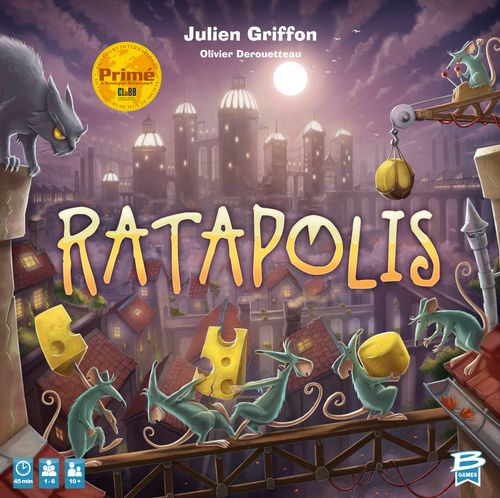
Ratapolis
Ratapolis Rulebook
Table of Contents
Table of Contents
Components
- 20 building tiles
- 10 building property tokens
- 1 hunter board
- 8 cheese tokens
- 5 cat figures
- 20 hunt cards
- 100 rat figures (20 each in red, blue, yellow, green and orange)
- 5 screens
- 1 game notepad
For scenario play:
- 6 event cards with two sides each (one side: 1 attack in the round or no attack in the round; one side: round is not played)
- 4 park tiles
- the booklet "Истории Ратаполиса" (Tales of Ratapolis), which is not included in this transcription
Game Elements
Building tile. Each tile shows a building letter, the building's capacity, a cheese pile (the cheese the player receives at the end of the game for each of their rats on this tile) and, for some buildings, a property. The capacity is the maximum number of rats that may be on this tile, equal to the number of players multiplied by a number printed on the tile. Example: in a 3-player game, this tile holds at most 6 rats.
Building property token. Some buildings have special properties; their letters are printed in orange. Such buildings have property tokens. A player receives a token if they have the majority of rats on that tile at the end of phase 5. The token shows the letter of the building it belongs to, the building's property and the building's capacity.
Hunt cards. These cards show where the hunter Baltus and his cats plan to strike. In other words, they show which building tile may be discarded at the end of the round.
Group of rats. A group is all rats of one colour on the same building tile. A single rat of one colour also counts as a group. Example: on a tile with letter O, the red player has a group of 1 rat, and the green player has a group of 2 rats.
City. The playing field, built from building tiles and park tiles, is the city of Ratapolis.
Goal of the Game
The most important thing in the life of every rat is cheese! The player who has collected the most cheese at the end of the game is the winner. To do this, players must plan their actions so that they keep as many rat figures as possible on building tiles in the city.
Setup
-
Each player chooses one of the 5 colours and places in front of them a screen and a set of 20 rat figures of that colour. Each player also needs a sheet from the game notepad and a pencil or pen to record their actions. The player circles a rat of their colour on their sheet.
-
Build your Ratapolis. For the first game, the recommended starting layout is the example below. Other layouts are described in the booklet "Истории Ратаполиса"; later you may invent your own layouts. Lay out the building and park tiles according to the chosen starting layout.
-
Take the building property tokens that exist in your city. Shuffle them and randomly take as many tokens as there are players plus 1; return the rest to the box. Turn over the building tiles whose property tokens you have chosen so that the side with the orange letter faces up, and place the property tokens on top of these buildings. All other building tiles must lie with the side bearing the yellow letter facing up.
-
Place one rat figure of your colour on each building tile in the game.
-
Place the hunter board, the cheese tokens and the cat figures beside the city.
-
Shuffle the hunt cards and place them face down as a stack on the hunter board.
Your Ratapolis is ready!
Course of the Game
The game lasts 8 rounds. Each round consists of 5 consecutive phases:
- Receiving hunt cards
- Planning actions
- Carrying out actions
- The cats hunt
- Distributing building property tokens
Phase 1: Receiving Hunt Cards
"Baltus… is here! And his cats… are too!"
Take 5 hunt cards from the top of the stack (in rounds 1–4) or 4 hunt cards (in rounds 5–8). Deal each player 1 card face down, and place the remaining cards face up on the hunter board. Place one cat figure on each building tile shown on the face-up hunt cards.
At the start of round 5, when the stack of hunt cards runs out, shuffle all discarded cards (16 cards) and make a new stack of hunt cards.
Important: at any time, players may look at the hunt card in their hand, but may not show their cards to other players.
In a 5-player game, in rounds 5–8 place all 4 hunt cards face up on the hunter board.
Example: this is what the hunter board looks like at the start of round 2 in a 3-player game. The hunter board has areas for the face-up hunt cards, an area for the hunt cards of the following rounds, an area for the hunt card that indicates the building attacked in round 1, a reminder of how to receive hunt cards in rounds 1–4 and 5–8, a display of the total number of hunt cards used in the round, and a discard area for hunt cards.
At the end of the current round the hunters will attack one of five buildings: either the buildings with letters C and F, which are visible on the open cards, or the letters shown on the cards in the players' hands.
Phase 2: Planning Actions
"You will get the cat you deserve!"
All players simultaneously plan 2 actions for the current round. To do this, each player writes on their sheet which action they will take first (in the left cell of the current round's row) and which action they will take second (in the right cell of the same row). Use the screen to hide your notes from other players.
In each cell a player may write one of 3 kinds of action. Different actions or identical actions may be planned.
- Attack a rival's rat. The player writes in the cell the letter of the building where they will attack, and the colour of the rat they will attack. To attack, the player must have at least one of their own rats on the chosen building tile.
- Move a group of rats. The player writes in the cell the letter of the building from which the rats are leaving, then draws an arrow and writes the letter of the building to which the rats will move. These tiles must be adjacent, that is, share at least 1 common side. The player must move all rats from the tile, if this is possible. A player may not move a group of rats onto empty areas that appear in the city after phase 4, "The cats hunt".
- Idle. The player puts a dash in the cell or leaves it empty.
Example: the red player has planned their actions. Their first action is to attack the green player's rat in the pharmacy (the tile with letter O). The attacked green rat returns to its owner behind the screen. Their second action is to move their group of rats from the market (tile with letter A) to the pharmacy (tile with letter O).
Important: when you have finished planning your actions, tell the other players. You may change your decision until all players are ready to move on to the next phase of the game.
Phase 3: Carrying Out Actions
"My little rats! Our time has come!"
After phase 2 "Planning actions" is complete, players simultaneously reveal their sheets and carry out all the actions in the left cell: first all planned attacks, then the moves. Once all actions in the left cell are complete, players simultaneously carry out all actions in the right cell, again first the attacks and then the moves.
-
Attack a rival's rat. For each attack, remove 1 rat of the attacked colour from the indicated tile. The figures of attacked rats return to their owners. All attacks take place simultaneously, so players may remove each other's rats, or several attackers may attack the same single rat.
Example: the red and yellow players both chose to attack the green player's rat in the pharmacy (building tile with letter O). The green rat returns to the green player. If there had been two green rats on the tile, both would have returned to the player, because the player was chosen as the target of 2 attacks.
-
Move a group of rats. All moves take place simultaneously. The player must move all rats of their group from the chosen tile. Exception: the building tile to which the player wants to move the rats cannot hold them. Remember that each building has a different capacity: the number of players multiplied by 1, 2 or 3.
Rat figures that cannot move onto the new building tile remain on their previous tile. If several players must move onto the same building tile and there is not enough room, each player moves an equal number of rats (if possible), and the remaining rats stay on their previous building tile.
-
Idle. A player who chose to idle does nothing.
Example of building capacity in a 3-player game:
- The pharmacy (tile with letter O) holds 3 × 1 = 3 rat figures.
- The fire station (tile with letter I) holds 3 × 2 = 6 rat figures.
- The market (tile with letter A) holds 3 × 3 = 9 rat figures.
Example: with their first action, the yellow and green players chose to escape from the pharmacy (tile with letter O) to the fire station (tile with letter I). But the chosen city tile can hold only 3 × 2 = 6 rats, and there are already 4 red rats there. Therefore the yellow and green players each move one rat.
With their second action, the green player chose to idle, and the yellow player moves all rats from the market (tile with letter A) to the pharmacy (tile with letter O). This is possible because the capacity of the pharmacy in a 3-player game is 3 rats.
The city after phase 3 looks like this.
Phase 4: The Cats Hunt
"C… C… Cats!"
After all players have carried out their 2 actions, the cat hunt phase begins. The hunt cards dealt to players in this round, together with the cards lying face up on the hunter board, are shuffled face down. The top card is turned face up and placed on the hunter board in the area of the current round. It stays there until the end of the game.
The building tile with the corresponding letter is attacked by the cats of the hunter Baltus. Remove this tile from the board, and return all rat figures on this tile to their owners.
An empty area appears in the city. Players may not move or place rat figures onto such empty areas (exception: the building property with letter H, the metro).
The remaining hunt cards used in this round are placed as a stack in the discard area on the hunter board. Players may not look through them during the game. Thus, the cards dealt to players at the start of the round remain a secret that passes from one round to the next (each player knows only their own cards).
Cat figures are returned from the board to the general supply. Try to remember which buildings they were standing on. Building cards discarded in rounds 1, 2 and 3 will not be attacked again by the cats until the end of round 4. Hunt cards discarded in rounds 5, 6 and 7 will not be attacked by the cats until the end of the game.
Example: a card indicates the building attacked by the cats in round 1. Discarded cards are placed in the discard area.
Example of what the city looks like after the cats' hunt in round 6.
Phase 5: Distributing Building Property Tokens
"Ratapolis is ours!"
Compare the number of rats on each building tile with an orange letter. If one of the players has an advantage (more rats than any other player), they receive the property token of this building and place it in front of them so that the other players can see it. A player may use the building's property while they own this token (more on this on page 12). If a player stops leading in the number of rats on the building tile, the property token passes to the new leading player. If the number of rats is equal, the property token returns to the building tile.
Start a new round!
End of the Game
The game ends after phase 4, "The cats hunt", in round 8.
Each rat figure that remains in the city brings its player as much cheese as is shown on the building tile where it stands.
For convenience in counting, turn the hunter board over to its reverse side. Move your rats from the building tiles to the spaces on the hunter board that match the amount of cheese. Calculate the result, adding the cheese tokens received (if any). It is also convenient to use the lower part of your sheet for counting.
The player with the most cheese wins. In case of a tie, the player who has more rats left in the city wins.
Example: the players count the cheese they have collected.
- Green player: 1 × [cheese pile] + 2 × [cheese pile] + 2 × [cheese pile] = 16 pieces of cheese
- Yellow player: 1 × [cheese pile] + 1 × [cheese pile] + 3 × [cheese pile] + 1 × [cheese pile] + 1 [cheese token] = 23 pieces of cheese
- Red player: 1 × [cheese pile] + 1 × [cheese pile] + 1 × [cheese pile] + 3 × [cheese pile] + 2 [cheese tokens] = 26 pieces of cheese
Note for the reader: the cheese-pile and cheese-token icons in this example are pictures in the source and are not legible as text in the source's text layer; their values are as shown on page 11 of the source. The totals (16, 23 and 26) are as printed.
Building Property Tokens
Building property tokens: the properties below apply to the building tiles with orange letters.
Market (letter A). If at the end of phase 3 "Carrying out actions" the building tile of the city with letter A has at least one free place, you may place a rat from your supply there.
Archive (letter B). You may ask one player to show you their hunt card during phase 2 "Planning actions".
Shooting range (letter C). You may attack rivals' rats not only on building tiles where you have at least one rat, but also on tiles adjacent to them.
Hotel (letter F). Each time you move a group of rats, you may place on the building tile one rat more than the maximum capacity. Rats that have already been moved in this way remain in their places, even if you lose the property token of this building. Only one rat above capacity may be placed on a tile.
Radio station (letter G). In phase 4 "The cats hunt" you may discard the drawn hunt card once. Shuffle it back into the stack of hunt cards for this round and draw a new card (you may not refuse the new card).
Metro (letter H). You may move rats through an empty area onto any building tile adjacent to that area.
Fire station (letter I). During a move, all of your rats are moved first, and then the rats of the other players.
Bus station (letter L). During an escape, you may move your rats through 1 tile. You may not move through empty space, but you may move through tiles that already hold the maximum number of rats.
Cheese shop (letter S). You receive 1 cheese token at the end of each round, starting from the round in which the building's property token was received.
Hospital (letter T). During phase 4 "The cats hunt", you may move one of your rats from the building tile being attacked to an adjacent tile.