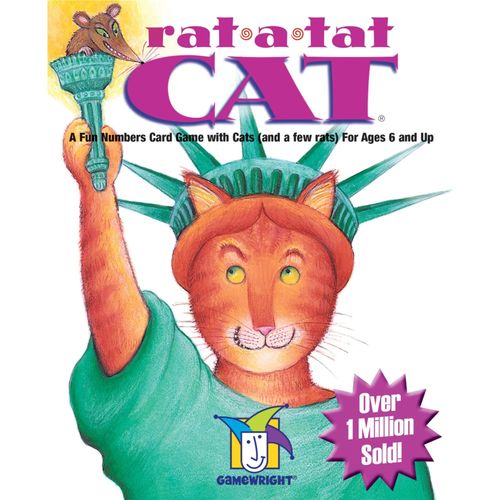
Rat-a-Tat Cat
Rat-a-Tat Cat Rulebook
Table of Contents
Table of Contents
Contents
54 cards: 28 Cat Cards, 17 Rat Cards 9 Power Cards - Peek, Swap & Draw 2
Object
To have the lowest score at the end of the game.
Set-up
Choose one player to be the dealer. The oldest player can be the scorekeeper, who will record each player's score at the end of each round of play.
Shuffle the deck and deal four cards, one at a time and face down, to each player. Stack the remaining cards face down, in the middle of the playing area, as the draw pile. Turn over the top card to start the discard pile. If that card is a Power card, turn over another card.
Without looking at your cards, place your four cards face down in a line in front of you.
Game Play
During the game, players will always have their four cards face down. To begin the game, all players secretly peek at their two outer cards once, then put them face down again. Each player now knows the point values of two of their four cards and needs to remember them during the game.
Note: If either of the outer cards are Power cards, the player keeps them, but they do not have their powers (described below). Power cards only have their powers when they are drawn from the top of the draw pile.
The player to the left of the dealer goes first, and play continues to the left.
On your turn, you may:
- Draw the top card from the discard pile. This card MUST be a number card and MUST be used to replace one of your cards. The card replaced is then discarded, face up, to the discard pile;
-OR-
- Draw the top card from the draw pile. You may use it to:
- replace one of your cards,
- Peek, Swap, or Draw 2 if it is a Power card (see below), or
- discard it face up to the discard pile.
Your choice is based on remembering the values of your four face down cards. Keep track of what you have so you won't accidentally replace your low point cards with high point cards!
Note: If the draw pile runs out, shuffle the discard pile and turn it over for a new draw pile.
Power Cards
Power cards have special abilities that help you during the game. Power cards only have their powers when you draw them from the draw pile. (You cannot use a power card dealt to you at the beginning of the game.) Because Power cards have no point value, if one of them is among your cards at the end of the game, you must replace it with a card drawn from the draw pile. (This can be risky, so you'll want to get rid of it early in the round.) Discarded power cards may not be used again by any player.
There are three kinds of Power cards:
Peek
When you draw a Peek, show the card and discard it. Then peek at any one of your cards. Now you will know what you have, or you can refresh your memory if you have forgotten what you have. This ends your turn.
Swap
When you draw a Swap, show the card and discard it. You may now switch any one of your cards with any card of another player (swapping is optional). The tricky part is that you can't look at your card, or at the card you are getting. After the swap your turn is over.
Draw 2
When you draw a Draw 2, show the card and discard it. Then you may take two more turns. First, draw the next card from the draw pile. You must decide whether to use this card and forfeit the second turn OR discard this card and draw a second card. This second card may be used or discarded. Your turn is then over. If either of the cards drawn are another Draw 2 card, the Draw 2 sequence starts again.
Ending the Round
When you think you have the lowest score and can win the round, you may end the round by knocking on the table and saying "rat-a-tat cat" at the end of your turn. Once you knock, every other player has one more turn. Each player then turns over their cards. Replace all Power cards by drawing from the draw pile, in turn order. If you draw another Power card, discard it and draw again.
Scoring
Players add the point values of their four cards. This is each player's score for the round. The scorekeeper records each player's score. Remember that players are trying to get as low a score as possible.
Next Rounds
All cards are collected and passed to the player to the left of the dealer who reshuffles and deals for the next round.
Ending the Game
The player with the lowest total score at the end of the game is the winner.
A game may be played three ways:
- Play for a certain number of rounds.
- Play for a specific length of time.
- Play to stay in the game and not reach 100 points. When you reach 100 points, you are out of the game. The last player in the game is the winner. You may also choose to play to 200, or any other number of points.
For Younger Players
When playing with younger children, leave your two outside cards face up, but leave your two inside cards face down. Each player now knows two cards of each of the other players. Only the face down cards may be swapped with a Swap card. All other rules of play are the same.
A Word from Gamewright
Rat-a-Tat Cat is not just a game of luck, but a game of skill, strategy, and awareness. As children play the game, they will develop a sense of timing and greater ease with numbers. They will learn ways to remember their cards and ways to figure out what cards other players might have. Reading other people's faces is often the key to getting the timing just right. Children will also begin to develop an intuitive sense of probability. Please write to us with your comments and suggestions. We'd love to hear from you!