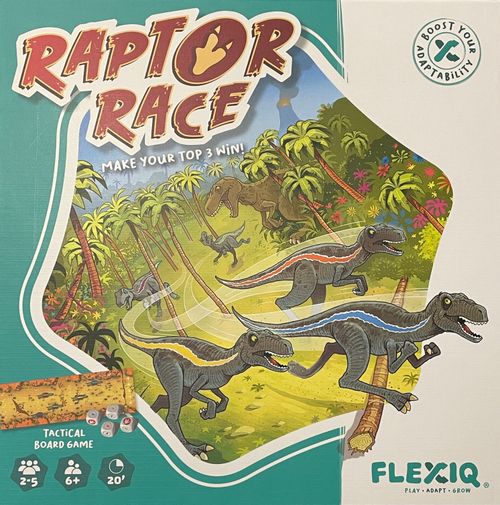
Raptor Race
Raptor Race Rulebook
Table of Contents
Table of Contents
Contents
1 game board (2-sided), 5 raptors in 5 different colours, 5 movement dice (4 'footprint' dice, 1 'arrows' die), 20 unique 'Top 3' target cards, Game Rules
Players: 2-5. Age: 6+. Playing time: 20 minutes.
Set Up
- Fold the 2-sided game board open and put the 5 raptors randomly on the starting positions.
- For the starter level, use the 'Desert'-side of the board and the 4 footprint dice.
- For the advanced level, use the 'Jungle'-side of the board and all 5 dice.
- Shuffle the 20 'Top 3' cards face down. Each player then picks 1 'Top 3' target card. Look at the card, but don't show it to the other players!
Play & Adapt
1 'Desert' Rules (Starter level)
On this track, the raptors can only move forwards & backwards in their own lanes. The game is played in turns and play continues clockwise. The youngest player starts.
First roll all 4 footprint dice. After each roll, set aside the dice you want to use and reroll the remaining dice. After each roll, you must set aside at least 1 die. You cannot reroll dice that were previously set aside. Once all dice are set aside (so after maximum 4 rolls), you must move the raptors according to the outcome of the dice.
Board icon: 'Starting positions'.
Moving the Raptors
You can decide in which order you move the raptors.
- Raptors will advance 1 step forwards for each die showing their colour.
- For each red T-Rex footprint, you must choose a raptor and move him 1 step back. If you have several T-Rex footprints, you can choose to move 1 raptor several steps back or several raptors 1 or more steps back.
- If, after advancing forwards or backwards, a raptor reaches a booster icon (i.e. a raptor footprint on the gameboard), you must choose a different raptor and move it 1 step forwards. Each time you reach or pass a booster, you activate it.
Booster: this icon indicates a game element that helps to boost your adaptability.
Example of a Turn
The starting position is Figure D1.
The player rolls the dice and the result of Roll 1 is orange, blue, blue and purple.
The player sets aside the orange die and rerolls the rest. The result of Roll 2 is orange, T-Rex, green. He then sets aside the orange and the T-Rex dice and rerolls the last die.
The result of Roll 3 is yellow. This makes the final result orange, orange, T-Rex and yellow.
Figure D1: the starting position. Figure D2: the position after the turn.
The player now moves the raptors accordingly. First he uses the 2 orange dice to advance the orange raptor 2 steps. It reaches the booster. The player uses the booster to advance the yellow raptor 1 step. Then the player uses the T-Rex die to move the blue raptor 1 step backwards. This raptor now steps onto a booster too, which the player uses to advance the yellow raptor again, which now also steps onto a booster. The player uses it to advance the orange raptor again. Finally, the player uses the yellow die to advance the yellow raptor. The final result of the turn can be seen in Figure D2.
2 'Jungle' Rules (Advanced level)
On this track, the raptors will need to switch lanes at the right time to avoid hitting the obstacles (trees or rocks). So you must use the arrows die wisely to move diagonally.
The game is played in exactly the same way as the Starter Level, but with the following additional rules:
- Start by rolling all 5 dice. You can reroll the arrows die as long as you have footprint dice to reroll.
- The number of arrows on the arrows die determines how many diagonal moves you MUST make whilst taking the steps determined by the footprint dice. This can be 0, 1 or 2 moves. So a diagonal move is always linked to a move forwards or backwards.
Beware
- Raptors cannot advance to a space that is occupied by another raptor or to a spot with an obstacle (so they must run around it).
- If a raptor is blocked and cannot move forwards, he must step sideways. If sideways is blocked too, he will not be able to move this turn and stays in the same spot.
- When using your T-Rex footprints to move a raptor 1 or more steps back, you can only choose raptors who can move backwards to a free spot. This move backwards can be diagonal if your arrows die allows this.
Example of a Turn (Jungle)
After rolling and rerolling the dice, the dice outcome is 2 blue, 1 green, 1 T-Rex and 2 diagonal moves.
Note: Section C contains a booster icon under the raptor. Figures J1, J2 and J3 show the board positions described below.
The player wants to advance the blue raptor as far as he can and to bring the orange raptor back. J1 shows the starting position. He plays 1 blue die and advances the blue raptor to (A). The blue raptor can't advance anymore, it is blocked by an obstacle in the front and a raptor to the right (orange raptor). The orange raptor is blocked by a palm tree from behind, so the player uses both the T-Rex die and one diagonal movement to send the orange raptor to point (C). The orange raptor lands on a booster at point (C). The player uses it to advance the blue raptor, but since he still has a rock in front of him, the blue raptor will move sideways to point (B) - see J2.
Now the player uses the second blue die to advance the blue raptor, but because the yellow raptor is in front of him he moves sideways again to point (D). The booster at point (D) allows the player to advance the yellow raptor to point (E) which also has a booster and the player uses that booster to advance the blue raptor again to point (F). Finally the green die is used to advance the green raptor to the booster at point (G) and the player uses it with the second diagonal move to advance the blue raptor to point (H) - see J3.
End of the Game - The Winner!
The game ends immediately when the first raptor crosses the finish line.
Note: You can tactically use certain dice before making a raptor cross the finish line. Once the raptor crosses the line, the remaining dice cannot be used anymore.
Now all players score points according to the end location of the raptors on their Top 3 target card as follows:
- If the 1st raptor on your card reaches the 1st place in the race, you earn 10 points.
- If the 2nd raptor on your card reaches the 1st or 2nd place, you earn 8 points.
- If the 3rd raptor on your card reaches the 1st, 2nd or 3rd place, you earn 5 points.
- If the 3 raptors on your card match the Top 3 in the game, even in the wrong order, you earn a bonus of 3 points.
The player with the most points, wins the game!
Note: If 2 or more raptors finish in second place, each player can choose which one is in second place and which one is in third place. If 2 or more raptors finish in third place and if there are no raptors tied for second place, each player can choose which raptor is in third place (See example).
Example of Scoring
The game ends when the blue raptor crosses the finish line.
The printed example shows each player's Top 3 card (slots 1, 2 and 3) with the points earned:
| Player | Card slot 1 (points) | Card slot 2 (points) | Card slot 3 (points) | Top 3 Bonus | Total |
|---|---|---|---|---|---|
| Player A | Blue (10) | Purple (0) | Green (5) | 0 | 15 |
| Player B | Purple (0) | Yellow (8) | Orange (5) | 0 | 13 |
| Player C | Orange (0) | Yellow (8) | Blue (5) | 3 | 16 |
Player A has the blue raptor at the first place and the green raptor at the third place (tied with the orange raptor), scoring him a total of 15 points. Player B has the yellow raptor at the second place and the orange raptor at the third place (tied with the green raptor), scoring him a total of 13 points. Player C has the yellow raptor at the second place and the blue raptor at the third place. His orange raptor didn't manage to get first place but he has the 3 raptors on his target card, giving him 3 bonus points, scoring him a total of 16 points and winning the game for him.