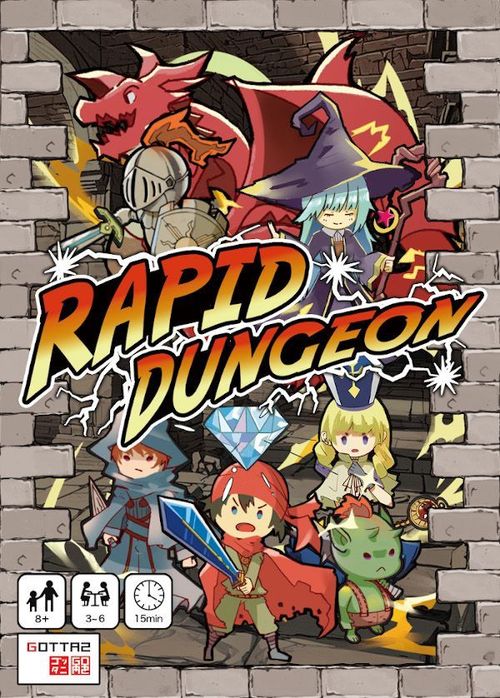
Rapid Dungeon
Rapid Dungeon Rulebook
Table of Contents
Table of Contents
Game Setup
- Dungeon Cards: Place cards with "life 4" faced up in the center of the table. This means the maximum life of each player becomes 4.
- Sponge Pawns and Life Cards: Take 1 sponge pawn and 1 life card. Indicate your remaining life by the direction or the face of the life card. Set your life to 4.
- Exploration Cards: Remove traps, thieves, potions and unicorns. Return the removed cards to the box. Shuffle all other cards. Deal 7 cards to each player. Place dealt cards face down in front of you as your deck.
- Determination of the Start Player: The player who dealt the cards becomes the start player. Discard pile will be created next to the start player. Once set up, proceed to "Game Start".
Game Start
- Time to Explore!
- Each player places a top card of their deck face down near the dungeon card.
- Simultaneously flip them face up with the chant "123!". If there are no cards left in the deck, proceed to "End of Game."
- Throw the Adventurer (Sponge Pawn)! Quickly throw your adventurer onto the revealed exploration card you want to get. Your adventurer cannot be placed onto the card you just revealed.
- Get the Exploration Cards!
- Successful Exploration: If your adventurer lands on an exploration card and its color matches the exploration card's color (light/dark), your adventurer succeeded in the exploration! If it succeeds, you acquire that exploration card. If several adventurers are placed onto the same exploration card, proceed to "(3) Judgment."
- Failed Exploration:
- A: The adventurer doesn't land on the card.
- B: The color of the adventurer doesn't match the exploration card's color.
- C: Judged as the failed exploration. Lose 1 life.
- If your life reaches to 0: If possible, discard one acquired exploration card and heal to your maximum life.
- Judgment:
- A: Overlapping adventurers. All adventurers except the bottom one fail the exploration.
- B: The adventurer who has occupied the largest area of the exploration card succeeds, while others fail.
- C: If several adventurers occupied the almost equal area of the card. Those adventurers fail the exploration.
Game End
- Scoring!
- Count the points indicated on acquired exploration cards.
- Count bonus points based on combinations of exploration cards (refer to Dungeon Cards).
- Sum up (1) and (2).
- The player with the highest score wins!
- In case of a tie, the player who got more exploration cards wins.
- If the number of the acquired cards is also tied, both players win.
Scoring example (figure 13 of the rulebook): the printed points on the acquired cards are 1 + 1 + 1 + 2 = 5 (group 1), and the bonus points from combinations are 2 + 2 + 6 + 7 + 12 = 29 (group 2), for a total of 34.
Dungeon Cards
The Dungeon Cards are the variant dungeons.
- Various Additional Dungeons
- You can create various dungeons by combining the exploration cards (variant rules).
- The game rounds can change from 7 to 11 depending on the rules you apply.
- Types of Additional Dungeons
- "Dungeon Entrance": Beginner (figure 14) / Advanced (figure 15).
- "Dungeon Depths": Beginner: Unicorn (figure 16) / Potion (figure 17) / Thief (figure 18). Advanced: Unicorn x Potion (figure 19) / Unicorn x Thief (figure 20) / Potion x Thief (figure 21). Boss Battle: Goblin King (figure 22) / Elder Dragon (figure 23).
- Presence of "Traps"
- Contents of Additional Dungeons
- "Dungeon Entrance"
- This dungeon can be played independently with 7 rounds.
- Additional Rules for Game Setup: Place the chosen "Dungeon Entrance" in the center of the table.
- Additional Rules: For Beginners' game, maximum life is 4. For Advanced players' game, maximum life becomes 2 and bonus points are applied. Follow this rule to set the initial life of each player during Game Setup.
- Bonus scoring table printed on the "Dungeon Entrance" cards (figures 14 and 15, and figure 13 for the scoring example). Beginner (figure 14): diamond = 2 (A); chest + key = 12 (B); red + yellow + blue = 6 (C); goblins (D): 1 goblin = 2, 2 = 4, 3 = 7, 4 = 11, 5 = 16, 6 or more = 22. Advanced (figure 15): diamond = 3 (A); chest + key = 18 (B); red + yellow + blue = 9 (C); goblins (D): 1 goblin = 3, 2 = 6, 3 = 11, 4 = 17, 5 = 24, 6 or more = 33.
- "Dungeon Entrance"
Q&A
- Q1. I accidentally placed my adventurer on an exploration card I just revealed. What happens?
- A1. Your adventurer fails the exploration.
- Q2. What happens if several players acquire Thief cards?
- A2. Take action from the player who has acquired fewer exploration cards.
- Q3. What if the number of acquired exploration cards is the same?
- A3. Take action clockwise from the start player.
Manner
Let's enjoy the game and have good manners!
- You must throw the adventurer. (figure 30)
- OK: Throw your adventurer at opponents' adventurers to push them out from the exploration card!
- NG: Push an opponent's adventurer out while holding your own in your hand. Do not throw the adventurer with all your might.
- Let's discuss together when making judgment!
Game Flow
The game flow chart in the rulebook reads as follows.
- Game setup
- Are there additional dungeons?
- No: go to Game start.
- Yes: Setup with additional dungeons, then go to Game start.
- Game start
- Play the exploration card.
- If there is no deck: go to Game End.
- If there is a deck: Throw adventurers, then Search card acquisition.
- Search card acquisition
- Exploration succeeded: Get the exploration card!, then return to Game start.
- Exploration failed: Lose 1 life.
- If your life is not 0: return to Game start.
- If your life becomes 0: Discard 1 acquired exploration card. Heal to full life, then return to Game start.