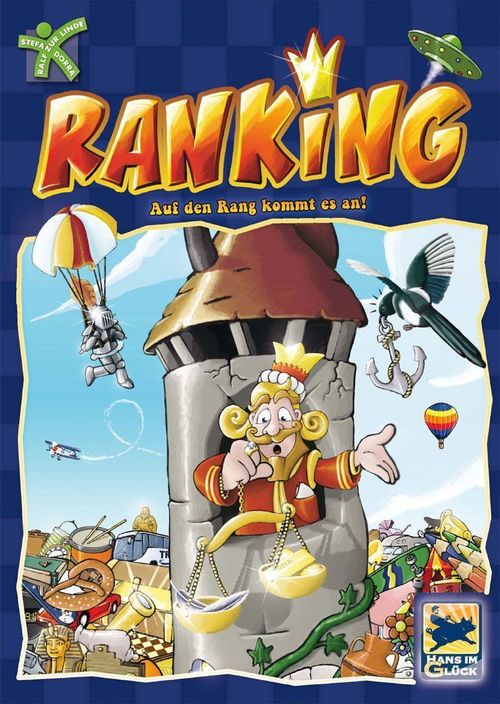
Ranking
Ranking Rulebook
Table of Contents
Table of Contents
Components
For 3-5 players, ages 8 and up, 30-45 minutes.
- 1 Tower
- 46 double-sided Question Tiles
- 1 Cloth Bag
- 5 Player Tiles in 5 different colours
- 5 Scoring Stones in 5 different colours
- 20 Guess Stones in 5 different colours
- 120 Picture Tiles
Setup
- Assemble the Tower and place it where everyone can reach it.
- Players decide first which side of the Question Tiles they want to play with (the red or blue patch on the flags). Both sides are equal, so there are no "easy" or "hard" questions. Then put all the Question Tiles into the Cloth Bag. Place the bag next to the Tower.
- Each player chooses a player colour and takes:
- One Player Tile in his colour, which he places in front of himself.
- One Scoring Stone in his colour, which he places on the lowest space of the Tower (the space marked 0), with the arrow point facing up.
- One Guess Stone in each of the other players' colours, which he places in front of himself.
- Special case: in a three-player game, each player receives 2 Guess Stones in each of the other players' colours.
- Shuffle the 120 Picture Tiles and place them face down in several stacks of any size as a supply. Each player draws 6 Picture Tiles, takes them into his hand and does not show them to the other players.
- The youngest player becomes the starting player.
The game can begin.
Examples of distributing the Guess Stones:
- Example for 4 players: If players in blue, yellow, green and red take part, then, for example, the red player receives 1 red Player Tile, 1 red Scoring Stone, and 1 blue, 1 yellow and 1 green Guess Stone.
- Example for 3 players: If players in blue, yellow and red take part, then, for example, the red player receives 1 red Player Tile, 1 red Scoring Stone, and 2 blue and 2 yellow Guess Stones.
If there are fewer than 5 players, the unused Player Tiles, Scoring Stones and Guess Stones are returned to the box.
Course of the Game
The game is played over several rounds. Each round is structured as follows:
- A. Reveal a Question Tile and place Picture Tiles
- B. Compare 2 Picture Tiles in turn and place Guess Stones
- C. Collect Victory Points
A. Reveal a Question Tile and Place Picture Tiles
The starting player draws a Question Tile from the bag. He places the Question Tile at the top of the Tower (with the side the players agreed on facing up) and reads the question aloud. The question could be, for example: "What is more valuable?"
Now all players simultaneously choose a Picture Tile from their hand and place it face down next to the Tower.
Tip: Picture Tiles that fit the question usually earn their owner more points during scoring.
Once all players have placed a Picture Tile, the starting player adds further Picture Tiles from the supply until there are 7 Picture Tiles there. He shuffles these well, so that the players do not know who placed which Picture Tile. The players know only their own Picture Tile. He then lines up the Picture Tiles in a row next to the 3rd floor of the Tower and turns them face up.
B. Compare 2 Picture Tiles in Turn and Place Guess Stones
1. Compare Picture Tiles
The starting player compares 2 Picture Tiles of his choice.
He decides which of the two chosen items fits the question better in his view. He comments on this decision with a more or less convincing reason. Then he pushes the Picture Tile that he thinks fits better one floor up, and the other one floor down. Afterwards he moves all the Picture Tiles back up against the Tower, so that no gap is left.
The next player in clockwise order then takes his turn and, as just described, compares two Picture Tiles.
When comparing, note that the two Picture Tiles must be on the same floor of the Tower.
Example: The player compares two items on the same floor and judges which is more valuable. Here he chooses the drum and the wing. He says: "The drum is a valuable rarity, a one-of-a-kind handcraft with excellent sound. The wing, on the other hand, is completely out of tune, the varnish is scratched, and there is probably a family of woodworms living in it." He moves the wing one position down (to floor 2) and the drum one position up (to floor 4).
After the comparison, the display looks as follows:
Note: Players are free to interpret the items on the Picture Tiles in whatever way they like while comparing. For example, a player may just as well interpret the suitcase as a trip around the world or as a move.
In this way a ranking (Rangliste) develops over the course of the round, in which the Picture Tiles spread across the different floors. During a round, players may compare the Picture Tiles with each other as often as they like.
The round ends when, after a comparison, 1 Picture Tile is at the very top on floor 6 and 1 Picture Tile is at the very bottom on floor 0, as shown in the illustration on the left.
2. Place Guess Stones
The players try to guess which Picture Tile belongs to the player who has just carried out a comparison. The corresponding Picture Tile can be marked with a Guess Stone in the colour of that player. A correct guess means that the Picture Tile earns fewer points during scoring.
Immediately after a player has carried out a comparison, each other player may (but is not obliged to) place exactly one Guess Stone on any Picture Tile; however, only stones in the colour of the player who has just carried out the comparison may be used. This also applies when a player's comparison ends the round.
The Picture Tile that is marked does not have to have been moved, and several Guess Stones may land on one and the same Picture Tile. There are no restrictions on the number or colour combination of Guess Stones that may lie on a Picture Tile.
Picture Tiles on which Guess Stones lie can still be used for comparisons. The Guess Stones lying on them stay on the Picture Tiles when they are moved.
A Guess Stone that has been placed is only removed at the end of the round.
Example: Because the yellow player has moved the drum up, Red and Blue suspect that the drum belongs to the yellow player, and each places 1 yellow Guess Stone on the drum.
C. Collect Victory Points
Now the secret of the Picture Tiles is revealed. The player who carried out the last comparison and ended the round points at each Picture Tile lying out, one after another from bottom to top, and asks who owns it. The player who owns it announces himself. He counts the Guess Stones in his colour on his Picture Tile. He subtracts the number of Guess Stones from the number of the floor on which the tile lies. Then he moves his Scoring Stone up the Tower by the remaining number of points.
Guess Stones in other colours have no influence on scoring.
If a player has more Guess Stones on his Picture Tile in a round than the number on the floor indicates, he does not move his Scoring Stone backwards and does not move it in this round.
Example: The yellow player's Picture Tile (the drum) is on floor 6 at the end of the round. There is 1 red and 2 yellow Guess Stones on the tile. The yellow player therefore subtracts 2 (for the Guess Stones) from the 6 points (the floor number) and moves 4 spaces up the Tower.
If a Scoring Stone reaches the roof space (the 7th step of the Scoring Stone), the player turns it so that the point faces down, and moves it down on the following steps.
Example: The yellow and the red player have both made 6 points so far. Their Scoring Stones are therefore on floor 6. In this round the yellow player makes 1 point and the red player makes 2 points. The yellow player's Scoring Stone then ends in the roof, and the red player's Scoring Stone is back on floor 6. However, both Scoring Stones now point downwards.
A New Round
After each round, all Picture Tiles are removed from the board and taken out of the game. Each player takes back his Guess Stones (those in the colours of the other players). In addition, each player draws a new Picture Tile from the supply, so that he again has 6 to choose from in his hand. The old Question Tile is also removed from the game and replaced by a new Question Tile from the bag. The player to the left of the player who ended the round becomes the new starting player. Steps A, B and C are then repeated until a Scoring Stone has moved 15 or more steps. This is exactly the case when a Scoring Stone is pulled out of the Tower again.
End of the Game
The game ends as soon as a player's Scoring Stone has left the Tower. The scoring is nevertheless completed. The player whose Scoring Stone leaves the Tower again wins the game and may call himself the one true "Ran King".
If the Scoring Stones of several players reach the goal in the same round, the player who would move further beyond the goal wins. If this is also equal, all of these players win.