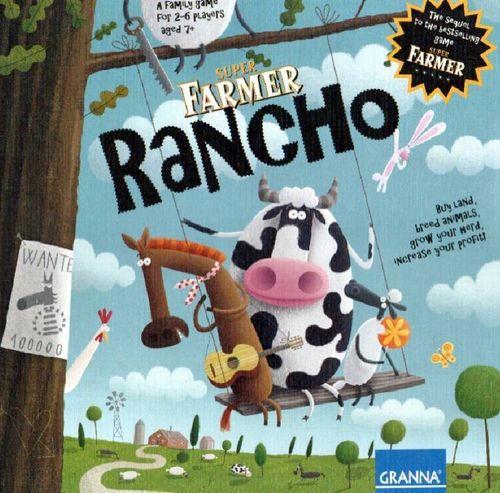
Rancho
Rancho Rulebook
Table of Contents
Table of Contents
Components
- board
- 96 animal tokens
- 3 large dog figures
- 3 small dog figures
- two twelve-sided dice
- a six-sided die
- coloured discs (markers)
- rulebook
The board shows the forest in the centre, surrounded by rings of pastures costing 1, 2 and 4, and the players' pens around the edge.
Object of the Game
You breed animals and have the ambition to own the best ranch in the neighbourhood. You buy pastures so that your animals have somewhere to live. The animals breed, and that brings you profit.
You may exchange the animals you have bred for others if you decide it pays, or buy more pastures so you can have more animals. To win, you must assemble a herd consisting of at least a horse, a cow, a sheep and a rabbit faster than the others.
However, all your plans may remain only dreams if you are not careful enough, because predators roam the nearby forest – the wolf and the fox. Your animals can easily fall prey to them.
Setup
Place the board in the middle of the table. Take the appropriate animal tokens and figures out of the box and place them next to the board. They will form the herd. The number of animals used depends on the number of players, according to the table below.
| Number of players | 2 | 3 | 4 | 5 | 6 |
|---|---|---|---|---|---|
| Rabbits | 20 | 30 | 40 | 50 | 60 |
| Sheep | 6 | 9 | 12 | 15 | 18 |
| Cows | 4 | 6 | 8 | 10 | 12 |
| Horses | 2 | 3 | 4 | 5 | 6 |
| Small dogs |
Set the remaining tokens and figures aside.
Each player takes all the round markers of one colour and places them in front of them on the table, takes the pen of the same colour (two adjacent spaces of one colour on the edge of the board) and places in it 1 sheep and 1 rabbit taken from the herd. If 2 people are playing, they should take pens on opposite sides of the board; 3 players take every other pen; and with 4 players, 2 opposite pens should be left free.
You are ready to play.
Playing the Game
Players take turns clockwise. The player who most recently saw a cow begins. Each player's turn consists of 2 consecutive steps – first they expand their ranch, then they breed their animals.
1. Expanding the Ranch
The player may – in any order – buy new pastures and exchange any number of their own animals for others. If the player does not want to buy pastures or exchange animals, they go straight to the second step of their round, breeding animals.
Exchanging Animals
The player exchanges their own animals with the herd. The prices are marked in two rows along the edges of the board. An exchange is only possible if there are enough animals in the herd.
The player may exchange:
- 1 sheep = 6 rabbits
- 1 cow = 2 sheep
- 1 horse = 2 cows
- 1 small dog = 3 rabbits
- 1 large dog = 6 rabbits
- pasture costing 1 = 1 rabbit
- pasture costing 2 = 2 rabbits
- pasture costing 4 = 4 rabbits
Of course, exchanges in the other direction are also possible (e.g. 6 rabbits can be exchanged for 1 sheep), as are more complex exchanges.
Example:
- 1 sheep for a small dog and 3 rabbits (because a sheep is worth 6 rabbits and a small dog 3 rabbits).
- 2 sheep, a small dog, a large dog and 3 rabbits can be exchanged for 1 horse (a small dog and 3 rabbits can be exchanged for 1 sheep, a large dog is worth 6 rabbits, so it can be exchanged for 1 sheep, 4 sheep can be exchanged for 2 cows, and 2 cows for a horse).
Buying Pastures
The player buys new pastures (the green spaces on the board), paying for them with animal tokens. The number on a pasture is its price in rabbits. Pastures cost 1, 2 or 4 rabbits. The player may buy any number of pastures. All of a player's pastures must form one common area and be connected to their pen.
The player marks purchased pastures by putting round markers of their colour into the holes. Pastures may also be bought by paying with animals other than rabbits, and buying pastures may be combined with exchanging animals. A pasture once bought cannot be sold or exchanged.
Example:
- For 1 sheep, the player buys 2 pastures, one for 2 rabbits and one for 4 rabbits (because a sheep is worth 6 rabbits).
- For a cow, the player buys 1 sheep and 3 pastures worth 2 rabbits (because 1 cow is worth 1 sheep and 6 rabbits).
2. Breeding Animals
The player rolls the two twelve-sided dice.
Each species of farm animal that is rolled on the dice may breed. The player adds the animal rolled on a die to those of the same species they already have on their own pastures and in their pen. For each full pair of animals, the player receives one new animal of that species from the herd.
Example: A player has 2 sheep and 5 rabbits. If the dice show:
- 2 rabbits – the player receives 3 rabbits (in total they have 7 rabbits, i.e. 3 pairs),
- a rabbit and a sheep – the player receives 3 rabbits and 1 sheep (in total they have 6 rabbits, i.e. 3 pairs, and 3 sheep, i.e. 1 pair),
- a rabbit and a cow – the player receives 3 rabbits (in total they have 6 rabbits, i.e. 3 pairs),
- 2 sheep – the player receives 2 sheep (in total they have 4 sheep, i.e. 2 pairs),
- a cow and a sheep – the player receives 1 sheep (in total they have 3 sheep, i.e. 1 pair),
- 2 cows – the player receives 1 cow (2 cows make 1 pair),
- a horse and a cow – the player gains nothing (there is no pair).
Animals that were not rolled on the dice do not breed, even if the player has full pairs of them on their pastures. If the herd runs short of animals of a given species, the player does not receive all the animals, but only as many as there are in the herd.
Example: A player has 11 rabbits on the board, and a rabbit was rolled on both dice. They should get 6 new rabbits, but there are only 4 in the herd, and that is all the player receives.
Space for Animals
The player must have room on their pastures and in their pen to place newly gained animals. Animals are of different sizes and take up more or less space:
- 6 rabbits fit on one space (stack them),
- 1 sheep fits on one space,
- a cow needs two adjacent spaces,
- a horse needs three adjacent spaces,
- small and large dogs do not need pastures (keep them next to your pen).
If the player does not have room on their pastures and in their pen for all the animals, they must return some of them to the herd. Before that, however, they may freely rearrange the animals on their pastures. The player may also rearrange animals when they gained no new animal from the dice roll.
The Wolf and the Fox
If a fox or a wolf is rolled on one of the dice, a predator has come out of the forest and threatens the grazing animals. The player rolls the six-sided die to find out which pastures are threatened.
If a fox or a wolf is rolled on one die and a farm animal on the other, the player first rolls the six-sided die and only afterwards breeds their animals.
If a fox is rolled on one die and a wolf on the other, the player decides which of the predators attacks first. If 2 foxes or 2 wolves are rolled, the player rolls the six-sided die twice.
Effects of Rolling a Fox or a Wolf
If a fox is rolled on a twelve-sided die, the rabbits on the pastures of the price shown by the six-sided die are removed from the board – those of all players.
If a wolf is rolled on a twelve-sided die, the sheep, cows and horses standing wholly or partly on the pastures shown by the six-sided die are removed from the board – those of all players.
Only animals placed entirely in a pen are always safe.
Example: A fox was rolled on one of the twelve-sided dice, and the six-sided die showed the pastures costing 1. All the rabbits on the pastures adjacent to the forest are removed from the board. The fox is no danger to sheep.
Example: A wolf was rolled on one of the twelve-sided dice, and the six-sided die showed the pastures costing 4. All sheep, cows and horses standing wholly or partly on those pastures are removed from the board. Rabbits stay on the board, as the wolf does not threaten them.
Dogs
Dogs defend the players' animals against attacks by the wolf and the fox.
If a player has a small dog, they may return it to the herd instead of the rabbits they would have to remove from the board after a fox was rolled.
If a player has a large dog, they may return it to the herd instead of the animals they would have to remove from the board after a wolf was rolled.
Example: A wolf was rolled on one of the twelve-sided dice, and the six-sided die showed the pastures costing 4. The player gives up a large dog, thereby saving 3 sheep.
End of the Game
The game ends immediately when one of the players has at least one rabbit, sheep, cow and horse on the board. The player who completed a full herd first can boast the best ranch in the neighbourhood and wins!
Frequently Asked Questions
What happens when a player gets blocked?
If a player has been blocked because other players have bought the spaces near their pen, they may buy free spaces on the board. However, to make the purchase, they must make a one-time payment to the opponent for passing through their space or spaces equal to what they are worth. In addition, they pay the normal value of the purchased space to the herd.
Example: The Orange player has been blocked by the Blue and Purple players. To buy the spaces marked with letters, Orange must pay the normal value of the space to the herd and additionally pay:
- for access to space A – 2 rabbits to Blue,
- for access to space B – 2 + 2 = 4 rabbits to Blue,
- for access to space C – 2 rabbits to Blue,
- for access to space D – 2 rabbits to Blue or 2 rabbits to Purple (the player may choose which opponent to pay),
- for access to space E – 2 rabbits to Purple,
- for access to space F – 2 + 1 = 3 rabbits to Purple.
So when buying the space marked E, the Orange player gives 2 rabbits to the herd and 2 rabbits to the Purple player. If Orange has bought space E, for space F they give only 1 rabbit to the herd.
What is the point of rearranging animals?
At the end of their turn, a player may rearrange the animals on their pastures in order to protect them from predator attacks.
Example: A player rolled a cow on both dice and so gained that animal. Since they only have free spaces on the inner and middle rings, they would have to place the cow there. However, that spot is very dangerous, because if any player rolls a wolf, there is a very high chance of losing the cow. So the player moves the cow into the pen and moves 1 sheep and 6 rabbits from the pen to its place.