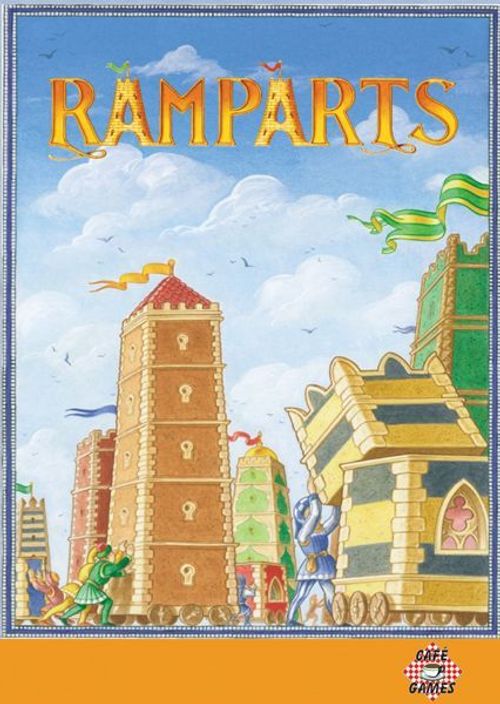
Ramparts
Ramparts Rulebook
Table of Contents
Table of Contents
Objective
Players try to move their pieces or towers onto the symbol spaces in order to score as many points as possible. The player with the most points wins.
Contents
- 1 game board
- 80 pieces with 4 different symbols
- 1 rulebook
Setup
Place the board on the table. The board is made up of 8 developing districts of the city of towers, each with four different building plots (the spaces marked with symbols). The streets of the city run around the districts.
Each player chooses a color. If there are only 2 or 3 players, apply the additional rules at the end of this booklet. There are 4 different symbols on the pieces, matching the symbol spaces on the board. Each of the 4 symbols appears 5 times in each of the 4 colors.
Place the 80 pieces face down and shuffle them. Then distribute them over the 80 street spaces. Do not place any piece on a building-plot space with a symbol! It is recommended to start in one corner of the board and then fill in the spaces row by row.
Choose a player to begin. Play continues turn by turn, clockwise.
Gameplay
On their turn, a player moves a tower or a piece of their color. Then it is the next player's turn.
A tower is a stack of two or more pieces. All the pieces in a tower must have the same symbol.
A tower always belongs to the player whose color is on top.
A tower can never be more than 5 pieces high; at that height it is safe and can no longer be captured by a piece or a tower. It can then be moved onto a symbol space without danger (see "Symbol Spaces" below).
A tower can never be split up; it must remain whole when it moves or when it stacks onto another piece or another tower.
A tower may — in keeping with the movement rules below — move onto another piece or another tower.
Movement
In these rules, "tower" is used to mean a stack of anywhere from one to five pieces.
A tower may move vertically or horizontally, never diagonally. It may not change direction during its move.
A tower may be moved any number of spaces, in a single direction. It may pass freely over all towers of its own color (regardless of symbol) as well as over unoccupied spaces. It is therefore forbidden to pass over an opponent's towers!
A tower may end its move on a free space or on a tower of the same symbol (regardless of color). You may not move a tower onto a tower with a different symbol.
Important: it is forbidden to stack a tower onto a tower of a different symbol.
Example 1: The piece marked A on the left:
- May move to a free space.
- May not land on a piece of a different symbol, at B.
- May, however, move over a tower of the same color (at B) in order to end on a tower of the same symbol.
Example 2: The piece marked A on the left:
- May not land on a tower of a different symbol at B.
- May not pass over a piece of a different color even to land on a piece of the same symbol.
- For the same reason, may not reach the free space by passing over one or more opposing towers.
A tower may only land on a symbol identical to its own. See the following example.
Example 3: The piece marked B on the left:
- May not move onto the different symbol to its right (at A).
- May land on the identical symbol at B.
- May also land on the tower marked B to the right, since it is the same symbol.
Only identical symbols may be stacked on each other.
A tower may pass over a symbol space just as it would over any empty space. A player may likewise pass freely over a symbol space occupied by a friendly tower, as normal.
If a player is temporarily unable to move, they pass their turn until they are able to play again.
There may only be one tower per space!
Symbol Spaces
Only towers on a symbol space score points at the end of the game.
A player may move one of their towers onto a symbol space during their turn. But be careful! A tower placed on a symbol space can no longer leave it for the rest of the game!
A player who brings a tower onto a symbol space may immediately play again, with another tower of course.
If, in this way, a player again brings a tower onto a symbol space, they may play again once more.
End of the Game
The game ends as soon as all four building plots of exactly one district are occupied by towers of the same color.
Each player's points are then determined using the counters or the corresponding towers of a single color, and the game ends immediately. Each player's points are determined as follows:
Only towers located on one of the 32 building plots score points.
Each level of a tower is worth one point to its owner. So a tower of 5 pieces is worth 5 points to whoever holds the top of it.
Towers in the district that triggered the end of the game score double for their owner.
The player with the most points wins the game.
The game can also end earlier if:
- There are no more towers left in any street.
- A player can no longer move because all the towers they control are already on a symbol space, and therefore immovable.
In this case, players simply count the points they have scored in the various zones up to this point.
Rules for 2 or 3 Players
Each player chooses one of the four colors. All the pieces are placed on the board as in the rules for four players.
In the four-player game, a player may only move towers belonging to them. With 2 or 3 players, the remaining colors are treated as neutral pieces, meaning that any player may move them:
- with 3 players, there is 1 neutral color;
- with 2 players, there are 2 neutral colors.
On their turn, a player may move a tower of their own color or a neutral piece.
If a player moves a neutral piece, that same piece may not be moved again by the other players on that same turn.
If a player moves their own tower onto an opposing or neutral piece of the same symbol, they form a tower as usual.
Neutral pieces can never be moved onto a piece or a tower to form a tower. They can only pass over other towers (so of any color) and, of course, over empty spaces.
On the other hand, a player's tower can never pass over a neutral piece.
Variant
Towers may be of any size (that is, they are no longer limited to a size of 5 as in the normal rules). Using this rule, a player must pay much closer attention to their towers, since they are never safe!
Tactics
The best way to learn is by playing. Every game situation is always unique since the pieces are placed differently each game. A player always has many useful moves available.
Before making their first move, players should try to get an overview of the position of the pieces on the board. Players should pay particular attention to the position of their own pieces as well as to the threats they may face from their opponents.
The earlier a player moves their towers onto a symbol space, the greater the danger that this position will be taken by an opponent.
A threat in one district can distract certain opponents who will fail to see real threats elsewhere.
By using the rule that allows an extra move — when a tower is placed on a symbol space — a player can quickly end the game. But the player who ends the game is not necessarily the one with the most points, and therefore not necessarily the winner!