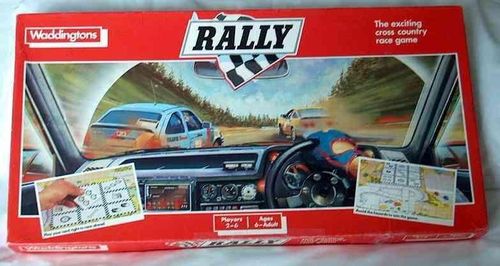
Rally
Rally Rulebook
Table of Contents
Table of Contents
Contents
- 1 Playing Board and Card Grid
- 44 Cards: 10 each with different numbers of tyres, spanners, petrol pumps or stop watches
- 4 Wild Cards
- 6 cars: red, green, yellow, blue, orange and white
- 1 Chequered Flag
- Set of Rules
Object of the Game
The Playing Area represents a cross-country rally route, with various hazards and obstacles on the way.
The Object of the Game is to be first past the chequered flag.
How to Play
- Each player chooses a car and puts it on the appropriate starting square.
- Shuffle the 44 cards well and place them face down at the side of the board. The top card is then placed face up in the centre of the card grid. Decide who is to start.
Using the Cards
- The first player takes the top card from the pack and places it face up on one of the 9 squares in the card grid. The card must not be placed on top of a square showing the same kind of symbol. For example, any tyre card cannot be placed on top of any other tyre card.
- You should try to place your card so that it completes a row of three cards, all of which show the same kind of symbols. A row may be made either horizontally, vertically or diagonally. If you make such a row of three cards, you count up the total number of symbols in that row, and you move your car forward along the track that number of spaces. See Diagram 1.
- If you can make more than one row of 3, then you can count the total number of symbols in each row that you have completed. See Diagram 2.
- If you are unable to make a row of three, you may place your card on any square (subject to Rule 3) and you move your car the number of spaces shown by that single card.
- The next player plays in a similar way and the play continues like this. Turns are taken in a clockwise direction.
The Wild Cards
- There are 4 Wild Cards in the pack. Each card shows one each of the symbols (tyre, spanner, petrol pump and stop watch) and a number from 1 to 4. You may place a Wild Card on any square in the card grid, regardless of what is already on that square. A Wild Card can be used to complete rows of 3, and counts as the number shown on the card. You can only use the Wild Card as one type of symbol in your turn. If you cannot complete a row of 3 with the Wild Card, then you place the card on any square in the grid and count only the number shown on the card. In subsequent turns, if the Wild Card remains uncovered, it can be used as any one of the 4 symbols in each turn, and can be used to complete other rows. See Diagram 3.
Moving your Rally Cars
- Cars can only be moved forwards, either in a straight line or diagonally. Cars cannot reverse or move sideways. Where the track narrows, the blue arrows show which route you must take. Diagonal moves must always be in a forward direction and you cannot move diagonally across any of the bales of straw. Your car cannot jump over any other car or any of the obstacles on the rally circuit (these include floods, bushes, rockfalls, avalanches and fallen trees).
- If your route ahead is blocked by another car, you can move up to the next unoccupied space behind the other car (if your card total is big enough). But you must then wait there until the road ahead is clear. See Diagrams 4 and 5.
- In the event that your route ahead is completely blocked and you cannot move your car when it is your turn, you still pick up a card and place it in the card grid.
The Chequered Flag
- The Chequered Flag is used to mark the finishing line of the rally race. It is placed across the Starting Grid as soon as all the cars in the race have left the Grid.
Using all the Cards
- If all the cards in the pack have been used up before the race is won, they are collected from the card grid, shuffled well and placed face down at the side of the board. The top card is then placed face up in the centre square of the card grid and play continues as before.
The Rally Winner
- The first player to go past the Chequered Flag is the Winner.
Variations
The insert prints two rules numbered 14 (The Rally Winner, above, and the first Variation below). Numbering is transcribed as printed.
- Rules 1 to 13 are for a one circuit Rally Race. For a longer game, play two or more circuits.
- For four, five or six players, use one car each and return any spare cars to the box. For a two-player or three-player game, each player may race a single car or more than one car. If you are racing more than one car each, you may move only one car in each turn but you can choose which one you move. To win the rally, you must be the first player to get all your cars past the chequered flag.
Advanced Game
The following rules are for a more strategic rally race, in which each player has a choice of which card to play on his or her turn. This means that you have a chance to play your cards more strategically and you can take advantage of different situations as they develop throughout the race.
- Each player chooses a car and puts it on the appropriate starting square. Decide who is to start.
- The 44 cards are shuffled well and 3 cards are dealt face down to each player. The remaining cards are placed face down at the side of the board. The top card from the pack is then placed face up in the centre of the card grid.
- The first player places in the grid any one of the three cards in his or her hand. The standard game rules apply for placing cards and moving the cars. The second player does the same, and so on until each player has played all three of his or her cards.
- A further 3 cards from the pack are then dealt to each player and play continues in this way. If all the cards in the pack have been used up before the race is won, they are collected from the grid, shuffled well, and 3 cards are again dealt face down to each player. The remaining cards are placed face down at the side of the board, and the top card from this pack is placed face up in the centre square of the card grid. Play continues as in Rule 18.
Diagrams
The insert's diagrams are reproduced here as their printed captions, with a description of each picture.
Diagram 1. The card grid shows a row of three cards all showing tyres, and the card just placed is marked "You have just placed this card."
A row of three cards all showing tyres has been made. The total number of tyres in this row is 6, so you can move your car forward 6 spaces.
Diagram 2. The card grid shows three completed rows of tyres. The card just placed is marked "You have just placed this card."
You have completed three rows of tyres, and the total number of tyres is:
8 horizontally 8 vertically 7 diagonally
You can move your car forward a total of 23 spaces.
The tyres in the other diagonal row (totalling 4 tyres) do not count, as you did not complete this row.
Diagram 3. The card grid shows a Wild Card showing the number 2, marked "You have just placed this Wild Card."
The Wild Card has completed two rows of tyres. The total number of tyres is:
6 horizontally 6 vertically
You can move your car 12 spaces forward.
The diagonal row of spanners also completed by the Wild Card does not count, as the Wild Card can be used only as a single symbol in your turn.
Diagram 4. A rally route map showing your car and another car, with the route ahead clear.
If you have totalled 6 from playing your card, you can move forward along the route shown.
Diagram 5. A rally route map showing your car and other cars blocking the route ahead.
In this case, if you have totalled 6 from playing your card, you can move forward only 3 spaces in this turn because your route ahead is blocked. You must then wait until one of the cars blocking your route has moved out of your way, and on your next turn you play another card and move your car accordingly.