Raise the Shields
Raise the Shields Rulebook
Table of Contents
Table of Contents
Materials
- 1 game sheet for each player
- 1 pencil and eraser per player
- 2 six-sided dice +1 for each player
Setup
- Give each player a game sheet, a pencil, and 1 die.
- Place the 2 shared dice in a central location.
- Choose one player to be first.
Realm Layout
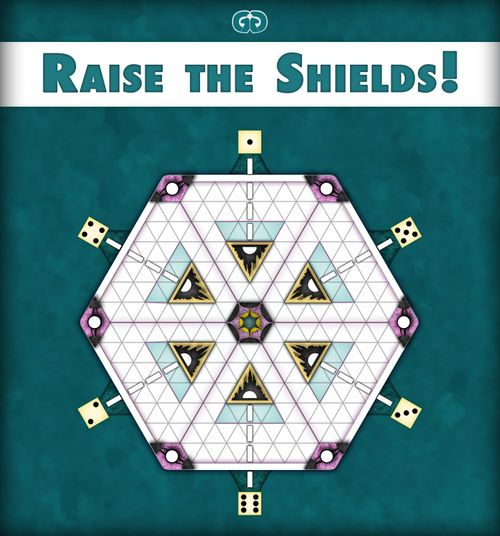
The game sheet shows a hexagonal realm drawn on a triangle grid, with sectors around it. The realm layout diagram labels the following components:
- Power plant: the central point of the realm. Connections start at power plants.
- Shield emitter: the circles at the outer edge of the realm. Connections end at shield emitters. An emitter is filled once it is powered.
- Shield: the white line between two adjacent shield emitters. A shield is fully activated when both of its emitters are powered.
- City: a triangle with a city skyline, marked with a city bonus ability (see City Bonus Abilities).
- Bonus region: the shaded triangles that contain a city's single-use ability.
- Attack rectangles: the rectangles at the outer edge of each sector. Four rectangles belong to each sector, and they are filled by the neighbor attacking that sector.
- Sector: a section of the realm, reached by the die assigned to Work Sector or Attack. The layout diagram also shows a triangular area outside the hexagon labelled "Sector 3" and a path labelled "Path of attack for 6".
How to Play
Roll the Dice
The first player rolls two shared dice and places them for all to see. Players also roll their individual dice. All players will simultaneously use the result of the shared roll and their own personal roll.
Assign the Dice
After every roll, each player individually chooses where to assign the three dice, keeping this information secret from other players. One die must be assigned to each of the following locations: Work Sector, Shape, and Attack.
- Work Sector: This die indicates where you will be working on connecting the power plant to a shield emitter. The connection is made by filling in triangles between these two locations.
- Shape: This die indicates the shape you will draw in your chosen work sector. The correlating shapes can be found at the bottom of your game sheet.
- Attack: This die indicates what sector you will attack in a neighboring realm. You will attack the player to your left.
The shape for each die face is printed at the bottom of the game sheet:
| Die face | Shape |
|---|---|
| 1 | A single triangle |
| 2 | A diamond (two triangles, one above the other) |
| 3 | A trapezoid (three triangles) |
| 4 | A large triangle (four triangles) |
| 5 | An hourglass (four triangles, meeting at a point) |
| 6 | A hexagon (six triangles) |
The bottom strip of the game sheet is labelled Work Sector, Shape, and Attack.
Example from the rulebook: If I assign a die to Work Sector, I will be filling in triangles in sector 1. If I assign a die to Shape, I will be drawing shape 3 so that it touches the power plant. If I assign a die to Attack, I will be attacking my neighbor in sector 6 by filling in a rectangle.
Implement Your Choices
Draw Connections
Draw your shape in your chosen sector. Keep this information private until everyone has drawn connections.
Use the following guidelines when drawing shapes:
- Connections start at power plants and end at shield emitters.
- One side of your shape must border the flat side of a previously filled triangle or of the power plant.
- Filled shapes may extend into adjacent work sectors.
- Your drawn shape may not overlap filled spaces or spaces that contain a city, shield emitter, or power plant.
- Draw around attack rectangles. Do not fill them.
When you fill a shaded triangle that is adjacent to a city, you enable that city's unique single-use ability. See City Bonus Abilities for details.
When your shapes connect a side of the power plant to a shield emitter, the emitter is powered. Fill the emitter's circle to show this.
When two adjacent shield emitters are powered, the shield between those two emitters is fully activated. Indicate this by filling in the white line attaching the two shield emitters.
Draw Attack
After all players have drawn their connections, reveal your game sheet. Then, tell your neighbor which sector you are attacking. You are attacking the neighbor to your left. They should fill in an attack rectangle in that sector.
- The first rectangle to be filled is the one that is closest to the matching die. Progress towards the target city with each additional attack on this sector.
- If your neighbor has raised a shield in this sector, your attack has no effect. No rectangles are filled.
- If all four rectangles in that sector are already filled, you destroy the city when you successfully attack it a fifth time.
Start the Next Round
The first player passes the dice to the left. That player becomes the new start player. Begin the next round.
Game End
The game ends when one player either raises all of their shields or when one player destroys one city belonging to a rival. The player who first does one of these things wins! Players may tie.
City Bonus Abilities
Each city has one specific bonus ability that may be used once during a game. This ability is enabled when filling a triangle in the city's bonus region. When you choose to use this ability, indicate its use by filling the semi-circle in the associated city. You may use one, and only one, action on any turn after it is enabled.
Diagram labels: Used ability (the filled triangle in the bonus region with its semi-circle filled) and Enabled ability (the shaded bonus triangle that has been filled).
City abilities:
- 1: Ignore one attack. Do not fill in an attack rectangle.
- 2: Add or subtract one from any die. You may wrap. (6 may become 1, and 1 may become 6.) This only applies to you.
- 3: Fill two triangles in one sector of your choice.
- 4: Reset one city ability. Erase the city's semi-circle.
- 5: Flip a shared die to its opposite side. This affects all players.
- 6: Erase one attack rectangle. It is too late if a city is destroyed.
The game sheet also prints the bonus abilities in short form: City 1: Ignore one attack. City 2: Add or subtract one from any die. City 3: Fill two triangles in one sector. City 4: Reset one city ability. City 5: Flip a shared die. City 6: Erase one attack rectangle.
Modifications for Solo Play
Your double-agents tell you where and when your enemies will attack, but will that be enough for you to save your realm?
- Setup: Roll three dice before the game starts. Fill one attack rectangle for each die.
- Assign the Dice: Assign dice to work sector and shape as normal. The die assigned to attack will attack your realm in that sector.
- Implement Your Choices: If an attack would be blocked by one of your shields, roll the attack die once more. Fill in one attack rectangle if this second attack is not blocked.
- Win Conditions: You win if you are able to raise all of the shields before any of your cities are destroyed.
- Increasing difficulty: If you have mastered standard solo play, increase the difficulty level by filling one attack rectangle in each sector before the game begins.
Variable Attack Card Expansion
"General, I just noticed that while we are attacking Etrullia, Vayndrak is attacking us. Do you think it might be wise to retaliate against Vayndrak?"
"That sounds like a splendid idea, Lieutenant. Unfortunately, we can only attack one target at a time."
"I know! Why don't we take turns. First, we attack Etrullia. Then, we attack Vayndrak."
"Excellent plan. No wonder you've risen through the ranks so quickly, Lieutenant. Good work."
Variable Attack Card
Before being able to use this expansion, cut out the double square on the right. Fold along the white line. Glue the squares back to back.
How to Use the Variable Attack Card
When playing a Raise the Shields with more than 2 people, place this card in a central area.
- Round 1: Place the card with the arrows flowing in a clockwise direction. Roll the dice, and play the round as usual.
- Round 2: Flip the card to its opposite side, the one with counter-clockwise arrows. Play this round as usual with one change. Instead of attacking your clockwise neighbor, attack your counter-clockwise neighbor.
- Following Rounds: Each time you end a round, flip the card to its opposite side and attack in the indicated direction.