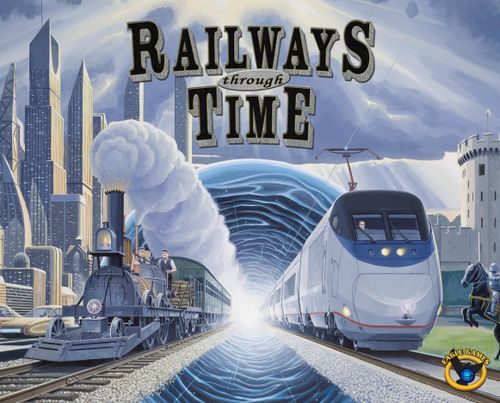
Railways Through Time
Railways Through Time Rulebook
Table of Contents
Table of Contents
Components
Each board represents a different time period. The boards are divided into hexes. Each hex may contain a city, mountains (brown), open (green) terrain, or a time gate (blazing red). Water (blue) and mountain ridges (dark brown), which run along the sides of some hexes, may also be present.
There are 8 Time Period Boards in total.
The other components are:
- 40 Operation Cards
- 1 Score Track
Game Start
Players begin by choosing which Time Period Boards (TPBs) they want to use. The recommended number of TPBs is the number of players plus 1. The Income Track is always used. It is recommended that players always include at least one time period with a red city.
Place a random number of goods cubes in each city equal to the number printed on that city. Unlike previous expansions, when playing with 2 or 3 players, players do not reduce the number of goods placed in cities.
Place face up beside the board the 4 starting Railroad Operation Cards: The Railroad Era Begins, Time Blazer, Speed Record and Passenger Lines.
Remove from the deck any operation cards that are specific to time periods not used in the current game. Then add additional operation cards to the deck, a number equal to twice the number of players.
Turn Order
Each round begins with an auction to determine turn order. The auction order always follows the turn order of the previous round.
The first player who passes must pay half of his bid (rounded down) and place his train at the bottom of the Score Track on the Turn Order diagram. The next player to pass becomes second from the end on the Turn Order diagram.
This continues until the player with the highest passing bid is determined. The winner of the auction pays his full bid to the bank and becomes the first player for that round.
Translator's note: the source names the Score Track as the place where the passing player's train goes, although the turn order is shown on the Turn Order diagram. The text is transcribed as printed.
End of Game
The number of empty city markers that ends the game depends on the number of players. It uses the same mechanic as Railways of the World. The chart for this can be found on the Income Track board.
New Rules
In Railways Through Time, players may now connect to the blazing red hexes of the time gates. Whenever a player connects track to a time gate hex, he must add an extra $1,000 to the cost of his construction. Building track from a city to a time gate hex ends the player's action, just as building track from city to city does.
Goods Delivery Through Time
When a player has track leading to time gate hexes in two different time periods, he may deliver goods freely between those two cities.
Example 1: In this example, a goods cube travels from the purple Stone Age city to the red Napoleonic city. This delivery of a red cube requires only a 1st-level engine, and it is worth 1 victory point.
Example 2: In this example, a goods cube travels from the red Napoleonic city to the purple Stone Age city, and then stops in the blue Stone Age city. This delivery of a blue cube requires a 2nd-level engine, and it is worth 2 victory points.
Example 3: In this example, red cubes are transported from the blue city to the purple Stone Age city, then carried to a grey city in Egypt, and finally land in the red city of the Napoleonic era. This delivery of a red cube requires a 3rd-level engine, and it is worth 3 victory points.
Goods may travel in any direction through time, wherever players have built their networks.
Players may NOT use time gates to deliver cubes to cities that are in the same time period as the sending city. Goods may never leave a time period and re-enter that same time period.
Track built from time gates MUST always connect to a city.
Goods may travel through many different time periods before reaching their final destination.
Time Line Requirements
In Railways Through Time, the Major Lines of Railways of the World have been replaced by Time Lines. Each time period has one or two Time Lines, shown in the upper corners of the boards.
Players compete to be the first to connect the two cities joined by a Time Line path on that board. As soon as a player finishes his first Time Line, he claims it by placing one of his train markers on the matching Time Line marker. No other player may claim that Time Line.
Every later Time Line that a player completes, after his first, MUST CONNECT to his original Time Line BEFORE it can be claimed. See the example below.
Translator's note: the original text refers to an example for this rule, which is shown as a diagram and is not reproduced here.
Time Lines do not award points when they are claimed; they are only claimed. At the end of the game, players count the Time Lines they have completed for which they are awarded victory points, according to the chart on the scoring board.
New Operation Cards
Time Blazer – The first player who transports a goods cube through time receives 2 additional points on the Income Track.
Boost – The cost of an engine upgrade is reduced by $5,000. This can reduce the cost of an engine upgrade to $0.
Time Bounty – The first player who delivers a goods cube to any city in the time period named on this card receives 1 additional point on the Income Track. The origin of the goods cube MUST come from any time period not named on this card.