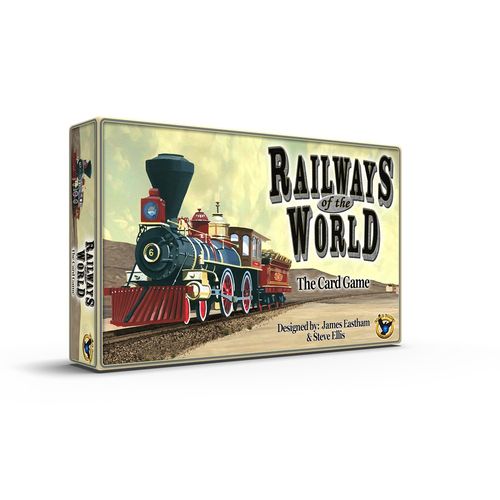
Railways of the World: The Card Game
Railways of the World: The Card Game Rulebook
Table of Contents
Table of Contents
Contents
- 1 Cloth Bag
- 1 Start City Board
- 1 First Player Card
- 1 Scoring Track
- 4 Player Reference Cards
- 5 Five value City Cards
- 5 Four value City Cards
- 10 Three value City Cards
- 5 Two value City Cards
- 21 Engine / Wild Cards
- 13 Violet Track Cards (6 value ones, 7 value twos)
- 13 Light Green Track Cards (6 value ones, 7 value twos)
- 13 Brown Track Cards (6 value ones, 7 value twos)
- 13 Orange Track Cards (6 value ones, 7 value twos)
- 13 White Track Cards (6 value ones, 7 value twos)
- 60 Goods (15 cubes in each color: Blue, Red, Black, Yellow)
- 48 Player Trains (12 in each color: Violet, Light Blue, Grey, Green)
Track Cards
There are 5 colors of Track Cards. Each color contains 13 Track Cards, 6 are value 1 Track Cards and 7 are value 2 Track Cards. Track Cards are discussed later in the Game Play section.
Each Track Card shows a Track Value, a Track Color, and a Color Symbol.
City Cards
There are 2, 3, 4, and 5 value City Cards. Connection track colors border the track entering the City Hex. Higher valued cities contain fewer connection colors, but produce more goods.
Each City Card shows a City Value, a Goods demand type, the Number of goods produced, a Goods demand color, a Connecting Track Color, and a Color Symbol.
City Values Serve Three Purposes
- The City Value determines how many Track Cards are required to build/connect to the City. City placement and connection is explained below.
- City Values are also used for end game scoring. End game scoring is explained in the 'Final Scoring' section.
- Goods Demand & Capacity. The number of goods each city produces is shown as small black squares inside the City Hex. Each city produces goods equal to the city value minus one. In addition to producing goods, each city has a "demand" for goods it needs (the color of the City Hex). A city that produces 2 goods and demands wood (red colored) goods is an example. The placement and delivery of goods is explained later.
Game Setup
Place the Scoring Track to one side. Each player takes a set of Trains and places 1 of them on the Scoring Track as a Scoring Marker. A second Train is set nearby to mark scores of 25 and higher. Place the Start City Board in the center of the playing area. Important: Any track color may connect to the Start City Board. Choose a starting player and give him the First Player Card. Give each player one Engine/Wild Card and one value 2 City Card (at random). Shuffle the remaining Engine/Wild, Track and City Cards together and deal two more cards to each player. Players should now have four cards in their hand (the Engine/Wild Card and the value 2 City Card given to them plus the two cards dealt to them). Place the remaining cards (face-down) to form a Draw Pile. Turn over the top three cards (face-up) to create the "Card Selection Area".
The layout consists of a Draw Pile, a Discard Pile, and the Card Selection Area (the three face-up cards next to the Draw Pile).
Order of Play
On your turn, do all 3 of the following:
-
Take ONLY ONE of these 5 actions:
- A) Build a link to a new City Card; or
- B) Play an Engine Card (may combine with delivery action); or
- C) Deliver Goods; or
- D) Discard a Card to Draw a Card or Replenish a Good; or
- E) Pass — do nothing.
-
Select 1 or 2 Cards — you may select these cards (in any combination) from:
- The top card of the Draw Pile; and/or
- Any of the three cards from the Card Selection Area*; and/or
- The top, face-up card in the Discard Pile.
*If you draw a card from the Card Selection Area, immediately replace it with a new card from the Draw Pile. If you select an Engine/Wild Card from the Card Selection Area or from the Discard Pile, you cannot draw a second card.
-
Check Hand Size: If you have more than 13 cards at the end of your turn, discard down to 13 cards. This does not count as a turn action.
A) Build a Link to a new City Card
When building a link to a new City Card (this must be a card from your hand), you must connect from either the Start City Board (and you may use any color track to connect to the Start City Board) or you must connect from an existing city, using like-colored Track Cards that match one set of tracks leading out of that existing city, to a new City Card played from your hand. Important: You may never build a link from the Start City Board to an existing city or from an existing city to another existing city. In other words, your track building action MUST ALWAYS build to a new City Card.
To build a link to a new City Card, you must play Track Cards with a total value equal to or greater than the value on the new City Card you are trying to build; regardless of whether the existing city you are building from is of a lesser or greater value. Note: You may use an Engine/Wild Card in place of a Track Card (its value is 1). However, at least one of the Track Cards you play must match the color of the City Card you are connecting to. When laying your Track Cards on the table, do not lay them end-to-end, but stack them (rather tightly) so the track value is showing. It is okay to bend or curve and slide or move existing links to accommodate new links as long as the connections remain the same. You will need to stack tightly and make tight curves and bends to save space on your playing surface.
Example: Becky (violet player) would like to build a link to a value 4 City Card in her hand with connection colors orange and brown. Becky also has 2 orange Track Cards in her hand (value 1 and a value 2) and an Engine/Wild Card. She may either build a link from the Start City Board or she may connect a new City Card to a City Card already on the table that has an orange connection. Becky decides to use the value 3 City Card with an orange connection. Becky plays all her orange Track Cards and her Engine/Wild Card (value 1) and builds a link to the value 4 city from the value 3 city.
When a player builds a link to a new City Card, that player immediately takes control of that link and places his train token on the link. Next, he scores points equal to the total track value of the cards used in that link. See 'Scoring' section below. At the end of the game, the player with the highest cumulative value of Track Cards linking to each city scores the value of that city. See 'Final Scoring' section below. In the case of ties, all involved players score the full points for that city.
When a city is built, goods must be placed on the city. Randomly (sight unseen) draw goods (the same number as the black squares in the City Hex) from the goods bag and place them on the City Hex.
B) Play an Engine Card
On your turn, you may play an Engine/Wild Card from your hand, face-up in front of you. You must first play an engine before you can deliver goods (below). The number of Engine Cards in front of you determines how big your engine is and the size of your engine determines the number of links over which you can deliver goods. A "link" is defined as one section of track between two cities. For example, if your engine size is three, you can deliver goods from one city to another city up to 3 links away. The Start City Board is considered a "city" and you can deliver goods through it, but not to it. Important: When you increase the size of your engine, you get to take an immediate "Deliver Goods" action (described below) as part of this "Play an Engine" action.
C) Deliver Goods
On your turn, you may deliver one goods cube from a city to another city demanding that type of good. You must own the first link of this delivery route. Except for the first link, you do not have to own any other link in your delivery route, but remember you must have one Engine/Wild Card in front of you to cover each link in the delivery route. To deliver, you simply move the good from one city to another city demanding that type of good. Important: A good must stop at the first city that demands that type of good. You may deliver any type of good to the value 5 cities. After delivering a goods cube, immediately score points equal to the number of links used in the delivery route and then place the goods cube in front of you. Note: Other players who own links used in making your delivery also score points at this time. See "Delivering Goods" under the 'Scoring' section below and also the 'Final Scoring' section below.
Example: Steve (green player) has 3 engines. He may deliver a grain good (yellow cube) to a city needing grain (yellow hex) up to 3 links away as long as the first link he moves over is his own. Steve moves 3 links, delivering to a city 3 links away and scores 3 points. He saves the cube for later. Note that the violet player, Becky, also scores one point for Steve's delivery.
D) Discard a Card to Draw a Card or Replenish a Good
You may discard a card from your hand and place it (face-up) on the top of the Discard Pile and then do one of the following:
- Immediately draw a card from the top of the Draw Pile or draw a card from the Card Selection Area (this cannot be an Engine/Wild Card). or
- Replenish a goods cube on an empty City Card. Draw 1 cube from the goods bag and place it on any city that currently has no goods cubes.
Scoring
Scoring takes place every time a link to a city is completed or when goods are delivered. Move your Score Marker (and possibly your opponents' Score Markers if they scored as well) along the Scoring Track each time you score.
Completing a Link – Players immediately score points equal to the total track value of the cards laid to connect to a city.
Example: Becky (violet player) just laid 2 orange Track Cards with a total track value of 3 to a 3 value city. She immediately scores 3 points for the sum of the value of all Track Cards (1 + 2 = 3) used to build the connection.
Delivering Goods – Players immediately score points equal to the total number of links used for a delivery. Opponents score one point for each link they control that your goods passed through.
Example: Steve (green player) delivers 1 grain, 3 links away. Steve scores 1 point times 3 links for his good, for a total of 3 points (1 x 3 = 3). Because Becky (violet player) controls one of the links along Steve's delivery route, Becky also scores—in this case, she scores 1 point (1 x 1 = 1).
Game End
The game end is triggered when one of three conditions occurs:
- The deck is exhausted; or
- One player runs out of trains; or
- When there are no more goods left in the goods bag.
When any of these conditions occur, play continues until the last player (furthest clockwise from the First Player) takes his turn. When taking this last turn, even after the deck is gone, players may still select cards from the Card Selection Area or the Discard Pile. After the last player has taken his final turn, starting with the First Player and moving clockwise, each player in turn may, if possible, make one more delivery (only a delivery – no track laying and no card playing or drawing).
Final Scoring
- Highest Cumulative Value of Links – Determine who has the highest cumulative value of Track Cards linking into each city. The person with the highest cumulative value scores points equal to the value of that city. In the case of a tie, each player involved receives points equal to the value of that city.
Example: At the end of the game, James (light blue player) has two 3-point links and a 2-point link while Steve (green player) has just one 4-point link in this example (which shows only part of the final layout). Since Steve has the highest value link going into the value 3 City (on left), he scores 3 points (the value of that city). Since James has a higher cumulative value of links (2+3=5) going into the value 4 City and Steve has only (4), James will score 4 points for this value 4 City. James also scores 2 and 3 points for the value 2 and the value 3 Cities (he has the only links going into those cities). James scores 9 points total compared to Steve's 3 points shown in this example.
-
Engines: Players score 1 point for each Engine they built during the game.
-
Goods Collection Bonus: During the game, save each goods cube that you deliver and set them in front of you so that they are visible to all players. Note: You may only use a goods cube once in any scoring combination. Score points for the following combinations:
- 2 points – each set of 3 identical goods (e.g. wood, wood, wood)
- 3 points – each set of 4 identical goods (e.g. ore, ore, ore, ore)
- 5 points – each set of 4 unique goods (e.g. grain, wood, ore, cattle)
Tie Breakers: In case of ties at the end of the final scoring, the player with the most links breaks the tie; if still tied, the player with the most cubes delivered wins; if still tied, enjoy the joint victory!
Note for Younger Players: Follow all the rules of the game, but omit the "goods delivery" portion (including Engine upgrades). Play with only Track and City Cards. This is a great way to introduce your family to the board game version of "Railways of the World".